Old Ways and New Ways of Living
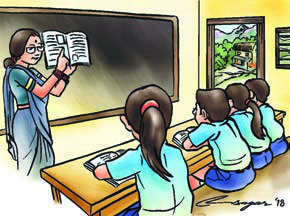
People do the same things in every age: they learn, they grow food, they raise families. What changes is HOW they do them. Compare a classroom where one teacher reads aloud from a single book with a classroom where every child has a laptop. The subject is the same, but the tools, the pace and the role of the student are completely different. Talking about such differences is the heart of this unit, because a lifestyle is simply the sum of the ways a group of people does its daily work.

Farming shows the same change even more sharply. For generations, a whole family cut rice by hand with sickles, bent over the field for days. A combine harvester now cuts, threshes and cleans a field of grain in a few hours with one driver.
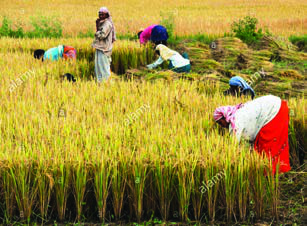
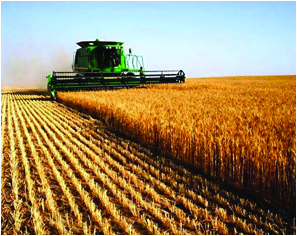
When you discuss each pair with a classmate, go beyond saying one is old and one is new. Ask what each way costs, who does the work, how long it takes, what skills it needs, and what is gained or lost when the new way replaces the old. Machines are faster, but hand work keeps more people employed and keeps old skills alive. There is real material for discussion on both sides.
Anne Frank and Her Diary
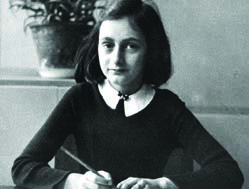
Anne Frank was a Jewish girl born on June 12, 1929 in Frankfurt, Germany. Because her family was Jewish, her father moved them to Holland in 1933 to escape Hitler's anti-Jewish laws. For her thirteenth birthday Anne received a notebook, and the diary she kept in it was published after the Second World War as The Diary of a Young Girl. It made her famous across the world, because it shows an ordinary teenager's honest thoughts during one of history's darkest times. The entry you study here was written on Saturday, June 20, 1942.
A diary is a personal record in which a person writes, day by day, what happened and how they felt about it. Because it is written for the writer alone, it is usually more honest than anything written for other readers.
Anne begins by saying that writing in a diary feels strange to her. She has never written anything before, and she suspects that nobody, not even she herself, will later care about the musings of a thirteen year old schoolgirl. She writes anyway, because she feels a strong need to get all kinds of things off her chest.
"Paper has more patience than people." Anne remembers this saying on a day when she sat at home bored and listless, brooding over her feelings. A page will listen to everything without interrupting, judging or getting tired. That patience is exactly what she cannot find in the people around her, and it is her reason for trusting a notebook with her secrets.
What the Diary Entry Tells Us
The real point that prompted Anne to keep a diary is simple: she does not have a friend. She knows nobody will believe that, so she explains. She has loving parents, a sixteen year old sister named Margot, about thirty people she can call friends, and a throng of admirers. On the surface she seems to have everything. But with her friends she can only talk about ordinary everyday things. She cannot confide in anyone, and she does not think that is liable to change. So she decides the diary itself will be the friend she has waited for, and she gives this friend a name: Kitty.
Before plunging into her stories, Anne gives Kitty a brief sketch of her life. Her father, the most adorable father she has ever seen, married her mother when he was thirty-six and she was twenty-five. Margot was born in Frankfurt in 1926 and Anne in 1929. In 1933 the family immigrated to Holland, where her father became Managing Director of the Dutch Opekta Company, which makes products used for jam. While the parents settled in Holland, Anne and Margot were sent to Aachen to stay with their grandmother. Margot went to Holland in December, and Anne followed in February, plunked down on the table as a birthday present for Margot. Anne studied at a Montessori nursery school until she was six, and after a heartbreaking farewell to her teacher Mrs. Kuperus she joined the Jewish Lyceum. After the pogroms of 1938, her two uncles fled Germany and found safe refuge in North America, and her seventy-three year old grandmother came to live with the family.
After May 1940 the good times ended. First came the war, then the capitulation, then the arrival of the Germans, and with them a series of anti-Jewish decrees that cut Jewish life down piece by piece:
- Jews were required to wear a yellow star and to turn in their bicycles.
- Jews were forbidden to use street-cars or to ride in cars, even their own.
- Jews were required to shop only between 3 and 5 PM, and only at Jewish-owned barbershops and beauty parlours.
- Jews were forbidden to be on the streets between 8 PM and 6 AM.
- Jews were forbidden to visit theatres, cinemas, swimming pools, tennis courts and all other sports grounds, and to take part in any public athletic activity.
- Jews were forbidden to sit in their own gardens after 8 PM, or to visit Christians in their homes.
- Jewish children were required to attend Jewish schools.
Anne's friend Jacque summed up that life in one sentence: "I don't dare do anything anymore, because I'm afraid it's not allowed." Anne's birthdays tell the same story. In 1940 little was done because the fighting had just ended in Holland. In 1941 her grandmother was sick and needed an operation. Grandma died in January 1942, and the 1942 celebration was meant to make up for all the missed ones, with Grandma's candle lit along with the rest. The entry closes on June 20, 1942 with the solemn dedication of the diary. A single diary entry like this teaches us more about a lifestyle than any list of facts could, because it shows the rules, the fears, the family and the small joys of one real life from the inside.
Words That Sound the Same
A homophone is a word that is pronounced the same as another word but has a different meaning and usually a different spelling. Night and knight sound identical; only the spelling tells a reader which meaning you intend.
English is full of homophone pairs, and they matter for both pronunciation and writing. When you speak, the two words in a pair are said exactly alike. When you write, choosing the wrong spelling changes your meaning entirely. Learn each pair as a pair, with both meanings side by side.
| Pair | First word means | Second word means |
| cell / sell | a small room, or the smallest unit of a living body | to give something in exchange for money |
| knead / need | to press and fold dough with the hands | to require something |
| coarse / course | rough, not smooth or fine | a series of lessons, or a path or direction |
| their / there | belonging to them | in or at that place |
| doe / dough | a female deer | a soft mixture of flour and water |
| fare / fair | the money paid for a journey | just and equal, or a market with entertainment |
| heal / heel | to make a wound or illness well again | the back part of the foot |
| wait / weight | to stay until something happens | how heavy something is |
| deer / dear | a wild grass-eating animal | much loved, or expensive |
| site / sight | a place where something is or will be built | the power of seeing, or something seen |
| waist / waste | the narrow middle part of the body | to use something carelessly, or rubbish |
| night / knight | the dark part of the day | a soldier of high rank in the Middle Ages |
In an exam, a homophone spelt wrongly is a wrong word, not a spelling slip. "The bus fair" and "the bus fare" are different statements, and only one of them is about money. Whenever you write one of these words, stop and check that the spelling matches the meaning you want.
Asking How Long: For and Since

Listen to how Pemba and Durgesh talk about Susan's retirement. Pemba says he has heard that Susan is retiring next month. Durgesh asks, "How long has she worked for the company?" Pemba answers, "She has worked there for more than 25 years." A question with "How long...?" asks about the length of a period that started in the past and continues to now, and the answer almost always carries for or since.
For introduces a length of time, the size of the whole period: for two hours, for several months, for more than 25 years, for a long time.
Since introduces the starting point of the period: since 5 o'clock, since last Monday, since 2010, since I came to this school. The period runs from that point up to now.
Practise the pattern in pairs. One student asks, "How long has Sumit been doing his homework?" and the other answers, "He has been doing it for two hours." "How long has Deepak lived in Japan?" "He has lived there since 2010." The clue decides the word: a length of time takes for, a starting point takes since.
Never write "since two hours" or "for 2010". Two hours is a length, so it takes for. 2010 is a starting point, so it takes since. If you can put "from ... until now" in front of the phrase, the word you need is since.
Present Perfect or Present Perfect Continuous?
The present perfect is formed with have/has + past participle: She has worked there for 25 years. It connects a past action or state to the present, and it is the tense for completed actions with a present result and for experiences up to now.
The present perfect continuous is formed with have/has + been + verb-ing: They have been waiting for half an hour. It stresses the activity itself, going on over a period up to now, often still unfinished.
The two tenses often stand close together, and the difference is what you want the listener to notice. "The road is wet; it has just rained heavily" reports a finished action whose result we can see. "It has been raining for a long time" points at the ongoing activity. "You look tired. What have you been doing?" asks about the activity that caused the tiredness. "How many times has Charles visited New York?" counts completed actions, so it takes the simple present perfect.
| Choose | When | Example |
| Present perfect | the action is complete, or you count how many times | I have just watered the plants. Charles has visited New York three times. |
| Present perfect continuous | the activity has been going on over a period, often unfinished | The boys have been playing computer games for over an hour. |
| Present perfect only | the verb describes a state, not an activity | How long have you known Gerry? My father has never eaten chocolates. |
State verbs such as know, like, believe and belong are not used in the continuous form. You must say "I have known Gerry for years", never "I have been knowing". Negatives with never and not also prefer the simple present perfect: "We have not seen Lisa recently."
The Rautes, the Last Nomads of Nepal
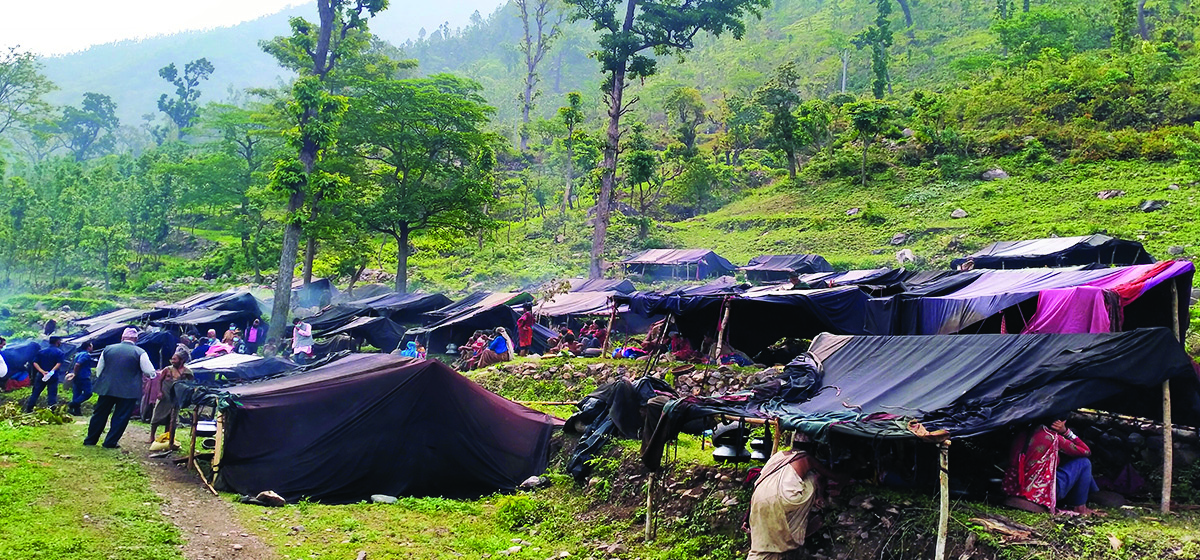
The Rautes are one of the most typical indigenous groups of Nepal, sustaining their unique cultural identity for generations. They are the only nomadic people in the country: they never settle permanently in any place, and they deny any idea of permanent settlement, education or agriculture. That the Rautes, the last fulltime nomads of Nepal, have survived into this century is truly remarkable in our time of diminishing cultural diversity. Their total population is estimated at about 180 people, or roughly 52 families, and the Karnali Province of Nepal remains their only sanctuary.
Nomadic people are people who move from place to place instead of living permanently in one settlement. Their homes, work and customs are all built around this movement.
There is no documented history of the Rautes, but one common belief is that once they fled from the state, they never returned, and instead established a different pattern of life in the jungle. To eke out their living they mastered the crafting of wooden products, learned to hunt monkeys, and adapted to forest life. Only the Mukhiya, the headman, talks to outsiders on behalf of the tribe about their lifestyle and traditions. The heredity of the Raute is categorised into three types: Kalyaal, Raskoti and Samaal. Their ethical norms and values, rituals and livelihood patterns are all important parts of who they are.
How Raute Men, Women and Children Live
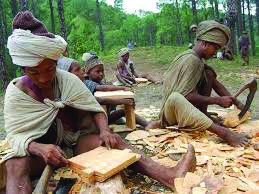
Like other ethnic groups following Hindu society, the Raute community maintains a patriarchal social hierarchy, but in matters of internal management women have a more prominent role than their male counterparts. There is a clear division of labour. The men make wooden utensils, hunt monkeys, trade their products in the market and collect food grains. Unmarried girls and widows also go to the countryside to collect food grains and deliver orders for craft items. Women bear the major responsibility for household chores and dominate almost every facet of the livelihood except socialising, hunting, carpentry and dancing. They hold the indigenous know-how on spring water sources, and because their work includes searching the jungle for medicinal herbs, firewood and vegetables, they have extensive knowledge of the forest and its ecosystem.
Husband and wife hold great respect and love for each other, and married women never travel outside the settlement area with anyone other than their husbands. Women collect firewood, cook meals and rear the children, and they may assist the men when the community shifts to a new location and builds new homes there, though making utensils and hunting are considered male tasks. Children up to the age of 10 to 14 are not assigned any major household responsibilities; they spend their days playing with natural objects and roaming around the settlement, and on special occasions they help their parents by fetching water from the spring and carrying small items during a move.
Hunting, Festivals and a Lesson for Us
Monkey hunting is considered fundamental to maintaining the cultural permanence of Raute hunting life, and their technique is very rare. Around 8 to 30 young and middle-aged members go hunting together as a group, carrying nets. They do not use guns, and they do not use bows and arrows.
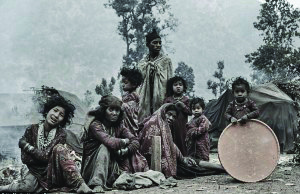
The Rautes observe the festivals of Saune Sankranti, Dashain, Tihar, Chaite Dashain and Maghe Sankranti. For the celebrations they manage food, homemade ale and meat in advance. Because everyone takes part fully in these community events, they do not like to meet strangers or to travel beyond their settlement area during the celebration period, and they take complete leave from carpentry and hunting. The festivals are observed with much joy and fervour amidst singing, dancing, feasting and their own ritual performances, and rice, meat and drinks play an important role in the feast.
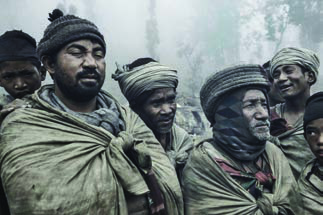
At a time when acculturation, the mixing and merging of cultures, has spread across the world and diversity is shrinking, the Rautes have been quite successful in sustaining their tradition. Their maintenance of a nomadic culture in a rapidly globalising world is commendable, and this global uniqueness makes them a precious part of the diverse people of Nepal. Humanity has a lot to learn from them: it is possible to value your own culture and keep it alive even when the whole world pulls in the other direction.
Listening: Happiness in Bhutan

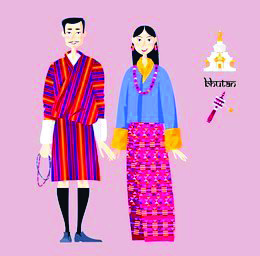
Before you listen, look at the two pictures and guess. Both represent the country Bhutan: one is its national flag and the other shows its national costume, the gho worn by men and the kira worn by women. The audio you will hear is about how Bhutan thinks about happiness. Listen for these things: the year the Gross National Happiness Committee was established, what the letters GDP stand for, the year a survey on happiness was held, the percentage of the population found to be happy, and how quality of life can be determined. Dates, percentages and full forms of abbreviations are exactly the details a listener must catch on the first hearing, so keep your pen ready and note each number as it is spoken. Afterwards, find Nepal's rank in this year's World Happiness Index and discuss it with a partner: does the rank match how happy people around you seem?
Talking About Experiences: Ever and Never
The present perfect is also the tense of life experience. Study how Binita and Samir talk. Binita asks, "Have you travelled a lot, Samir?" He answers, "Yes, I've been to lots of places." She continues, "Have you ever been to Sri Lanka?" and he replies, "Yes, I've been to Sri Lanka once." But about China he says, "No, I haven't been to China." Ever in a question means at any time in your life; never in an answer means at no time in your life. No exact date is mentioned, because the experience matters, not when it happened.
Have been to means someone visited a place and came back. Samir has been to Sri Lanka: he went there once and returned. Use this pattern with ever for questions about experience: Have you ever been to Lumbini?
The same tense rewrites present simple sentences when a starting point or a length of time is added. "I know Samim" plus the clue "I came to this school" becomes "I have known Samim since I came to this school." "Subin is unemployed" plus "last January" becomes "Subin has been unemployed since last January." "They are waiting for the bus" plus "half an hour" becomes "They have been waiting for the bus for half an hour." The clue tells you both the word to use, since or for, and reminds you that the situation is still true now.
Writing a Diary and an Essay
Your first writing task is to keep a diary for a week. Begin each entry with the day and date, the way Anne begins with SATURDAY, JUNE 20, 1942. Mention the activities you did during the day, then go further: pick one particular incident and express your views and attitudes about it. What happened is only half a diary; how you felt about it is the half that makes the diary yours. Write in the first person, write honestly, and do not worry about impressing a reader, because the reader is you.
The second task is an essay on the effects junk foods have on children. Build it from the given clues, one paragraph per clue. Start with an introduction to junk food. Then explain its causes, such as advertising and lack of education. Next describe the harmful effects on health: headache, heart attacks, dental problems, high blood pressure, obesity and high cholesterol. Follow with the effects on the economy, since junk food means more expenditure and an extra burden on the family, and the effects on other factors such as socialisation and poor academic achievement. Close with a conclusion that states your own position and suggests what children and parents should do.
Project: Study a Community Near You
The unit ends by sending you out to do what its readings did: study a real community. Conduct a brief survey of one of the ethnic communities of your locality. Talk to members of the community, observe respectfully, and take notes. Then prepare a short report with these parts in order: an introduction, the population and history of the community, its settlement areas, its lifestyle, and its culture and festivals. The reading on the Rautes is your model: notice how it moves from who the people are, to where they live, to how they divide their work, to what they celebrate. A good report does the same for the community you choose.
The full lesson is waiting for you
The notes are free to read in full. A free account opens the rest of the practice, and tracks your progress and confidence score for every subject. Presentations and videos need approval from Learn Yeti.