The Earth and Space Around Us
People have always looked up at the sky and wondered what is out there. Today we do far more than wonder. Astronauts float outside space stations and look down at the blue Earth. Rockets carry satellites and probes away from our planet. Giant radio telescopes, built like huge dishes in the hills, listen day and night for signals coming from deep space. And beyond all of these machines lie the planets themselves, like Saturn with its famous rings. Talking about these things in English needs a set of words you will meet again and again in this unit: planet, spaceship, astronaut, rocket, telescope, orbit and signal.
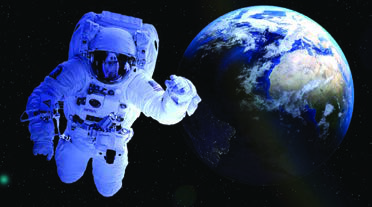
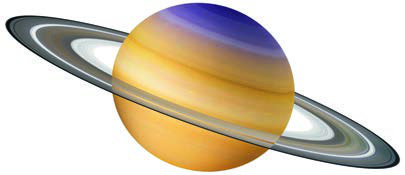

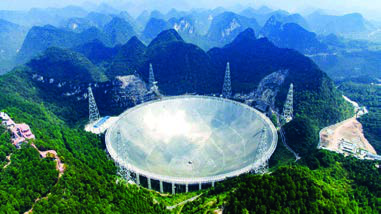
Before reading the story below, think about two questions and try to answer them honestly in your own words. What would you do if a strange bright object appeared in the sky in front of you? And do you believe life exists on planets other than the Earth? Scientists have not found any proof of life beyond Earth yet, but the question is open, and writers love it. The story you are about to read imagines one answer.
A Message from Another Planet
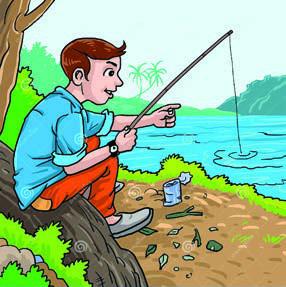
Suren Majhi had spent the whole day fishing on the sandy bank of the Sun Koshi River and had caught nothing. He was tired, and the twilight was fading into darkness. Suddenly he noticed a bright object in the distance over the river. His first thought was that it must be a helicopter, probably flying to Diktel. But something was wrong with that idea: there was no noise at all. The object came closer and closer, and slowly it took on the shape of a saucer. It landed on the bank about 50 meters away from him.
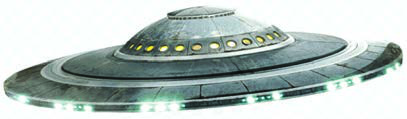
Suren got up and walked towards the object. He had once seen a film about a spaceship, and he thought this was probably one, come from another planet. As he went closer, a door opened, and Suren was drawn into the vessel. Inside, he found himself in a room full of control panels with flashing lights. He was frightened, and he almost jumped when a voice spoke: it welcomed him by name, told him not to be afraid, and asked him to sit down on the couch behind him. Amazed, Suren asked how the voice knew his name.
The voice explained everything. The visitors came from another planet and had been observing the Earth for several months. Their devices had recorded radio and television broadcasts, and from these they had learned to speak English, since it is the most widely used language in the world. Using a long distance listening device, they had learned Suren's name and also that he was the best student in his school. That was why they had chosen him: they wanted him to pass on an important message to the leaders of his nation and of the world.
Suren protested. Would leaders really listen to a poor kid like him? He asked them to open the door and let him leave. The voice refused, and told him to look at the screen: the ship was already several thousand kilometers from the Earth, though only a few minutes had passed. Then came the message itself. On their planet, all resources are recycled. On Earth, people are wasting their resources, and soon there will be nothing left. The visitors wanted Suren to tell his people that recycle collection centers should be set up in every town and city on Earth. Cans, bottles, old household appliances, in fact everything which is no longer in use, should be taken there and recycled.
Suren saw one more problem. If he told people he had been in a spaceship, they would probably think he was joking, or out of his mind. The voice had an answer for this too. The visitors gave him a tiny computer, far more advanced than any found on Earth, and told him that when a computer engineer examined it, his story would surely be believed. The screen lit up and Suren watched the world grow larger and larger. He saw the Himalayas and the River Sunkoshi. Then the screen went dark, the door opened, and Suren stepped out onto the sand. As soon as he was out, the spaceship ascended at an enormous speed and disappeared. At home, before going to bed, Suren wondered whether it had all been a dream. But when he put his hand in his pocket, he could feel the tiny computer.
Understanding the Story
To retell this story well, you need its events in the right order. Notice how each event causes the next one, which is what makes the story feel real even though it is fantasy.
- Suren had been fishing all day when he saw a bright object over the Sunkoshi River.
- The spaceship landed on the bank of the river, about 50 meters away.
- When Suren went closer to the vessel, he was pulled into it.
- A voice welcomed him by name and asked him to sit on the couch.
- The visitors said they wanted to send a message to the leaders of Nepal and the world.
- They gave Suren a tiny computer as proof of his story.
- Back at home, Suren wondered whether he had been dreaming, until he felt the computer in his pocket.
The visitors are imaginary, but their message is real: the Earth is wasting its resources. If everything no longer in use, from cans and bottles to old appliances, were collected and recycled, nothing would be thrown away for good. The story uses a spaceship to make us hear a warning we usually ignore.
The Three Sounds of Final -ed
Regular past tense verbs all end in the letters -ed, but those letters are pronounced in three different ways. Which sound you use depends on the last sound of the base verb, not on its spelling. Say the base verb aloud and listen to how it ends.
Final -ed is pronounced /t/ after voiceless sounds such as k, s, sh, ch, f and p, as in walked and jumped. It is pronounced /d/ after voiced sounds, which include all vowels and sounds like n, l, m, v and z, as in opened. It is pronounced /ɪd/, as an extra syllable, only when the base verb already ends in a t or d sound, as in landed.
Here are the ten verbs from the story, sorted into the three boxes. Say each one aloud and feel the difference: walked has one syllable, but landed has two.
| /t/ | /d/ | /ɪd/ |
| walked | opened | landed |
| passed | frightened | ascended |
| asked | recorded | |
| finished | ||
| jumped |
Do not pronounce every -ed as a full extra syllable. Walked is one syllable, never "walk-ed". The extra /ɪd/ syllable appears only after a t or d sound, so landed and recorded get it, but walked, passed and opened do not.
Saying Where Places Are
When somebody asks you where a place is, you answer with a preposition of place. The seven you need here are next to, opposite, between, behind, in front of, above and below. Each one describes a different position. Next to means directly beside. Opposite means facing, usually across a road. Between means with one thing on each side. Behind and in front of describe what is at the back and at the front. Above and below describe what is higher and lower.


The practice works on a small town with four roads. New Road runs across the top of the map, and three roads run down from it: West Road on the left, Old Road in the middle and East Road on the right. The supermarket, the cinema hall and the stadium stand along New Road. The post office and the police post are near West Road, together with the hospital, the school and the bus park. The bank and the fun park sit beside Old Road, and the hotel, the restaurant and the pharmacy are around East Road.
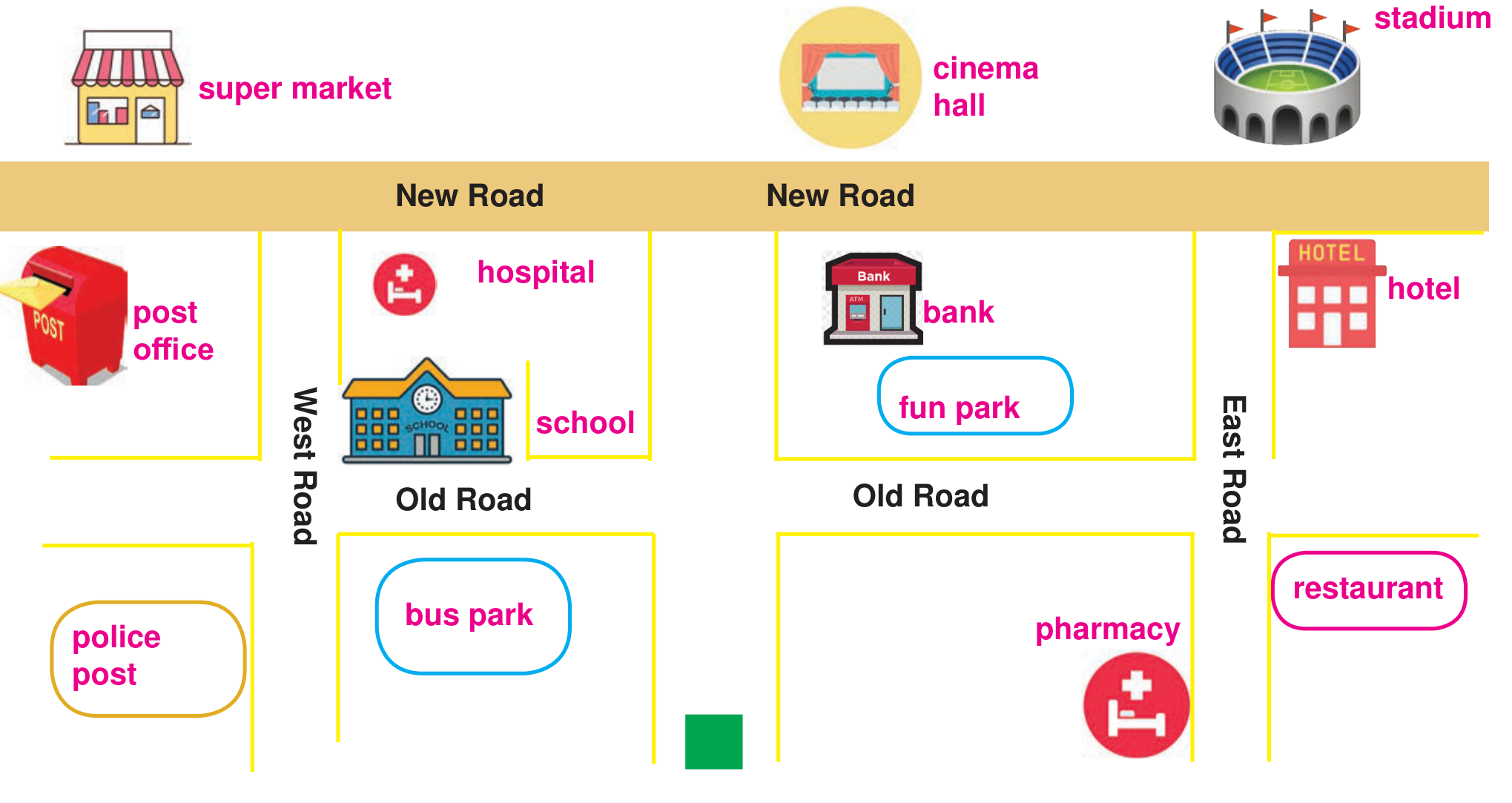
Work in pairs. One of you asks where a place is, and the other answers with a full sentence using a preposition. Then swap roles. Here is how the conversation runs.
In, At and On for Place
Three small prepositions, in, at and on, cause more mistakes than any long word in English. Each one answers the question "where" in a different way, and once you see the pattern, most sentences choose themselves.
In is used for enclosed spaces and for large areas: in the house, in the field, in England, in Kathmandu. If something is inside a space with boundaries, use in.
At is used for a point or an exact place, often somewhere you go for a purpose: at the corner of the street, at the hotel, at Bhadrakali temple, at Ratna Rajya Campus, at the top of the page.
On is used for surfaces and for things attached to them: on the carpet, on the wall, on Sheetal's T-shirt. If one thing touches the surface of another, use on.
So we say the horses are grazing in the field, because the field is an area they are inside. We will meet at the corner of the street, because a corner is an exact point. The dog is sleeping on the carpet, because the carpet is a surface. Rachita lives in England, the cat is somewhere in the house, the instruction is at the top of the page, and there is a picture of a house on Sheetal's T-shirt.
Some place phrases are fixed and must be learnt whole, without an article: in bed, at school, in prison, in hospital, on a farm, in the air, at the station, at the airport. We say she is still in hospital, not "in the hospital", when we mean she is there as a patient.
Up-Hill: A Poem About the Road of Life
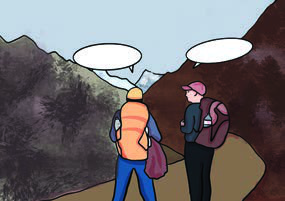
Up-Hill was written by Christina Rossetti, an English poet of the nineteenth century. The whole poem is a conversation between two voices. One voice, a traveller, asks eight anxious questions about a journey. The other voice, a guide who already knows the road, answers every question calmly. Read it aloud with a partner, one of you asking and the other answering.
Does the road wind up-hill all the way?Yes, to the very end.Will the day's journey take the whole long day?From morn to night, my friend.But is there for the night a resting-place?A roof for when the slow dark hours begin.May not the darkness hide it from my face?You cannot miss that inn.Shall I meet other wayfarers at night?Those who have gone before.Then must I knock, or call when just in sight?They will not keep you standing at that door.Shall I find comfort, travel-sore and weak?Of labour you shall find the sum.Will there be beds for me and all who seek?Yea, beds for all who come.
On the surface, this is about walking. The traveller asks whether the road climbs up-hill all the way, and the guide says yes, to the very end. The journey will take the whole day, from morning to night. There is an inn where the traveller can rest at night, and the darkness cannot hide it. On the road she will meet other wayfarers, those who have gone before her, and she will not even need to knock, because they will not keep her standing at the door. Tired and travel-sore, she will find the sum of her labour, and there are beds for everyone who comes.
Underneath, the poem carries a second meaning. The up-hill road stands for a person's life, which is full of struggle from beginning to end. The single day, from morn to night, stands for one whole lifetime. The inn stands for the final resting place at the end of life, and the wayfarers who have gone before are the people who have already died. The comforting guide promises that the door will open for everyone and that there are beds for all who come, which means that rest at the end of life is refused to no one. Reading the poem both ways, as a walk and as a life, is what makes it worth reading twice.
Up-Hill has eight questions and eight answers. Life, like the road, is uphill work all the way, but the poem's answer to every anxious question is reassurance: the resting place exists, it cannot be missed, and there is room in it for everyone.
Listening for Facts About Pluto

The listening task in this unit is about Pluto. Before the audio plays, you answer two warm up questions: how many planets there are in the solar system, and whether you think Pluto is a planet. The answer to the first is eight. Pluto was called the ninth planet for seventy six years, but in 2006 scientists placed it in a new category called dwarf planet, partly because of the discovery of Eris, a distant world of about the same size, in 2005.
While the audio plays, you have two jobs. First, you complete five sentences with the correct words or phrases: they ask what group Pluto was removed from in 2006, what Pluto is made of along with ice, what kind of years its 250 year orbit is measured in, what happened to Eris in 2005, and what new category the scientists created. Second, you listen again and tick True or False against five statements, about Pluto's size compared with the Moon, how long the NASA New Horizons spacecraft took to reach Pluto, whether Eris is about the same size as Pluto, whether scientists disqualified Eris as a planet, and whether Pluto belongs to the dwarf planet club.
Good listeners prepare before the audio starts. Read every sentence and every statement first, and predict what kind of word each blank needs: a noun, a number, a date. Then listen for exactly those things. Numbers and dates like 2005, 2006 and 250 are signposts: when you hear one, the answer to some question is nearby. Do not try to write full sentences while listening. Note one or two words, and complete your answers after the audio ends.
Prepositions That Belong to Their Words
Many English verbs, adjectives and nouns come with a fixed preposition attached, and no rule of logic will tell you which one. You are envious of somebody, never "envious with". You abide by a rule, never "abide to" it. These pairs must be learnt as single units, the way you learn a new word. Here are the pairs practised in this unit, each in a natural sentence.
| Word and its preposition | Example sentence |
| due to | Due to a traffic jam, we are late today. |
| eligible for | You are not eligible for admission to this course. |
| play with | Look! She is playing with her young son. |
| entrusted to | The office is entrusted to maintain law and order. |
| envious of | He is envious of his rich neighbour. |
| estranged from | He became estranged from his family after the argument. |
| excuse for | You had no excuse for misbehaving with the clerk. |
| familiar with | I am quite familiar with her. |
| brought up | She was brought up by her grandmother. |
| abide by | Gopal did not want to abide by his father's wishes. |
Never learn the word alone. Write envious of, familiar with and abide by into your notebook as complete phrases, and always memorise them inside a full sentence. A learner who knows only "envious" will guess the preposition, and guessed prepositions are usually wrong.
Writing an Account
Account writing is a technique of reporting or describing an event or experience. It is a written document that presents the events in proper order, giving the reader enough detail to reach a conclusion about what happened.
An account has a fixed shape, and every part of it does a job.
- Heading: optional but highly recommended. It addresses the audience and states the purpose, for example "To the Head Teacher, an account of the recent trip to Pokhara".
- Introduction: states the purpose of the account and gives any background information the reader needs, briefly explaining what you are about to describe.
- Body: elaborates the event itself. If there is more than one subject, give each one its own paragraph, and include the relevant details a reader needs to reach a proper conclusion.
- Conclusion: a very crucial part, because here you mention the purpose of your writing again.
- Sign-off: end with "Written by", your full name or signature, and the date.
The writing task of this unit asks you to imagine that you recently met someone from another planet and spent about an hour with him or her, and to write an account describing your feelings and reactions. Use the story of Suren as your raw material for ideas, but write about yourself. Report the events in order: how the meeting began, what the visitor looked and sounded like, what you talked about, and how the hour ended. Because the task asks for feelings and reactions, do not only say what happened; say that you were frightened at first, then curious, then strangely calm. Finish by saying what the meeting left you thinking, and sign off with your name and the date.
Writing Rules and Regulations
Rules and regulations are written in short, firm sentences, and English has a fixed set of expressions for them: is or are allowed to, is or are not allowed to, strictly prohibited, forbidden to, can and cannot, is or are required to, is or are expected to, must and must not. Notice that rules do not usually say please. They state what a visitor may do, must do and must never do. Here is a model set of rules for the visitors in a park.
- Visitors are required to buy a ticket at the gate.
- Children below five years must be accompanied by an adult.
- Visitors are allowed to bring food, but they must use the dustbins.
- Plucking flowers is strictly prohibited.
- Visitors are not allowed to walk on the grass beds.
- Visitors cannot bring pets into the park.
- Everyone is expected to keep noise low near the pond.
- Visitors must not light fires anywhere inside the park.
Project: Finding Out About Space Tourism
Space tourism means travelling to space for pleasure rather than for science or work, the way tourists travel to another country. Private companies now sell short flights to the edge of space, and a few very rich passengers have even stayed on the space station. The project asks you to search for and collect information about this kind of tourism and present it to the class in a small group. Divide the work: one member collects facts about which companies fly tourists, another finds out what a ticket costs, another gathers what passengers experience, such as weightlessness and the view of the Earth. Prepare a short presentation together, decide who speaks about which part, and practise once before presenting. A good presentation gives facts, not opinions, and ends with one question for the class to discuss.
The full lesson is waiting for you
The notes are free to read in full. A free account opens the rest of the practice, and tracks your progress and confidence score for every subject. Presentations and videos need approval from Learn Yeti.