Multiplying by the Same Number Again and Again
In warm, damp weather bacteria multiply very fast. In conditions that suit them, one kind of bacterium doubles every twenty minutes. If there is one bacterium at the start, twenty minutes later there are two, after forty minutes there are four, and after sixty minutes there are eight. How many will there be after one hundred and twenty minutes? The answer comes from multiplying by 2 again at every stage.
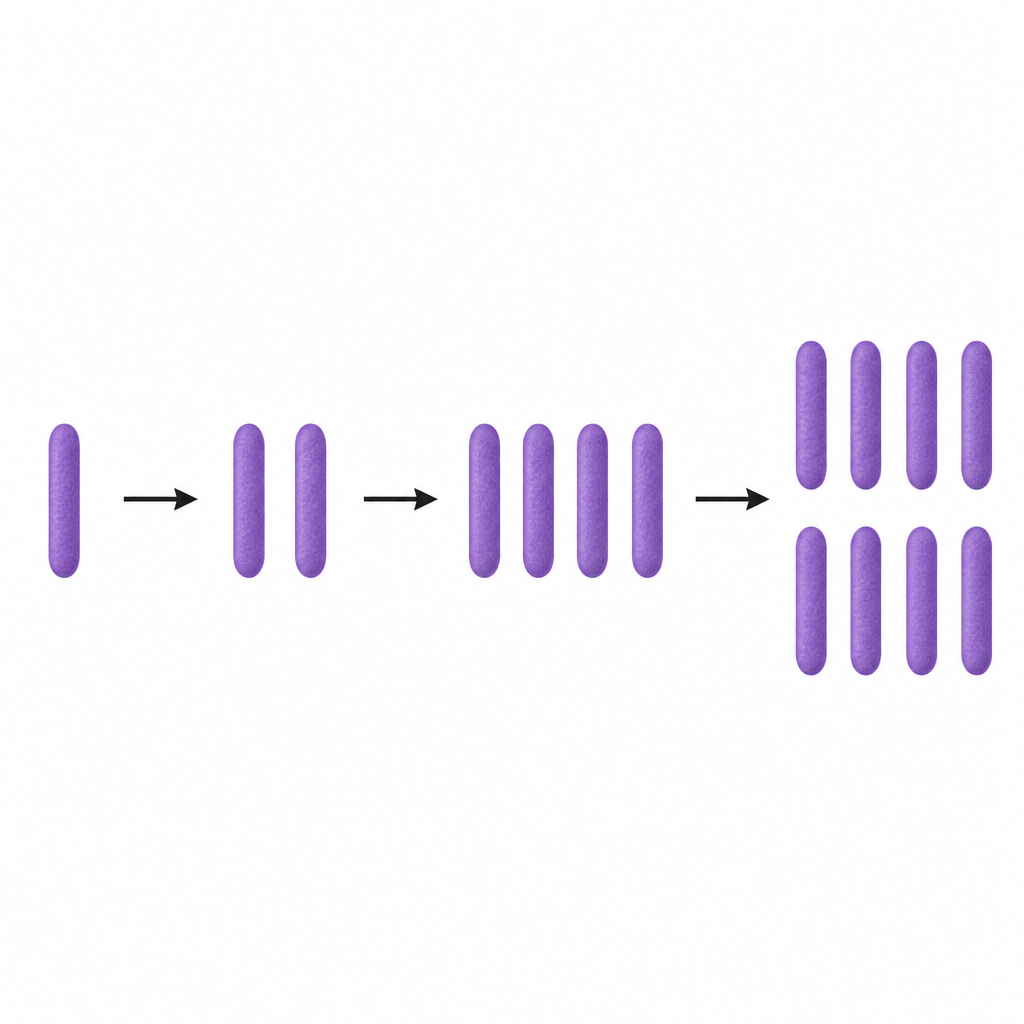
Setting this growth out in a table shows a clear pattern.
| Time (minutes) | Number | As a product | Short form |
| At the start | 1 | 1 | 1 |
| 20 | 2 | \( 2 \) | \( 2^1 \) |
| 40 | 4 | \( 2 \times 2 \) | \( 2^2 \) |
| 60 | 8 | \( 2 \times 2 \times 2 \) | \( 2^3 \) |
| 80 | 16 | \( 2^3 \times 2 \) | \( 2^4 \) |
| 100 | 32 | \( 2^4 \times 2 \) | \( 2^5 \) |
| 120 | 64 | \( 2^5 \times 2 \) | \( 2^6 \) |
After one hundred and twenty minutes there are 64 bacteria, and 64 is \( 2 \times 2 \times 2 \times 2 \times 2 \times 2 \). Writing 2 six times over is slow, so we write \( 2^6 \) instead. This short way of writing a number multiplied by itself many times is what an index is for.
Base: the number or letter that is being multiplied by itself. In \( 2^6 \), the base is 2.
Index: the small raised number that tells how many times the base is multiplied by itself. In \( 2^6 \), the index is 6. More than one index is called indices.
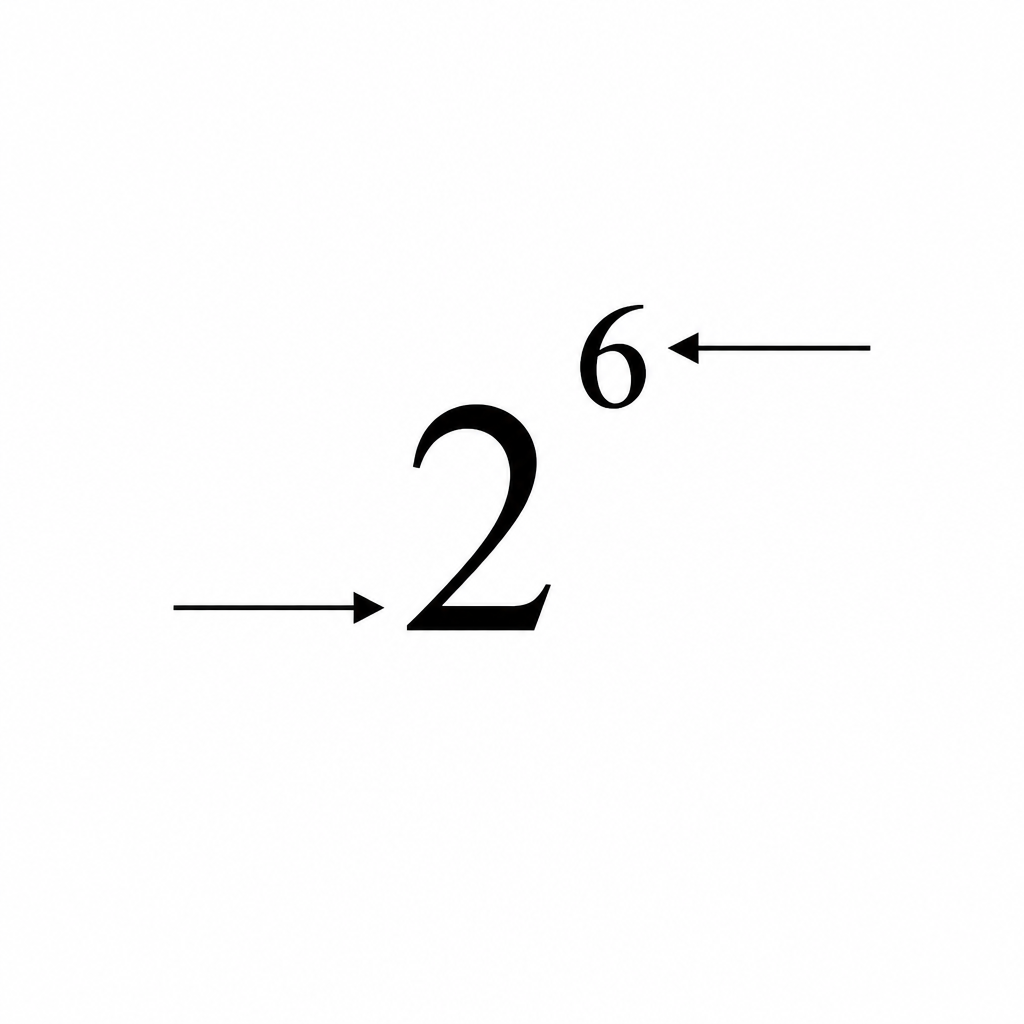
In \( a^n \), the letter \( a \) is the base and \( n \) is the index. We read it as 'a to the power n'.
The Laws of Indices
When powers are multiplied, divided or raised to another power, there is no need to write every factor out each time. Writing them out once shows a pattern, and that pattern is what each law states. Below, every law is first built from the factors and then stated.
Adding Indices When You Multiply
What happens when two powers with the same base are multiplied? Write out \( x^2 \times x^3 \) in full:
\[ x^2 \times x^3 = (x \times x) \times (x \times x \times x) \]
That is five x's altogether, so:
\[ x^2 \times x^3 = x^5 = x^{2+3} \]
In the same way, \( x^3 \times x^1 \) puts three x's beside one more x, making four:
\[ x^3 \times x^1 = x^4 = x^{3+1} \]
When powers with the same base are multiplied, the base stays the same and the indices are added. \( x^m \times x^n = x^{m+n} \)
Multiplying powers adds the indices, it does not multiply them. \( x^3 \times x^4 \) is \( x^7 \), not \( x^{12} \). The number in front is a different matter and is multiplied as usual, so \( 3x^4 \times 2x^3 = 6x^7 \).
Subtracting Indices When You Divide
Now look at division. Write \( x^3 \div x^1 \) as a fraction and cancel:
\[ x^3 \div x^1 = \frac{x \times x \times x}{x} \]
The x on the bottom cancels one x on the top, and two x's are left:
\[ x^3 \div x^1 = x^2 = x^{3-1} \]
In \( x^5 \div x^2 \), two x's cancel and three are left, which is \( x^3 \). So the index on the bottom is taken away from the index on the top.
When powers with the same base are divided, the base stays the same and the index of the denominator is subtracted from the index of the numerator. \( x^m \div x^n = x^{m-n} \)
What an Index of Zero Means
Any number divided by itself gives 1, so \( x^m \div x^m = 1 \). Using the law for division on the same expression gives:
\[ x^m \div x^m = x^{m-m} = x^0 \]
Both answers belong to the same expression, so they must be equal, which gives \( x^0 = 1 \). Division by zero is not allowed, so the base must not be zero.
Any number except zero, raised to the index zero, has the value 1. \( x^0 = 1,\ (x \neq 0) \)
Giving a Power to a Product or a Quotient
What happens when two things are multiplied inside a bracket and the whole bracket is given a power? Write \( (xy)^3 \) out in full:
\[ (xy)^3 = xy \times xy \times xy \]
The order of a product may be changed, so the x's can be gathered on one side and the y's on the other:
\[ (xy)^3 = (x \times x \times x)(y \times y \times y) \]
\[ (xy)^3 = x^3 y^3 \]
The same thing happens with a fraction. \( \left( \frac{x}{y} \right)^3 \) means \( \frac{x}{y} \) multiplied three times, which puts three x's on the top and three y's on the bottom.
\[ \left( \frac{x}{y} \right)^m = \frac{x^m}{y^m} \]
When a product or a quotient is raised to a power, that power is given to each base separately. \( (xy)^m = x^m y^m \)
A minus sign inside the bracket is raised to the power as well. \( (-3x)^4 = 81x^4 \), because a negative number multiplied an even number of times becomes positive. In \( -3x^4 \) only the x carries the power, so the two are not the same.
Negative Indices
What does a negative index mean? Start from the law for multiplying. In \( x^m \times x^{-m} \) the indices add up to zero:
\[ x^m \times x^{-m} = x^{m-m} = x^0 = 1 \]
Now divide both sides by \( x^m \):
\[ x^{-m} = \frac{1}{x^m} \]
So a term with a negative index moves from the top of a fraction to the bottom, and its index becomes positive. The reverse is true as well: a negative index on the bottom moves to the top and turns positive, so \( \frac{1}{x^{-m}} = x^m \).
A base with a negative index on the top of a fraction is written on the bottom with a positive index. \( x^{-m} = \frac{1}{x^m} \)
A negative index does not make the answer negative. The value of \( 3^{-2} \) is \( \frac{1}{9} \), not \( -9 \).
A Power Raised to Another Power
\( (x^2)^3 \) means \( x^2 \) multiplied three times over:
\[ (x^2)^3 = x^2 \times x^2 \times x^2 \]
The bases are the same, so the indices add, and adding 2 three times is the same as \( 2 \times 3 \):
\[ (x^2)^3 = x^6 = x^{2 \times 3} \]
When a power is raised to another power, the two indices are multiplied. \( (x^m)^n = x^{mn} \)
The Six Laws at a Glance
Multiplying: \( x^m \times x^n = x^{m+n} \)
Dividing: \( x^m \div x^n = x^{m-n} \)
Zero index: \( x^0 = 1,\ (x \neq 0) \)
Power of a product: \( (xy)^m = x^m y^m \)
Power of a quotient: \( \left( \frac{x}{y} \right)^m = \frac{x^m}{y^m} \)
Negative index: \( x^{-m} = \frac{1}{x^m} \)
Power of a power: \( (x^m)^n = x^{mn} \)
Worked Examples: Multiplying and Dividing
Simplify \( p^4 \times p^3 \times p^{-5} \).
Step 1: All three terms have the same base p, so the indices are added:
\[ p^4 \times p^3 \times p^{-5} = p^{4+3-5} \]
Step 2: Working out the indices:
\[ = p^2 \]
Now simplify \( 8x^5 \div 2x^2 \).
Step 1: Separate the numbers from the letters:
\[ 8x^5 \div 2x^2 = (8 \div 2)(x^5 \div x^2) \]
Step 2: The numbers divide as usual and the letters divide by subtracting indices:
\[ = 4x^{5-2} = 4x^3 \]
The law works in the same way when the indices themselves contain letters. Take \( x^{3n-2} \div x^{2n-5} \).
Step 1: The whole index being subtracted must be kept inside a bracket:
\[ x^{3n-2} \div x^{2n-5} = x^{(3n-2)-(2n-5)} \]
Step 2: Removing the bracket changes the signs inside it:
\[ = x^{3n-2-2n+5} \]
Step 3: Collecting like terms:
\[ = x^{n+3} \]
Sometimes the index left after dividing is zero or negative. That is what happens in \( \frac{a^{n-2}}{a^{n+2}} \).
Step 1: Subtract the index on the bottom from the index on the top:
\[ \frac{a^{n-2}}{a^{n+2}} = a^{(n-2)-(n+2)} \]
Step 2: Simplifying the index, the two n's cancel:
\[ = a^{-4} \]
Step 3: Writing the negative index on the bottom of a fraction:
\[ = \frac{1}{a^4} \]
Worked Examples: Brackets and Several Letters
Simplify \( \left( \frac{x^2 y^2}{x^3 y} \right)^3 \).
Step 1: By the law for a quotient, the top and the bottom each take the power:
\[ \left( \frac{x^2 y^2}{x^3 y} \right)^3 = \frac{(x^2 y^2)^3}{(x^3 y)^3} \]
Step 2: By the power of a power law, every index is multiplied by 3:
\[ = \frac{x^6 y^6}{x^9 y^3} \]
Step 3: Subtracting the indices of each base:
\[ = \frac{y^{6-3}}{x^{9-6}} = \frac{y^3}{x^3} \]
Now take \( (x^3 y^{-2})^3 (-2x^{-2} y^3)^4 \), which has both a negative index and a negative coefficient.
Step 1: Multiply every index in the first bracket by 3:
\[ (x^3 y^{-2})^3 = x^9 y^{-6} \]
Step 2: In the second bracket the coefficient \( -2 \) takes the power too, and \( (-2)^4 = 16 \):
\[ (-2x^{-2} y^3)^4 = 16x^{-8} y^{12} \]
Step 3: Multiplying the two, the indices of each base are added:
\[ = 16x^{9-8} y^{-6+12} \]
Step 4: Working out the indices:
\[ = 16xy^6 \]
Worked Examples: Indices Written with Letters
When the indices are letters such as a, b and c, they are still added and subtracted in the usual way. Simplify \( x^{a-b} \times x^{b-c} \times x^{c-a} \).
Step 1: The base is the same, so the indices are added:
\[ = x^{a-b+b-c+c-a} \]
Step 2: Each letter appears once as a plus and once as a minus, so they all cancel:
\[ = x^0 = 1 \]
In the same way, the indices of \( a^y \times a^x \times a^{y-x} \) add to \( y + x + y - x = 2y \), so the answer is \( a^{2y} \).
Finding the Value of an Expression
To find a value, first put the given number in place of each letter, then work out the powers. Find the value of \( a^b \times b^c \times c^a \) when \( a = 1 \), \( b = 2 \) and \( c = 3 \).
Step 1: Putting the numbers in place of the letters:
\[ a^b \times b^c \times c^a = 1^2 \times 2^3 \times 3^1 \]
Step 2: Working out each power:
\[ = 1 \times 8 \times 3 \]
Step 3: Multiplying:
\[ = 24 \]
Large numbers become easy to handle once they are written with the same base. Writing \( 8 = 2^3 \) and \( 4 = 2^2 \) turns \( \frac{2^2 \times 4^2}{8^2} \) into a short piece of work with the answer 1.
The full lesson is waiting for you
The notes are free to read in full. A free account opens the rest of the practice, and tracks your progress and confidence score for every subject. Presentations and videos need approval from Learn Yeti.