Money Borrowed, Money Saved, and the Extra Amount
Sometimes the money a person already has is not enough to start something. Raising goats, opening a shop or expanding a farm all need extra money. At such times people borrow from a neighbourhood savings group, a cooperative or a bank. These institutions do not hand over money for free. After an agreed length of time, the borrower returns the money that was taken along with some extra money. That extra money is called interest. The opposite happens too. When we deposit money in a bank, the bank uses our money and pays us some extra money for it. That extra money is also interest.
If a savings group lends money at Rs 10 of interest on every Rs 100 for one year, the interest on any other sum can be worked out from that same rate. If Rs 100 earns Rs 10, then Rs 500 earns five times as much. Rs 5,000 earns fifty times as much. The table below sets this out.
| Sum of money (Rs) | Interest for 1 year (Rs) | Interest for 3 years (Rs) |
| 100 | 10 | 30 |
| 500 | 50 | 150 |
| 1,000 | 100 | 300 |
| 5,000 | 500 | 1,500 |
The table shows that a person who borrows Rs 5,000 must pay Rs 1,500 of interest in 3 years. At the end of the three years the borrower hands back the borrowed money together with the interest, that is Rs 5,000 + Rs 1,500 = Rs 6,500 in one lump. The interest for each year has been worked out on the borrowed sum only, so all three years earn the same interest. Interest worked out on the borrowed sum alone in this way is called simple interest.
The Five Quantities of Simple Interest
Bhumika deposited Rs 5,000 in a savings account at Nepal Bank. Two years later the bank returned Rs 5,800, which was Rs 800 more than she had put in. Every quantity used in simple interest is hidden inside this one story. The Rs 5,000 she deposited is the principal, the Rs 800 the bank added is the interest, the 2 years is the time, and the Rs 5,800 she received in one lump is the amount. These names must be kept apart clearly, because a question tells you which quantities are given and which one is wanted by using exactly these names.
Principal (P): the sum of money that is borrowed or lent, or the sum deposited in a financial institution, is called the principal. It is written as P.
Interest (I): the extra money added to the principal after a fixed length of time is called the interest. It is written as I.
Rate of interest (R): the interest on Rs 100 for one year is called the rate of interest. It is written as a percentage.
Time (T): the fixed length of time for which the money is borrowed or deposited is called the time. In the formula it is always written in years.
Simple interest: interest that is worked out on the principal alone for the whole length of time is called simple interest.
What a Rate of Interest Really Means
At what rate was Bhumika's money earning interest? To find out, we use the unitary method. First find what one rupee earns, then find what Rs 100 earns. Here Rs 5,000 earns Rs 800 of interest in 2 years.
Step 1: Sharing the interest equally among the 5,000 rupees gives the interest on Rs 1 for 2 years:
\[ \frac{800}{5000} \]
Step 2: Dividing that by the 2 years gives the interest on Rs 1 for 1 year:
\[ \frac{800}{5000 \times 2} \]
Step 3: Multiplying that by 100 gives the interest on Rs 100 for 1 year:
\[ \frac{800 \times 100}{5000 \times 2} = 8 \]
The interest on Rs 100 for one year is Rs 8, so the rate on Bhumika's account is R = 8% per year.
A rate of 8% per year simply means that Rs 100 earns Rs 8 of interest in one year. Every rate of interest is read in this same way.
Finding Interest by the Unitary Method
Somaya borrowed Rs 20,000 from a cooperative at 10% per year to grow vegetables. How much interest must she pay in two years? Let us find it by the unitary method, without using any formula.
Step 1: A rate of 10% per year means Rs 100 earns Rs 10 in one year. Dividing by 100 gives the interest on Rs 1 for 1 year:
\[ \frac{10}{100} \]
Step 2: Multiplying by 20,000 gives the interest on Rs 20,000 for 1 year:
\[ \frac{10 \times 20000}{100} \]
Step 3: In simple interest every year earns the same, so multiplying by 2 gives the interest for 2 years:
\[ \frac{10 \times 20000 \times 2}{100} \]
Step 4: Working out the arithmetic:
\[ = 4000 \]
So Somaya must pay Rs 4,000 of interest in two years.
The Formula for Simple Interest
Instead of repeating that work for every question, we can put letters in place of the numbers and build one formula. Suppose Rs P is borrowed for T years at R% per year.
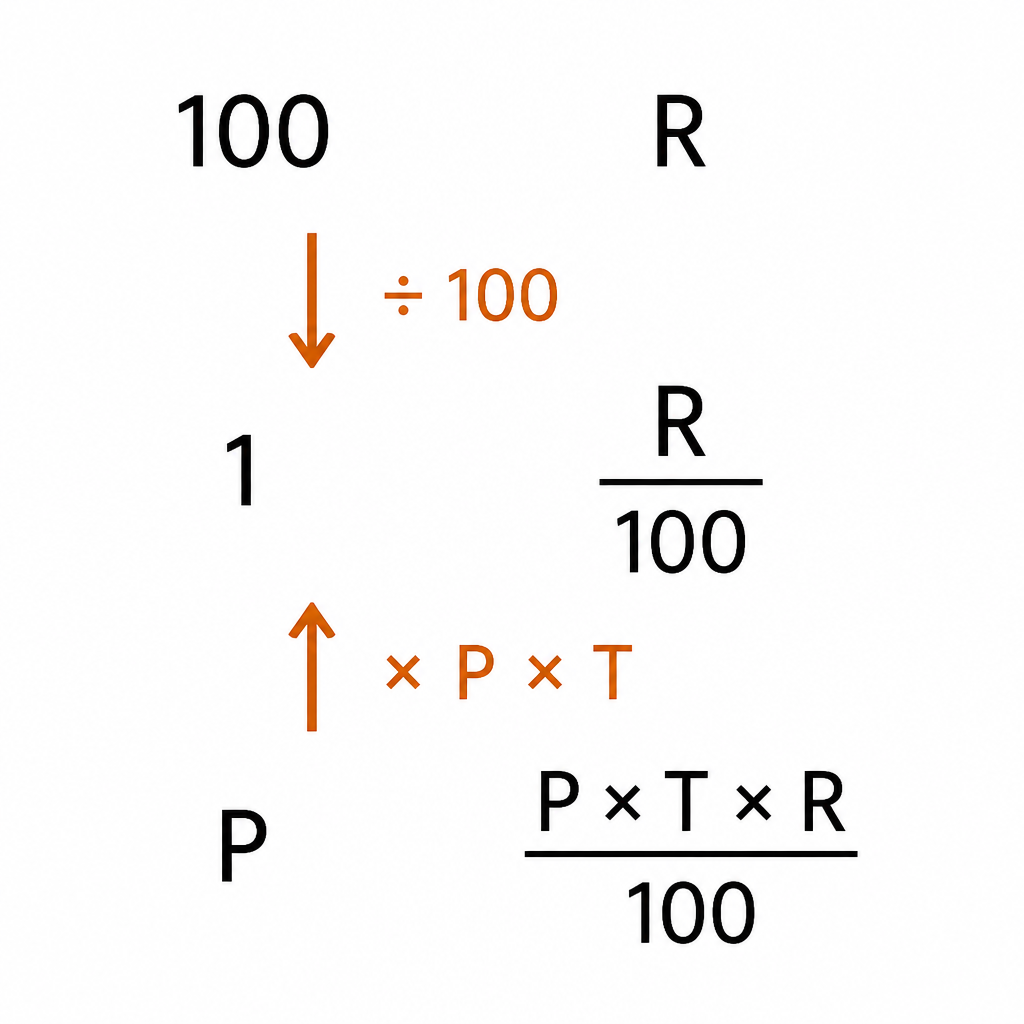
Step 1: A rate of R% per year means Rs 100 earns Rs R in one year. Dividing by 100 gives the interest on Rs 1 for 1 year:
\[ \frac{R}{100} \]
Step 2: Multiplying by T gives the interest on Rs 1 for T years:
\[ \frac{T \times R}{100} \]
Step 3: Multiplying by P gives the interest on Rs P for T years:
\[ \frac{P \times T \times R}{100} \]
This is the formula for simple interest, and it is worth learning by heart.
\[ I = \frac{P \times T \times R}{100} \]
Here P and I are in rupees, T is in years and R is a percentage per year. When R is put into the formula, only the number is written and the percent sign is left out, because the dividing by 100 has already been done inside the formula.
If the time is given in months or days, it must be changed into years before it goes into the formula. Putting 6 in place of 6 months makes the answer twelve times too big. In the same way, never change 10% into 0.10 before putting it into the formula.
Turning Months into Years
There are 12 months in a year, so dividing the number of months by 12 turns them into years. Sometimes the answer comes out neatly as a decimal, and sometimes the working is easier if it is left as a fraction.
| Time as given | In years |
| 6 months | \( \frac{6}{12} = 0.5 \) years |
| 3 years 6 months | \( 3 + \frac{6}{12} = 3.5 \) years |
| 30 months | \( \frac{30}{12} = 2.5 \) years |
| 40 months | \( \frac{40}{12} = \frac{10}{3} \) years |
Now let us use the formula together with this changing of months. Santaman borrowed Rs 5,000 from a bank at 10% per year to start a livestock business. How much interest must he pay after 3 years and 6 months? The quantities given are these:
- Principal \( P = 5000 \)
- Rate \( R = 10 \)
- Time \( T = \) 3 years 6 months
- Interest \( I = ? \)
Step 1: Changing the time into years:
\[ T = 3 + \frac{6}{12} = 3.5 \]
Step 2: Putting all three values into the formula:
\[ I = \frac{5000 \times 3.5 \times 10}{100} \]
Step 3: Multiplying and then dividing:
\[ I = 1750 \]
So Santaman must pay Rs 1,750 of interest after 3 years and 6 months.
Working Backwards to Find P, T or R
The formula holds four quantities. If any three of them are known, the fourth can be found. To do that, put the known values into the formula and solve the equation for the one that is missing.
Manju has to pay Rs 2,400 of interest in 3 years at 10% per year. How much money had she borrowed? Here \( R = 10 \), \( T = 3 \), \( I = 2400 \) and the principal Rs P is unknown.
Step 1: Putting the known values into the formula:
\[ 2400 = \frac{P \times 3 \times 10}{100} \]
Step 2: Multiplying both sides by 100 and tidying the numbers:
\[ 30 \times P = 2400 \times 100 \]
Step 3: Dividing both sides by 30:
\[ P = \frac{2400 \times 100}{30} = 8000 \]
So the money Manju had borrowed was Rs 8,000.
The same method works when the time is the unknown. How long does Rs 4,000 take to earn Rs 720 of interest at 6% per year?
Step 1: Putting the values into the formula:
\[ 720 = \frac{4000 \times T \times 6}{100} \]
Step 2: Simplifying the numbers on the right side:
\[ 720 = 240 \times T \]
Step 3: Dividing both sides by 240:
\[ T = 3 \]
So it takes 3 years. Finding the rate follows exactly the same path. If Rs 7,500 earns Rs 1,800 in 4 years, then \( 1800 = \frac{7500 \times 4 \times R}{100} \), which gives \( 1800 = 300 \times R \) and \( R = 6 \). The rate is 6% per year.
The Amount
Lakpa saved Rs 10,000 out of his monthly earnings and deposited it in Nepal Bank for 3 years at 8% per year. How much interest does he receive, and how much money does he get back in one lump when the principal and the interest are put together?
Step 1: Putting \( P = 10000 \), \( T = 3 \) and \( R = 8 \) into the formula:
\[ I = \frac{10000 \times 3 \times 8}{100} \]
Step 2: Working it out gives the interest:
\[ I = 2400 \]
Step 3: Adding the interest to the principal gives the lump sum:
\[ 10000 + 2400 = 12400 \]
Here the lump sum of Rs 12,400, made of the principal and the interest together, is the amount.
Amount (A): the single sum made by adding the interest to the principal at the end of the fixed time is called the amount. It is written as A.
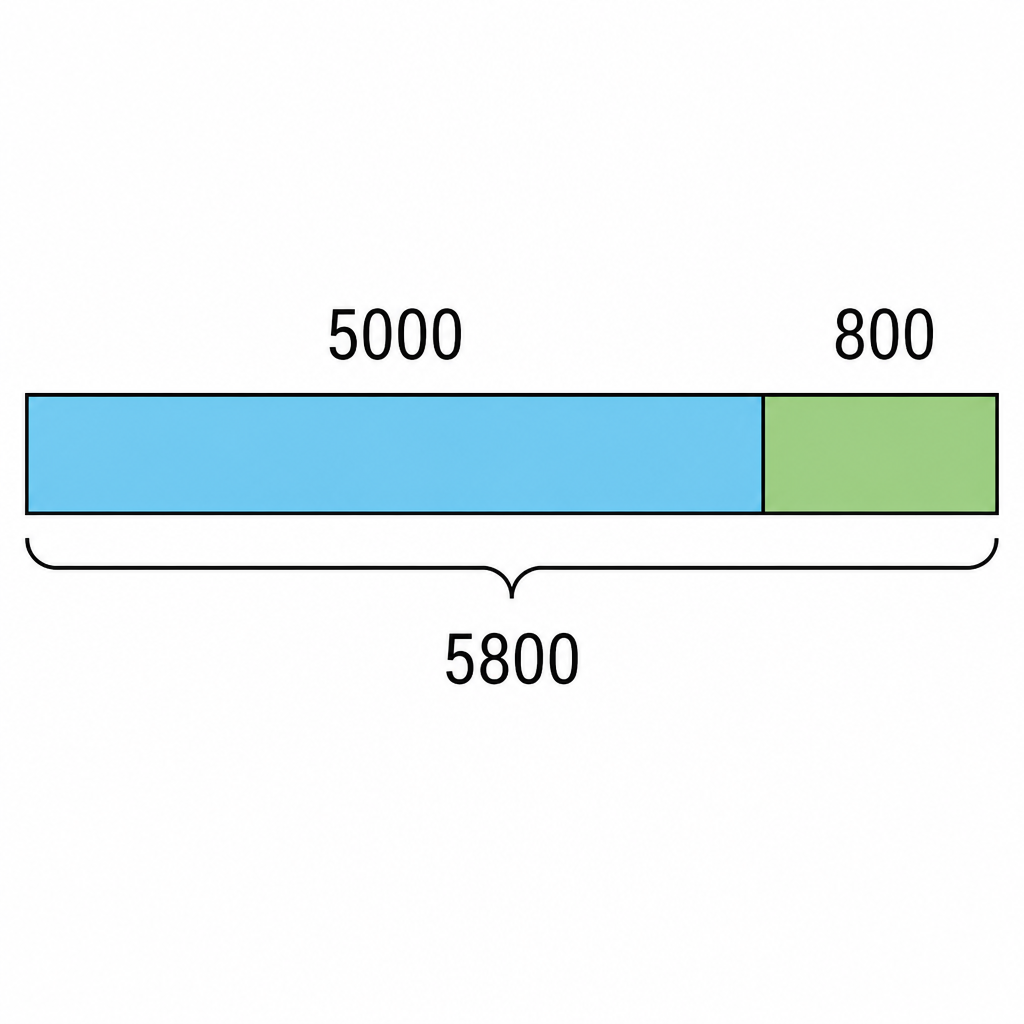
\[ A = P + I \]
A Formula for the Amount
The amount does not always have to be found by working out the interest first and adding afterwards. The two formulas can be joined into one. Suppose Rs P earns interest Rs I in T years at R% per year.
Step 1: By the meaning of the amount:
\[ A = P + I \]
Step 2: Replacing I by its own formula:
\[ A = P + \frac{P \times T \times R}{100} \]
Step 3: Taking P out as a common factor of both terms:
\[ A = P\left(1 + \frac{TR}{100}\right) \]
Step 4: Writing what is inside the bracket as a single fraction:
\[ A = P\left(\frac{100 + TR}{100}\right) \]
Rajkishor deposited Rs 8,000 of profit from his shop in a bank for 3 years at 12% per year. How much money does he get back after 3 years? Here \( P = 8000 \), \( R = 12 \) and \( T = 3 \).
Step 1: Putting the values into the formula for the amount:
\[ A = 8000\left(\frac{100 + 3 \times 12}{100}\right) \]
Step 2: Doing the addition inside the bracket:
\[ A = 8000\left(\frac{136}{100}\right) \]
Step 3: Multiplying out:
\[ A = 10880 \]
The same answer can be checked another way. The interest is \( I = \frac{8000 \times 3 \times 12}{100} = 2880 \), and then \( A = 8000 + 2880 = 10880 \). Both routes give the same answer, so Rajkishor gets Rs 10,880 back after 3 years.
Finding the Principal from the Amount
Sometimes the money that will come into the hand at the end is known, and what must be deposited at the start is wanted. How much must be deposited at 7.5% per year to receive Rs 2,375 in one lump after 40 months? Here \( A = 2375 \), \( R = 7.5 \), and the time is given in months.
Step 1: Changing the time into years:
\[ T = \frac{40}{12} = \frac{10}{3} \]
Step 2: Putting the values into the formula for the amount:
\[ 2375 = P\left(\frac{100 + \frac{10}{3} \times 7.5}{100}\right) \]
Step 3: Doing the multiplication and addition inside the bracket:
\[ 2375 = P\left(\frac{125}{100}\right) \]
Step 4: Multiplying both sides by 100 and dividing by 125 to leave P alone:
\[ P = \frac{2375 \times 100}{125} = 1900 \]
So Rs 1,900 must be deposited at the start.
Income Tax on Interest
The government charges income tax on the interest a bank pays on savings. The tax falls on the interest only, never on the principal. So to find the money that actually reaches the hand, work out the interest, take the tax off it, and then add what is left to the principal.
Aadira saves Rs 40,000 in a bank at 5% per year and must pay income tax of 5% on the interest she earns. How much money does she receive in all after 4 years?
Step 1: Working out the interest for 4 years:
\[ I = \frac{40000 \times 4 \times 5}{100} = 8000 \]
Step 2: Working out 5% of that interest as tax:
\[ \frac{5}{100} \times 8000 = 400 \]
Step 3: Taking the tax off the interest leaves the interest she keeps:
\[ 8000 - 400 = 7600 \]
Step 4: Adding that interest to the principal gives the total received:
\[ 40000 + 7600 = 47600 \]
So Aadira receives Rs 47,600 in all after 4 years.
The income tax is charged on the interest, not on the amount. Never take 5% off the amount of Rs 47,600. Doing that makes the answer far too small.
All the Formulas in One Place
Every formula below comes from moving the parts of the one formula \( I = \frac{PTR}{100} \) around. Look at which quantity is wanted, and pick the formula that gives it.
| What is wanted | Formula |
| Interest | \( I = \frac{PTR}{100} \) |
| Principal | \( P = \frac{100I}{TR} \) |
| Time | \( T = \frac{100I}{PR} \) |
| Rate | \( R = \frac{100I}{PT} \) |
| Amount | \( A = P + I \) |
| Amount (in one go) | \( A = P\left(\frac{100+TR}{100}\right) \) |
Get into the habit of writing down which of P, T, R, I and A are given and which one is wanted, before doing any working. Once that is done, the rest of the work is only putting values into one formula.
The full lesson is waiting for you
The notes are free to read in full. A free account opens the rest of the practice, and tracks your progress and confidence score for every subject. Presentations and videos need approval from Learn Yeti.