When Two Quantities Change Together
A bus is running at a steady speed of 50 kilometres every hour. In one hour it covers 50 kilometres. In two hours it covers 100 kilometres. The time doubled and the distance doubled with it. The table below records how far the bus has gone after each hour.
| Time (hours) | Distance (km) |
| 1 | 50 |
| 2 | 100 |
| 3 | 150 |
| 4 | 200 |
| 5 | 250 |
Look down the table. As the time grows the distance grows with it, and it grows in the same proportion. When the time became three times as much, the distance also became three times as much. Going more kilometres took more hours. In a situation like this we say the time and the distance have a direct relation.
Now look at a different situation. Ten people take 16 days to finish a job. If they all work at the same steady rate, then adding more workers finishes the job sooner. Double the workers and the number of days is halved.
| Days | Number of people |
| 16 | 10 |
| 8 | 20 |
| 4 | 40 |
| 2 | 80 |
| 1 | 160 |
Here the number of days is falling while the number of people is rising in the same proportion. When the days were halved, the people doubled. When the days fell to a quarter, the people became four times as many. In a situation like this we say the number of people and the number of days have an indirect relation.
Direct variation: when one of two quantities increases or decreases and the other increases or decreases in the very same proportion, the two are said to be in direct variation.
Indirect variation: when one quantity increases and the other decreases in the same proportion, and when one decreases the other increases in the same proportion, the two are said to be in indirect variation.
After reading any problem, ask yourself one question: if I increase the first quantity, does the second one go up or come down? Up means direct variation. Down means indirect variation.
Find the Value of One First
Bhargav bought 10 pencils for Rs 150. Bhumika bought 8 pencils for Rs 120. Both of them bought the same kind of pencil from the same shop. To find out which of them paid more for a single pencil, the first thing to work out is the price of one pencil.

Bhargav has ten pencils and Bhumika has eight. Setting the two groups side by side makes the difference in number easy to see.
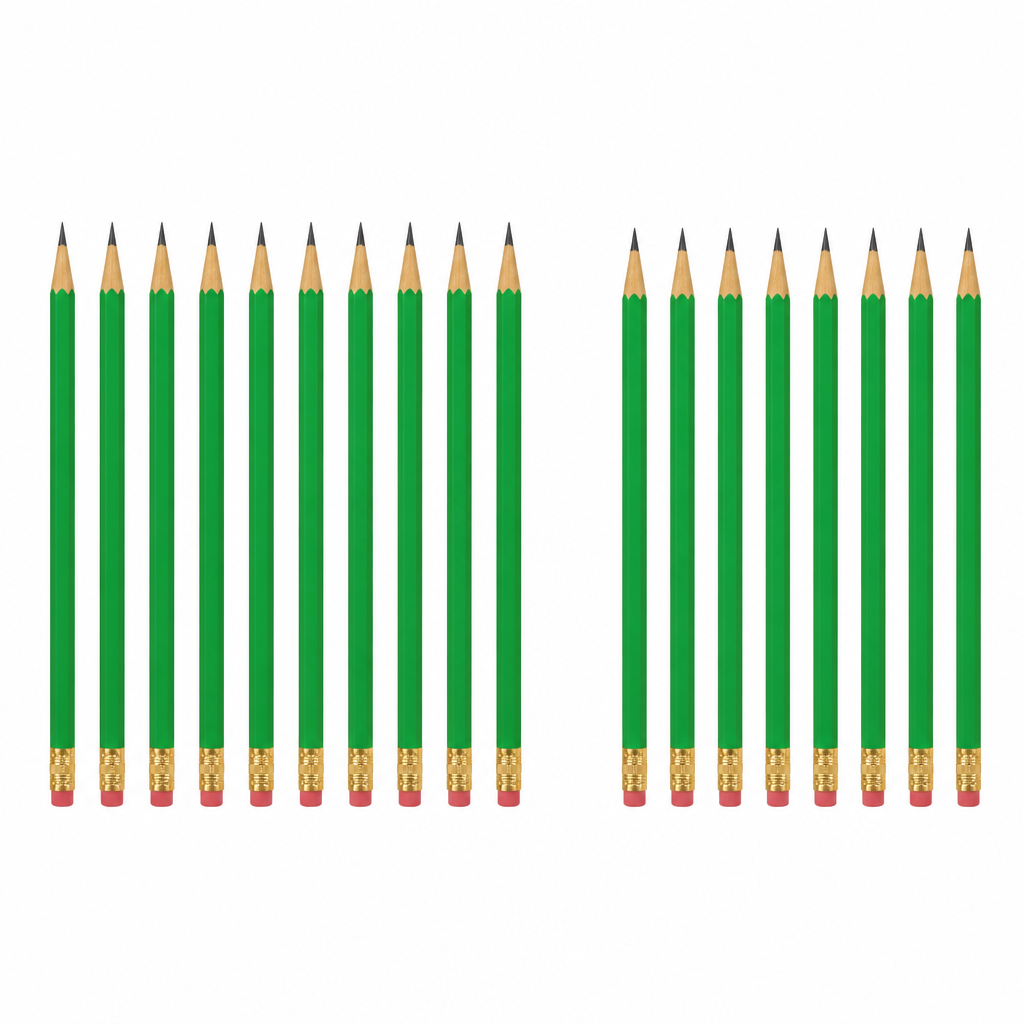
Take Bhargav's purchase first. If ten pencils cost Rs 150, then one pencil costs:
\[ \frac{150}{10} = 15 \]
Doing the same for Bhumika, eight pencils cost Rs 120, so one pencil costs:
\[ \frac{120}{8} = 15 \]
Each of them paid Rs 15 for one pencil, so neither paid more than the other. The ratio of the numbers is \( 10 : 8 = 5 : 4 \) and the ratio of the prices is \( 150 : 120 = 5 : 4 \). The two ratios are equal, which tells us the number of pencils and their cost are in direct variation.
Unitary method: the way of solving a problem in which you first work out the value of one single unit from the information given, and then use that one value to find whatever the question asks for.
Now suppose Bhumika had bought 12 pencils instead. How much would she have paid? We can set up a proportion and solve it.
Step 1: Eight pencils cost Rs 120, and let the cost of 12 pencils be \( x \). Since number and cost are in direct variation, the proportion is:
\[ \frac{8}{12} = \frac{120}{x} \]
Step 2: Cross multiplying gives:
\[ 8x = 12 \times 120 \]
Step 3: Working out the product on the right:
\[ 8x = 1440 \]
Step 4: Dividing both sides by 8:
\[ x = \frac{1440}{8} = 180 \]
So 12 pencils would cost Rs 180. The check is easy: at Rs 15 each, twelve pencils come to \( 15 \times 12 = 180 \).
Solving a Direct Variation Problem
If 10 kg of apples cost Rs 950, what will 3 kg of the same apples cost? Here, when the weight of the apples goes down the price goes down with it, so weight and price are in direct variation.
| Quantity (kg) | Price (Rs) |
| 10 | 950 |
| 3 | x (taken as) |
Step 1: Because weight and price are in direct variation, the proportion is written like this:
\[ \frac{10}{3} = \frac{950}{x} \]
Step 2: Cross multiplying:
\[ 10 \times x = 3 \times 950 \]
Step 3: Simplifying the right hand side:
\[ 10x = 2850 \]
Step 4: Dividing both sides by 10:
\[ x = 285 \]
So 3 kg of apples cost Rs 285. Always look at whether the answer makes sense. Three kilograms is less than ten, so the answer had to come out smaller than Rs 950, and it did.
Problems with Three Quantities
Sometimes one problem carries three quantities at once. Ten people earn Rs 1,60,000 in 20 days. The three quantities here are the number of people, the number of days and the money earned. More people means more money earned, and more days also means more money earned. So the money has a direct relation both with the people and with the days.
Step 1: The amount one person earns in 20 days, in rupees:
\[ \frac{1{,}60{,}000}{10} = 16{,}000 \]
Step 2: The amount one person earns in one day:
\[ \frac{16{,}000}{20} = 800 \]
That Rs 800 is the key to the whole problem. From this one figure, what one person earns in one day, every other question can be answered. Now let us find what 15 people earn in 10 days.
Step 3: What 15 people earn in one day:
\[ 800 \times 15 = 12{,}000 \]
Step 4: What 15 people earn in 10 days:
\[ 12{,}000 \times 10 = 1{,}20{,}000 \]
So 15 people earn Rs 1,20,000 in 10 days. The same problem can also be solved with a table. All three quantities are written in the table and the unknown one is taken as \( x \).
| People | Days | Earnings (Rs) |
| 10 | 20 | 1,60,000 |
| 15 | 10 | x (taken as) |
\[ \frac{x}{1{,}60{,}000} = \frac{15}{10} \times \frac{10}{20} \]
\[ x = \frac{15}{10} \times \frac{10}{20} \times 1{,}60{,}000 \]
\[ x = 1{,}20{,}000 \]
Now turn the question round. Working at the same rate, how many days must ten people work to earn Rs 96,000? We know one person earns Rs 800 in a day, so ten people earn \( 800 \times 10 = 8{,}000 \) in a day.
\[ \frac{96{,}000}{8{,}000} = 12 \]
So ten people earn Rs 96,000 in 12 days.
In a problem with three quantities, write down a quantity in the table even when it does not change. Leaving it out is how students lose track of which ratio belongs where, and the answer goes wrong.
Two Ways to Find the Length of the Wall
Thirty people build a wall 600 metres long in 20 days. Working at the same rate, how many metres of wall will 15 people build in 18 days? Let us solve it by finding one unit first.
Step 1: The length of wall 30 people build in one day, in metres:
\[ \frac{600}{20} = 30 \]
Step 2: The length one person builds in one day:
\[ \frac{30}{30} = 1 \]
Step 3: The length one person builds in 18 days:
\[ 1 \times 18 = 18 \]
Step 4: The length 15 people build in 18 days:
\[ 18 \times 15 = 270 \]
So 15 people build 270 metres of wall in 18 days. The same problem also yields to the table method. People and work are in direct variation, and days and work are in direct variation too. So both ratios are taken just as they stand.
| People | Days | Length of wall (m) |
| 30 | 20 | 600 |
| 15 | 18 | x (taken as) |
\[ \frac{x}{600} = \frac{15}{30} \times \frac{18}{20} \]
\[ x = \frac{15}{30} \times \frac{18}{20} \times 600 \]
\[ x = 270 \]
Both ways gave the same answer. Finding one unit first shows you what is happening at every line. The table method is quicker. Either may be used in an examination, but with the table method you must first decide, for every pair, whether the relation is direct or indirect.
Indirect Variation at Work
If 20 workers take 24 days to do a job, how many days will 15 workers take to do the same job? There are fewer workers now, so the job will take longer. The number of workers and the number of days are in indirect variation.
| Number of workers | Working days |
| 20 | 24 |
| 15 | x (taken as) |
Step 1: Since this is indirect variation, the ratio of the workers matches the ratio of the days the other way round:
\[ \frac{20}{15} = \frac{x}{24} \]
Step 2: Cross multiplying:
\[ x \times 15 = 20 \times 24 \]
Step 3: Multiplying out the right hand side:
\[ 15x = 480 \]
Step 4: Dividing both sides by 15:
\[ x = \frac{480}{15} = 32 \]
So 15 workers take 32 days for that job. With fewer workers the days rose from 24 to 32, which is exactly what we expected.
Writing the proportion for indirect variation the same way as for direct variation turns the answer upside down. Before writing any proportion, always ask: when the workers go down, do the days go up or down?
People, Days and Hours per Day
Ten people of a community worked together and built a bamboo shelter in 14 days. They worked at the rate of eight hours a day. Now seven people have to finish another shelter of the same size in 16 days. How many hours a day must they work?
Here, when the people go down the daily hours must go up, so people and hours per day are in indirect variation. In the same way, when the days go up the daily hours come down, so days and hours per day are in indirect variation too.
Step 1: The hours a day one person would need to finish it in the same 14 days:
\[ 8 \times 10 = 80 \]
Step 2: The hours one person would need to finish it in a single day:
\[ 80 \times 14 = 1120 \]
Step 3: The hours a day seven people would need to finish it in a single day:
\[ \frac{1120}{7} = 160 \]
Step 4: The hours a day seven people need to finish it in 16 days:
\[ \frac{160}{16} = 10 \]
So seven people can build that shelter in 16 days by working ten hours a day. Now ask the other question: if those seven work at the old rate of eight hours a day, how many days will they need?
Step 1: The days one person would need at eight hours a day:
\[ 14 \times 10 = 140 \]
Step 2: The days seven people need at eight hours a day:
\[ \frac{140}{7} = 20 \]
So seven people working eight hours a day can build that shelter in 20 days.
What the Arrows in the Table Tell You
In the table method an arrow is drawn in every column. The arrow in the column holding the unknown is always drawn first. After that, the relation decides which way each of the other arrows points.
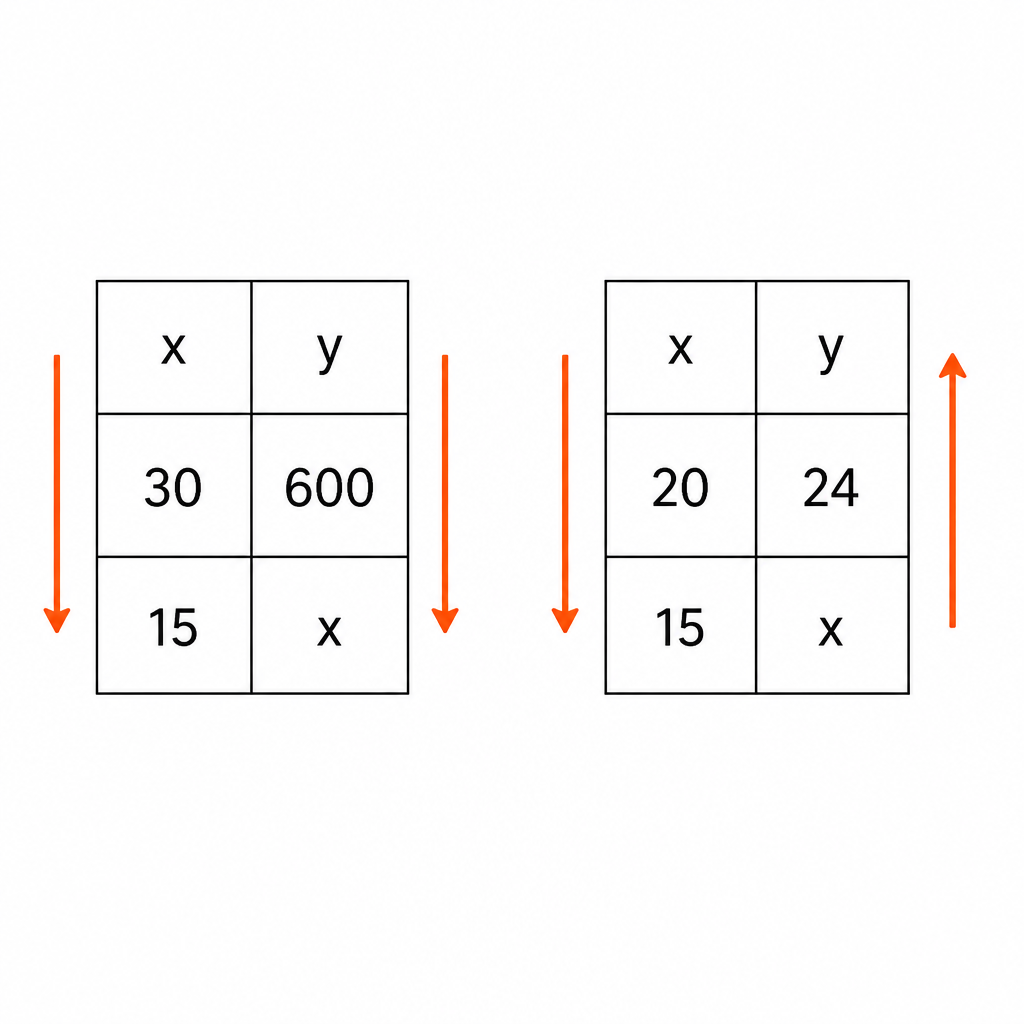
| Relation | Arrow direction | The ratio |
| Direct variation | Both arrows the same way | Taken as it stands |
| Indirect variation | Arrows the opposite way | Turned upside down |
Now put this to work on a problem. Painting six houses in 24 days needs 32 people. How many days would one person take to paint those six houses? The people have fallen from 32 to 1, so the days will rise a great deal.
\[ 24 \times 32 = 768 \]
So one person would take 768 days to paint the six houses. Now the next question: how many extra people must be brought in to finish that same work in 8 days? Finishing in one day would need 768 people, so the number needed to finish in 8 days is:
\[ \frac{768}{8} = 96 \]
There were 32 people to begin with and 96 are now needed. So the number of extra people to be brought in is:
\[ 96 - 32 = 64 \]
So 64 more people must be brought in. Notice carefully whether the question asks how many are needed or how many extra are needed. Answering 96 is not the same as answering 64.
For any unitary method problem, do three things in order: name the quantities, decide for each pair whether it is direct or indirect, and only then start calculating.
The full lesson is waiting for you
The notes are free to read in full. A free account opens the rest of the practice, and tracks your progress and confidence score for every subject. Presentations and videos need approval from Learn Yeti.