What Happens When a Shop Buys and Sells
A shop buys goods and then sells those same goods to customers. The price at which the shop buys an item is called its cost price. The price at which that same item is sold to a customer is called its selling price. These two prices are hardly ever equal, and the difference between them is what tells us whether the shop gained or lost on that item.
Cost price (CP): the amount paid to buy an item.
Selling price (SP): the amount received when that item is sold.
Profit: when the selling price is greater than the cost price, the difference between them is the profit.
Loss: when the selling price is less than the cost price, the difference between them is the loss.
Two items are on display in a clothing shop. The shopkeeper bought a pair of trousers for Rs.700, but only three pieces of one size are left, so they are priced at Rs.500 to clear them. Beside them hangs a sweater bought for Rs.900 and priced at Rs.1200. These two items show two opposite things.


For the trousers the selling price is Rs.500 and the cost price is Rs.700. The selling price is the smaller one, so there is a loss:
\[ L = 700 - 500 = 200 \]
For the sweater the selling price is Rs.1200 and the cost price is Rs.900. The selling price is the bigger one, so there is a profit:
\[ P = 1200 - 900 = 300 \]
Profit and Loss Written as Percentages
Is a profit of Rs.300 large or small? The amount alone cannot answer that. Rs.300 gained on Rs.900 is a fine return, but Rs.300 gained on Rs.90000 is almost nothing. So profit and loss are always written as a percentage of the cost price. The cost price is always the base, because that is the money the shopkeeper put at risk.
\[ P\% = \frac{P}{CP} \times 100\% \]
\[ L\% = \frac{L}{CP} \times 100\% \]
Step 1: Putting the sweater's profit of Rs.300 over its cost price of Rs.900:
\[ P\% = \frac{300}{900} \times 100\% \]
Step 2: Both parts of the fraction divide by 300, so it simplifies and gives:
\[ P\% = \frac{1}{3} \times 100\% = 33.33\% \]
Step 3: Putting the trousers' loss of Rs.200 over its cost price of Rs.700:
\[ L\% = \frac{200}{700} \times 100\% = 28.57\% \]
Do not divide by the selling price when finding profit percent or loss percent. The division is always by the cost price. For the trousers, dividing 200 by 500 gives 40%, and that answer is wrong.
Marked Price and Discount
Every item in a shop carries a price written on it. That is the price the trader has fixed and shown to the customer. Sometimes the shop takes less than that written price and sells the item cheaper. The amount taken off is the discount. Whatever the customer actually pays after that amount is taken off is the selling price of the item.
Marked price (MP): the price a trader fixes for an item and shows to the customer.
Discount: when an item is sold for some amount less than its marked price, that reduced amount is called the discount.
Sandeep goes to a shop to buy a jacket for the winter. The jacket is priced at Rs.2200 and the shop has announced a 10% discount. The bill he is handed after buying it sets the figures out like this.

| Item on the bill | Amount (Rs.) |
| Marked price of the jacket | 2200 |
| Discount at 10% | 220 |
| Total amount payable | 1980 |
The marked price of the jacket here is Rs.2200. A discount of 10% on that fixed price gives Sandeep Rs.220 off. He therefore buys the jacket for Rs.220 less than the written price, and the selling price of that jacket becomes Rs.1980.
The Two Rules of Discount
Every discount question rests on two rules. The first finds how much the discount is worth in rupees, and the second takes that amount off to leave the selling price.
\[ D = MP \times \frac{d\%}{100} \]
\[ SP = MP - D \]
Both rules also run backwards. If the marked price and the selling price are both known, the discount is \( D = MP - SP \), and from that the discount percent follows:
\[ d\% = \frac{D}{MP} \times 100\% \]
A discount percent is always worked out on the marked price, never on the cost price. A profit percent is always worked out on the cost price. The two percentages have different bases, and swapping them gives a wrong answer.
Finding the Selling Price After a Discount
Rajukanta buys a storybook priced at Rs.600 with a discount of 15%. How much does she have to pay the shop?
Step 1: Here the book's marked price is \( MP = 600 \) and the discount is \( d\% = 15\% \). The discount is 15% of 600:
\[ D = 600 \times \frac{15}{100} \]
Step 2: Carrying out the multiplication gives the discount in rupees:
\[ D = 90 \]
Step 3: Taking the discount off the marked price leaves the selling price:
\[ SP = 600 - 90 = 510 \]
So Rajukanta has to pay Rs.510 for that storybook.
A second way: think of the marked price as 100x. A discount of 15% is then 15x, so the selling price is \( 100x - 15x = 85x \).
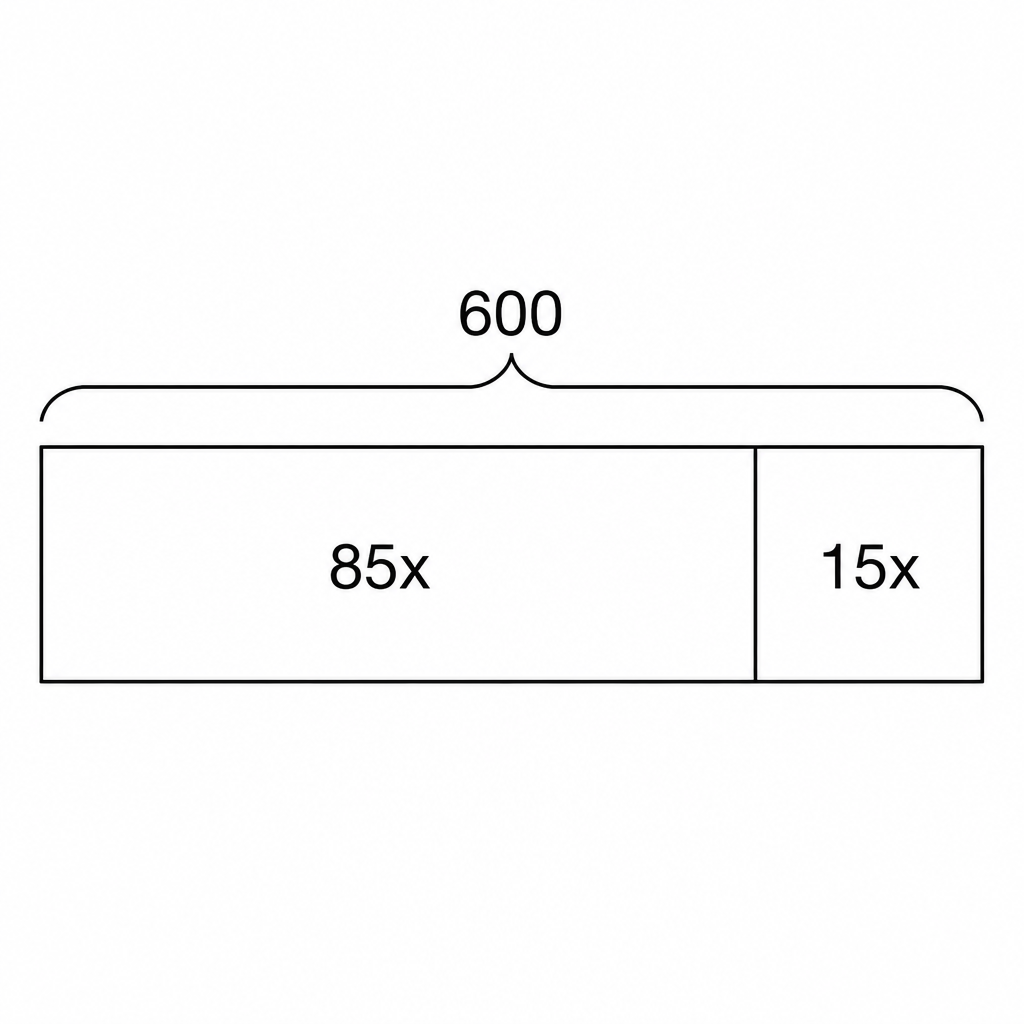
Step 1: The marked price is given as Rs.600, so the whole strip is worth 600:
\[ 100x = 600 \]
Step 2: Dividing both sides by 100:
\[ x = 6 \]
Step 3: The selling price is 85x, so:
\[ 85x = 85 \times 6 = 510 \]
Both ways give the same answer of Rs.510. Either one may be used, whichever feels easier.
Working Back to the Marked Price
Nabin buys a mobile phone at a discount of 8% and pays the shop Rs.22,080. What was the marked price of that phone?
Step 1: Let the marked price be x. The discount is 8% of x, so the selling price gives this equation:
\[ 22080 = x - \frac{8}{100}x \]
Step 2: Writing both terms on the right over the common denominator 100:
\[ 22080 = \frac{100x - 8x}{100} \]
Step 3: Subtracting the like terms in the numerator:
\[ 22080 = \frac{92x}{100} \]
Step 4: Multiplying both sides by 100 clears the denominator:
\[ 92x = 2208000 \]
Step 5: Dividing both sides by 92:
\[ x = 24000 \]
So the marked price of that phone was Rs.24,000.
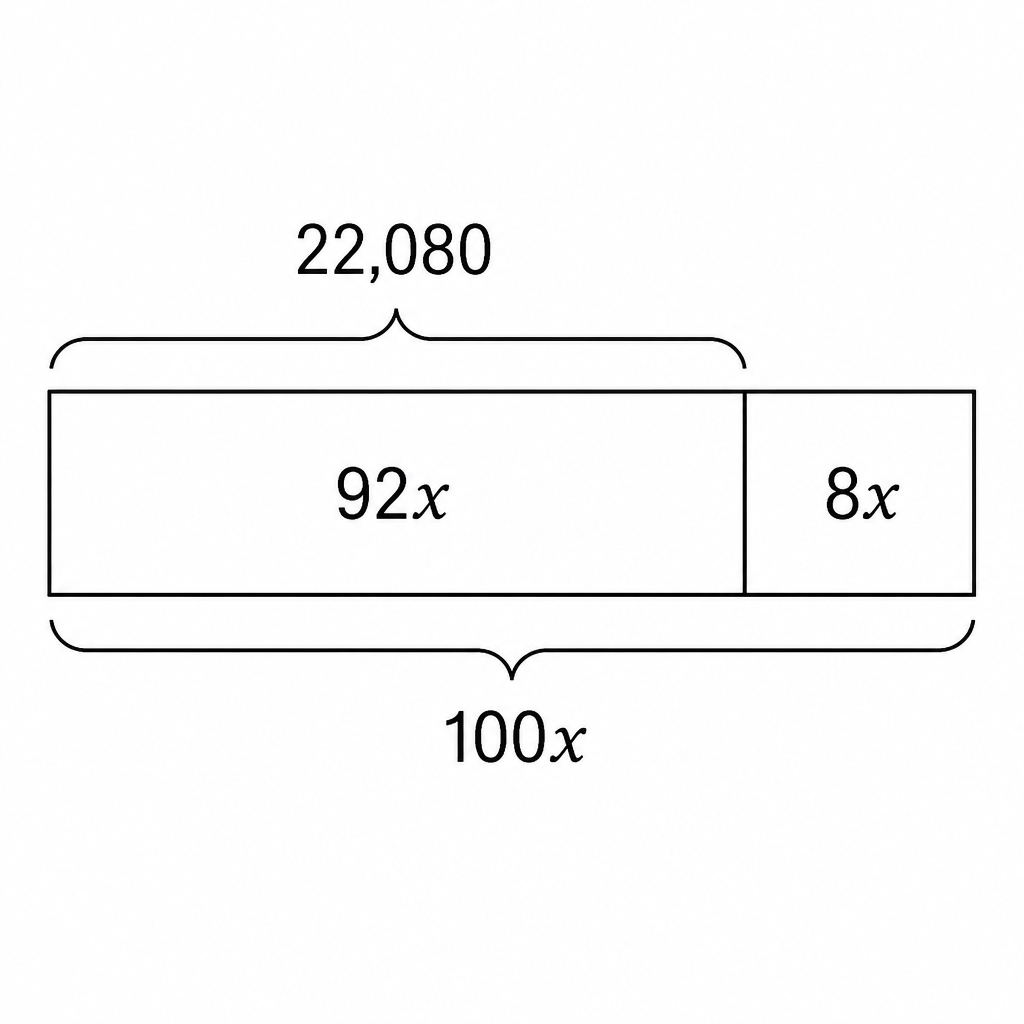
Step 1: Taking the marked price as 100x makes the discount 8x, so the selling price is:
\[ SP = 100x - 8x = 92x \]
Step 2: The selling price is given as Rs.22,080, so:
\[ 92x = 22080 \]
Step 3: Dividing by 92:
\[ x = 240 \]
Step 4: The marked price is 100x, so:
\[ MP = 100 \times 240 = 24000 \]
The marked price of that phone is therefore Rs.24,000. To check the answer, take 8% of 24000, which is Rs.1920, off the marked price and Rs.22,080 comes back.
Cost Price, Marked Price and Discount in One Problem
Jujuman buys a computer for Rs.36000. He fixes its marked price 25% above the cost price. If he then sells that computer at a discount of 25%, let us find the marked price, the discount, the selling price and the profit or loss percent.
Step 1: The marked price is the cost price with 25% of it added on:
\[ MP = 36000 + 36000 \times \frac{25}{100} \]
Step 2: Since 25% of 36000 is Rs.9000, this becomes:
\[ MP = 36000 + 9000 = 45000 \]
Step 3: The discount is 25% of the marked price, not of the cost price:
\[ D = 45000 \times \frac{25}{100} = 11250 \]
Step 4: Taking the discount off the marked price gives the selling price:
\[ SP = 45000 - 11250 = 33750 \]
Step 5: The selling price has come out below the cost price, so this is a loss:
\[ L = 36000 - 33750 = 2250 \]
Step 6: The loss percent is worked out on the cost price:
\[ L\% = \frac{2250}{36000} \times 100\% = 6.25\% \]
Do not assume that adding 25% and then taking 25% off brings the price back to where it started. The first 25% was taken on the cost price of Rs.36000 and the second on the marked price of Rs.45000. The second base is larger, so more comes off than went on, and the result here is a loss.
Every Formula in One Place
| What is wanted | Formula |
| Profit | \( P = SP - CP \) |
| Loss | \( L = CP - SP \) |
| Profit percent | \( P\% = \frac{P}{CP} \times 100\% \) |
| Loss percent | \( L\% = \frac{L}{CP} \times 100\% \) |
| Discount amount | \( D = MP \times \frac{d\%}{100} \) |
| Selling price | \( SP = MP - D \) |
| Discount percent | \( d\% = \frac{D}{MP} \times 100\% \) |
Before solving any question, sort out which price each given amount is. The cost price is what the shop paid, the marked price is what is written on the item, and the selling price is what the customer actually paid.
The full lesson is waiting for you
The notes are free to read in full. A free account opens the rest of the practice, and tracks your progress and confidence score for every subject. Presentations and videos need approval from Learn Yeti.