Comparing Two Quantities by Division
Count the boys and the girls in any classroom and you get two different numbers. Suppose a class has 20 boys and 25 girls. There are two ways of comparing those numbers. The first way is to subtract. Taking 20 away from 25 leaves 5, and that only tells you there are 5 more girls. The second way is to divide, and in mathematics division is the stronger way of comparing two quantities.
Write the number of boys divided by the number of girls as a fraction, and it looks like this:
\[ \frac{20}{25} = \frac{4}{5} \]
That fraction says the class has 4 boys for every 5 girls. The class has 45 students in all, so comparing the boys with the whole class gives \( \frac{20}{45} = \frac{4}{9} \), and comparing the girls with the whole class gives \( \frac{25}{45} = \frac{5}{9} \). A comparison made by dividing like this is what we call a ratio.
Subtracting tells you how many more. Dividing tells you how many times as many. A ratio always tells you the second thing.
Ratio
Sobhit has 1 dozen pencils and the whole dozen cost Rs 120. Sobhina has 6 pens and the six together cost Rs 150. These two purchases can be compared, but before comparing you have to be clear about which thing is being set against which.
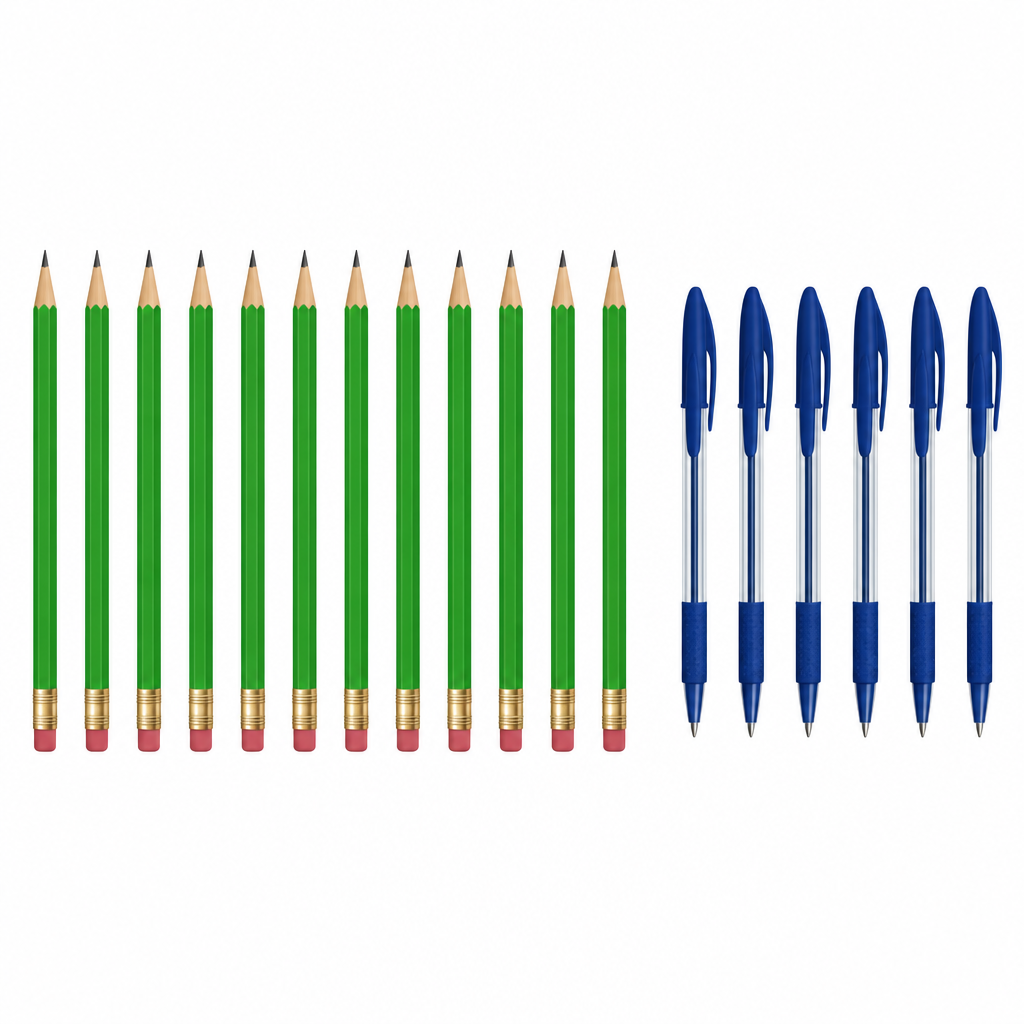
Step 1: One dozen means 12, so the ratio of the number of pencils to the number of pens is:
\[ \frac{12}{6} = 2:1 \]
Step 2: To get the price of one pencil, divide the price of the dozen by 12:
\[ \frac{120}{12} = 10 \]
Step 3: In the same way, to get the price of one pen, divide Rs 150 by 6:
\[ \frac{150}{6} = 25 \]

Step 4: One pencil costs Rs 10 and one pen costs Rs 25, so the ratio of their prices is:
\[ \frac{10}{25} = 2:5 \]
When two quantities a and b are measured in the same unit, the ratio of a to b is written as \( \frac{a}{b} \) or a:b, and the ratio of b to a is written as \( \frac{b}{a} \) or b:a. The form a:b is read as a is to b, and b:a is read as b is to a.
a:b and b:a are not the same. If the ratio of the price of a pencil to the price of a pen is 2:5, then the ratio of the price of a pen to the price of a pencil is 5:2. Whichever quantity the question names first becomes the first term.
Matching the Units Before Writing a Ratio
Both quantities must be in the same unit before a ratio is written. If the units differ, change them into one common unit first and only then divide. Three pairs of quantities are worked out below.
(a) 25 cm and 30 cm are both already in centimetres, so divide straight away and reduce to lowest terms:
\[ \frac{25}{30} = \frac{5}{6} = 5:6 \]
(b) A dozen is 12, so 2 dozen is 24 pieces. Now both quantities are counts of pieces:
\[ \frac{24}{20} = \frac{6}{5} = 6:5 \]
(c) 1 kg is 1000 gm, so write both quantities in grams:
\[ \frac{250}{1000} = \frac{1}{4} = 1:4 \]
Writing 250 gm and 1 kg as 250:1 is wrong. Change 1 kg into 1000 gm first, and only then divide. A ratio taken before the units match is always a wrong ratio.
A ratio has no unit of its own. The ratio of 250 gm to 1 kg is 1:4, not 1:4 gm. The unit cancels out in the division.
Finding the Other Quantity When the Ratio Is Known
Mohammad and Abdul put money into a factory in the ratio 2:3. Mohammad invested Rs 2,00,000. How much did Abdul invest? Here the ratio and one of the two quantities are known, and the other has to be found.
Step 1: Let Abdul's investment be Rs b. Since the two investments are in the ratio 2:3:
\[ \frac{200000}{b} = \frac{2}{3} \]
Step 2: Cross multiplying the two sides:
\[ 2b = 3 \times 200000 \]
Step 3: Dividing both sides by 2 gives the value of b:
\[ b = \frac{600000}{2} = 300000 \]
So Abdul invested Rs 3,00,000.
There is a second way, and it is to read the ratio as equal parts. The ratio 2:3 says the whole investment is split into 5 equal parts, of which Mohammad put in 2 parts and Abdul put in 3 parts. Let one part be x.
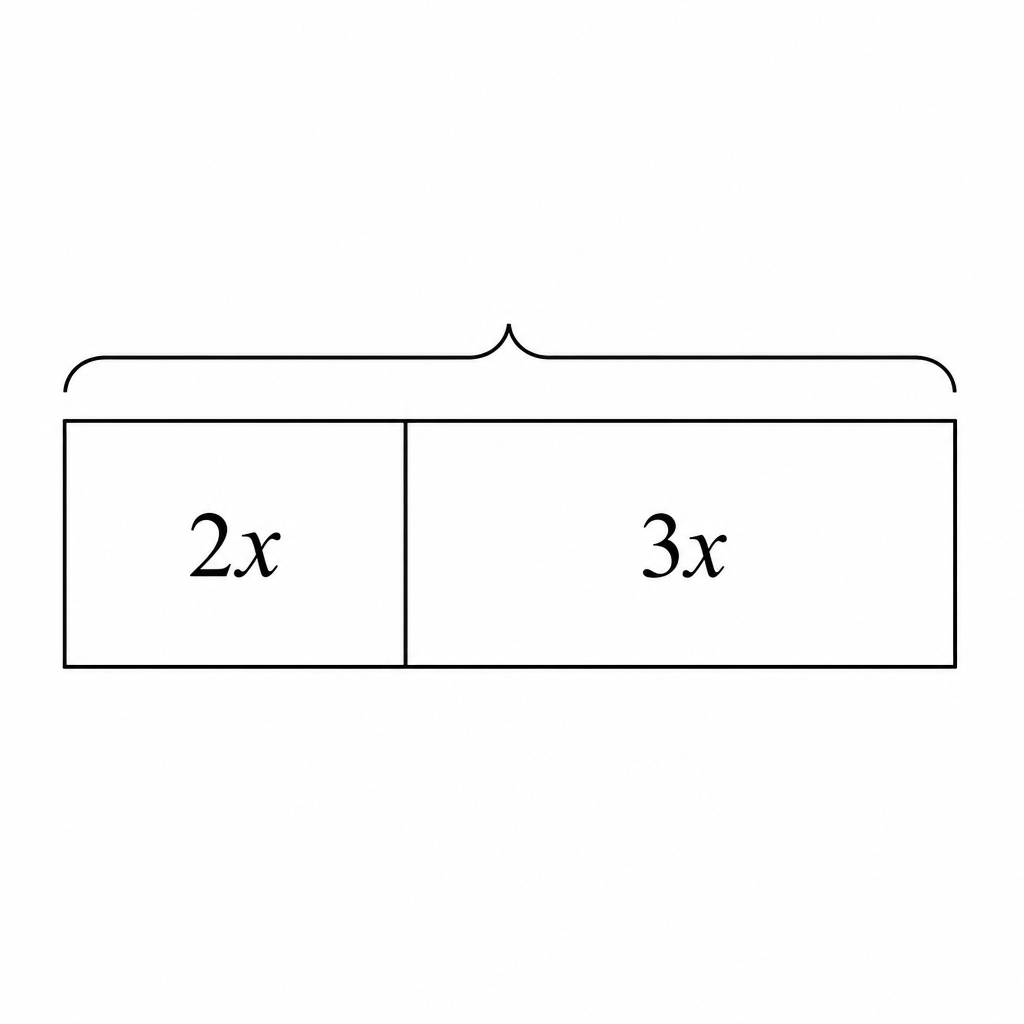
Step 1: Mohammad put in 2 parts, and that is Rs 2,00,000:
\[ 2x = 200000 \]
Step 2: Finding the value of one part:
\[ x = 100000 \]
Step 3: Abdul put in 3 parts, so his investment is:
\[ 3x = 3 \times 100000 = 300000 \]
Both methods give the same answer. The parts method is the more useful one when a question has three or more shares in it.
Ages and the Ratio that Changes with Time
The ratio of Bishal's age to Dhaniya's age today is 4:5. Four years from now the ratio of their ages will be 5:6. How old are they now? The point to hold on to is that time adds the same number of years to both of them, yet the ratio itself changes.
Step 1: Let their present ages be 4x and 5x. Four years later Bishal's age is \( 4x + 4 \) and Dhaniya's age is \( 5x + 4 \). The new ratio is 5:6, so:
\[ \frac{4x+4}{5x+4} = \frac{5}{6} \]
Step 2: Cross multiplying:
\[ 6(4x+4) = 5(5x+4) \]
Step 3: Opening the brackets on both sides:
\[ 24x + 24 = 25x + 20 \]
Step 4: Moving the x terms to one side and the numbers to the other gives \( 24 - 20 = 25x - 24x \), and so:
\[ x = 4 \]
Step 5: Putting the value of x back gives Bishal's present age:
\[ 4x = 4 \times 4 = 16 \]
Step 6: In the same way, Dhaniya's present age is:
\[ 5x = 5 \times 4 = 20 \]
Check it. Four years later their ages are 20 and 24, and \( \frac{20}{24} = \frac{5}{6} \). The answer holds.
When you form the ratio for some years later or some years earlier, add or subtract the same number from both ages. Changing only one person's age is the commonest mistake in these questions.
Sharing an Amount in a Given Ratio
The annual incomes of Dolma, Ramvilas and Sonam are in the ratio 3:4:5. Their incomes add up to Rs 24,00,000. What does each of them earn in a year? Here the total is known and it has to be shared out in the given ratio.
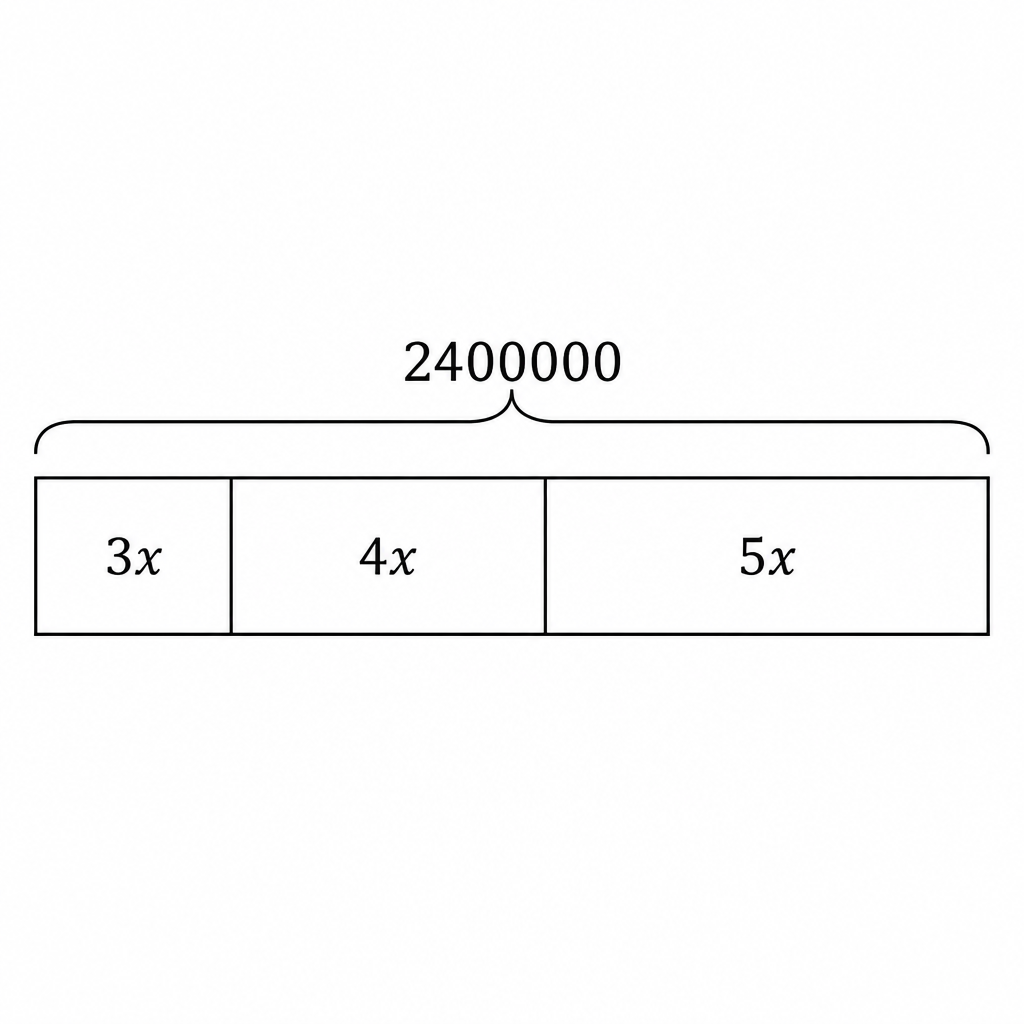
Step 1: First find how many parts there are altogether:
\[ 3 + 4 + 5 = 12 \]
Step 2: Dolma gets 3 of the 12 parts, so her income is:
\[ \frac{3}{12} \times 2400000 = 600000 \]
Step 3: Ramvilas gets 4 parts, so his income is:
\[ \frac{4}{12} \times 2400000 = 800000 \]
Step 4: Sonam gets 5 parts, so his income is:
\[ \frac{5}{12} \times 2400000 = 1000000 \]
In the second method the three incomes are taken as 3x, 4x and 5x and added. From \( 3x + 4x + 5x = 2400000 \) we get \( 12x = 2400000 \), which gives \( x = 200000 \). The three incomes are then Rs 6,00,000, Rs 8,00,000 and Rs 10,00,000. They add back to Rs 24,00,000, so the answer is right.
Proportion
Fold one sheet of paper into 3 equal parts and colour one part. Fold a second sheet of the same size into 6 equal parts and colour two parts. On the first sheet the coloured part compared with the whole is 1:3, and on the second it is 2:6. Reduce 2:6 to its lowest terms and it becomes 1:3, and sure enough the same amount of paper is coloured on both sheets.
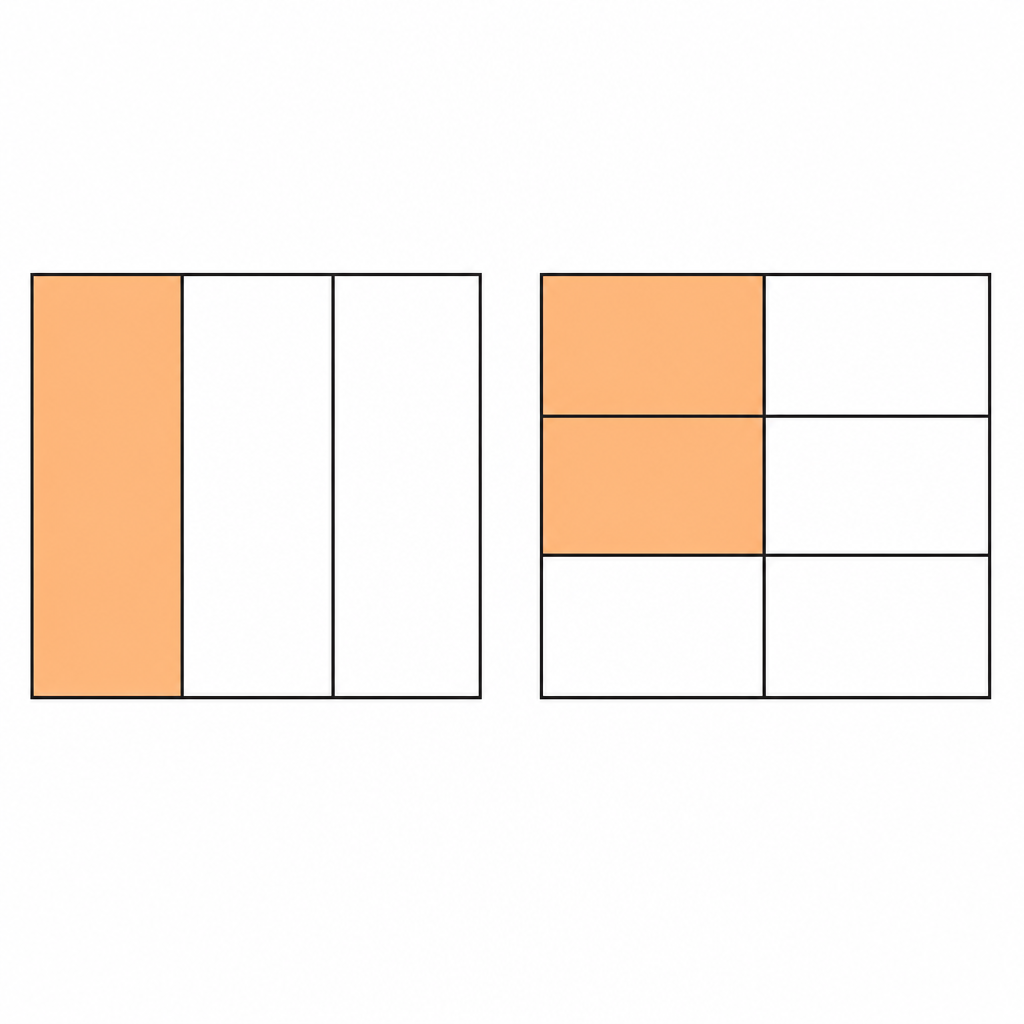
When the lowest terms of two ratios are equal, the two ratios are said to be in proportion. If the ratio of a to b equals the ratio of c to d, then a, b, c and d are in proportion, and this is written as a:b::c:d.
Extremes and Means
The four terms of a proportion have names of their own, and the names come from where each term sits. The two outer terms and the two inner terms play different roles.
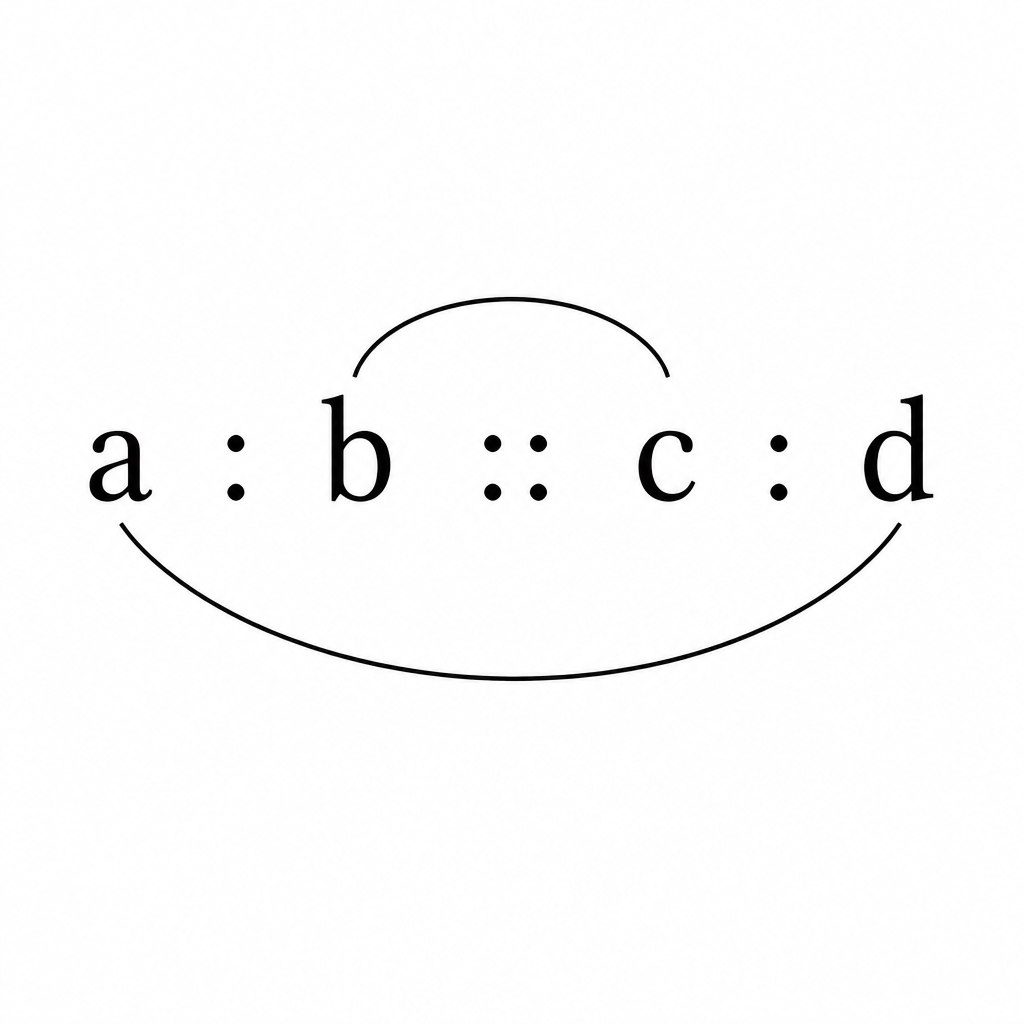
In the proportion a:b::c:d, the first and the last terms, that is a and d, are called the Extremes.
In the proportion a:b::c:d, the two middle terms, that is b and c, are called the Means.
The product of the Extremes always equals the product of the Means. This is the quick way to test whether four numbers are in proportion.
\[ a \times d = b \times c \]
Take an example. If 5, 8, 10, a are in proportion, what is the value of a? Step 1: The first ratio equals the second ratio, so:
\[ \frac{5}{8} = \frac{10}{a} \]
Step 2: Here the Extremes are 5 and a, and the Means are 8 and 10. Setting the two products equal:
\[ 5 \times a = 8 \times 10 \]
Step 3: Dividing both sides by 5 gives the value of a:
\[ a = \frac{80}{5} = 16 \]
When you multiply the Extremes, the first term must be paired with the last term. In 5, 8, 10, a it is wrong to multiply 5 by 10, because 10 is the third term sitting at the top of the second ratio, not the partner of 5.
The Number that Must Be Added to Change a Ratio
What number added to both 4 and 5 makes their ratio 5:6? The same number goes into both places, and that unknown number is what we have to find.
Step 1: Let the number to be added be y. After adding, the ratio has to be 5:6, so:
\[ \frac{4+y}{5+y} = \frac{5}{6} \]
Step 2: Cross multiplying:
\[ 6(4+y) = 5(5+y) \]
Step 3: Opening the brackets:
\[ 24 + 6y = 25 + 5y \]
Step 4: Bringing the y terms to one side:
\[ y = 1 \]
So 1 must be added to both 4 and 5. Checking, the new numbers are 5 and 6, and their ratio is indeed 5:6.
Using a Proportion to Find an Unknown Quantity
If Rs 150 buys 12 bananas, how many bananas will Rs 900 buy? As the money goes up the number of bananas goes up at the same rate, so the ratio of the amounts of money equals the ratio of the numbers of bananas. The table below shows which number pairs with which.
| Money (Rs) | Number of bananas |
| 150 | 12 |
| 900 | x |
Step 1: Let Rs 900 buy x bananas. Setting the two ratios equal:
\[ \frac{150}{900} = \frac{12}{x} \]
Step 2: Cross multiplying:
\[ 150x = 900 \times 12 \]
Step 3: Dividing both sides by 150:
\[ x = \frac{10800}{150} = 72 \]
So Rs 900 buys 72 bananas.
Take one more. A tea seller mixes milk and water in the ratio 3:5. For two glasses of tea he used 300 ml of milk. How many millilitres of water did he use? Step 1: Let the water be x ml. Milk and water are in the ratio 3:5, so:
\[ \frac{300}{x} = \frac{3}{5} \]
Step 2: Cross multiplying:
\[ 3x = 300 \times 5 \]
Step 3: Dividing both sides by 3:
\[ x = \frac{1500}{3} = 500 \]
So the tea seller used 500 ml of water.
Do not forget to write the unit ml in the answer.
Telling a Ratio from a Proportion
A ratio and a proportion look alike, but they are two different things. A ratio is a comparison of two quantities, while a proportion is a statement that two ratios are equal. The table sets the difference out.
| Point | Ratio | Proportion |
| How many terms | Two terms, as in a:b | Four terms, as in a:b::c:d |
| What it says | A comparison of two quantities | That two ratios are equal |
| Symbol | One colon : | A double colon :: in the middle |
| How to test it | Put both in one unit and divide | Compare the products of the Extremes and the Means |
For instance 3:4 is a ratio. But 3:4::6:8 is a proportion, because \( 3 \times 8 = 24 \) and \( 4 \times 6 = 24 \) are equal. Seen this way, every proportion has two ratios hidden inside it.
The full lesson is waiting for you
The notes are free to read in full. A free account opens the rest of the practice, and tracks your progress and confidence score for every subject. Presentations and videos need approval from Learn Yeti.