Numbers That Can Be Written as a Fraction
An average Nepali adult is about \( \frac{21}{4} \) feet tall. A runner covers 200 m in one minute. At sea level water freezes at \( 0^\circ \)C. Each of these three numbers, \( \frac{21}{4} \), 200 and 0, can be written as one integer divided by another integer. That single test decides whether a number belongs to the rational family.
Rational number: a number that can be written in the form \( \frac{a}{b} \), where \( a \) and \( b \) are integers and \( b \neq 0 \). For example 2, 5, \( -7 \), \( \frac{5}{8} \), 2.13 and \( 1.\overline{6} \) are rational numbers.
Every integer is already a rational number, because you may give it a denominator of 1. So \( 5 = \frac{5}{1} \), \( -1 = \frac{-1}{1} \) and \( 0 = \frac{0}{1} \). The same rational number can be written in many equal forms, such as \( 2 = \frac{2}{1} = \frac{4}{2} = \frac{6}{3} \). The denominator is never zero, because dividing by zero is not allowed. A negative fraction such as \( \frac{-4}{7} \) is rational too.
Three Kinds of Decimal Number
Dividing the numerator of a fraction by its denominator always gives a decimal, and that decimal is one of three kinds. In \( \frac{4}{5} = 0.8 \) the division stops, so it is a terminating decimal number. In \( \frac{5}{3} = 1.666\ldots \) the division never stops but one digit repeats for ever, so it is a non terminating recurring decimal number. In \( \frac{4}{7} = 0.\overline{571428} \) a block of six digits repeats, so this one is recurring as well.
The third kind never comes out of dividing a whole number by a whole number. Such a decimal never stops, and no digit or block of digits settles into a repeating pattern, for example 2.134… . It is called a non terminating and non recurring decimal number.
| Kind of decimal | Example | As a fraction |
| Terminating | \( \frac{4}{5} = 0.8 \) | Possible |
| Non terminating recurring | \( \frac{5}{3} = 1.\overline{6} \) | Possible |
| Non terminating and non recurring | \( 2.134\ldots \) | Not possible |
The first two kinds can be turned back into fractions, so they are rational numbers. The third kind cannot, and that is exactly where a new family of numbers begins.
Irrational Numbers
Some square roots come out neatly. The square root of 4 is 2, and \( 2 = \frac{2}{1} \) can be written as a fraction, so \( \sqrt{4} \) is rational. In the same way the square root of \( \frac{4}{9} \) is \( \frac{2}{3} \), the decimal 0.25 can be written as \( \frac{25}{100} \), and \( 4.666\ldots \) can be written as \( \frac{42}{9} \). All of these are rational.
But the square root of 2 is \( 1.41421356\ldots \). This decimal neither stops nor settles into a repeating pattern, so it cannot be written in the form \( \frac{a}{b} \). The value of \( \pi \), which is \( 3.1415926\ldots \), behaves in the same way. Numbers like these are called irrational numbers.
Irrational number: a number that cannot be expressed in the form \( \frac{a}{b} \). Every non terminating and non recurring decimal belongs to this family. Examples are \( \sqrt{2} \), \( \sqrt{5} \), \( \sqrt[3]{10} \), \( \sqrt{\frac{1}{3}} \), \( \sqrt{7} \), \( 2.134\ldots \) and \( \pi \).
Do not call a number irrational just because it carries a root sign. \( \sqrt{4} = 2 \), \( \sqrt{169} = 13 \) and \( \sqrt{\frac{4}{9}} = \frac{2}{3} \) are all rational. Work the root out first, then decide.
\( \frac{22}{7} \) is rational and \( \pi \) is irrational. Even so, \( \frac{22}{7} \) is used in place of \( \pi \) when working sums, because \( \frac{22}{7} = 3.142857\ldots \) sits very close to the value of \( \pi \). It is a convenient approximation, never an exact equal.
Turning a Recurring Decimal into a Fraction
The key to changing a recurring decimal into a fraction is subtraction. Make two statements that carry the same repeating tail, then subtract, and the tail cancels itself out. Let us write \( 0.\overline{3} \) as a fraction.
Step 1: Call the number \( x \) and write it out as a decimal:
\[ x = 0.333\ldots \quad \text{(i)} \]
Step 2: Only one digit repeats, so multiply both sides by 10:
\[ 10x = 3.333\ldots \quad \text{(ii)} \]
Step 3: Subtracting (i) from (ii) makes the decimal tail disappear:
\[ 10x - x = 3.333\ldots - 0.333\ldots \]
Step 4: Simplifying both sides:
\[ 9x = 3 \]
Step 5: Dividing both sides by 9 and reducing the fraction:
\[ x = \frac{3}{9} = \frac{1}{3} \]
Step 6: The answer:
\[ 0.\overline{3} = \frac{1}{3} \]
Now take \( 0.\overline{41} \), where two digits repeat. Multiplying by 10 would not line the tails up, so multiply by 100 instead.
Step 1: Call the number \( x \):
\[ x = 0.4141\ldots \quad \text{(i)} \]
Step 2: Two digits repeat, so multiply by 100:
\[ 100x = 41.4141\ldots \quad \text{(ii)} \]
Step 3: Subtracting (i) from (ii):
\[ 99x = 41 \]
Step 4: Dividing by 99 gives the fraction:
\[ x = \frac{41}{99} \]
One repeating digit needs a multiplier of 10, two repeating digits need 100 and three repeating digits need 1000. The number of zeros after the 1 matches the number of repeating digits.
The Family of Real Numbers
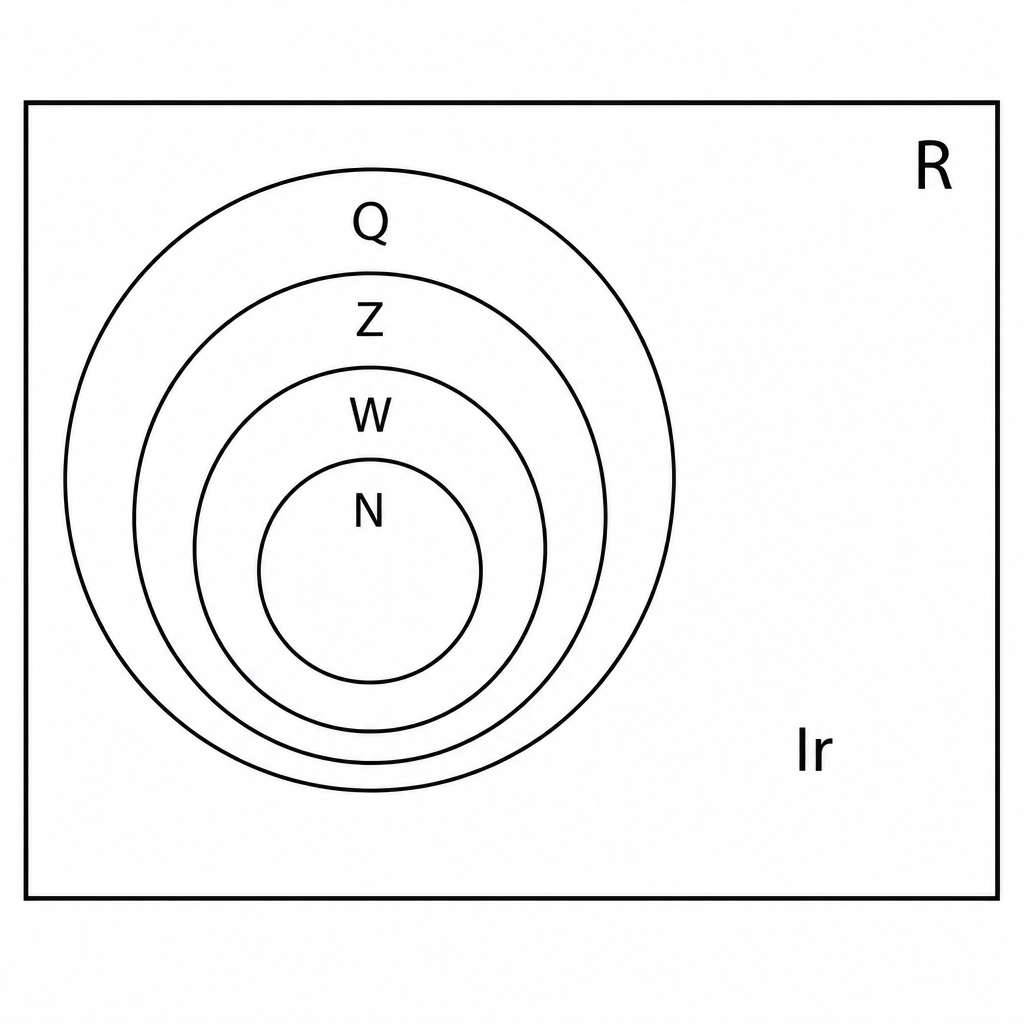
The counting numbers are called natural numbers and are written \( N = \{1, 2, 3, \ldots\} \). Adding zero to them gives the set of whole numbers \( W \). Bringing in the negative numbers gives the set of integers \( Z \). Integers together with fractions make the set of rational numbers \( Q \), and the set of irrational numbers is written \( Ir \).
\( Q \) and \( Ir \) are separate sets with no member in common. Put together they form the set of real numbers, written \( R \). Every number that can be shown on the number line is a real number. In set notation the relationship between these sets is written as follows.
\[ N \subseteq W \subseteq Z \subseteq Q \subseteq R \]
\[ Ir \subseteq R \]
| Set | Symbol | Example members |
| Natural numbers | \( N \) | 1, 2, 3, … |
| Whole numbers | \( W \) | 0, 1, 2, 3, … |
| Integers | \( Z \) | …, \( -2 \), \( -1 \), 0, 1, 2, … |
| Rational numbers | \( Q \) | \( \frac{4}{7} \), \( -1 \), 0.75, \( 0.\overline{3} \) |
| Irrational numbers | \( Ir \) | \( \sqrt{2} \), \( \sqrt{5} \), \( \pi \) |
| Real numbers | \( R \) | every member of \( Q \) and of \( Ir \) |
Showing the Square Root of 2 on the Number Line
Integers are easy to place on the number line, but where exactly does \( 1.41421356\ldots \) go? Measuring with a ruler always leaves a little error. The Pythagoras theorem gives the exact place, because a right angled triangle whose two shorter sides are 1 unit each has a hypotenuse of exactly \( \sqrt{2} \).
Step 1: Draw a number line, call the origin O, and mark the point A one unit to the right of it.
Step 2: At A, stand a perpendicular AB of length 1 unit above the number line. Triangle OAB is now a right angled triangle.
Step 3: Write the Pythagoras theorem for a right angled triangle:
\[ p^2 + b^2 = h^2 \]
Step 4: Here the perpendicular \( p = 1 \) and the base \( b = 1 \), so:
\[ h^2 = 1^2 + 1^2 = 2 \]
Step 5: Taking the square root of both sides gives the length of the hypotenuse OB:
\[ h = \sqrt{2} \]
Step 6: Put the compass point on O, open it to the length OB, and cut an arc. Name D the point where the arc meets the number line. Since \( OD = OB = \sqrt{2} \), the point D is exactly where \( \sqrt{2} \) sits on the number line.
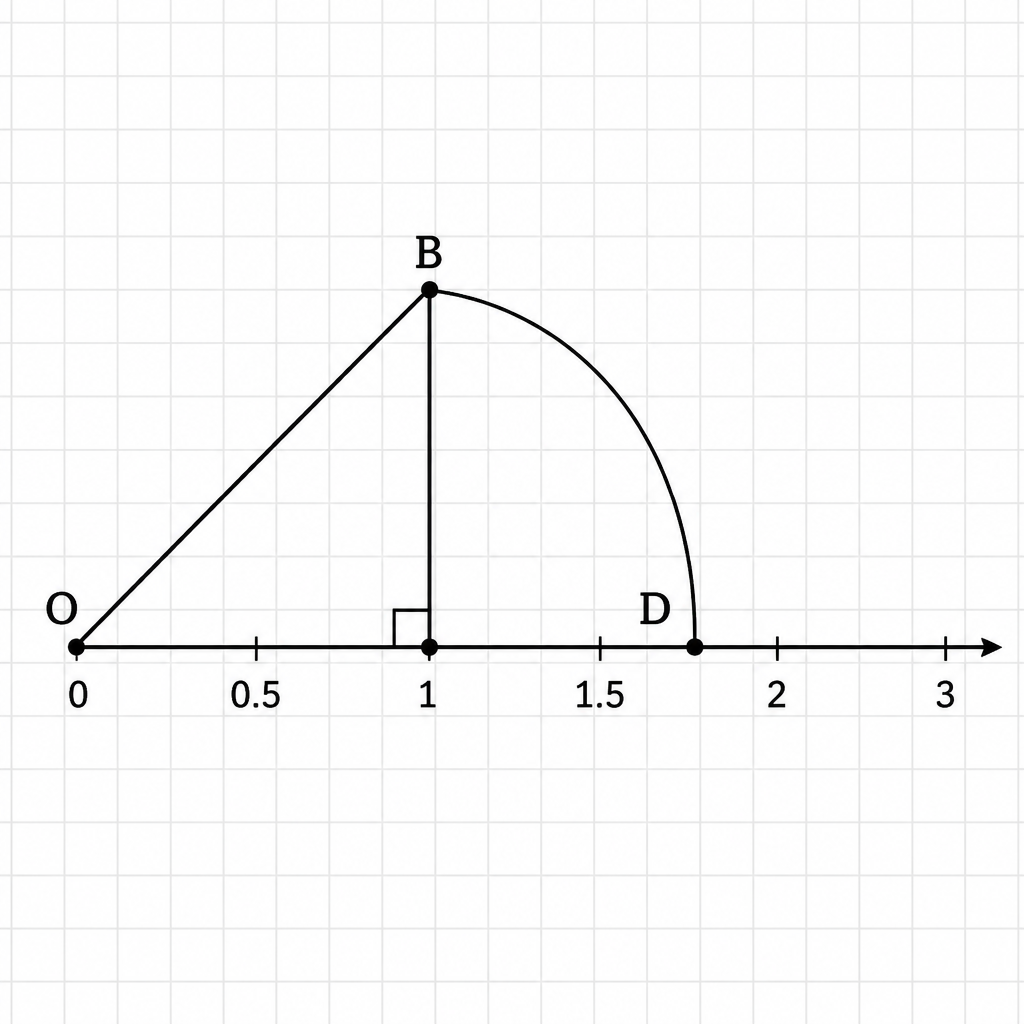
Do not let the compass opening change while you swing the arc. If the radius shifts even slightly, the point D moves and the mark no longer lands on \( \sqrt{2} \).
Showing the Square Root of 3 on the Number Line
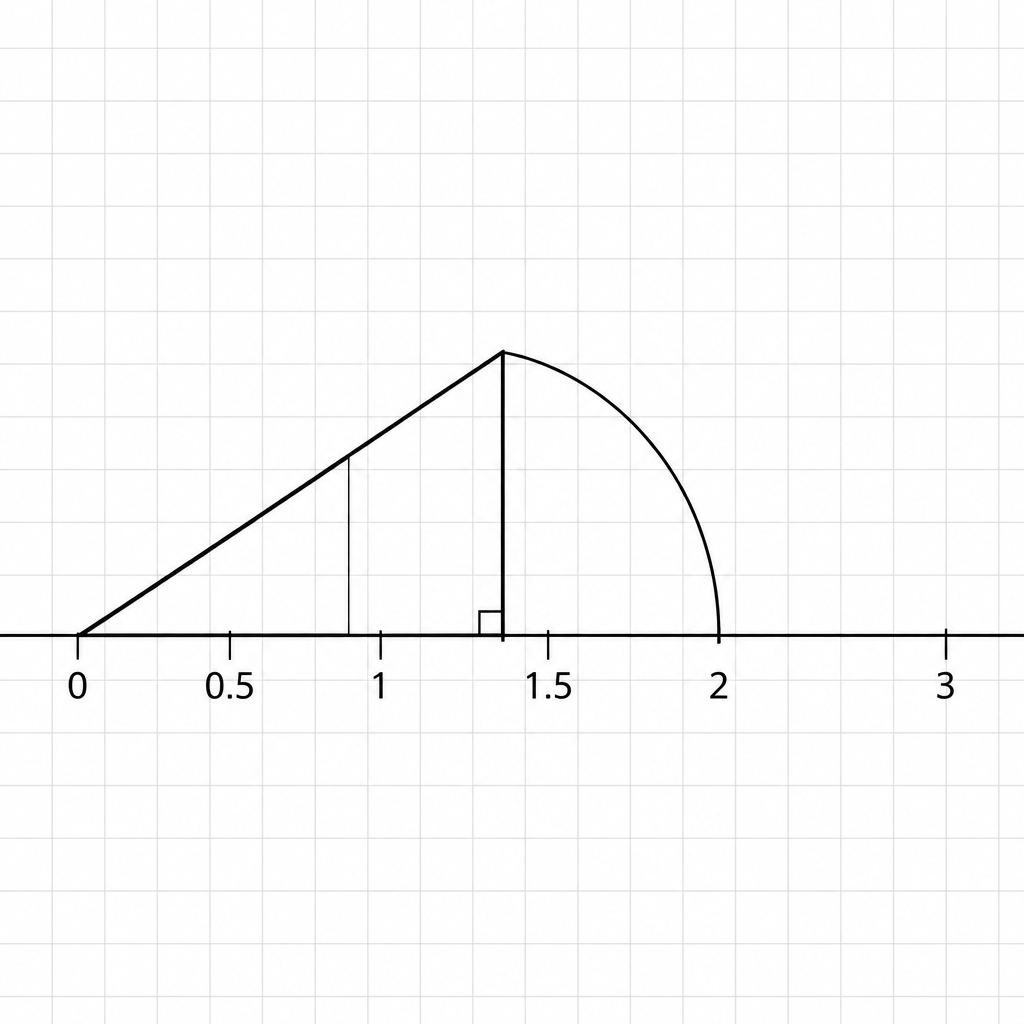
Once \( \sqrt{2} \) is fixed, a second right angled triangle built on it gives \( \sqrt{3} \). The hypotenuse of the first triangle becomes the base of the new one.
Step 1: Take the point D that marks \( \sqrt{2} \) on the number line and stand a perpendicular DE of 1 unit at that point.
Step 2: In the right angled triangle ODE the base is \( \sqrt{2} \) and the perpendicular is 1, so by the Pythagoras theorem:
\[ OE^2 = (\sqrt{2})^2 + 1^2 \]
Step 3: Working out the squares:
\[ OE^2 = 2 + 1 = 3 \]
Step 4: Taking the square root gives the hypotenuse:
\[ OE = \sqrt{3} \]
Step 5: Open the compass to OE and cut an arc from O. The point where the arc meets the number line is \( \sqrt{3} \). Carrying the same chain further gives \( \sqrt{4} \), \( \sqrt{5} \), \( \sqrt{6} \) and so on.
Scientific Notation of Numbers
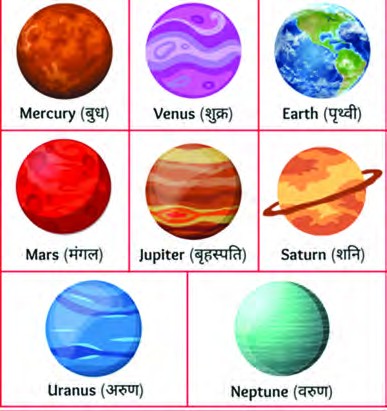
Mercury is the planet closest to the Sun, and its distance is 57,910,000 km. Neptune, the farthest one, is 4,495,060,000 km away. Numbers this long are hard to count out, and dropping a single zero makes the answer ten times wrong. So a short way of writing them is needed.
| Planet | Average distance (km) | Scientific notation |
| Mercury | 57,910,000 | \( 5.791 \times 10^{7} \) |
| Venus | 108,210,000 | \( 1.0821 \times 10^{8} \) |
| Earth | 149,600,000 | \( 1.496 \times 10^{8} \) |
| Mars | 227,920,000 | \( 2.2792 \times 10^{8} \) |
| Jupiter | 778,570,000 | \( 7.7857 \times 10^{8} \) |
| Saturn | 1,433,530,000 | \( 1.43353 \times 10^{9} \) |
| Uranus | 2,872,460,000 | \( 2.87246 \times 10^{9} \) |
| Neptune | 4,495,060,000 | \( 4.49506 \times 10^{9} \) |
Scientific notation: a way of writing a number as a number with a single digit before the decimal point, multiplied by a power of 10. It is used to express very large and very small numbers.
The mass of the Earth is 5,972,000,000,000,000,000,000,000 kg. Breaking it up gives 5.972 multiplied by a power of 10 with twenty four zeros, that is \( 5.972 \times 10^{24} \) kg. The mass of one hydrogen atom is \( 1.673 \times 10^{-27} \) kg. The same notation carries both the mountain sized number and the dust sized one.
Now write 0.00037 in scientific notation. For small numbers the power of 10 comes out negative.
Step 1: Write the decimal as a fraction:
\[ 0.00037 = \frac{37}{100000} \]
Step 2: Write the numerator with a single digit before the point and the denominator as a power of 10:
\[ = \frac{3.7 \times 10^{1}}{10^{5}} \]
Step 3: Using the index law \( \frac{x^m}{x^n} = x^{m-n} \):
\[ = 3.7 \times 10^{1-5} \]
Step 4: Simplifying the index gives the answer:
\[ = 3.7 \times 10^{-4} \]
Only one digit may stand before the decimal point. Writing 57,910,000 as \( 57.91 \times 10^{6} \) is not scientific notation. The correct form is \( 5.791 \times 10^{7} \).
Writing a Scientific Notation Back as a Decimal
To go the other way, first write the power of 10 out in full, then multiply or divide. In \( 6.3 \times 10^{3} \) we have \( 10^{3} = 1000 \), so \( 6.3 \times 1000 = 6300 \). A negative index has to be taken to the denominator. Take \( 7.4 \times 10^{-5} \).
Step 1: Move the negative index down to the denominator:
\[ 7.4 \times 10^{-5} = \frac{7.4}{10^{5}} \]
Step 2: Write the power of 10 out in full:
\[ = \frac{7.4}{100000} \]
Step 3: Dividing moves the decimal point five places to the left:
\[ = 0.000074 \]
Simplifying Numbers Written in Scientific Notation
Before adding or subtracting, the two numbers must carry the same power of 10. Once they match, take the common power outside and work only on the numbers in front. Simplify \( 3.4 \times 10^{2} + 4.57 \times 10^{3} \).
Step 1: Rewrite the term with the smaller index so that it carries the larger one:
\[ 3.4 \times 10^{2} = 0.34 \times 10^{3} \]
Step 2: Both terms now carry the same index:
\[ 0.34 \times 10^{3} + 4.57 \times 10^{3} \]
Step 3: Taking the common power of 10 outside:
\[ = (0.34 + 4.57) \times 10^{3} \]
Step 4: Adding inside the bracket gives the answer:
\[ = 4.91 \times 10^{3} \]
Subtraction follows the same habit. In \( 4.54 \times 10^{-3} - 2.4 \times 10^{-3} \) the indices already match, so the answer is \( (4.54 - 2.4) \times 10^{-3} = 2.14 \times 10^{-3} \).
For multiplication and division the indices need not be made equal. Multiply or divide the front numbers, and handle the powers of 10 with the index laws. Take \( (2.0 \times 10^{3}) \times (4.12 \times 10^{4}) \).
Step 1: Group the front numbers together and the powers of 10 together:
\[ = (2.0 \times 4.12) \times (10^{3} \times 10^{4}) \]
Step 2: Applying \( x^m \times x^n = x^{m+n} \):
\[ = 8.24 \times 10^{3+4} \]
Step 3: Adding the indices gives the answer:
\[ = 8.24 \times 10^{7} \]
For division, \( \frac{9.60 \times 10^{7}}{1.60 \times 10^{4}} \) is written as \( \frac{9.60}{1.60} \times 10^{7-4} \), which gives \( 6 \times 10^{3} \). The law used here is \( \frac{x^m}{x^n} = x^{m-n} \).
Make the indices equal before adding or subtracting. Add the indices when multiplying and subtract them when dividing. When the answer is written down, keep exactly one digit before the decimal point.
The full lesson is waiting for you
The notes are free to read in full. A free account opens the rest of the practice, and tracks your progress and confidence score for every subject. Presentations and videos need approval from Learn Yeti.