Base, Digits and Place Value
When we count from day to day we use only ten digits: 0, 1, 2, 3, 4, 5, 6, 7, 8 and 9. Once those ten are used up we do not invent a new symbol. We move to a new place instead, and the place decides how much a digit is worth. Look at 1256. The 6 stands for ones, the 5 stands for tens, the 2 stands for hundreds and the 1 stands for thousands. The same digit is worth different amounts in different places.
| Thousands | Hundreds | Tens | Ones |
| \( 10^3 \) | \( 10^2 \) | \( 10^1 \) | \( 10^0 \) |
| 1 | 2 | 5 | 6 |
The second row shows what each place is worth, written as a power of 10. Ones are \( 10^0 \), tens are \( 10^1 \), hundreds are \( 10^2 \) and thousands are \( 10^3 \). Using those powers we can open a number out and see what it is made of. Writing 1256 in expanded form:
\[ 1256 = 1\times 1000 + 2\times 100 \]
\[ +\ 5\times 10 + 6\times 1 \]
\[ = 1\times 10^3 + 2\times 10^2 \]
\[ +\ 5\times 10^1 + 6\times 10^0 \]
Decimal numeration system: the way of writing numbers that uses the ten digits from 0 to 9, with place values \( 10^0, 10^1, 10^2, 10^3 \) and so on.
That raises a question. Why ten digits, and not some other number of them? What happens if we choose a different base? This is exactly where the binary and quinary systems begin. The number that becomes the base of the powers is called the base of that system, and the base of the decimal system is 10.
Base: the number whose powers make the place values of a system. With base 10 the places are \( 10^0, 10^1, 10^2 \), and with base 2 they are \( 2^0, 2^1, 2^2 \).
The Binary Number System
When we switch on a lamp at home the switch is either closed or open. An electrical circuit has only these two states. When the switch is on the lamp lights, and when it is off the lamp goes dark. There is no third state.
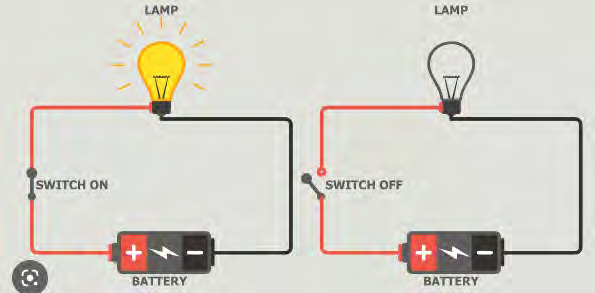
Instead of writing these two states in words we can write them as symbols. Let the lit state be 1 and the dark state be 0. Two digits are then enough to say everything.

From the numbers 0 up to 150 in the decimal system, pick out only those written with 1 and 0. They are 0, 1, 10, 11, 100, 101, 110, 111. Counting these in order and setting them beside the decimal numbers shows how counting works in the binary system.
| Binary | Decimal |
| 1 | 1 |
| 10 | 2 |
| 11 | 3 |
| 100 | 4 |
| 101 | 5 |
| 110 | 6 |
| 111 | 7 |
| 1000 | 8 |
| 1001 | 9 |
| 1010 | 10 |
Binary Number System: the way of writing numbers that uses only the two digits 0 and 1. Counting in it goes 1, 10, 11, 100, 101 and so on.
Do not read \( 10_2 \) as ten. It is read as one zero, base two, and its value is two. Never leave out the small 2 written after a binary number. Without it a reader will take the number to be a decimal one.
Place Value and Expanded Form in Base Two
Where the decimal system has ones, tens, hundreds and thousands, the binary system has ones, twos, fours, eights, sixteens and thirty twos. The place values are powers of 2 instead of powers of 10.
| Sixteens | Eights | Fours | Twos | Ones |
| \( 2^4 \) | \( 2^3 \) | \( 2^2 \) | \( 2^1 \) | \( 2^0 \) |
| 16 | 8 | 4 | 2 | 1 |
Using this table any binary number can be written in expanded form. Working from the right towards the left, multiply each digit by the value of its place.
\[ 1_2 = 1\times 2^0 \]
\[ 10_2 = 1\times 2^1 + 0\times 2^0 \]
\[ 11_2 = 1\times 2^1 + 1\times 2^0 \]
\[ 100_2 = 1\times 2^2 + 0\times 2^1 + 0\times 2^0 \]
\[ 101_2 = 1\times 2^2 + 0\times 2^1 + 1\times 2^0 \]
A place that holds a zero is still written down. Even though \( 0\times 2^1 \) is worth nothing, dropping that place would slide the other digits along and change the number completely.
Changing a Decimal Number into Binary
There are two ways of doing this. The first way is to break the number into a sum of powers of 2. Take 27.
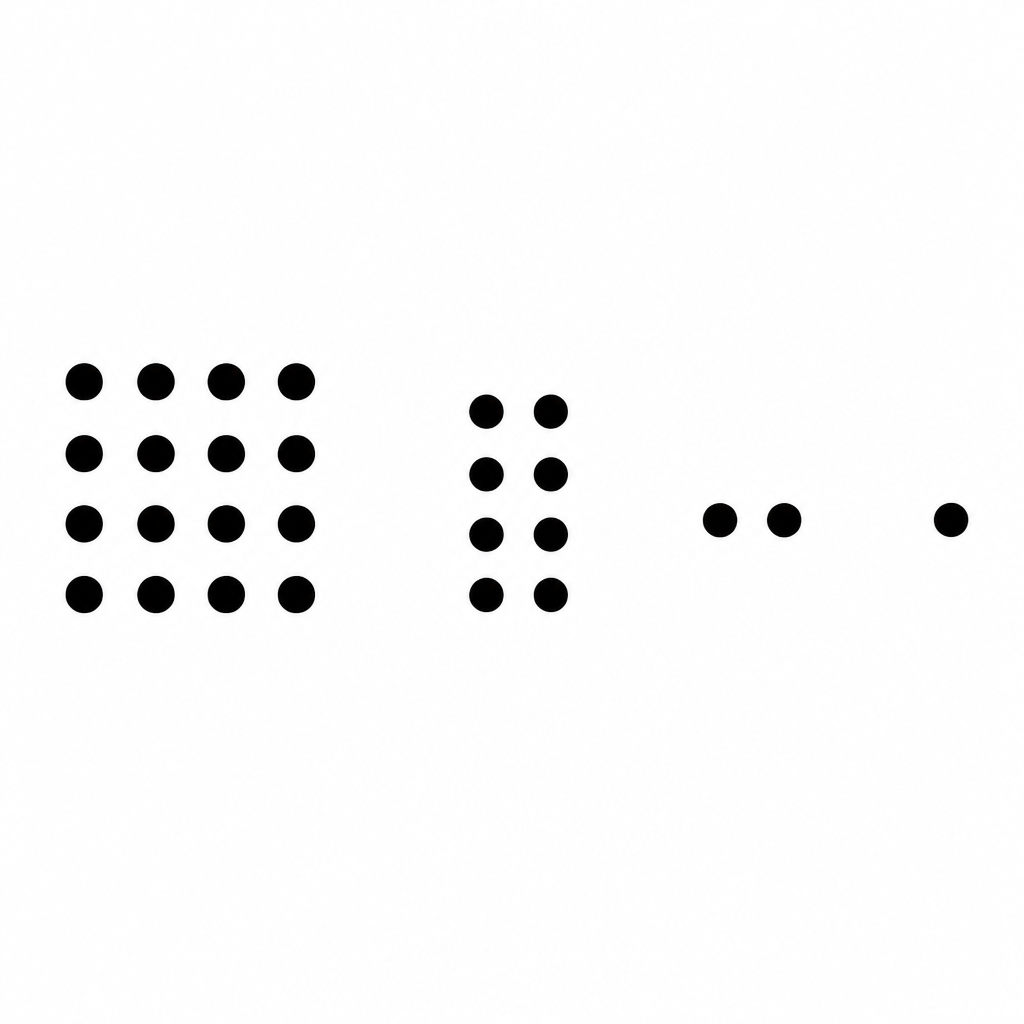
Step 1: The largest power of 2 that is not more than 27 is 16. Breaking up what is left in the same way:
\[ 27 = 16 + 8 + 2 + 1 \]
Step 2: Writing each part as a power of 2:
\[ 27 = 2^4 + 2^3 + 2^1 + 2^0 \]
Step 3: The \( 2^2 \) place is empty, so a 0 is put there to fill every place:
\[ 27 = 1\times 2^4 + 1\times 2^3 + 0\times 2^2 \]
\[ +\ 1\times 2^1 + 1\times 2^0 \]
Step 4: Writing the multipliers 1, 1, 0, 1, 1 in order:
\[ 27 = 11011_2 \]
The second way is by division, and for a large number it is much quicker. In base 10 a remainder can be anything from 0 to 9, but in base 2 the remainder can only be 0 or 1. So we keep dividing the number by 2 and keep the remainders. Take 25 into binary.
| Division | Quotient | Remainder |
| 25 ÷ 2 | 12 | 1 |
| 12 ÷ 2 | 6 | 0 |
| 6 ÷ 2 | 3 | 0 |
| 3 ÷ 2 | 1 | 1 |
| 1 ÷ 2 | 0 | 1 |
The division stops when the quotient becomes 0. Now the remainders are read from the bottom upwards, giving 1, 1, 0, 0, 1. So:
\[ 25 = 11001_2 \]
In the division method the remainders are always read from the bottom upwards. Read them downwards and the number comes out reversed, which makes the answer wrong.
Here is one more. Writing 43 in expanded form using powers of 2:
\[ 43 = 32 + 8 + 2 + 1 \]
\[ = 1\times 2^5 + 0\times 2^4 + 1\times 2^3 \]
\[ +\ 0\times 2^2 + 1\times 2^1 + 1\times 2^0 \]
\[ 43 = 101011_2 \]
Changing a Binary Number into Decimal
Going the other way is even easier. Write the binary number in expanded form using powers of 2 and then simplify it. Take \( 100101_2 \). It has six digits, so the places needed run from \( 2^5 \) down to \( 2^0 \).
| Place | Value in base ten | Digit | Product |
| \( 2^5 \) | 32 | 1 | 32 |
| \( 2^4 \) | 16 | 0 | 0 |
| \( 2^3 \) | 8 | 0 | 0 |
| \( 2^2 \) | 4 | 1 | 4 |
| \( 2^1 \) | 2 | 0 | 0 |
| \( 2^0 \) | 1 | 1 | 1 |
Adding up the products in the last column:
\[ 32 + 0 + 0 + 4 + 0 + 1 = 37 \]
\[ 100101_2 = 37 \]
The answer 37 is not given a base 10 label. The decimal system is our ordinary system, so its numbers are written with no base marked on them. Now take \( 1001_2 \).
\[ 1001_2 = 1\times 2^3 + 0\times 2^2 \]
\[ +\ 0\times 2^1 + 1\times 2^0 \]
\[ = 8 + 0 + 0 + 1 = 9 \]
A long number is no different. In \( 1001011_2 \) the places holding a 1 are \( 2^6, 2^3, 2^1 \) and \( 2^0 \), which are 64, 8, 2 and 1. Adding them:
\[ 1001011_2 = 64 + 8 + 2 + 1 = 75 \]
The Quinary Number System
Now move up from base 2 to base 5. From the decimal numbers 0 up to 59, pick out only those written with the digits 0, 1, 2, 3 and 4. Every number containing a 5, 6, 7, 8 or 9 drops out. What is left is 1, 2, 3, 4, 10, 11, 12, 13, 14, 20 and so on.
| Quinary | Decimal |
| 1 | 1 |
| 2 | 2 |
| 3 | 3 |
| 4 | 4 |
| 10 | 5 |
| 11 | 6 |
| 12 | 7 |
| 13 | 8 |
| 14 | 9 |
| 20 | 10 |
The table shows that in base five no new digit appears after four. As soon as we reach five the place changes and we write 10. That 10 is not ten, it is five. It works exactly like tying pens into bundles of five.

Quinary numeration system: the way of writing numbers that uses only the five digits 0, 1, 2, 3 and 4, with place values \( 5^0, 5^1, 5^2, 5^3 \) and so on.
Place Value and Expanded Form in Base Five
The place values in base 5 are ones, fives, twenty fives and one hundred and twenty fives. These are the powers of 5.
| One hundred twenty fives | Twenty fives | Fives | Ones |
| \( 5^3 \) | \( 5^2 \) | \( 5^1 \) | \( 5^0 \) |
| 125 | 25 | 5 | 1 |
Split 27 pens into bundles of five and you get five bundles with 2 pens left over. Tie those five bundles together into one bigger bundle and you get one bundle of twenty five. So 27 holds one twenty five, no fives and two ones.
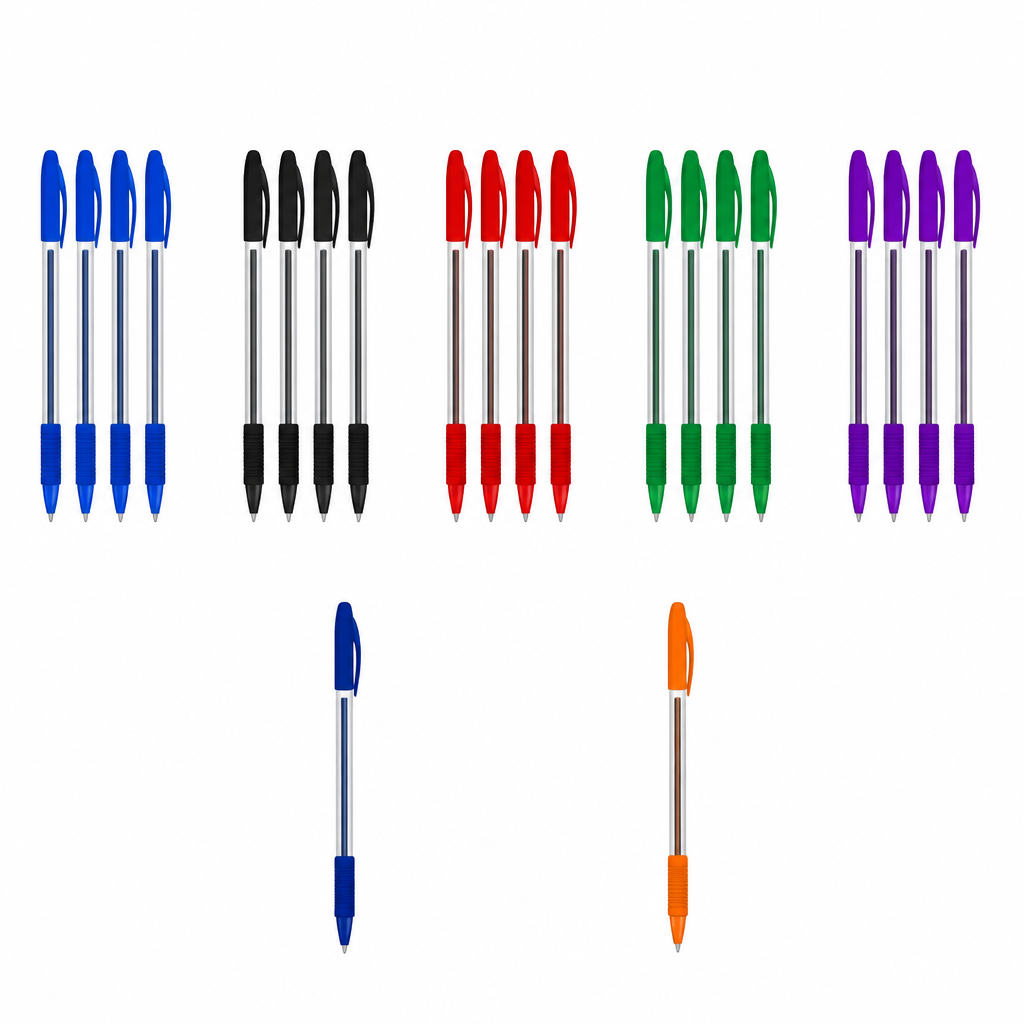
\[ 27 = 5 + 5 + 5 + 5 + 5 + 2 \]
\[ = 5\times 5 + 2 = 5^2 + 2 \]
\[ = 1\times 5^2 + 0\times 5^1 + 2\times 5^0 \]
The same work is done with a bigger number. Splitting 179 into groups that are powers of 5:
\[ 179 = 125 + 50 + 4 \]
\[ = 1\times 5^3 + 2\times 5^2 + 0\times 5^1 + 4 \]
\[ 179 = 1204_5 \]
Now write some base five numbers in expanded form. In \( 43_5 \) the 4 sits in the fives place and the 3 sits in the ones place.
\[ 43_5 = 4\times 5^1 + 3\times 5^0 \]
\[ 104_5 = 1\times 5^2 + 0\times 5^1 + 4\times 5^0 \]
\[ 1340_5 = 1\times 5^3 + 3\times 5^2 \]
\[ +\ 4\times 5^1 + 0\times 5^0 \]
Changing a Decimal Number into Base Five
Just as we divided by 2 for binary, here we keep dividing by 5. In base 5 a remainder can only be 0, 1, 2, 3 or 4, and those are exactly the digits of the system. Take 432 into base five.
Step 1: Dividing 432 by 5 gives this quotient and remainder:
\[ 432 \div 5 = 86 \text{ r } 2 \]
Step 2: Carrying the division on until the quotient becomes 0:
| Division | Quotient | Remainder |
| 432 ÷ 5 | 86 | 2 |
| 86 ÷ 5 | 17 | 1 |
| 17 ÷ 5 | 3 | 2 |
| 3 ÷ 5 | 0 | 3 |
Step 3: Reading the remainders from the bottom upwards gives 3, 2, 1, 2. So:
\[ 432 = 3212_5 \]
Now take 512. Here 512 ÷ 5 = 102 remainder 2, then 102 ÷ 5 = 20 remainder 2, then 20 ÷ 5 = 4 remainder 0, and 4 ÷ 5 = 0 remainder 4. Reading the remainders from the bottom upwards:
\[ 512 = 4022_5 \]
Checking an answer is easy. Open \( 4022_5 \) back out and you get \( 4\times 125 + 0 + 2\times 5 + 2 = 512 \). Make a habit of checking every conversion this way.
Changing a Base Five Number into Decimal
Here too we write the number in expanded form and simplify. Take \( 234_5 \).
Step 1: Multiplying each digit by the value of its place:
\[ 234_5 = 2\times 5^2 + 3\times 5^1 + 4\times 5^0 \]
Step 2: Putting in the value of each power of 5:
\[ = 2\times 25 + 3\times 5 + 4\times 1 \]
Step 3: Multiplying and then adding:
\[ = 50 + 15 + 4 = 69 \]
A longer number works in the same way. \( 142013_5 \) has six digits, so the places run from \( 5^5 \) down to \( 5^0 \).
\[ 1\times 5^5 + 4\times 5^4 + 2\times 5^3 \]
\[ +\ 0\times 5^2 + 1\times 5^1 + 3\times 5^0 \]
\[ = 3125 + 2500 + 250 + 0 + 5 + 3 \]
\[ 142013_5 = 5883 \]
Going from One Base to Another
There is no direct road from base five to base two. First bring the number into the decimal system, and only then take it on to the other base. The decimal system is the bridge between the two. Take \( 43_5 \) into binary.
Step 1: Writing \( 43_5 \) in expanded form:
\[ 43_5 = 4\times 5^1 + 3\times 5^0 \]
Step 2: Simplifying gives the value in the decimal system:
\[ = 20 + 3 = 23 \]
Step 3: Now divide 23 by 2 again and again. The remainders come out as 1, 1, 1, 0, 1. Reading them from the bottom upwards:
\[ 43_5 = 10111_2 \]
The same bridge is used in the other direction. To take \( 10011_2 \) into base five, first go to the decimal system:
\[ 10011_2 = 16 + 0 + 0 + 2 + 1 = 19 \]
Now divide 19 by 5. Here 19 ÷ 5 = 3 remainder 4, and 3 ÷ 5 = 0 remainder 3. Reading the remainders from the bottom upwards:
\[ 10011_2 = 34_5 \]
Telling Which System a Number Belongs To
The small base written after a number tells which system it belongs to. \( 1001_2 \) is binary and \( 4023_5 \) is quinary. A number with no base written on it is taken to be decimal, such as 350 and 257903.
The digits used also give a clue. A binary number can never contain a digit other than 0 or 1. A quinary number can never contain 5, 6, 7, 8 or 9. So 350 cannot be a base five number, because it contains a 5.
A number made only of 0 and 1 is not automatically binary. Written as 1001 with no base marked, it is the decimal number one thousand and one. The base decides, not the digits.
The full lesson is waiting for you
The notes are free to read in full. A free account opens the rest of the practice, and tracks your progress and confidence score for every subject. Presentations and videos need approval from Learn Yeti.