Shapes That Cover a Surface
Look carefully at a classroom floor, a brick wall and the ceiling of a hall. Each of these surfaces is covered by pieces of just a few shapes. The pieces are laid so that an edge of one piece lies along an edge of the next. No bare patch is left anywhere, and no piece climbs on top of another. Covering a whole surface by repeating shapes in this way is called a tessellation.
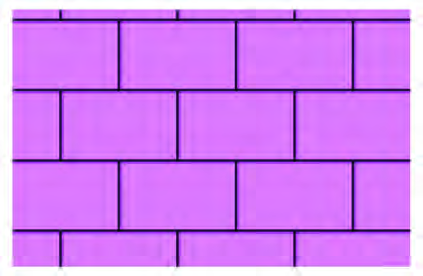
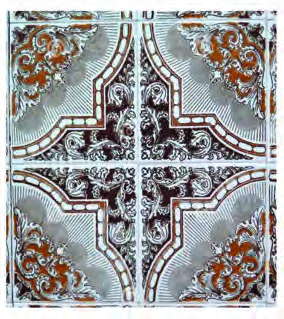
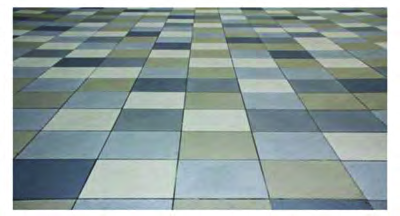
Not every repeating pattern is a tessellation. Equal circles can be packed as closely as you like, but small white gaps always survive between them. Because the surface is not completely covered, the pattern is not a tessellation.
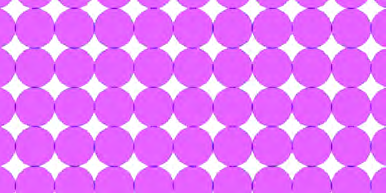
Tessellation: a covering of a surface made by repeating one or more shapes so that there is no gap left uncovered and no part where two shapes overlap.
The Angles That Meet at One Point
In a tessellation many corners crowd into one point. Turning once all the way round a point makes an angle of \( 360^\circ \). So the angles of all the corners meeting at that point must add to exactly \( 360^\circ \). If they add to less, a gap is left. If they add to more, the shapes overlap.
Every interior angle of a regular polygon is the same size. For a regular polygon with \( n \) sides, one interior angle is:
\[ \frac{(n-2) \times 180^\circ}{n} \]
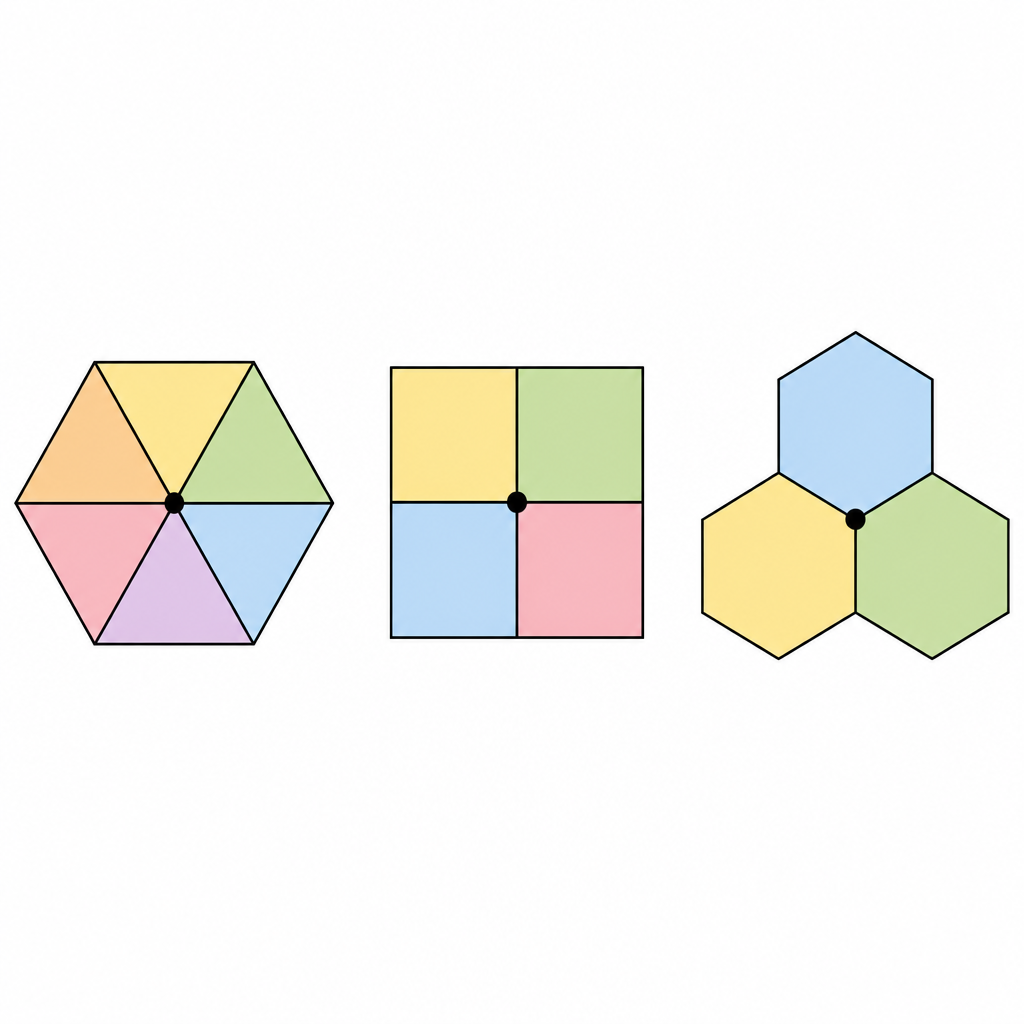
Let us test whether regular hexagons on their own can cover a surface.
Step 1: A hexagon has 6 sides, so putting \( n = 6 \) into the interior angle rule gives:
\[ \frac{(6-2) \times 180^\circ}{6} \]
Step 2: Working out the bracket first:
\[ \frac{4 \times 180^\circ}{6} = 120^\circ \]
Step 3: Now check whether \( 120^\circ \) divides \( 360^\circ \) exactly:
\[ 360^\circ \div 120^\circ = 3 \]
Step 4: Exactly three hexagons at one point fill the whole turn:
\[ 120^\circ + 120^\circ + 120^\circ = 360^\circ \]
The sum is exactly \( 360^\circ \), so regular hexagons on their own do cover a surface. The same test can be run on equilateral triangles and on squares.
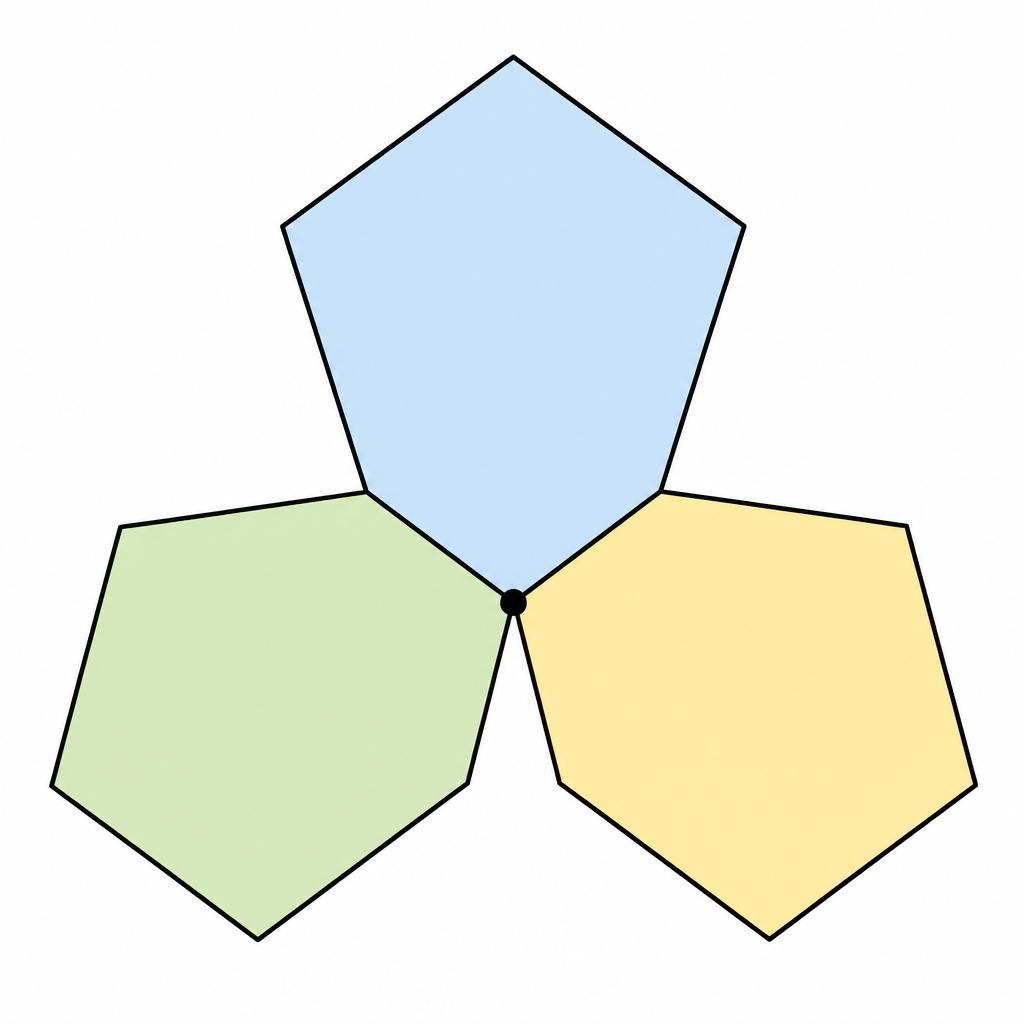
Not every regular polygon passes this test. A regular pentagon has an interior angle of \( 108^\circ \). Three pentagons at a point give \( 108^\circ \times 3 = 324^\circ \), which leaves a wedge of \( 360^\circ - 324^\circ = 36^\circ \) uncovered. A fourth pentagon will not fit into that wedge, it can only overlap. So regular pentagons alone never tessellate.
| Regular polygon | Sides | Interior angle | Covers alone? |
| Equilateral triangle | 3 | \( 60^\circ \) | Yes |
| Square | 4 | \( 90^\circ \) | Yes |
| Regular pentagon | 5 | \( 108^\circ \) | No |
| Regular hexagon | 6 | \( 120^\circ \) | Yes |
| Regular octagon | 8 | \( 135^\circ \) | No |
Regular Tessellation
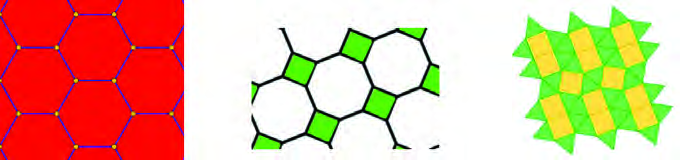
Cut many equal pieces of one shape out of coloured paper, starting with the equilateral triangle, and stick them on a chart paper so that no gap and no overlap is left. Do the same on two more chart papers, once with squares and once with regular hexagons. All three times the surface gets covered completely, and each covering uses only one kind of regular polygon.
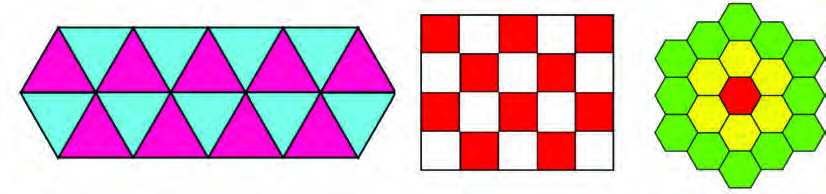
Regular tessellation: a tessellation built from copies of one single kind of regular polygon, for example a covering made only of equilateral triangles or only of squares.
Only three regular tessellations exist, because \( 60^\circ \), \( 90^\circ \) and \( 120^\circ \) are the only interior angles of regular polygons that divide \( 360^\circ \) exactly.
Naming a Tessellation with Numbers
A tessellation is named with numbers. Choose one point where several polygons meet, then write down the number of sides of every polygon whose corner touches that point, taken in order from the smallest number to the largest. A dot is placed after the side count of each polygon.
- Choose one point in the pattern where the corners of the polygons meet.
- Go once round that point and take the polygons touching it one after another.
- Write down the number of sides of each polygon, not the number of polygons.
- Set those numbers out from smallest to largest, separated by dots.
Take the covering made of equilateral triangles. Six triangles meet at each point, and every triangle has 3 sides, so the number 3 is written six times and the name is \( 3.3.3.3.3.3 \). The angle check agrees, since \( 60^\circ \times 6 = 360^\circ \). In the same way four squares meet at each point, giving the name \( 4.4.4.4 \), and three hexagons meet at each point, giving the name \( 6.6.6 \).
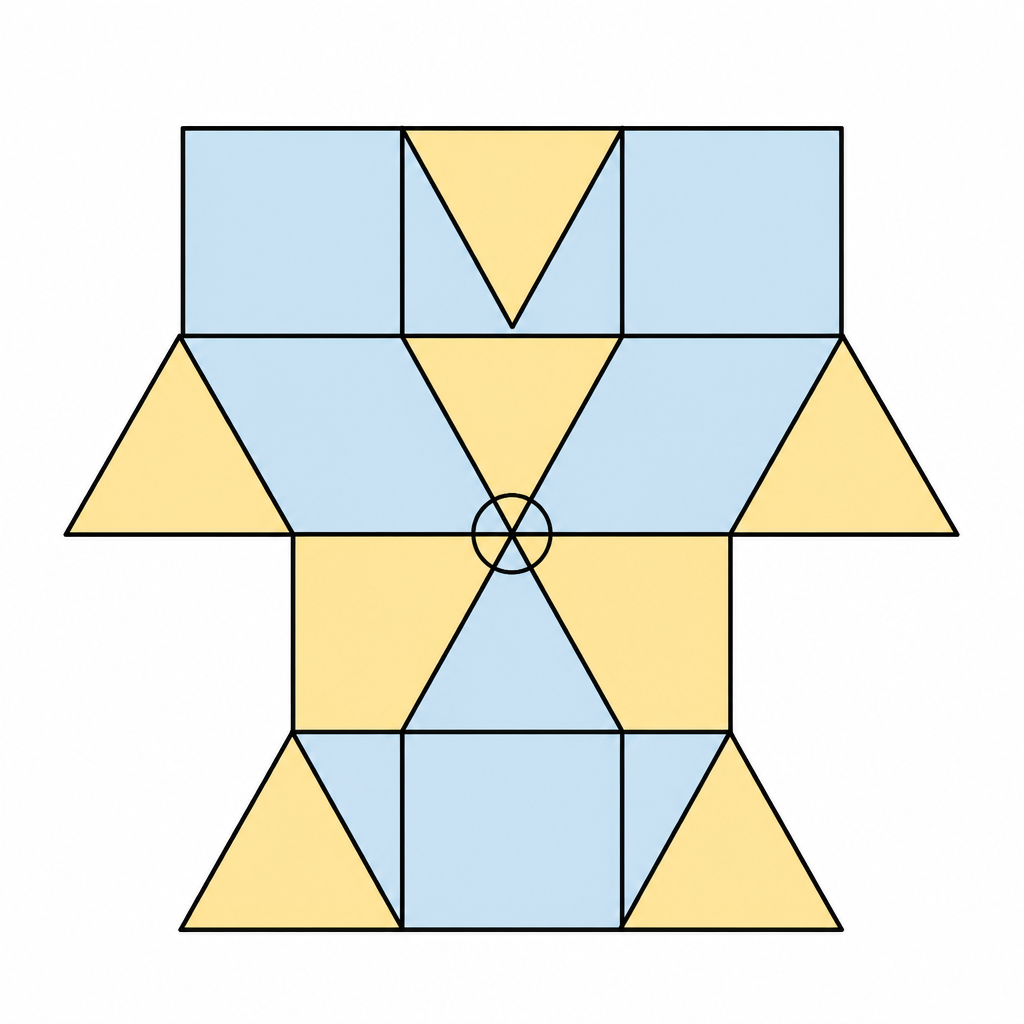
Write the number of sides, never the number of polygons. Three hexagons at a point give the name \( 6.6.6 \) and not \( 3.3.3 \). The numbers must also be set out from the smallest to the largest.
Semi-regular Tessellation
Now build one pattern from equilateral triangles together with squares, and another from regular hexagons together with equilateral triangles. Both patterns cover the surface with no gap and no overlap, but each of them uses two different regular polygons. A covering like this is called a semi-regular tessellation.
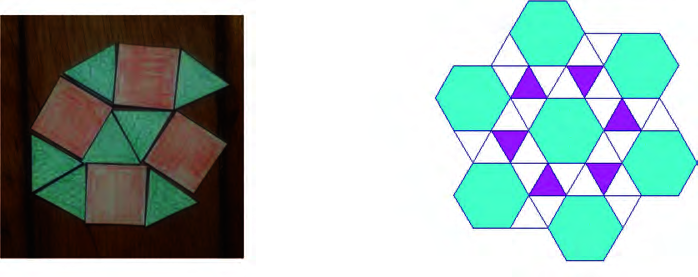
Semi-regular tessellation: a tessellation built from two or more different regular polygons, for example one made of equilateral triangles with squares, or one made of equilateral triangles with regular hexagons.
Name the pattern made of triangles and squares. At one point three triangles and two squares meet, and going round they come as triangle, triangle, square, triangle, square. The name is therefore \( 3.3.4.3.4 \). The angles agree, since \( 60^\circ + 60^\circ + 90^\circ + 60^\circ + 90^\circ = 360^\circ \). In the hexagon pattern four triangles and one hexagon meet at a point, so its name is \( 3.3.3.3.6 \), and the angles give \( 60^\circ \times 4 + 120^\circ = 360^\circ \).
In a semi-regular tessellation the same arrangement must repeat at every single corner. If one corner reads \( 3.3.4.3.4 \) while another corner is arranged differently, the covering is not semi-regular.
Finding a Missing Polygon from the Name
When some of the polygons at a point are known, the angle sum finds the rest. Suppose one corner of a semi-regular tessellation holds one square and two copies of the same regular polygon. Let us work out which polygon that is.
Step 1: A square contributes \( 90^\circ \), so the two remaining angles together must be:
\[ 360^\circ - 90^\circ = 270^\circ \]
Step 2: The two polygons are alike, so each interior angle is:
\[ 270^\circ \div 2 = 135^\circ \]
Step 3: To find how many sides \( n \) a regular polygon with a \( 135^\circ \) angle has, use the rule:
\[ \frac{(n-2) \times 180^\circ}{n} = 135^\circ \]
Step 4: Multiplying both sides by \( n \) and opening the bracket:
\[ 180n - 360 = 135n \]
Step 5: Taking \( 135n \) to the left and simplifying:
\[ 45n = 360 \]
Step 6: Dividing both sides by 45:
\[ n = 8 \]
The answer \( n = 8 \) shows the polygon is a regular octagon, so that tessellation is named \( 4.8.8 \). The same method works elsewhere. At a corner holding one equilateral triangle and two squares, the angle still missing is \( 360^\circ - 60^\circ - 90^\circ - 90^\circ = 120^\circ \), which belongs to a regular hexagon, and the covering is named \( 3.4.6.4 \).
Drawing a Tessellation on Grid Paper
A tessellation can be drawn by hand on dotted grid paper and on squared grid paper. The dots of a triangular grid sit at the corners of equilateral triangles, so hexagons and rhombuses grow easily there, while squares and shapes cut from squares grow easily on a squared grid.
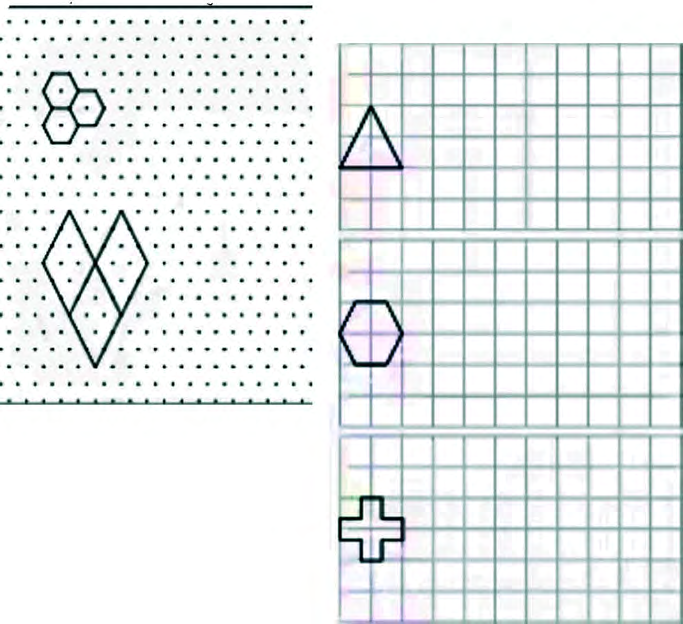
- Count how many dots or how many grid squares long each side of the starting shape is.
- Copy the shape beside the first one using exactly those measurements, with a whole side touching a whole side.
- Keep adding copies sideways until one full row is complete.
- Repeat that row above and below it until the drawing reaches the edge of the grid.
- Finally check the drawing for any gap left open or any place where two shapes overlap.
The Eleven Names That Work
Only eleven names are possible when tessellations are built from regular polygons. The first three of them are the regular tessellations and the other eight are semi-regular. Cutting pieces from thick paper and building any one of them makes a good display for a class exhibition.
\( 3.3.3.3.3.3 \) equilateral triangles only
\( 4.4.4.4 \) squares only
\( 6.6.6 \) regular hexagons only
\( 3.3.3.3.6 \) triangles and hexagons
\( 3.3.3.4.4 \) triangles and squares
\( 3.3.4.3.4 \) triangles and squares
\( 3.4.6.4 \) triangle, square and hexagon
\( 3.6.3.6 \) triangles and hexagons
\( 3.12.12 \) triangle and twelve sided polygons
\( 4.6.12 \) square, hexagon and twelve sided polygon
\( 4.8.8 \) square and two octagons
The full lesson is waiting for you
The notes are free to read in full. A free account opens the rest of the practice, and tracks your progress and confidence score for every subject. Presentations and videos need approval from Learn Yeti.