The Address of a Point on a Plane
On graph paper two number lines are laid so that they cut across each other. The line that runs across is called the X-axis, and it is written as XOX'. The line that stands upright is called the Y-axis, and it is written as YOY'. The point where the two axes cut each other is called the origin, and it is marked with the letter O. The origin is the place where all counting begins.
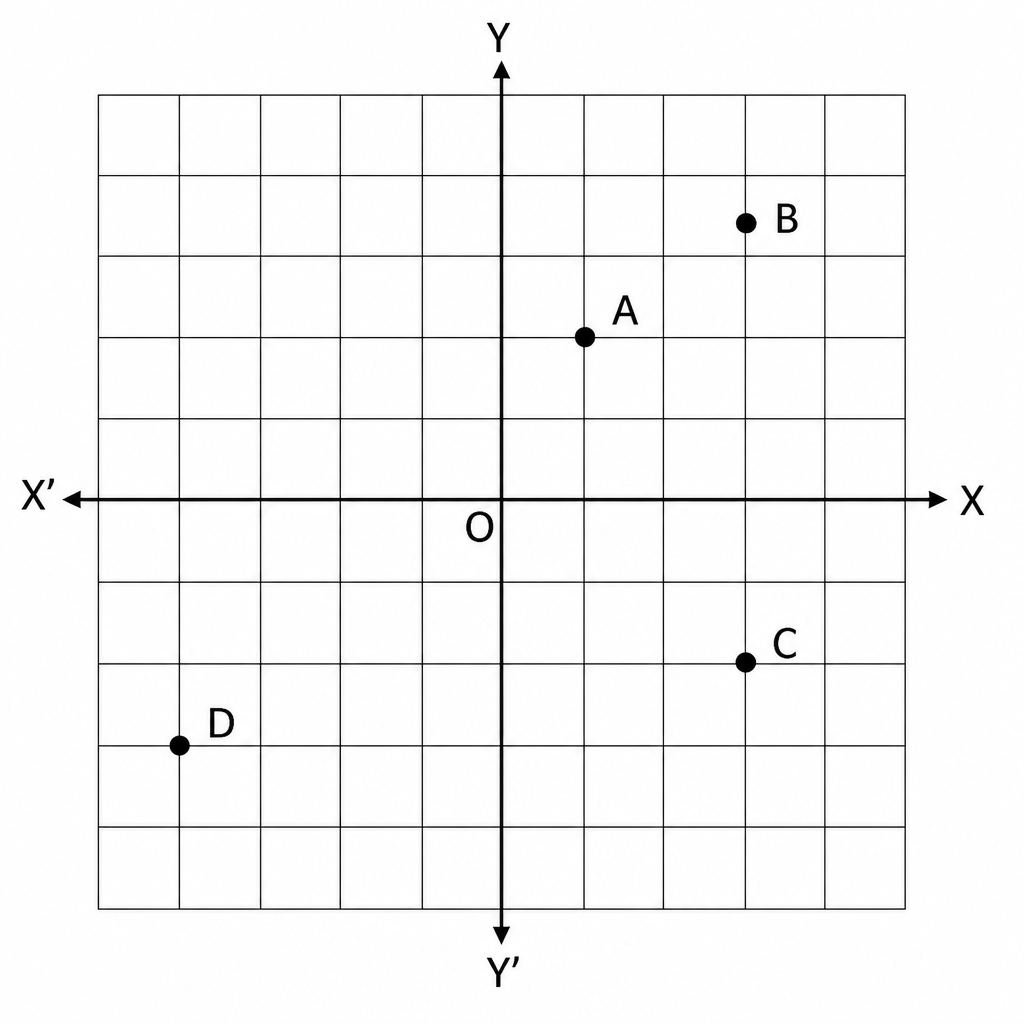
Where a point sits on a plane can be said completely with two numbers. The first number tells how many units you move right or left from the origin. The second number tells how many units you then move up or down. The two numbers are written together inside brackets, separated by a comma, like this: (3, 5).
Coordinates: the ordered pair of numbers that gives the position of a point. The first number is the distance along the X-axis and the second is the distance along the Y-axis, written as (x, y).
Origin: the point where the X-axis and the Y-axis cross. You move nothing sideways and nothing up or down to reach it, so its coordinates are (0, 0).
Plotting a point is always done the same way. Follow the order given below.
- Start at the origin O.
- Move sideways by the first number of units. Go right if the number is positive and left if it is negative.
- Now move up or down from there by the second number of units. Go up if it is positive and down if it is negative.
- Put a small dot where you land and write the name of the point beside it.
In the part that is right and up, both coordinates are positive, as in (4, 3).
In the part that is left and up, the first is negative and the second positive, as in (-4, 3).
In the part that is left and down, both are negative, as in (-4, -3).
In the part that is right and down, the first is positive and the second negative, as in (5, -5).
(3, 5) and (5, 3) are not the same point. The first number is always the sideways move and the second is always the up or down move. Swapping them plots a different place altogether.
The Right Angle Rule
The whole business of finding a distance rests on one old rule. In a right angled triangle the side opposite the right angle is the longest side, and it is called the hypotenuse. The other two sides are the perpendicular and the base. Pythagoras' theorem ties the three lengths together.
Pythagoras' theorem: in a right angled triangle the square of the hypotenuse equals the sum of the squares of the other two sides. Taking h for the hypotenuse, p for the perpendicular and b for the base, \( h^2 = p^2 + b^2 \).
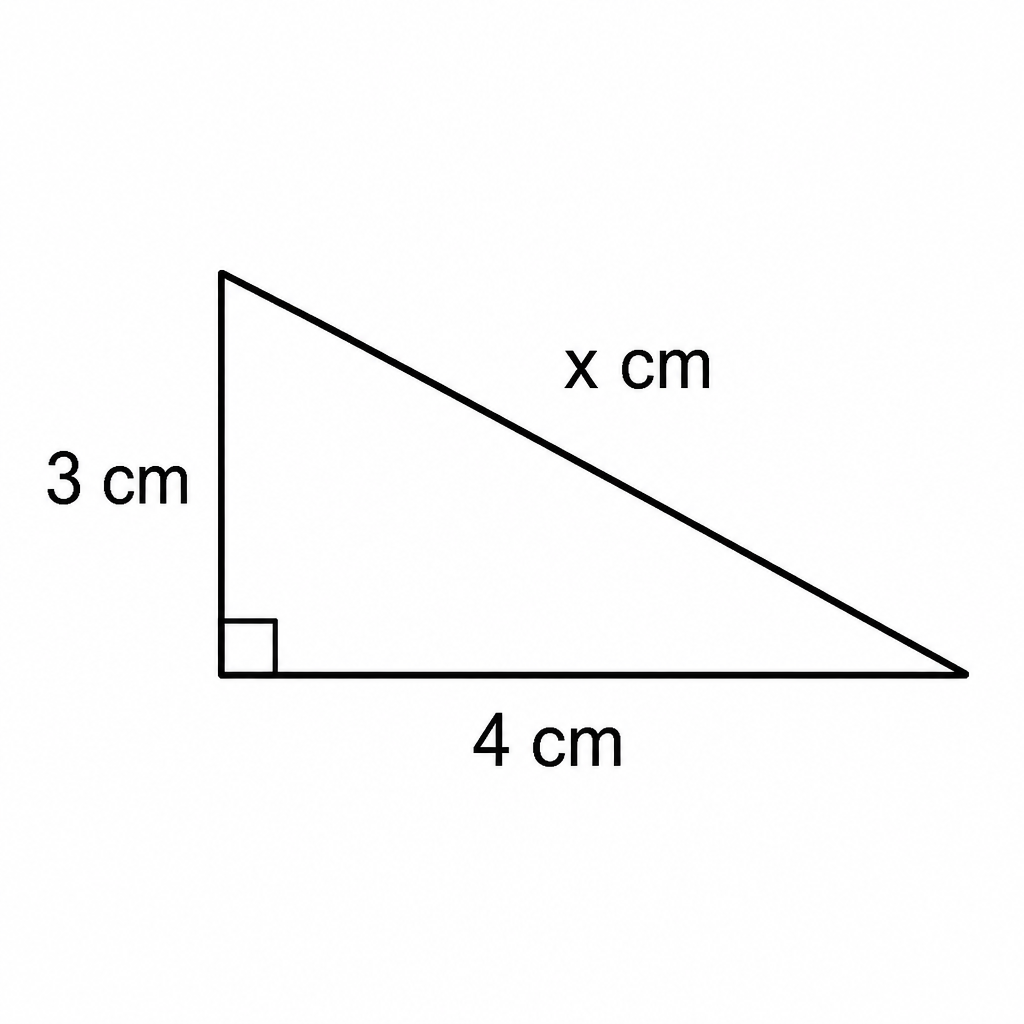
Let us find x in the triangle above. Here p = 3 cm, b = 4 cm and h = x.
Step 1: By Pythagoras' theorem the mathematical statement is:
\[ x^2 = 3^2 + 4^2 \]
Step 2: Working out both squares:
\[ x^2 = 9 + 16 \]
Step 3: Adding the two numbers:
\[ x^2 = 25 \]
Step 4: Taking the square root of both sides:
\[ x = 5\,\text{cm} \]
Sometimes the hypotenuse is known and a shorter side has to be found. Suppose a right angled triangle has p = 24 cm, h = 26 cm and b = x.
Step 1: Putting the known lengths into the theorem:
\[ 26^2 = 24^2 + x^2 \]
Step 2: Bringing the unknown side to one side on its own:
\[ x^2 = 26^2 - 24^2 \]
Step 3: Working out the squares and subtracting:
\[ x^2 = 676 - 576 = 100 \]
Step 4: Taking the square root:
\[ x = 10\,\text{cm} \]
Before using the theorem, be sure which side is the hypotenuse. It is always the side opposite the right angle and always the longest one. Treating a shorter side as the hypotenuse and adding gives a wrong answer every time.
The same theorem also checks whether a triangle is right angled. Only if the square of the longest side equals the sum of the squares of the other two is the triangle right angled. For sides \( \sqrt{10} \), 3 and \( \sqrt{19} \) we get \( 10 + 9 = 19 \), so that triangle is right angled. For sides 4, 11 and 12 we get \( 16 + 121 = 137 \) while \( 12^2 = 144 \), so that one is not.
Building the Distance Between Two Points
Now take two points \( A(x_1, y_1) \) and \( B(x_2, y_2) \) on the plane. The length of the straight line joining them is the distance between them. That line runs slanting, so it cannot be counted off square by square. Instead it is made the hypotenuse of a right angled triangle.
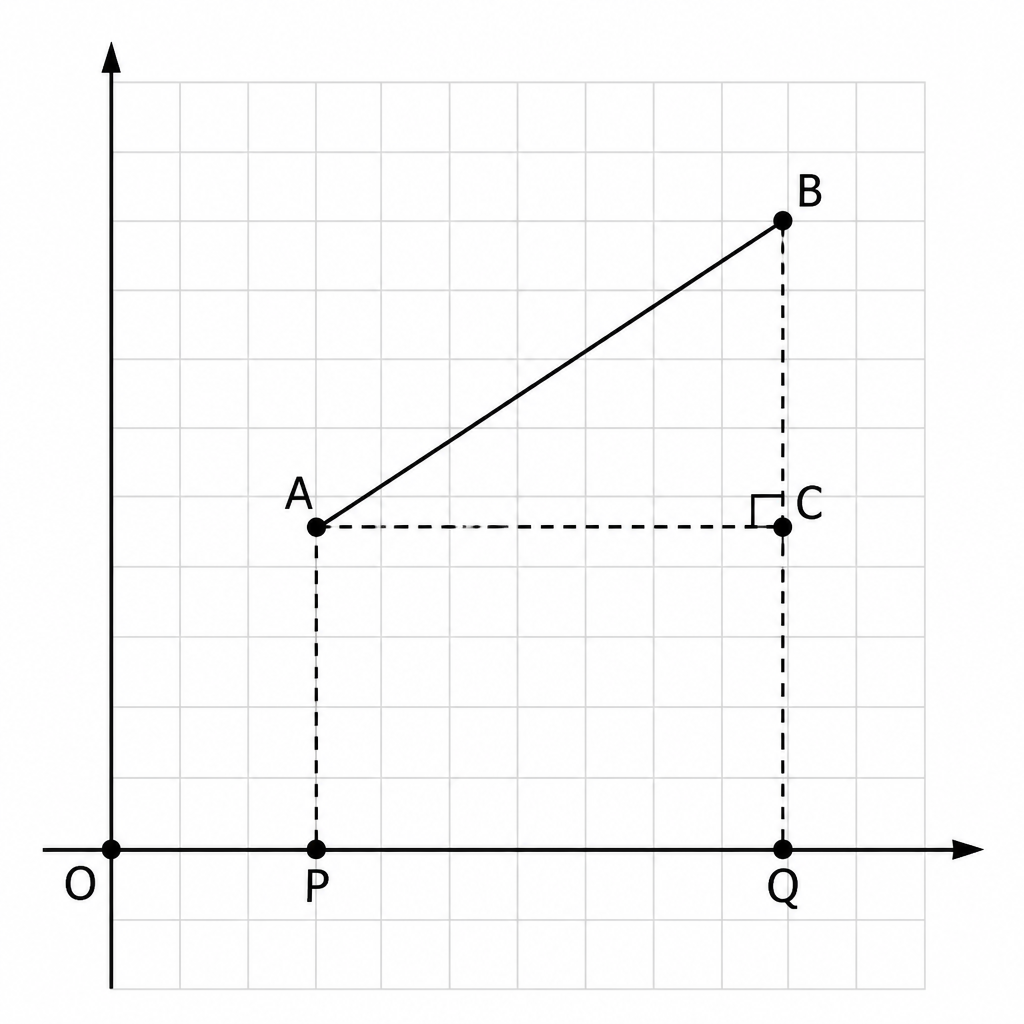
Step 1: Draw AP perpendicular from A to the X-axis, BQ perpendicular from B to the X-axis, and AC perpendicular from A to BQ. This gives \( OP = x_1 \), \( AP = y_1 \), \( OQ = x_2 \) and \( BQ = y_2 \).
Step 2: Since AC and PQ are equal, the horizontal side is:
\[ AC = OQ - OP = x_2 - x_1 \]
Step 3: Since CQ and AP are equal, the vertical side is:
\[ BC = BQ - CQ = y_2 - y_1 \]
Step 4: Triangle ACB has its right angle at C, so by Pythagoras' theorem:
\[ AB^2 = AC^2 + BC^2 \]
Step 5: Putting in the two side lengths:
\[ AB^2 = (x_2 - x_1)^2 + (y_2 - y_1)^2 \]
Step 6: Taking the square root gives the distance:
\[ AB = \sqrt{(x_2 - x_1)^2 + (y_2 - y_1)^2} \]
Distance formula: the distance between \( A(x_1, y_1) \) and \( B(x_2, y_2) \) is \( AB = \sqrt{(x_2 - x_1)^2 + (y_2 - y_1)^2} \) units.
Even if the formula slips your mind, the idea does not. Find the difference in the x values and the difference in the y values, square both and add, then take the square root. This is Pythagoras' theorem, written with the names of the points in it.
Subtract an x from an x and a y from a y, never an x from a y. Reversing the order of a subtraction does no harm, because squaring removes the minus sign, but forgetting to square can leave a negative answer, and a distance is never negative.
Using the Formula: The Radius of a Circle
A circle has its centre at A(4, 6), and P(10, 8) lies on its circumference. What is the radius? The radius is the distance from the centre to any point on the circumference, so the job is simply to find AP.
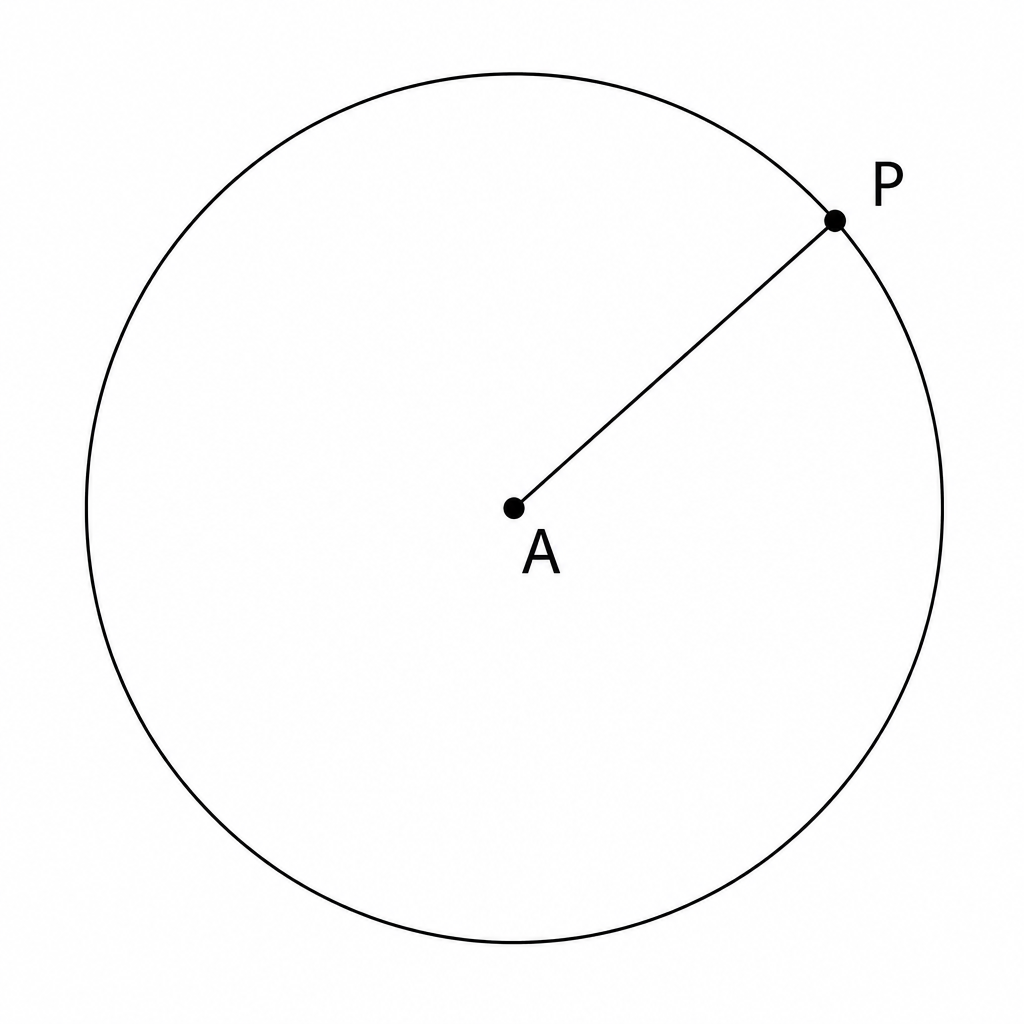
Step 1: Here \( x_1 = 4 \), \( y_1 = 6 \), \( x_2 = 10 \) and \( y_2 = 8 \). Putting these into the formula:
\[ AP = \sqrt{(10 - 4)^2 + (8 - 6)^2} \]
Step 2: Doing the subtractions inside the brackets:
\[ AP = \sqrt{6^2 + 2^2} \]
Step 3: Squaring and adding:
\[ AP = \sqrt{36 + 4} = \sqrt{40} \]
Step 4: Since \( 40 = 4 \times 10 \), the square root simplifies to:
\[ AP = 2\sqrt{10} \]
So the radius of the circle is \( 2\sqrt{10} \) units. There is no need to turn the square root into a decimal. A factor is taken outside the root only when it is a perfect square.
Points That Sit on the Axes
Sometimes the coordinates are not given, and only the axis and the number of units are named. A point sitting on the X-axis has gone neither up nor down, so its \( y = 0 \). In the same way a point sitting on the Y-axis has not moved sideways at all, so its \( x = 0 \).
| Where the point sits | Coordinates |
| 5 units right along the X-axis | (5, 0) |
| 6 units up along the Y-axis | (0, 6) |
| 8 units left along the X-axis | (-8, 0) |
| At the origin itself | (0, 0) |
Now let us find the distance from P to Q, where P is at 5 units on the X-axis and Q is at 6 units on the Y-axis. By the rule above, P is (5, 0) and Q is (0, 6).
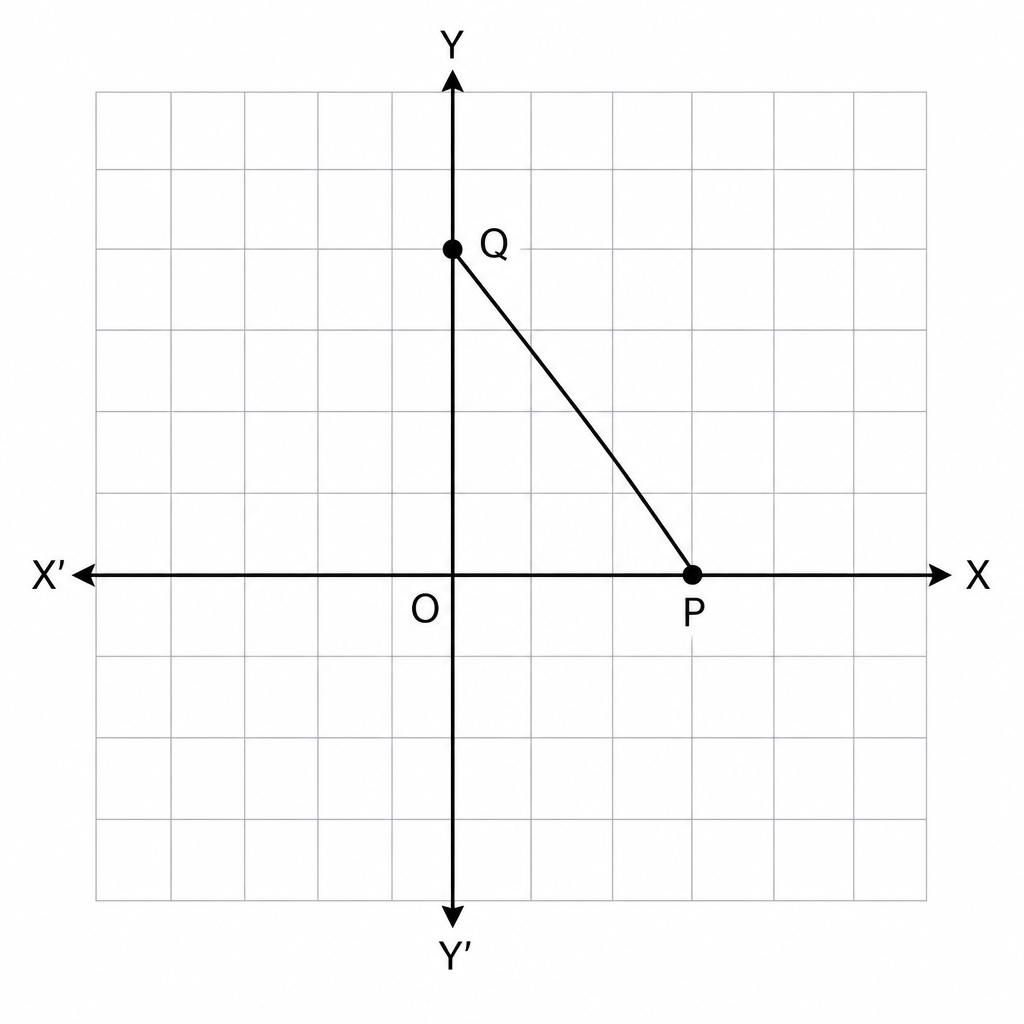
Step 1: With \( x_1 = 5 \), \( y_1 = 0 \), \( x_2 = 0 \) and \( y_2 = 6 \):
\[ PQ = \sqrt{(0 - 5)^2 + (6 - 0)^2} \]
Step 2: Squaring removes the minus sign, so:
\[ PQ = \sqrt{25 + 36} \]
Step 3: Adding the two squares:
\[ PQ = \sqrt{61} \]
61 has no perfect square factor, so the root cannot be made simpler. The distance from P to Q is therefore \( \sqrt{61} \) units.
When the Two Points Line Up
When two points have the same y coordinate they lie on one horizontal line. Then \( y_2 - y_1 = 0 \) and only the difference in the x values is left in the formula. For example, the distance between (2, 2) and (7, 2) is \( \sqrt{(7 - 2)^2 + 0} = 5 \) units, which you can also get by counting squares on the graph.
In the same way, when the x coordinates match, the points lie on one vertical line and the distance is just the difference in the y values. The distance between (1, 7) and (1, 1) is 6 units. These short cuts are not separate rules; they are the formula in an easy case.
Recognising a Shape from its Sides
The distance formula gives the lengths of the sides, and the lengths tell you what the shape is. Checking whether opposite sides match and whether the diagonals match names a triangle or a quadrilateral. Let us check that A(-4, 0), B(-4, -4), C(2, -4) and D(2, 0) are the vertices of a rectangle.
Step 1: A and B share an x value, so AB is vertical:
\[ AB = \sqrt{0 + (-4 - 0)^2} = 4 \]
Step 2: B and C share a y value, so BC is horizontal:
\[ BC = \sqrt{(2 + 4)^2 + 0} = 6 \]
Step 3: In the same way \( CD = 4 \) and \( DA = 6 \). Now the diagonal AC:
\[ AC = \sqrt{6^2 + 4^2} = \sqrt{52} \]
Step 4: The other diagonal BD:
\[ BD = \sqrt{6^2 + 4^2} = \sqrt{52} \]
Opposite sides are equal and the two diagonals are equal as well, so ABCD is a rectangle. The same method measures the three sides of a triangle and settles whether it is equilateral, isosceles or scalene.
The same formula works on a map. Find the distance in units from the coordinates of two towns, then multiply by the scale, which says how many kilometres one unit stands for, to get the real distance.
The full lesson is waiting for you
The notes are free to read in full. A free account opens the rest of the practice, and tracks your progress and confidence score for every subject. Presentations and videos need approval from Learn Yeti.