Faces, Edges and Vertices of a Solid Object
Most of the things we handle every day have length, breadth and height, all three at once. Such things are called solid objects. A brick, a dice, a water tank and an ice cream cone are all solid objects. The outside of a solid is sometimes built entirely out of flat pieces and sometimes it curves. By counting those outer pieces, the lines where the pieces meet and the points where those lines meet, we can describe the build of any solid. Four solids are shown below. Look at each one carefully and try to say what shape its pieces are.
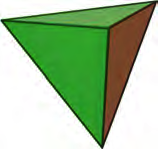
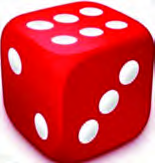
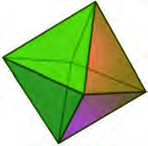
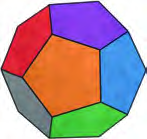
Face: a face is one of the flat or curved surfaces that closes a solid object in from the outside.
Edge: an edge is the line formed where two faces meet.
Vertex: a vertex is the point where two or more edges meet. It is also called a corner.
While counting you have to turn the solid over in your mind. Looking at a dice from the front you see only three faces, but there are three more behind, so the total is 6 faces. In the same way a dice has 12 edges and 8 vertices. Once you have counted, there is an easy way to check your answer, and the relation below gives it.
Counting only the faces you can see is the most common mistake here. The hidden faces, edges and corners belong to the solid too, so turn the object round, or hold a model in your hand, before you write the count.
The Relation Between Faces, Edges and Vertices
When you count the faces, edges and vertices of solids with flat faces and put the counts in a table, a neat rule appears. In the table F stands for the number of faces, E for the number of edges and V for the number of vertices.
| Solid | Faces F | Edges E | Vertices V | F + V | E + 2 |
| Solid with four triangular faces | 4 | 6 | 4 | 8 | 8 |
| Cube (a dice) | 6 | 12 | 8 | 14 | 14 |
| Solid with eight triangular faces | 8 | 12 | 6 | 14 | 14 |
| Solid with twelve five sided faces | 12 | 30 | 20 | 32 | 32 |
In every row the numbers in the last two columns are equal. Written as a rule, this says:
\[ F + V = E + 2 \]
This relation holds for every solid built from flat faces. Let us check it on the solid with twelve five sided faces.
Step 1: Putting the number of faces and the number of vertices into the left side:
\[ F + V = 12 + 20 \]
Step 2: Adding those two numbers gives the value of the left side:
\[ 12 + 20 = 32 \]
Step 3: On the right side, 2 is added to the 30 edges:
\[ E + 2 = 30 + 2 = 32 \]
Step 4: Both sides come out as 32, so the relation is satisfied:
\[ F + V = E + 2 \]
The Triangular Prism
Every face of the solid below is flat. Two of its faces are triangles which are parallel to each other and congruent, and three of its faces are rectangles which join those two triangles.
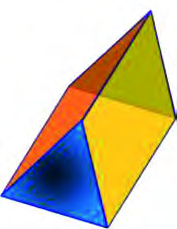
Prism: a prism is a solid object made of plane faces in which the top and bottom faces are parallel and congruent. Those two faces are called the bases of the prism, and the remaining faces are called its lateral surfaces.
A prism is named after the shape of its base. If the base is a triangle it is a triangular base prism, and if the base is a rectangle it is a rectangular base prism. In the hollow model below each face is given a different colour, so the bases and the lateral surfaces can be told apart at a glance.
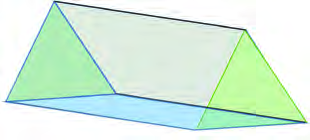
A triangular prism has 5 faces, 9 edges and 6 vertices altogether. The faces and vertices add up to \( 5 + 6 = 11 \), and adding 2 to the edges also gives \( 9 + 2 = 11 \), so the relation is satisfied here as well.
The Pyramid
Now look at a different kind of solid. Its bottom face is a polygon and all its other faces are triangles. Those triangles rise upwards and meet at one single point.
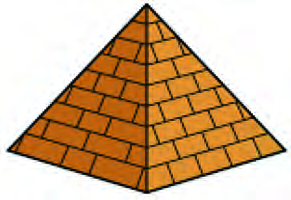
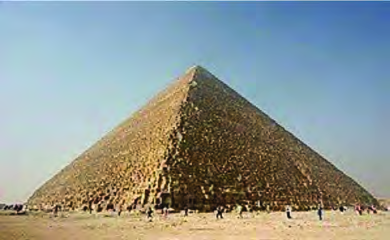
Pyramid: a pyramid is a three dimensional solid whose base is a polygon and whose lateral surfaces have one common vertex.
In a pyramid every face other than the base is a triangular lateral surface. When the base is a regular polygon with equal sides and equal angles, the lateral surfaces are congruent to one another. The vertical height of a pyramid is perpendicular to the plane of the base.
Naming a Pyramid by Its Base
A pyramid takes its name from the shape of the polygon at its base. Four pyramids are shown below, and each one has a different base.
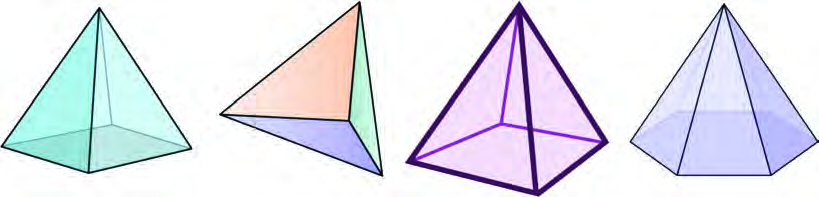
- (a) If the base is a triangle, it is a triangular base pyramid.
- (b) If the base is a rectangle, it is a rectangular base pyramid.
- (c) If the base is a square, it is a square base pyramid.
- (d) If the base is a hexagon, it is a hexagonal base pyramid.
Worked Example 1: A Triangular Base Prism
The six vertices of the triangular base prism below are named A, B, C, D, E and F. Three questions are asked about it.
- (a) Write the names of all the faces of the prism.
- (b) Which faces of the prism are congruent to one another?
- (c) Write the relation between the edges, faces and vertices.
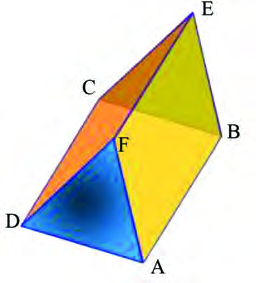
Step 1: The two triangular bases are found first. They are the end triangles \( \triangle ADF \) and \( \triangle BCE \).
Step 2: Next come the rectangular lateral surfaces. There are three of them, namely ABCD, ABEF and CDFE.
Step 3: Congruence is checked. The two bases of a prism are always congruent, so \( \triangle ADF \) and \( \triangle BCE \) are congruent. Here the base is an equilateral triangle, so the three rectangular lateral surfaces are congruent to one another as well.
Step 4: The count gives 5 faces, 9 edges and 6 vertices. The left side of the relation is:
\[ F + V = 5 + 6 = 11 \]
Step 5: Adding 2 to the number of edges gives the right side:
\[ E + 2 = 9 + 2 = 11 \]
Step 6: Both sides equal 11, so the relation asked for is:
\[ F + V = E + 2 \]
Worked Example 2: Comparing a Prism and a Pyramid
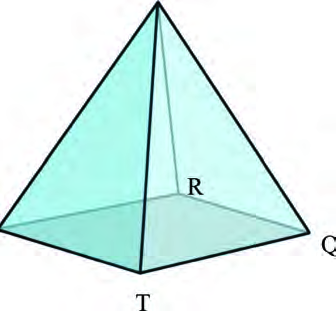
A pyramid with a rectangular base is shown below. Three questions are answered by comparing it with the triangular prism above.
- (a) Name all the faces of both solids.
- (b) Which faces are congruent in each of them?
- (c) Write the relation between the edges, faces and vertices in each of them.
Step 1: The faces of the prism are written first. They are the two triangles \( \triangle ADF \), \( \triangle BCE \) and the three rectangles ABCD, ABEF and CDFE.
Step 2: The faces of the pyramid are written next. The bottom face is a rectangle, and four triangular lateral surfaces rise from its four sides, so there are 5 faces altogether.
Step 3: Congruence is checked. In the prism the two triangular bases are congruent. In the pyramid the triangles that stand opposite each other are congruent in pairs, so there are two pairs of congruent faces.
Step 4: The pyramid has 5 faces, 8 edges and 5 vertices. The left side gives:
\[ F + V = 5 + 5 = 10 \]
Step 5: Adding 2 to the edges gives the right side:
\[ E + 2 = 8 + 2 = 10 \]
Step 6: As with the prism, both sides come out equal for the pyramid too. So in both solids:
\[ F + V = E + 2 \]
| Feature | Triangular prism | Rectangular base pyramid |
| Base | Two congruent triangles | One rectangle |
| Lateral surfaces | Three rectangles | Four triangles |
| Faces | 5 | 5 |
| Edges | 9 | 8 |
| Vertices | 6 | 5 |
Nets of Solid Objects
If a solid made by folding paper is opened out along its edges and spread on a table, a flat figure appears. That figure is the net of the solid. A net shows every face of the solid at once, side by side in one plane, so the number and the shape of the faces can be read straight off the net.
Net: the flat figure obtained by opening a solid object along its edges and spreading it out on a plane is called the net of that solid.
A net has exactly as many pieces as the solid has faces.
When the net is folded, no two pieces may land on the same face.
The edges that are to be joined must be equal in length.
The Net of a Cube
Cube: a cube is a solid object enclosed by six congruent square faces.
A cube has 6 faces, 12 edges and 8 vertices. When it is cut along some edges and laid flat, six equal squares are obtained.
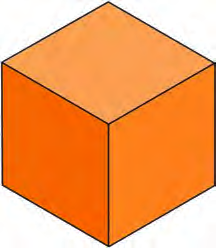
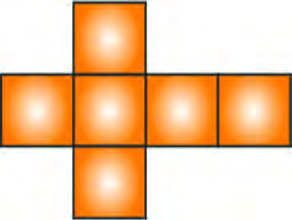
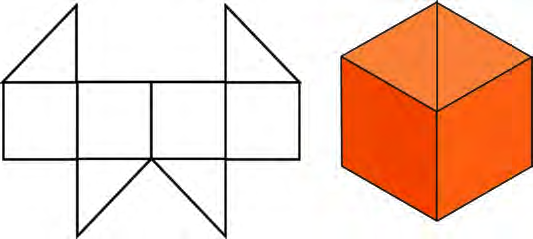
A cube does not have only one net. Six squares joined in a different arrangement can also fold up into a cube. A different net of this kind, and the cube it makes, are shown below.
The Net of a Cuboid
Cuboid: a cuboid is a solid object enclosed by six rectangular faces, in which the opposite faces are congruent to each other.
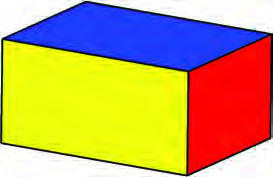
A cuboid also has 6 faces, 12 edges and 8 vertices, exactly as a cube does. Its faces, however, are rectangles and not squares. Its net is shown below.
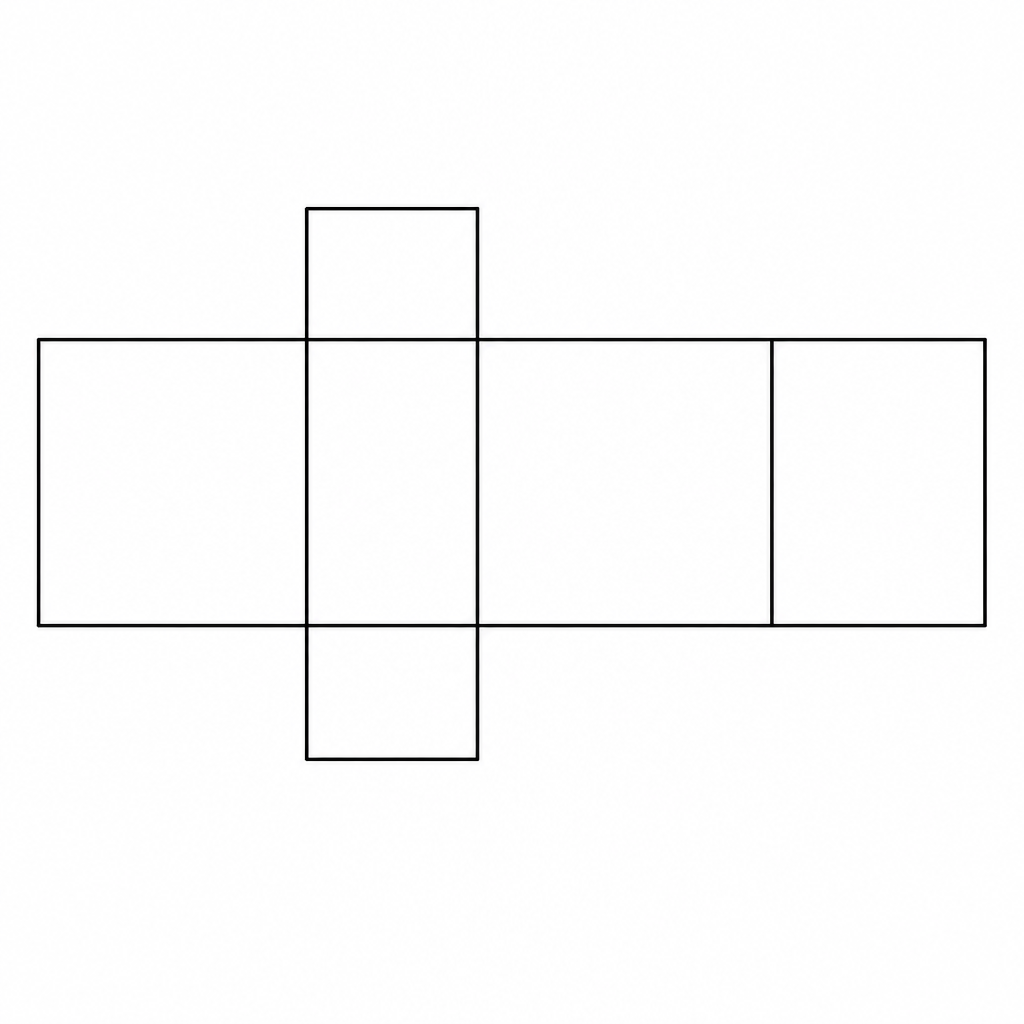
That is where the two nets differ. In a cube net all six pieces are squares of one size, so any piece can become any face. In a cuboid net the rectangles match in three pairs, so a matching pair has to end up on opposite faces. The similarity is that both nets have six pieces, and both fold up to give 12 edges and 8 corners.
The Net of a Tetrahedron
Tetrahedron: a tetrahedron is a solid object enclosed by four triangular faces. It is the same thing as a triangular base pyramid.
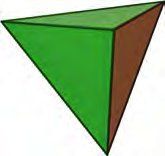
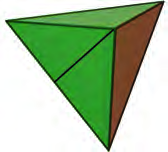
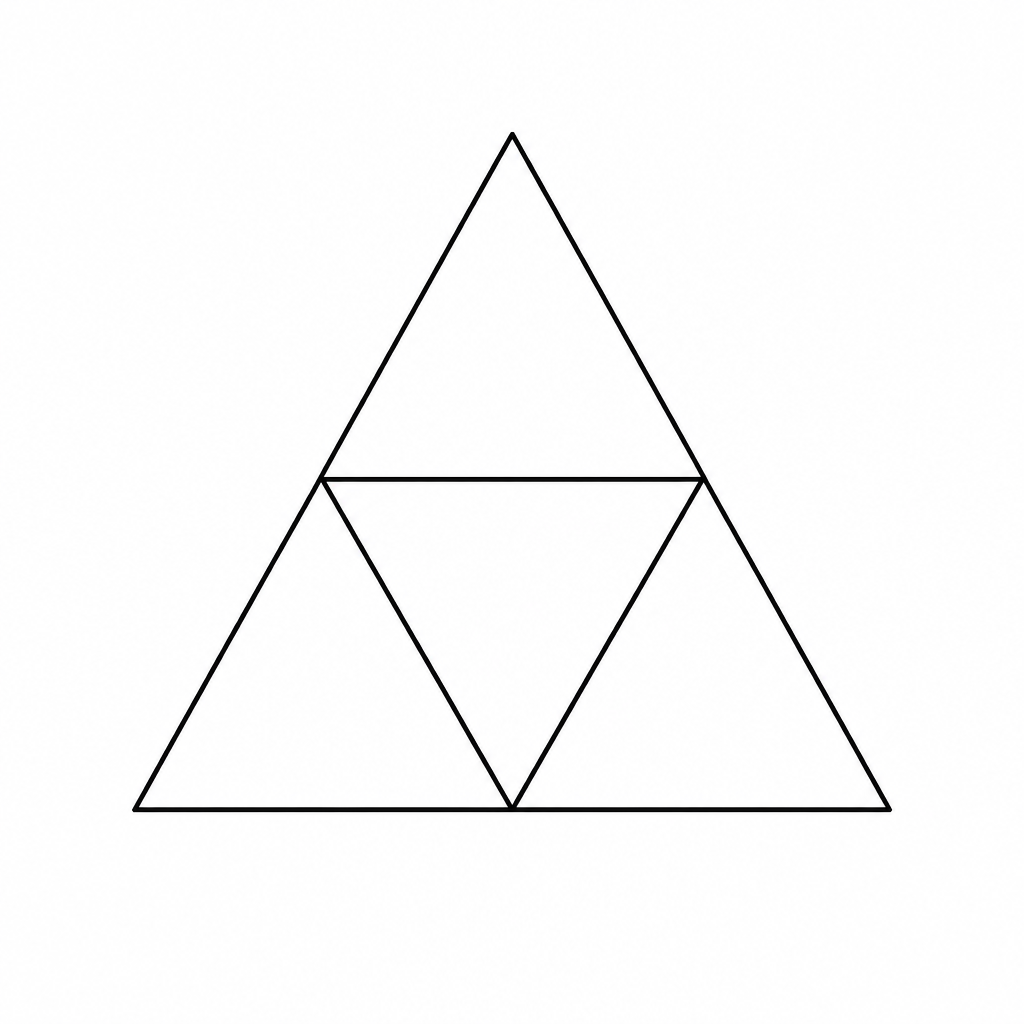
A tetrahedron has 4 faces, 6 edges and 4 vertices. The faces and vertices give \( 4 + 4 = 8 \), and adding 2 to the edges also gives \( 6 + 2 = 8 \). Its net is made of four triangles.
The Net of a Cone
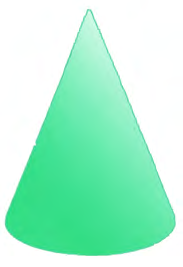
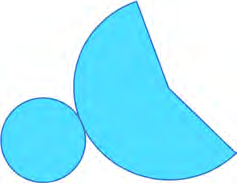
Cone: a cone is a solid object having one flat circular face and one curved surface which rises from the rim of that circle to a single vertex.
A cone has 2 surfaces, one flat circular face and one curved surface. It has 1 edge and 1 vertex. When a hollow cone is opened out, you get the bottom circle together with a sector of a larger circle which was the curved surface.
The Net of a Cylinder
Cylinder: a cylinder is a solid object having two congruent parallel circular faces and one curved surface joining them.
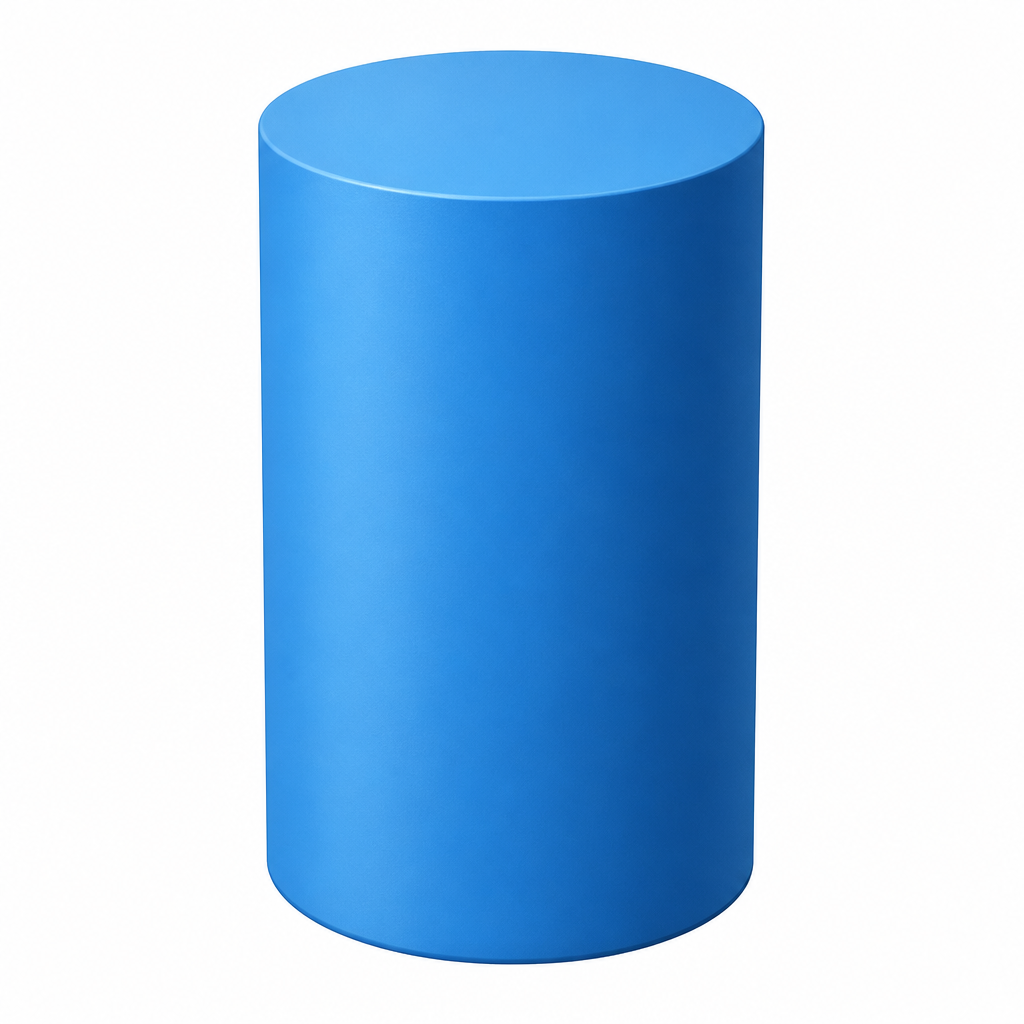
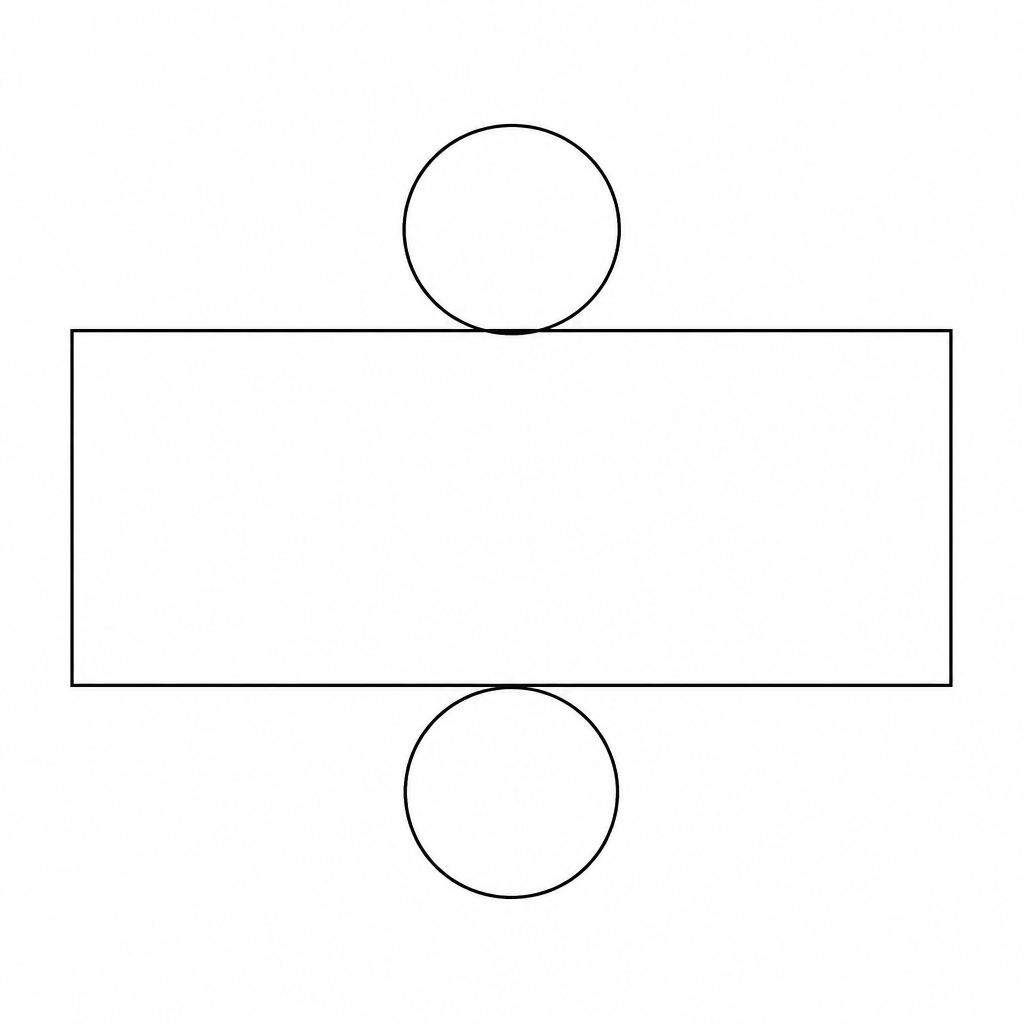
The tube that holds badminton shuttlecocks is a good model of a cylinder. A cylinder has 3 surfaces, two flat circles and one curved surface. It has 2 edges and not a single vertex. If you cover the whole cylinder with paper and then peel the paper off, you get one rectangle and two circles.
The relation \( F + V = E + 2 \) works only for solids whose faces are all flat. A cone and a cylinder have a curved surface, so the relation must not be applied to them.
How to Test Whether a Net Folds into a Cube
Not every figure made of squares will fold into a cube. Here is a way of testing one without cutting any paper.
- Step 1: Count the squares. If there are not exactly 6, the net cannot make a cube.
- Step 2: Look for four squares lying in one row. When folded, those four wrap round as the four side faces.
- Step 3: Check that the two remaining squares are joined to different squares of that row, one going on top and one underneath.
- Step 4: Fold it up in your mind and see whether any two squares land on the same face. If two overlap, it is not a cube net.
Let us run the test on the figure below. It has four squares in a row, one square above the second of them and one square below the third.
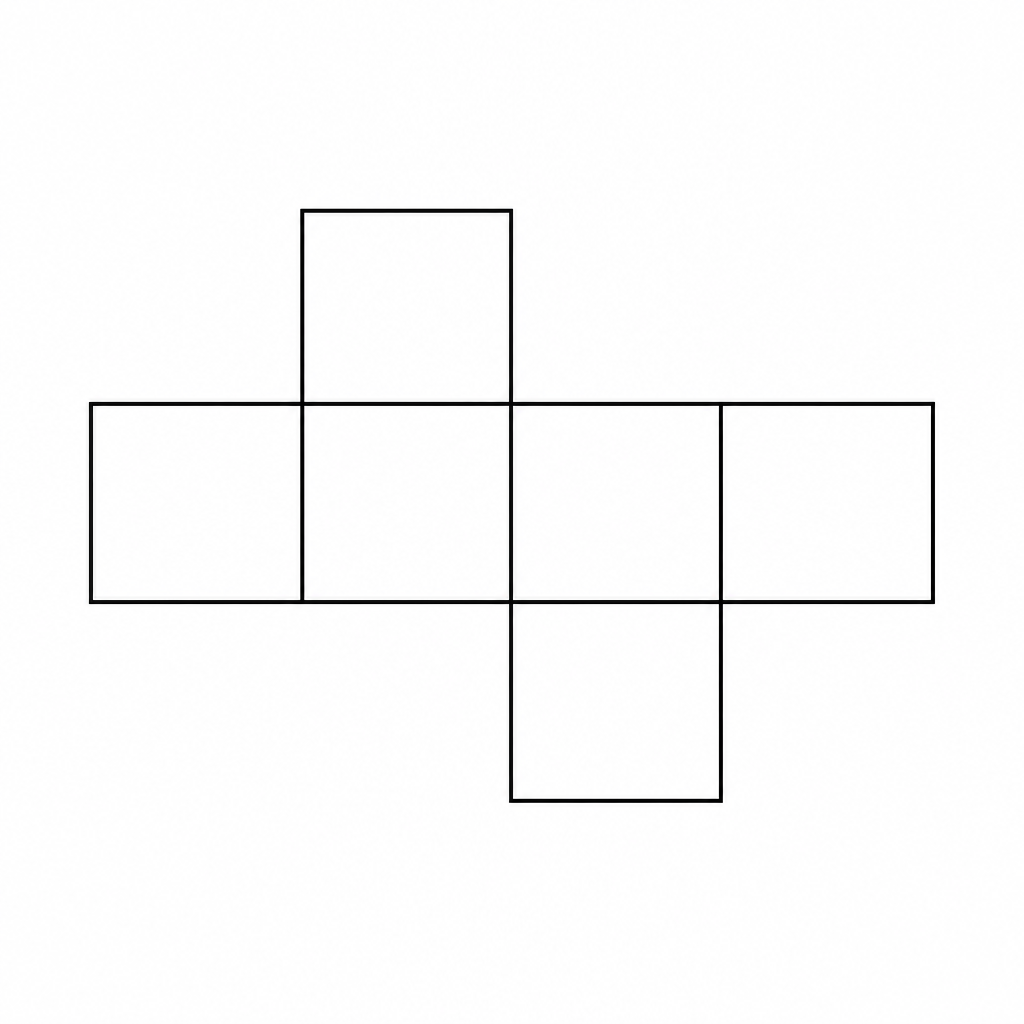
There are 6 squares in all, the four in the row become the sides, the square above closes the top, the square below closes the bottom, and no two squares overlap. So this net does fold into a cube.
Now look at one that fails. In a figure where all six squares are placed in a single row the count is right, but the arrangement is wrong.
As it is rolled up, the first four squares form the sides and then the fifth and sixth squares land on top of the first and second. No square is left to close the top and the bottom, so this one does not make a cube.
All the Solids Side by Side
| Solid | Faces | Edges | Vertices | Net |
| Cube | 6 | 12 | 8 | 6 equal squares |
| Cuboid | 6 | 12 | 8 | 6 rectangles in three pairs |
| Triangular prism | 5 | 9 | 6 | 2 triangles and 3 rectangles |
| Rectangular base pyramid | 5 | 8 | 5 | 1 rectangle and 4 triangles |
| Tetrahedron | 4 | 6 | 4 | 4 triangles |
| Cone | 2 (1 flat, 1 curved) | 1 | 1 | 1 circle and 1 sector |
| Cylinder | 3 (2 flat, 1 curved) | 2 | 0 | 1 rectangle and 2 circles |
The counts tell you the frame of a solid and the net tells you its surface. Know both the counts and the net, and you know the solid completely.
Making the Models with Your Own Hands
Building a hollow model from juice pipes, broom sticks or wheat straw makes the faces, edges and vertices easy to see. With your teacher beside you, follow the order below.
- Step 1: Get 9 pipes of equal length ready for a triangular prism and 8 for a rectangular base pyramid.
- Step 2: Build the base first, two triangles for the prism and one rectangle for the pyramid.
- Step 3: Join the corners of the base with the remaining pipes, and in the pyramid bring them all to one single point.
- Step 4: Stick paper of a different colour on each face so the faces can be told apart, then present it to the class.
- Step 5: Draw the nets of a cube, a cuboid, a tetrahedron, a cone and a cylinder on paper, fold them, and make the solid models.
Use scissors only when you cut paper and pipes, and do that work in front of your teacher or an adult at home. Never point the tip of the scissors towards anyone.
The full lesson is waiting for you
The notes are free to read in full. A free account opens the rest of the practice, and tracks your progress and confidence score for every subject. Presentations and videos need approval from Learn Yeti.