Comparing Figures by Shape and by Size
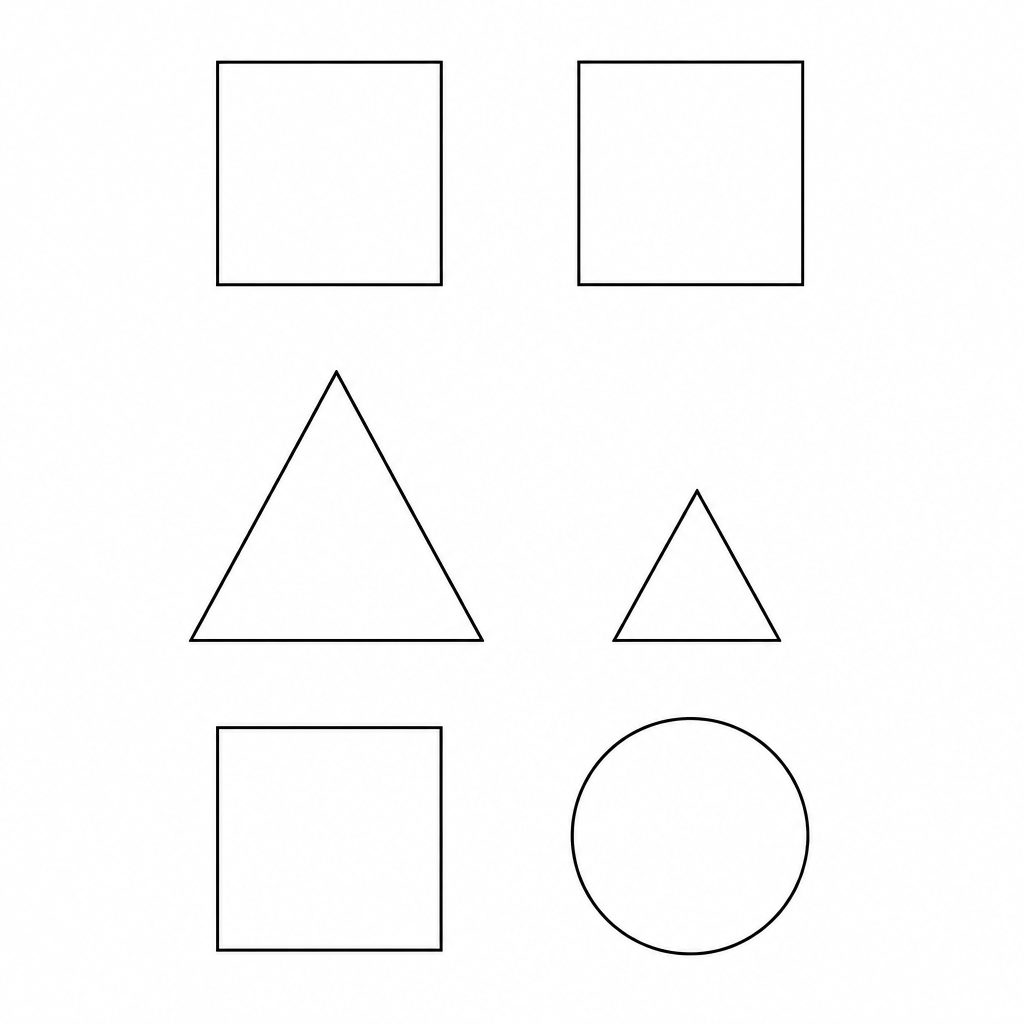
When we put two plane figures side by side, there are only two things worth asking. First, is the shape the same? Second, is the size the same? The answers to those two questions sort every pair of figures into three groups.
- Same shape and same size. One figure placed on top of the other covers it exactly.
- Same shape but not the same size. One is small and the other is large, yet they are built the same way.
- A different shape altogether. Such a pair is neither equal in size nor alike in build.
A square beside another square of exactly the same side belongs to the first group. A square beside a square of half that side belongs to the second group, because both are squares but their sizes differ. A square beside a circle belongs to the third group. These three groups are where congruency and similarity begin. Figures of the first group are called congruent and figures of the second group are called similar.
Congruent Triangles
Draw two triangles ABC and PQR on graph paper, cut them out and lay one on top of the other. If they fit exactly, then their angles and their sides are equal in pairs. The angle that lands on another angle forms one pair, and the same is true of the sides.
Two triangles that have the same shape and the same size are called congruent triangles. In congruent triangles the corresponding angles are equal and the corresponding sides are equal.
Congruency has its own symbol. If triangle ABC and triangle PQR are congruent we write it like this:
\[ \triangle ABC \cong \triangle PQR \]
Corresponding Angles and Corresponding Sides
The angles that land on each other are called corresponding angles, and the sides that land on each other are called corresponding sides. If \( \triangle ABC \cong \triangle PQR \), the order of the letters itself says which part matches which. A matches P, B matches Q and C matches R.
- Corresponding angles: \( \angle BAC = \angle QPR \)
- \( \angle ABC = \angle PQR \)
- \( \angle BCA = \angle QRP \)
- Corresponding sides: \( AB = PQ \)
- \( BC = QR \)
- \( AC = PR \)
Never shuffle the letters when you write a congruency. \( \triangle ABC \cong \triangle PQR \) and \( \triangle ABC \cong \triangle QPR \) claim different pairings. Always line up the letters so that equal angles sit in matching positions.
Tests for Congruent Triangles
A triangle has six parts, three angles and three sides. To say that two triangles are congruent we do not have to measure all six. If certain parts are equal, the rest follow on their own. The five tests below say exactly which parts are enough.
SAS: two sides and the angle between them
RHS: right angle, hypotenuse and one side
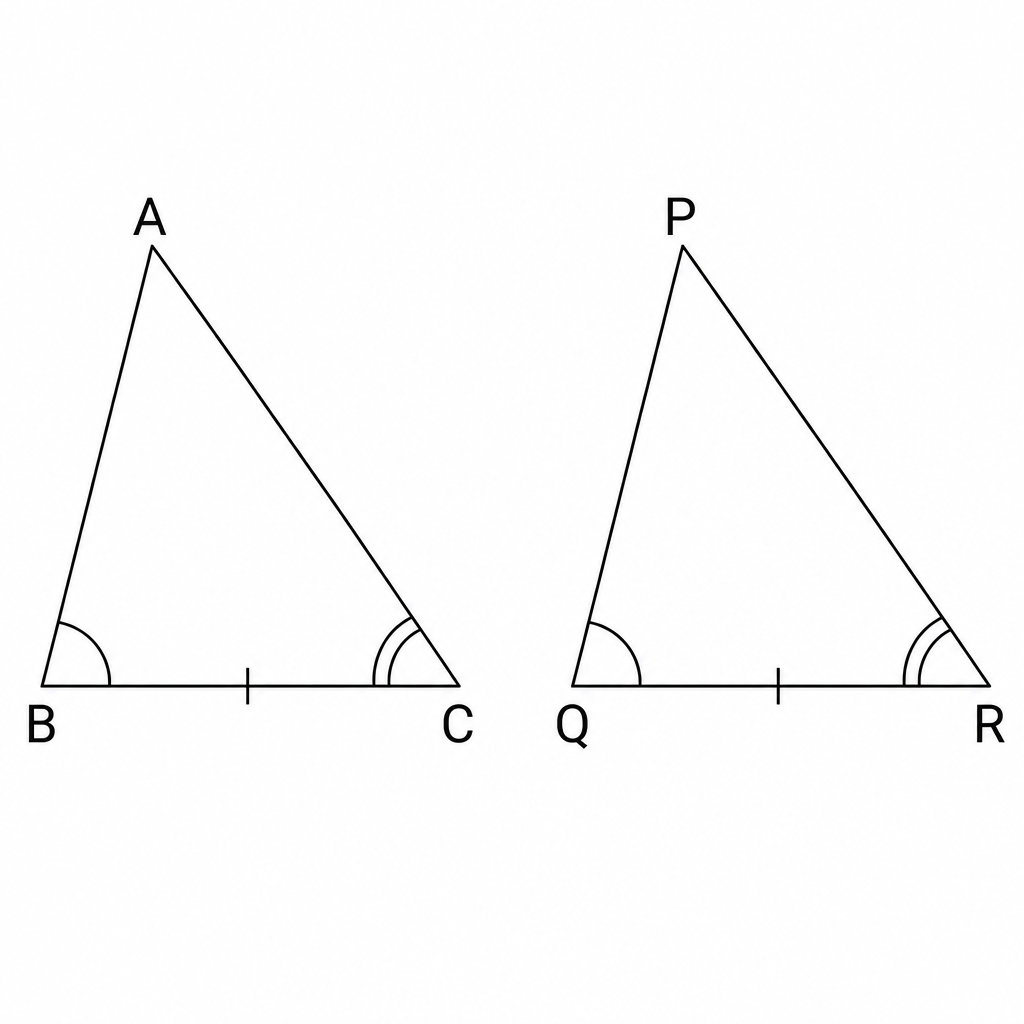
ASA: two angles and the side between them
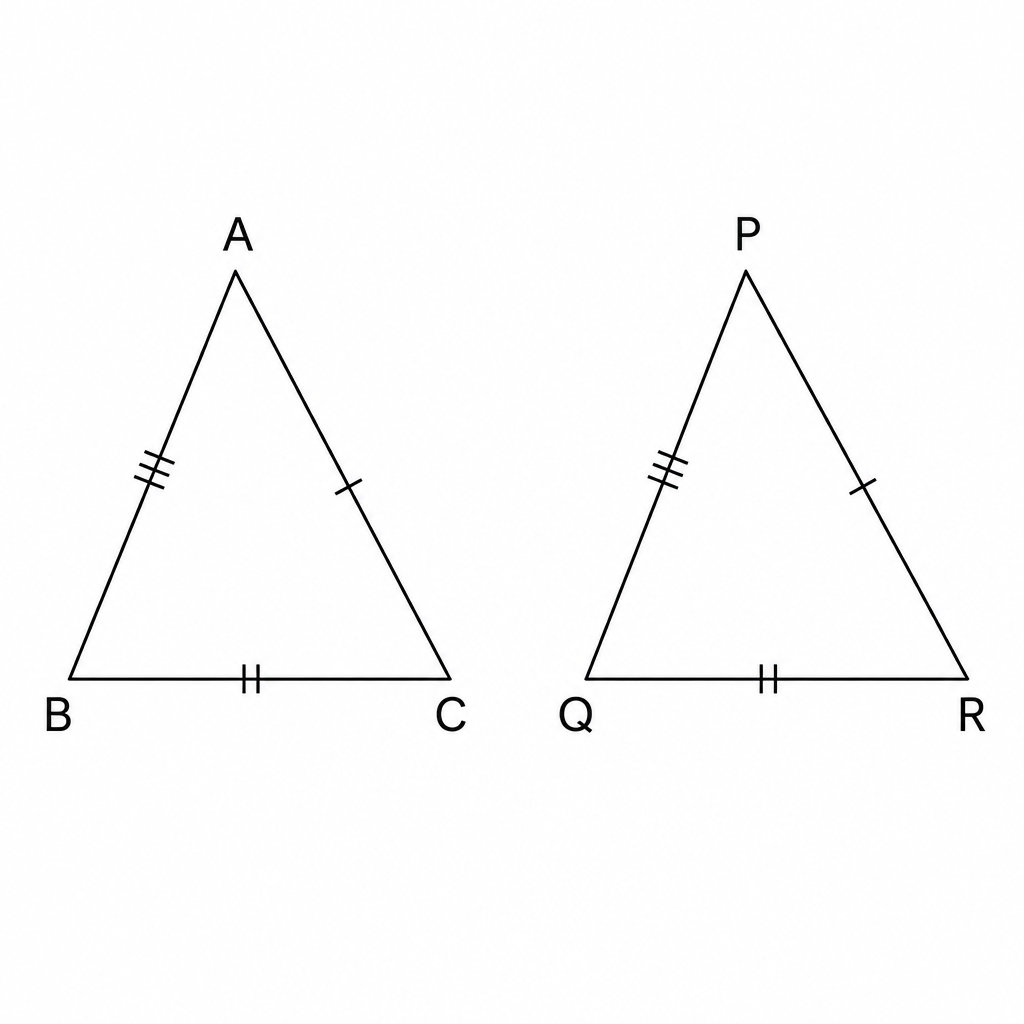
SSS: all three sides
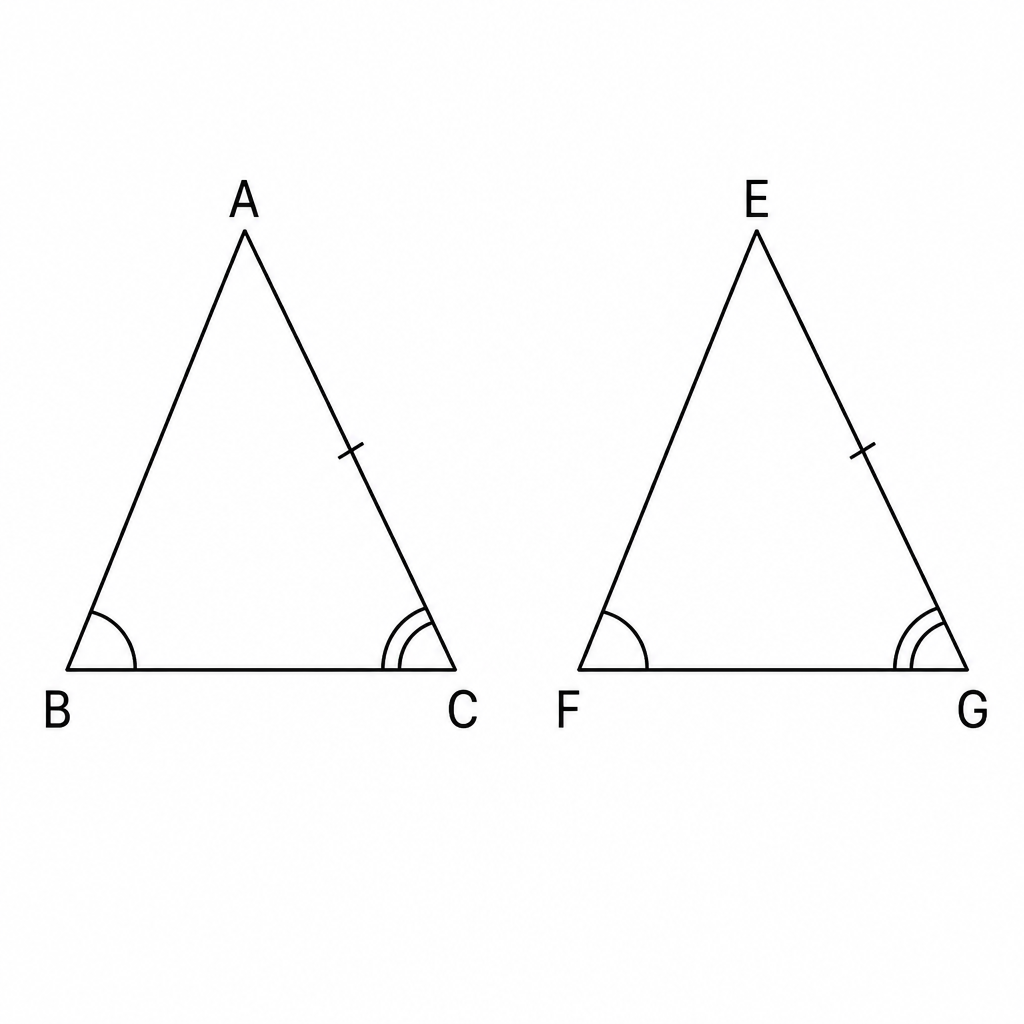
AAS: two angles and one side
Side, Angle, Side (SAS)
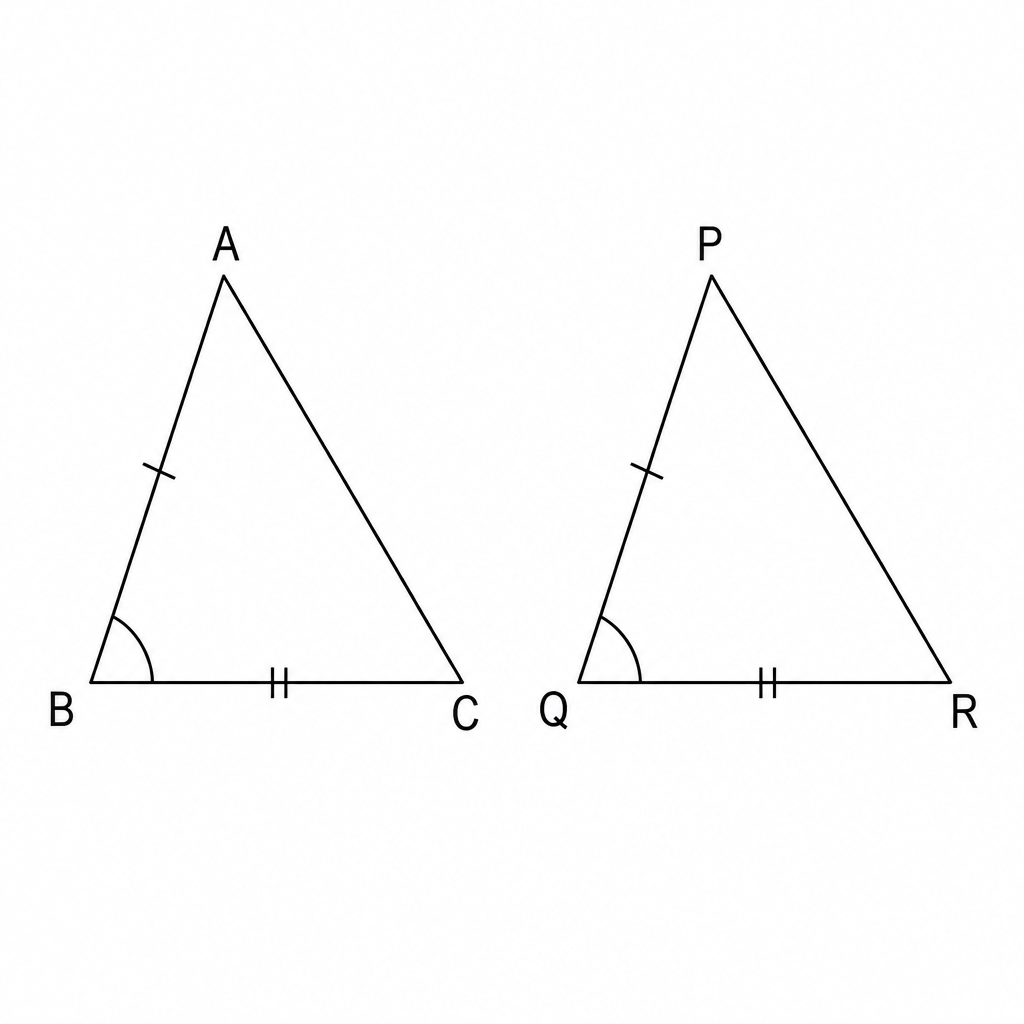
Take side AB, side BC and the angle \( \angle ABC \) that lies between them. Now build a triangle PQR with PQ as long as AB, QR as long as BC and \( \angle PQR \) exactly as big as \( \angle ABC \). Measure the remaining parts and you find \( AC = PR \), \( \angle BAC = \angle QPR \) and \( \angle ACB = \angle PRQ \). Once two sides and the angle between them are fixed, the third vertex has nowhere else to go, so only one triangle can be built.
If two sides of one triangle and the angle between them are equal to two sides of another triangle and the angle between them, then the two triangles are congruent. This is congruency by Side, Angle, Side, written SAS.
Right angle, Hypotenuse, Side (RHS)
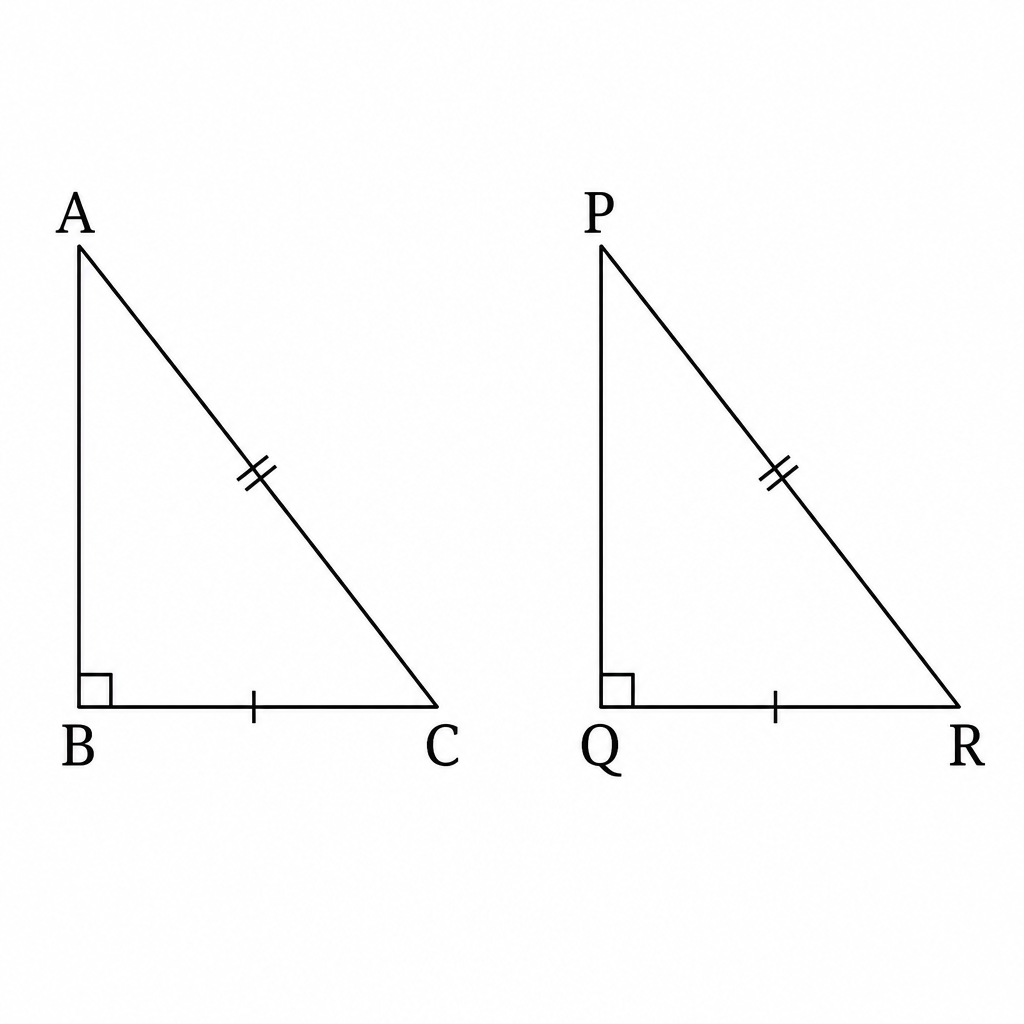
Now take a right angled triangle ABC with the right angle at B, so that AC is the hypotenuse. Build a right angled triangle PQR whose hypotenuse PR equals AC and whose side QR equals BC. Measuring the rest gives \( AB = PQ \), \( \angle BAC = \angle QPR \) and \( \angle ACB = \angle PRQ \). This test works only for right angled triangles.
If the right angle, the hypotenuse and one side of a triangle are equal to the right angle, the hypotenuse and one side of another triangle, the two triangles are congruent. This is congruency by Right angle, Hypotenuse, Side, written RHS.
Angle, Side, Angle (ASA)
Take \( \angle ABC \), \( \angle ACB \) and the side BC that lies between them. Build a triangle PQR with \( \angle PQR \) and \( \angle PRQ \) the same size and QR the same length. Once the side is fixed, drawing an angle at each of its ends sends two rays that meet at one point, so the third vertex lands in one place only. Measuring gives \( AC = PR \), \( AB = PQ \) and \( \angle BAC = \angle QPR \).
If two angles of one triangle and the side between them are equal to two angles of another triangle and the side between them, the two triangles are congruent. This is congruency by Angle, Side, Angle, written ASA.
Side, Side, Side (SSS)
Build a triangle PQR whose sides PQ, QR and PR are equal to AB, BC and AC in that order. Now measure the angles with a protractor and you get \( \angle BAC = \angle QPR \), \( \angle ABC = \angle PQR \) and \( \angle ACB = \angle PRQ \). Once the three side lengths are fixed, the shape of the triangle settles by itself and no angle has to be given.
If the three sides of one triangle are equal to the three sides of another triangle, the two triangles are congruent. This is congruency by Side, Side, Side, written SSS.
Angle, Angle, Side (AAS)
The three angles of a triangle add up to \( 180^\circ \), so once two angles are known the third follows. Because of that, two angles and any one side are enough, even when that side does not lie between the two angles. Take \( \angle ABC \), \( \angle ACB \) and the side AC, then build a triangle EFG with \( \angle EFG \), \( \angle FGE \) and EG of the same measures. The remaining parts come out equal as well.
If one side of a triangle, one angle standing on that side and the angle opposite it are equal to one side of another triangle, one angle standing on that side and the angle opposite it, then the triangles are congruent. This is congruency by Angle, Angle, Side, written AAS.
Two Sides and an Angle That Is Not Between Them
Why does SAS insist that the angle lie between the two sides? Look at what happens when it does not. Draw a ray from A, mark a point B above it and join AB. With B as centre, one single radius can cut that ray at two different points, call them C and D. Now in triangle ABC and triangle ABD, the side AB is shared, the angle at A is shared and \( BC = BD \). Two sides and an angle are equal, yet the two triangles clearly do not fit on each other. So two sides and an angle that is not between them do not guarantee congruency.
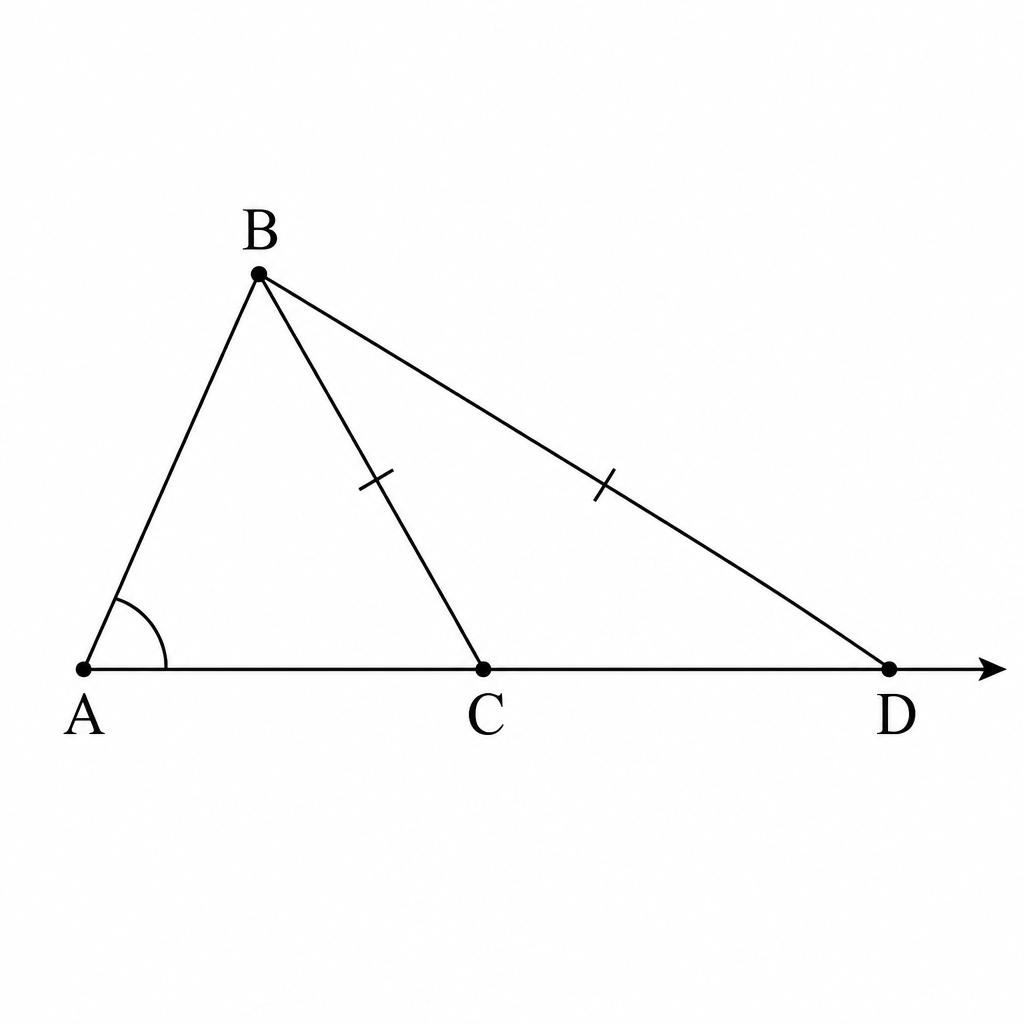
Never write that two triangles are congruent just because two sides and some angle are equal. Before using SAS, check that the given angle really does lie between those two sides.
Deciding Which Test Applies
When a pair of triangles is given, first write down which parts are equal, then see which test that list matches. The four pairs below are handled exactly that way.
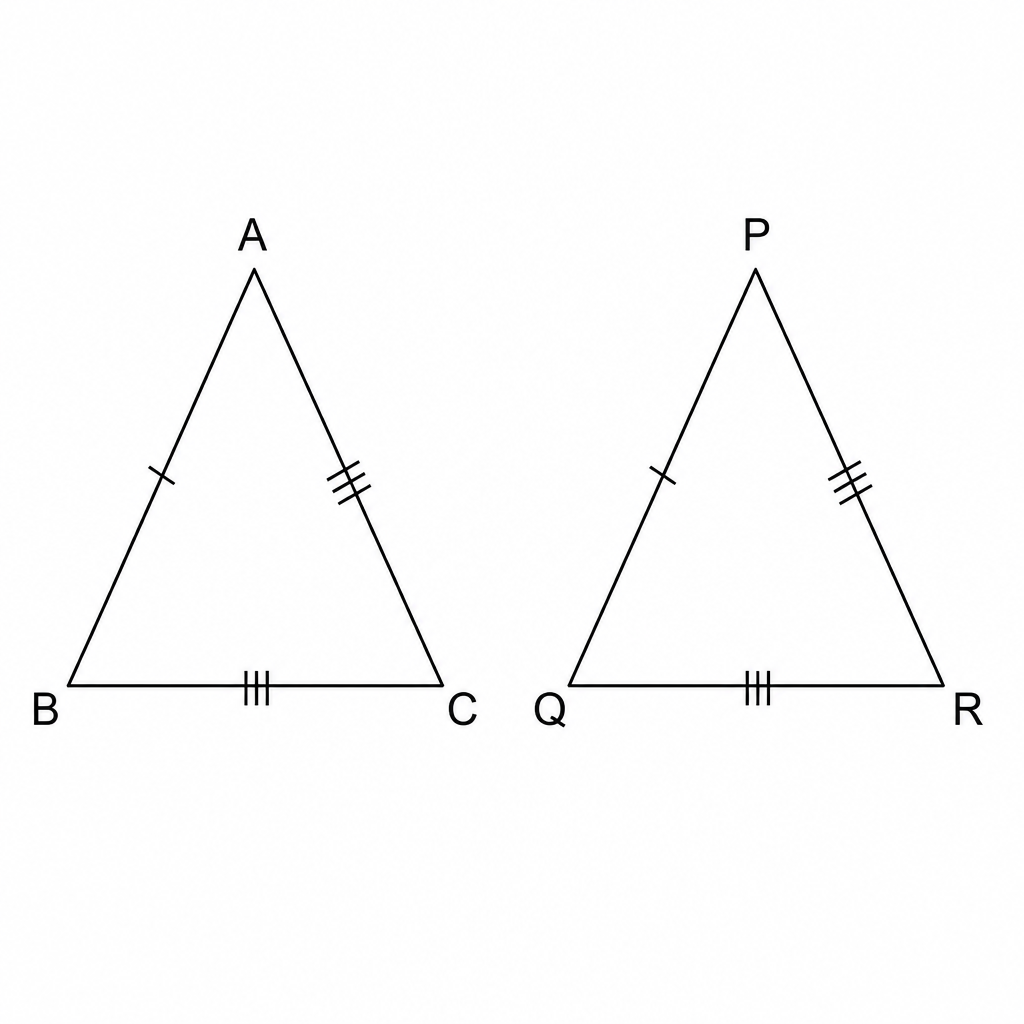
(a) In triangle ABC and triangle PQR, \( AB = PQ \), \( BC = QR \) and \( AC = PR \). All three sides are equal, so by SSS:
\[ \triangle ABC \cong \triangle PQR \]
(b) In triangle KLM and triangle STU, \( \angle KLM = \angle STU = 90^\circ \), the hypotenuses satisfy \( MK = SU \) and the sides satisfy \( LM = ST \). A right angle, a hypotenuse and a side are equal, so by RHS:
\[ \triangle KLM \cong \triangle STU \]
(c) In triangle LMN and triangle IJK, \( \angle LMN = \angle IJK \), the side \( MN = JK \) and \( \angle LNM = \angle IKJ \). The side MN lies between those two angles, so by ASA:
\[ \triangle LMN \cong \triangle IJK \]
(d) In triangle ABC and triangle DEF, \( AB = DE \), \( \angle BAC = \angle EDF \) and \( AC = DF \). The angle lies between the two sides, so by SAS:
\[ \triangle ABC \cong \triangle DEF \]
Finding an Unknown Measure from Congruent Triangles
Triangle ABC and triangle XYZ are congruent. Here \( \angle A = \angle X = 35^\circ \), \( \angle B = \angle Y = 123^\circ \) and \( \angle C = \angle Z = 22^\circ \). The sides are \( AB = (1.7x - 1.3) \) cm, \( XY = (3x - 3.9) \) cm, \( AC = 4.9 \) cm and \( BC = 4.3 \) cm. Find the value of \( x \) and the remaining side lengths.
Step 1: AB and XY are corresponding sides, so they are equal. The mathematical statement is:
\[ 1.7x - 1.3 = 3x - 3.9 \]
Step 2: Collecting the terms in \( x \) on one side and the numbers on the other:
\[ 3x - 1.7x = 3.9 - 1.3 \]
Step 3: Subtracting on both sides:
\[ 1.3x = 2.6 \]
Step 4: Dividing both sides by 1.3:
\[ x = \frac{2.6}{1.3} = 2 \]
Step 5: Putting \( x = 2 \) into the expression for AB:
\[ AB = 1.7 \times 2 - 1.3 = 2.1 \]
Step 6: Putting the same value into XY as a check:
\[ XY = 3 \times 2 - 3.9 = 2.1 \]
Step 7: Both come to 2.1 cm, so \( x = 2 \) is right. The remaining corresponding sides are equal too, so \( XZ = AC = 4.9 \) cm and \( YZ = BC = 4.3 \) cm.
Similar Figures
Draw a figure on squared paper. Now draw the same figure on a second sheet with every line segment half as long, and on a third sheet with every line segment twice as long. All three come out the same shape. The second is small and the third is large. The sizes differ because every length has been multiplied by the same number, while the angles have not changed at all.
Two plane figures of the same shape are called similar figures. Whether they are smaller, larger or of the very same size, figures of the same shape are similar.
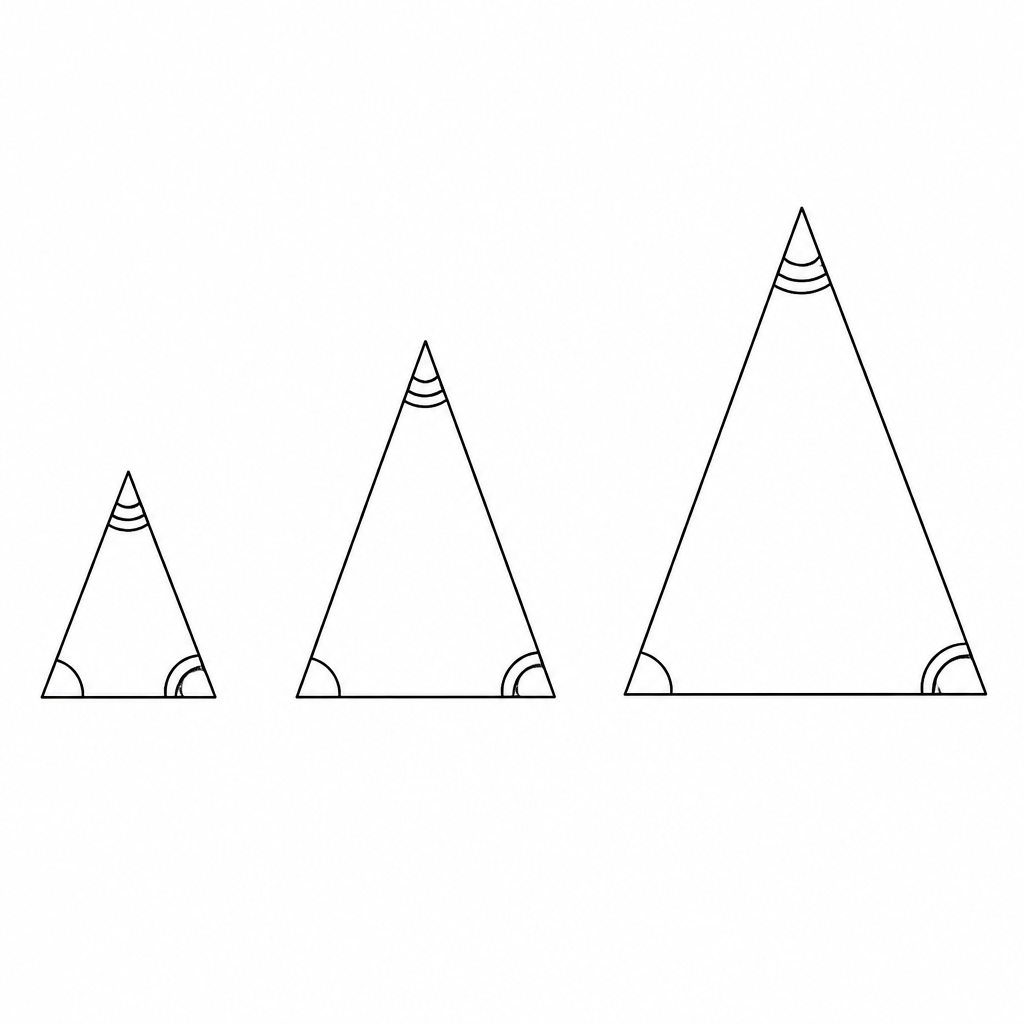
Similar Triangles
Take two line segments AB and PQ of different lengths. Put an angle of one chosen size at A and the same size at P, then an angle of another chosen size at B and the same at Q, and name the points where the arms cross C and R. The triangles ABC and PQR built this way have the same shape but different sizes. Measure their sides and all three ratios come out equal.
\[ \frac{BC}{QR} = \frac{AC}{PR} = \frac{AB}{PQ} \]
In similar triangles the equal angles are called corresponding angles and the sides opposite those equal angles are called corresponding sides. If the corresponding angles of two triangles are equal and their corresponding sides are proportional, the two triangles are called similar triangles.
Similarity has its own symbol, \( \sim \). If triangle ABC and triangle PQR are similar we write:
\[ \triangle ABC \sim \triangle PQR \]
Every pair of congruent triangles is also a pair of similar triangles, because their corresponding sides are in the ratio \( 1 : 1 \). The reverse is not true, since similar triangles need not be the same size.
Writing that the corresponding sides of similar triangles are equal is wrong. They are only proportional. It is the corresponding angles that are equal.
Finding Angles and Sides from Similar Triangles
In the first example \( \triangle ABC \sim \triangle PQR \). Here \( \angle BAC = 60^\circ \), \( \angle ABC = 70^\circ \), \( \angle BCA = 50^\circ \), \( \angle QPR = 60^\circ \) and \( \angle PQR = 70^\circ \). Name the corresponding parts and find \( \angle PRQ \).
Step 1: From the order of the letters, A corresponds to P, B to Q and C to R. So the sides opposite those equal angles, namely BC with QR, AC with PR and AB with PQ, are the corresponding sides.
Step 2: Corresponding angles are equal, so the required angle is:
\[ \angle PRQ = \angle BCA = 50^\circ \]
In the second example \( \triangle ABC \sim \triangle DEF \) with \( \angle B = \angle E \) and \( \angle C = \angle F \). The sides given are \( AB = 4 \) cm, \( AC = 3 \) cm and \( DE = 8 \) cm. Find DF.
Step 1: The corresponding sides of similar triangles are in equal ratio, so:
\[ \frac{AB}{DE} = \frac{AC}{DF} \]
Step 2: Putting in the given lengths:
\[ \frac{4}{8} = \frac{3}{DF} \]
Step 3: Cross multiplying:
\[ 4 \times DF = 8 \times 3 \]
Step 4: Dividing both sides by 4:
\[ DF = \frac{24}{4} = 6 \]
So \( DF = 6 \) cm. The ratio here is \( 1 : 2 \), which means every side of DEF is twice the corresponding side of ABC.
Telling Congruency and Similarity Apart
| Basis | Congruent triangles | Similar triangles |
| Shape | Same | Same |
| Size | Equal | May or may not be equal |
| Corresponding angles | Equal | Equal |
| Corresponding sides | Equal | Proportional |
| Ratio of sides | 1 : 1 | Any one fixed ratio |
| Symbol | ≅ | ~ |
If the corresponding sides of two triangles come out in the ratio \( 1 : 1 \), the triangles are not merely similar, they are congruent.
The full lesson is waiting for you
The notes are free to read in full. A free account opens the rest of the practice, and tracks your progress and confidence score for every subject. Presentations and videos need approval from Learn Yeti.