Knowing a Triangle by Its Sides and Its Angles
One triangle always carries two names at the same time. The first name comes from its sides. A triangle with all three sides equal is equilateral. A triangle with exactly two equal sides is isosceles, and the remaining side is called its base. A triangle with three unequal sides is scalene. The second name comes from its angles. If all three angles are smaller than 90 degrees the triangle is acute angled, if one angle is exactly 90 degrees it is right angled, and if one angle is larger than 90 degrees it is obtuse angled.
The small tick marks drawn on the sides tell you which sides are equal, and the small square drawn at a corner tells you that corner is a right angle. Once you can read these two marks you can name a triangle without measuring anything.
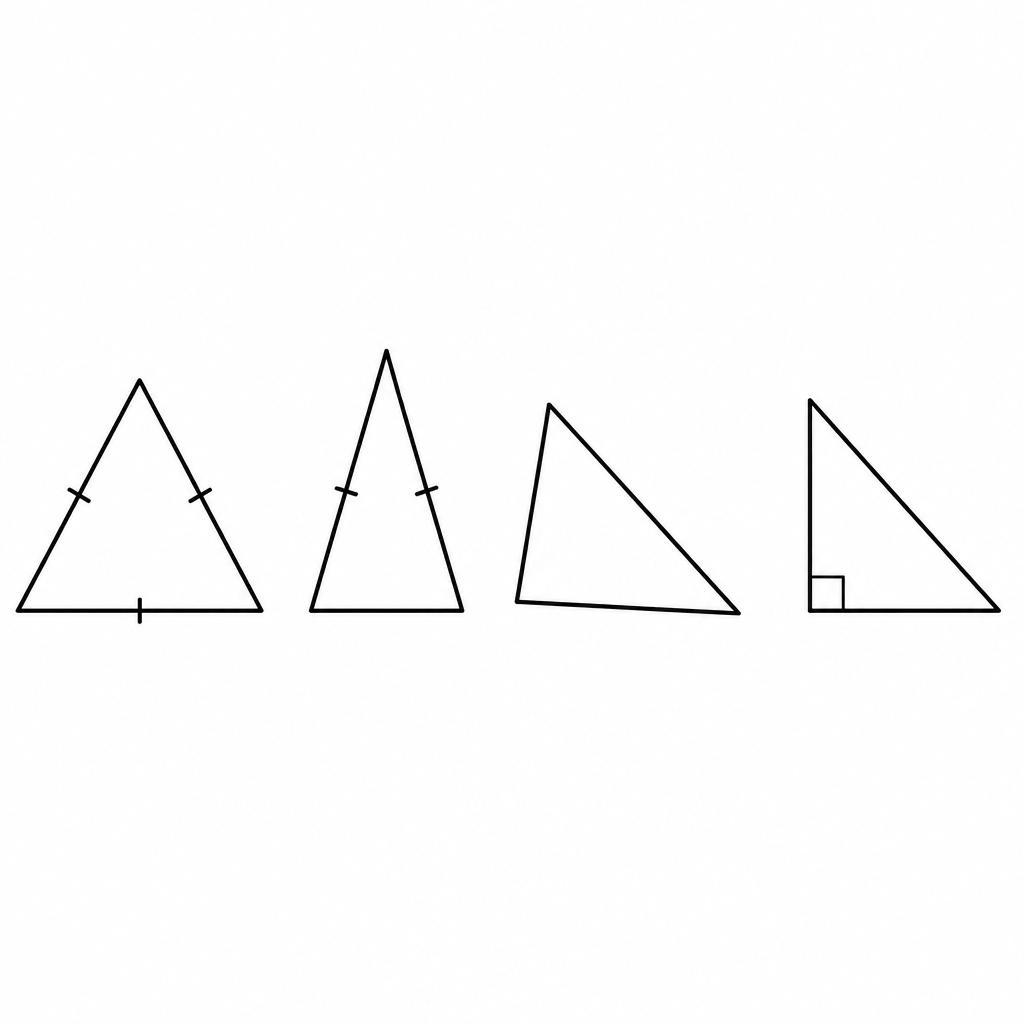
The Three Angles of a Triangle
Draw a triangle on paper and cut it out. Now tear off all three corners and lay them side by side so that their points meet at one place. The three corners always close up into a straight line. The angle along a straight line measures 180 degrees, so the three angles of the triangle must add up to 180 degrees as well.
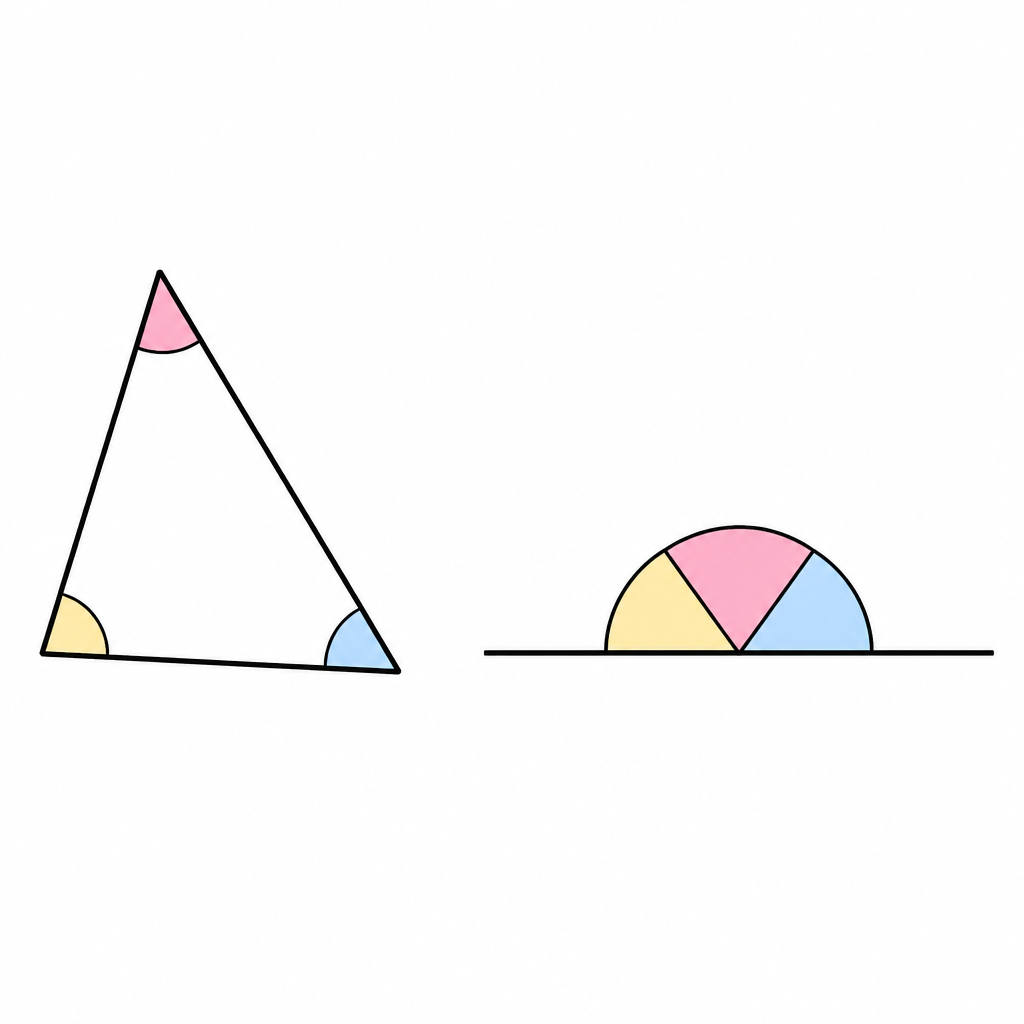
The three interior angles of a triangle add up to 180 degrees.
\[ \angle A + \angle B + \angle C = 180^\circ \]
The Angles of an Equilateral Triangle
Cut out an equilateral triangle and fold it so that vertex B lands exactly on vertex C. Angle B sits perfectly on top of angle C. Fold it again so that C lands on A, and angle C sits on top of angle A. This means all three angles are equal. Since three equal angles must still total 180 degrees, each one measures \( 180^\circ \div 3 = 60^\circ \).
All the angles of an equilateral triangle are equal, so each one of them measures 60 degrees.
The Base Angles of an Isosceles Triangle
Cut out a triangle with two equal sides and fold it down the middle so that vertex B falls on vertex C. Angle B settles exactly on angle C. The angle between the two equal sides is called the vertex angle, and the other two are the base angles. Folding any isosceles triangle, whatever its size, gives the same result every time.
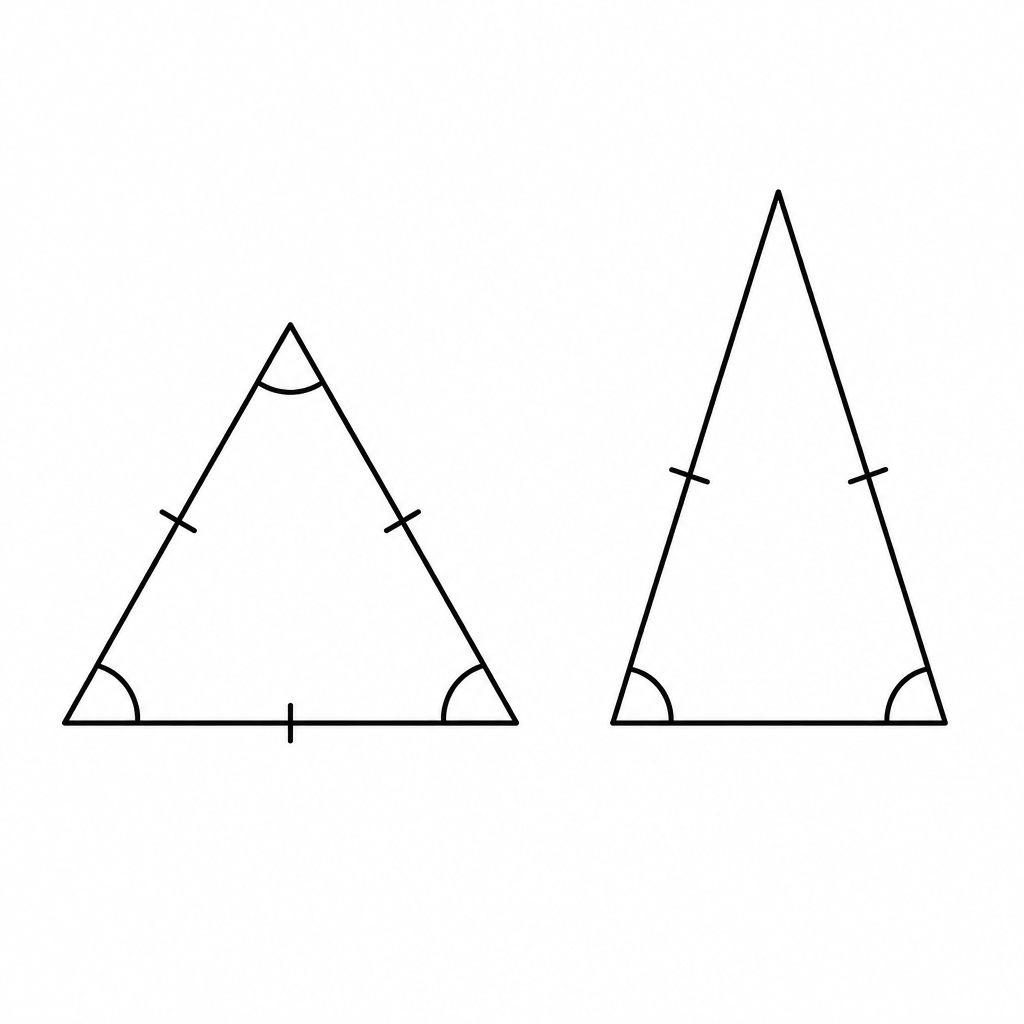
The base angles of an isosceles triangle are equal to each other.
Do not write that all the angles of an isosceles triangle are equal. Only the two base angles are equal, and the vertex angle can be quite different from them.
The Right Angled Isosceles Triangle
When one angle of a triangle is a right angle and the two sides forming that right angle are equal, the triangle is called a right angled isosceles triangle. Here the vertex angle is 90 degrees, so the other two angles must share \( 180^\circ - 90^\circ = 90^\circ \) between them. Those two are base angles, so they are equal, and each one measures \( 90^\circ \div 2 = 45^\circ \).
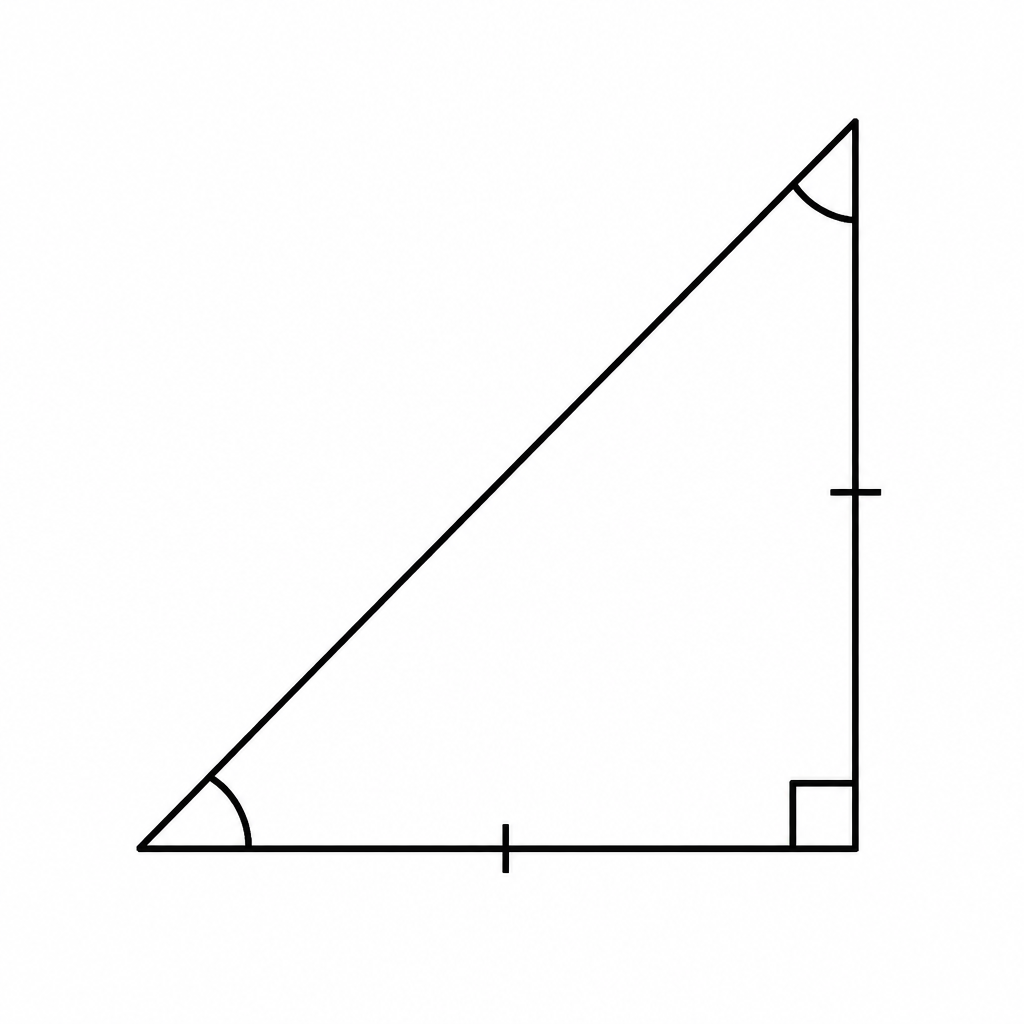
Each base angle of a right angled isosceles triangle measures 45 degrees.
Working Out a Missing Angle
In a triangle ABC the angle ABC is a right angle and its size is written as 2x. The angle BCA and the angle CAB are each written as x. Let us find the value of x.
Step 1: The three interior angles of a triangle add up to 180 degrees, so:
\[ \angle ABC + \angle BCA + \angle CAB = 180^\circ \]
Step 2: Putting in the sizes that are given:
\[ 2x + x + x = 180^\circ \]
Step 3: Collecting the like terms together:
\[ 4x = 180^\circ \]
Step 4: Dividing both sides by 4:
\[ x = 45^\circ \]
The same answer comes out of a second route. The given triangle is a right angled isosceles triangle, so angle ABC is 90 degrees and the base angles are angle BCA = angle CAB = 45 degrees. So x is 45 degrees either way.
Now look at a case where parallel lines join in. Here NM and OP are parallel and the line MO cuts across both of them. In the triangle MNO the angle MNO is 80 degrees and the angle NMO is 70 degrees. The angle MON is marked x and the angle MOP is marked y.
Step 1: The transversal MO makes a pair of alternate angles, and alternate angles are equal, so:
\[ y = 70^\circ \]
Step 2: Writing the angle sum of the triangle MNO:
\[ 80^\circ + 70^\circ + x = 180^\circ \]
Step 3: Adding the two known angles:
\[ 150^\circ + x = 180^\circ \]
Step 4: Taking 150 degrees from both sides:
\[ x = 30^\circ \]
The Diagonals of a Rhombus
Rhombus: a quadrilateral whose four sides are all equal in length and whose opposite sides are parallel.
Diagonal: the straight line segment joining two opposite vertices of a quadrilateral.
Draw both diagonals AC and BD of a rhombus ABCD. They cross at a point O. Now measure AO, CO, BO and DO. In a rhombus of any size AO and CO come out equal, and BO and DO come out equal too. Measuring angle AOB and angle BOC gives 90 degrees for both. So each diagonal cuts the other exactly in half, and the angle between them is a right angle.
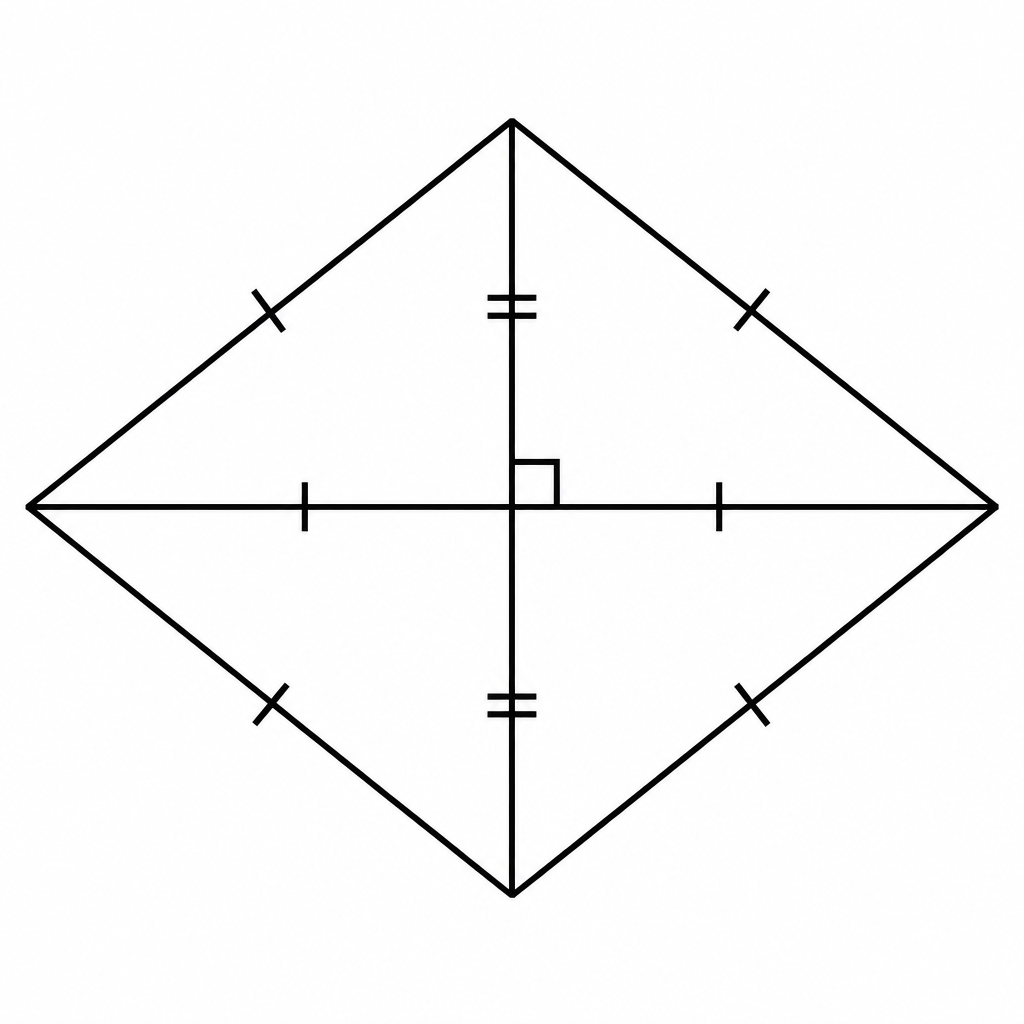
Measuring the angles that the diagonals cut the corner angles into shows a second property. Angle ADB equals angle BDC, and angle BAC equals angle CAD. So each diagonal cuts the corner angle it passes through into two equal halves.
The diagonals of a rhombus bisect each other at right angles, and each diagonal also bisects the corner angle it meets.
Rhombus and Square Compared
Take eight sticks of the same length and build two closed figures from four sticks each. One can be made into a rhombus and the other into a square. Both have four equal sides, yet they are not the same figure.
| What is the same | What is different |
| All four sides are equal. | Every angle of a square is 90 degrees, but a rhombus has no such rule. |
| The four angles add up to 360 degrees. | All angles of a square are equal, while a rhombus has only its opposite angles equal. |
| Opposite sides are parallel. | The two diagonals of a square are equal in length, but those of a rhombus are not. |
The Properties of a Kite
Kite: a quadrilateral that has two pairs of equal adjacent sides.
In a kite ABCD the sides AB and AD are equal and the sides BC and DC are equal. It has two diagonals, AC and BD, and they are not the same length. The long diagonal AC and the short diagonal BD cross at a point P. Measuring BP and PD gives equal lengths, and angle APB and angle APD both come out as 90 degrees. AP and PC, however, are not equal. So the long diagonal bisects the short one, and not the other way round.
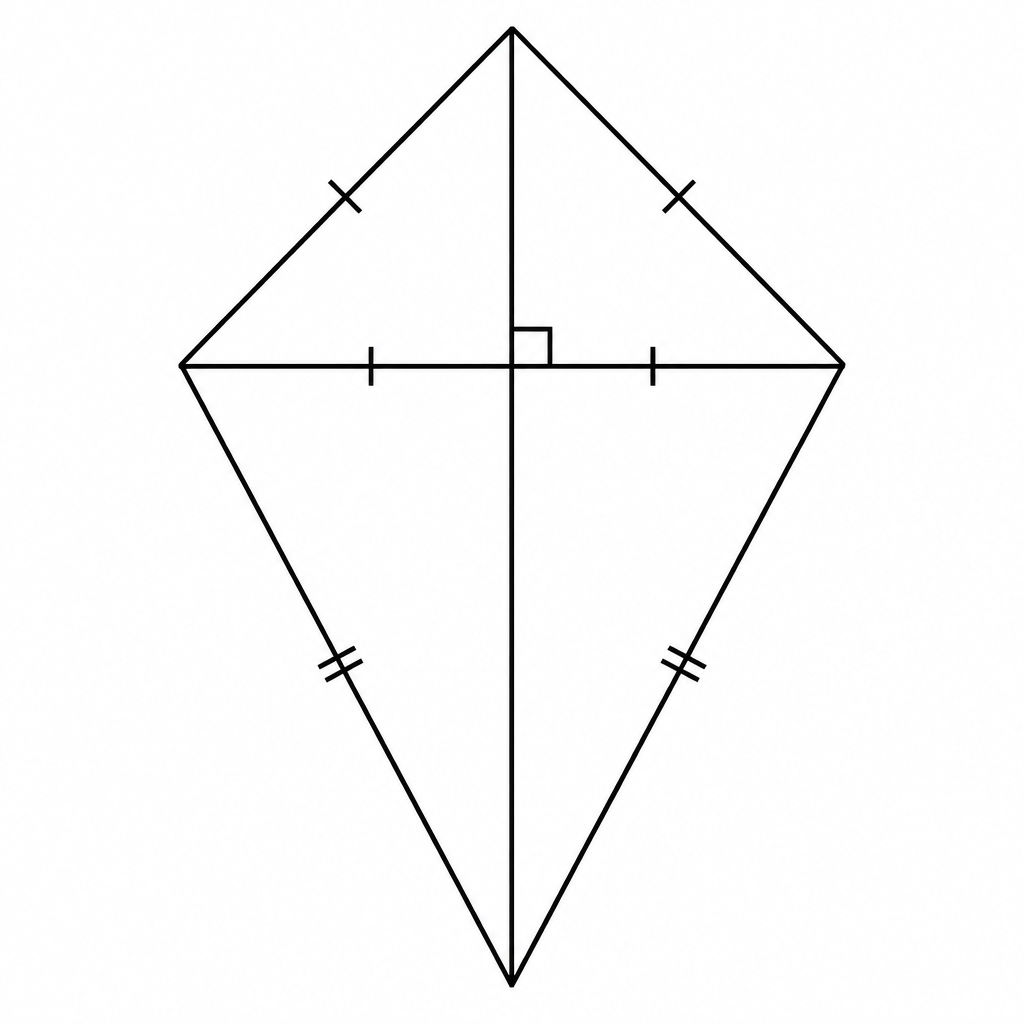
The short diagonal BD splits the kite into triangle ABD and triangle BCD. In triangle ABD the sides AB and AD are equal, so it is isosceles, and in triangle BCD the sides BC and DC are equal, so it is isosceles too. Also the angles caught between the unequal sides, that is angle ABC and angle ADC, are equal to each other.
A quadrilateral with two pairs of equal adjacent sides is a kite. Its long diagonal bisects the short diagonal at right angles, the angles between the unequal sides are equal, and the short diagonal divides the kite into two isosceles triangles.
Do not write that the short diagonal of a kite bisects the long one. It works the other way: the long diagonal is the one that cuts the short diagonal exactly in half.
Finding the Length of a Diagonal
In a rhombus ABCD the side AB is 5 cm and the diagonals cross at the point P, with BP measuring 3 cm. Let us find the length of the diagonal AC. Because the diagonals cross at right angles, triangle APB is a right angled triangle, so the Pythagoras relation \( h^2 = p^2 + b^2 \) can be used on it.
Step 1: Writing the Pythagoras relation for the right angled triangle APB:
\[ AB^2 = AP^2 + BP^2 \]
Step 2: Putting in the lengths that are given:
\[ 5^2 = AP^2 + 3^2 \]
Step 3: Working out the squares:
\[ 25 = AP^2 + 9 \]
Step 4: Taking 9 from both sides:
\[ AP^2 = 16 \]
Step 5: Taking the square root:
\[ AP = 4 \text{ cm} \]
Step 6: Since P bisects AC, the whole diagonal is twice that length:
\[ AC = 2 \times 4 = 8 \text{ cm} \]
The Trapezium
A parallelogram has both pairs of opposite sides parallel. What happens if only one of those pairs is left parallel? The figure that comes out has one pair of opposite sides parallel while the other pair is not parallel at all. A quadrilateral like this is called a trapezium.
Trapezium: a quadrilateral in which only one pair of opposite sides is parallel.
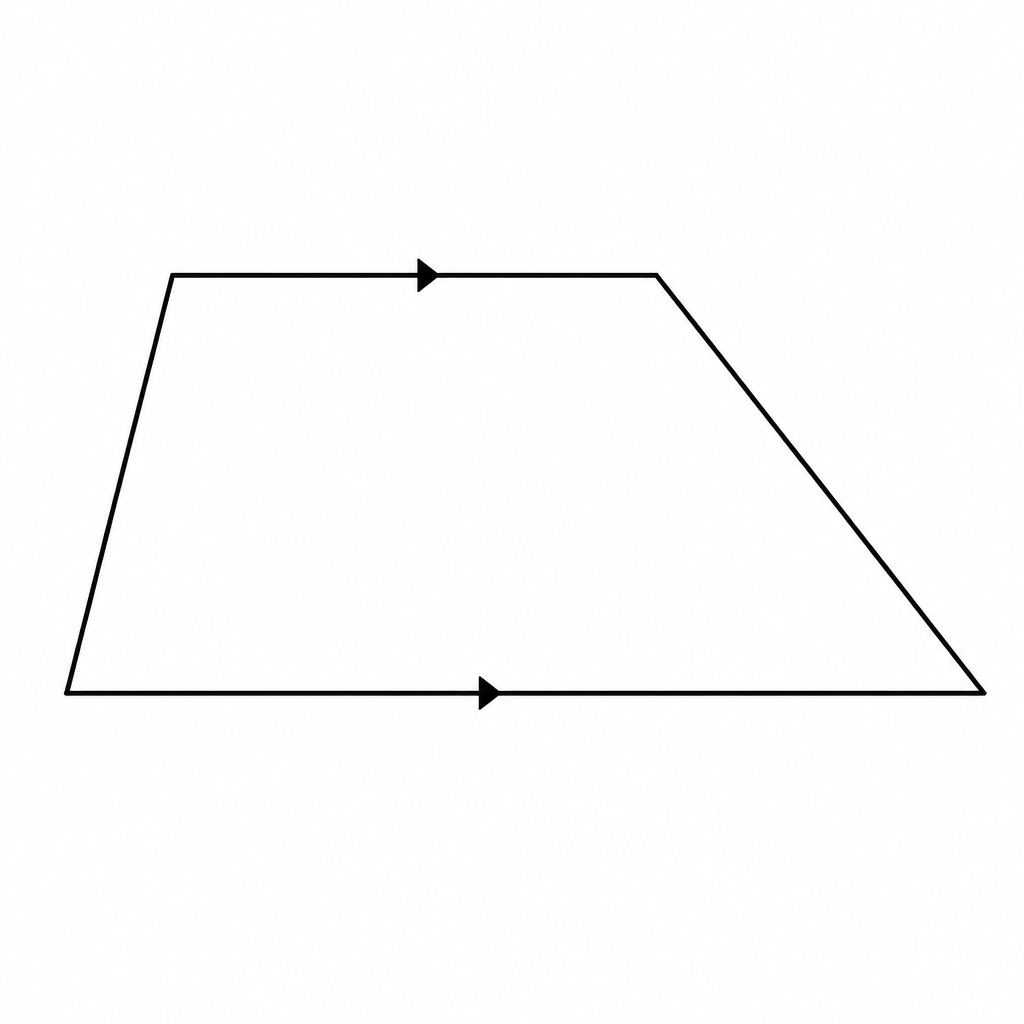
In a trapezium ABCD the sides AB and DC are parallel while AD and BC are not. Measure the two interior angles that sit on the non parallel side AD, that is angle DAB and angle ADC, and add them. The total is 180 degrees. The two angles on the other non parallel side BC, angle ABC and angle BCD, also add up to 180 degrees.
The two interior angles standing on a non parallel side of a trapezium add up to 180 degrees, which is exactly why its one pair of opposite sides is parallel.
Rhombus: four equal sides, diagonals bisecting each other at right angles.
Kite: two pairs of equal adjacent sides, the long diagonal bisecting the short one.
Trapezium: only one pair of opposite sides parallel.
Constructing a Rectangle and a Square
Every angle of a rectangle is 90 degrees and its opposite sides are equal, so knowing two adjacent sides is enough to build the whole figure. Here is how a rectangle ABCD with adjacent sides of 5 cm and 3 cm is constructed.
- Draw a rough sketch of the rectangle first.
- On a base line mark off AB so that it measures 5 cm.
- At A use the compass to construct an angle of 90 degrees, giving a ray AF so that angle FAB is 90 degrees.
- Open the compass to 3 cm, put its point at A and cut the ray AF. Call the cut point D.
- At B construct an angle of 90 degrees in the same way, giving a ray BH so that angle HBA is 90 degrees.
- With the compass still open to 3 cm, put its point at B and cut the ray BH. Call the cut point C.
- Join C to D. The rectangle ABCD is now complete.
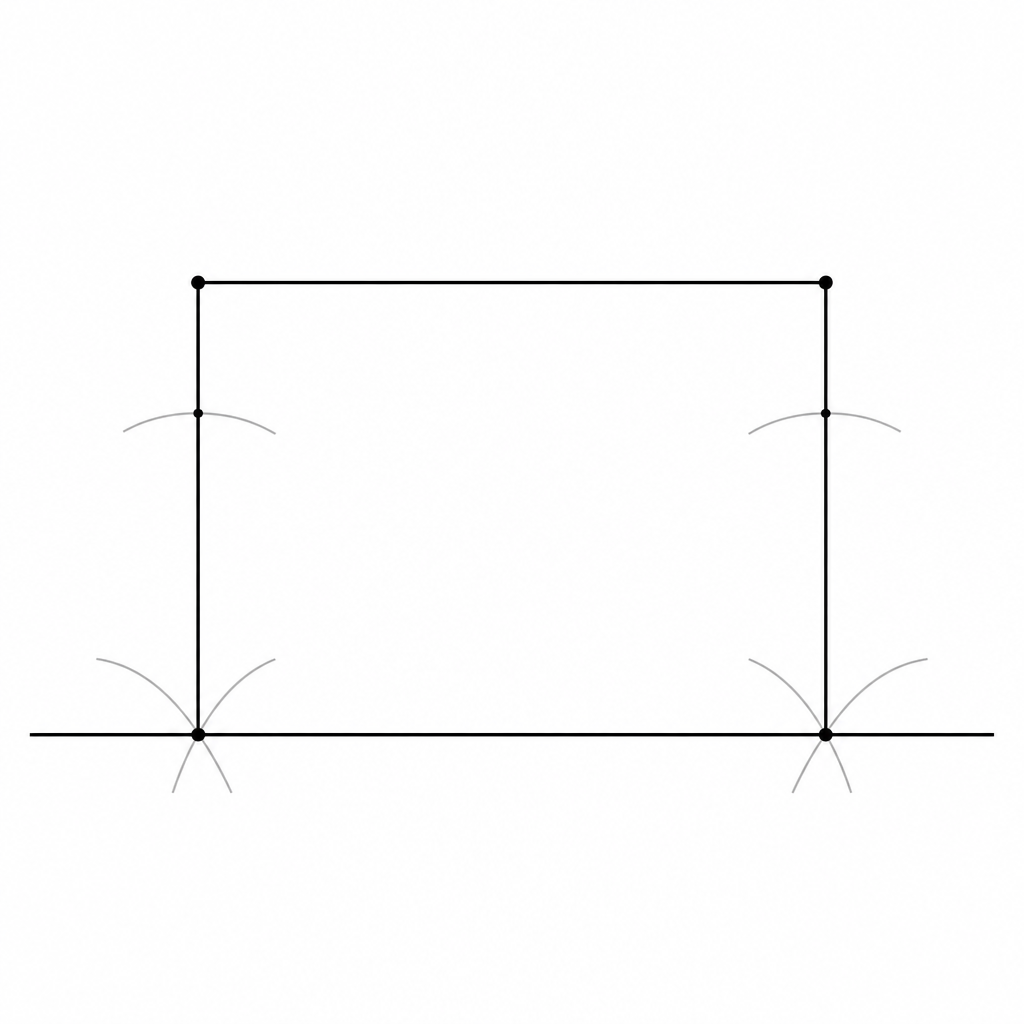
A square has four equal sides and four right angles, so one side length is all the information needed. To build a square of side 4 cm, follow exactly the same steps, but mark AB as 4 cm on the base line and draw both arcs with the compass opened to 4 cm. Joining C and D completes the square ABCD.
Do not change the compass opening between one arc and the next, or the sides will not come out equal. The compass point is also very sharp, so never leave it turned towards yourself or towards the student beside you.
Constructing a Parallelogram
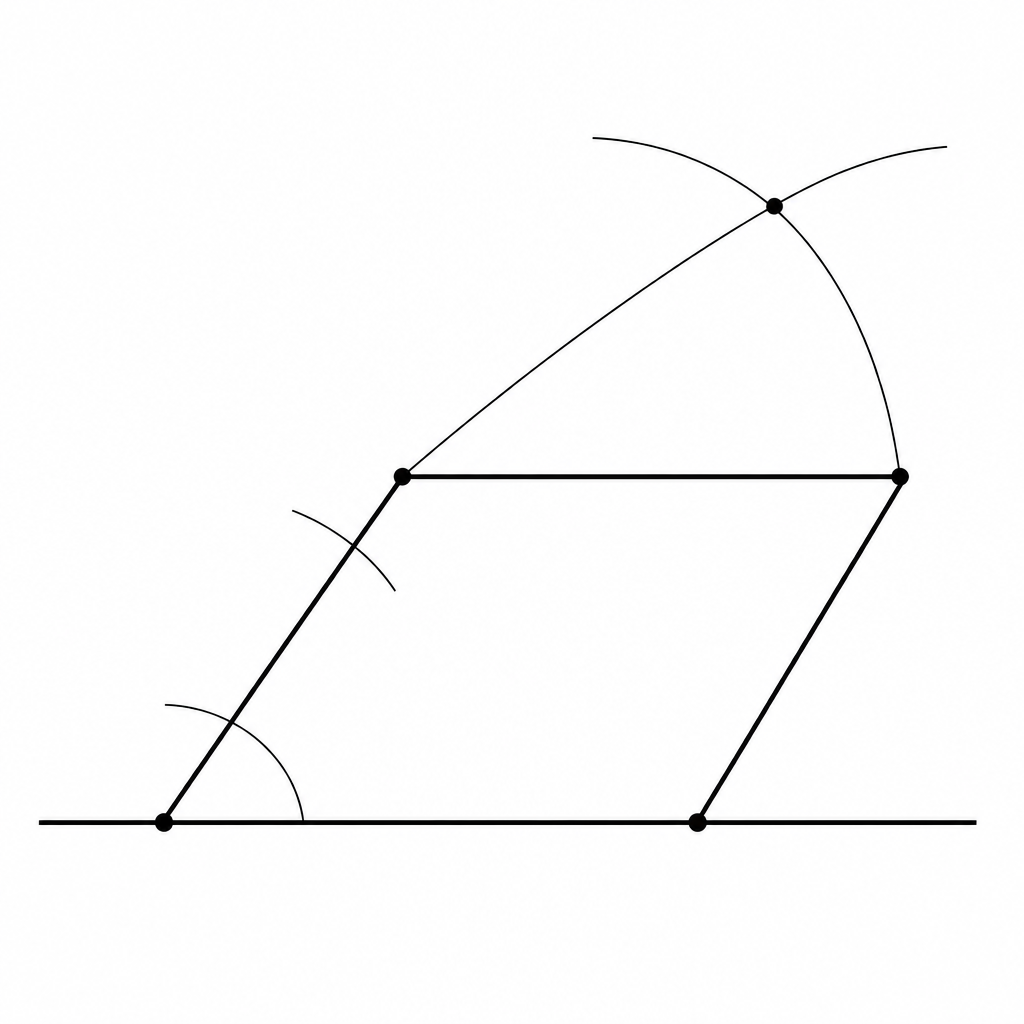
The opposite sides of a parallelogram are equal and parallel. The information given can come in different forms, so the method changes with it. In the first case the two adjacent sides are 7 cm and 4 cm and the angle between them is 60 degrees.
- Draw a rough sketch first.
- On a base line mark off AB so that it measures 7 cm.
- At A construct an angle of 60 degrees with the compass, giving a ray AF so that angle FAB is 60 degrees.
- Open the compass to 4 cm, put its point at A and cut the ray AF. Call the cut point D.
- From B draw an arc equal to AD, and from D draw an arc equal to AB. Call the point where they cross C.
- Join C to D and B to C.
- The parallelogram ABCD is now complete.
In the second case the adjacent sides are 7 cm and 4 cm and one diagonal is 8 cm long. Here a triangle is built first and the remaining vertex is found afterwards.
- Draw a rough sketch first.
- On a base line mark off AB so that it measures 7 cm.
- Draw an arc of radius 8 cm from A and an arc of radius 4 cm from B.
- Call the crossing point C, then join A to C and B to C. Triangle ABC is now made.
- Draw an arc of radius 4 cm from A and an arc of radius 7 cm from C. Call the crossing point D.
- Join A to D and C to D.
- The parallelogram ABCD is now complete.
In the third case the adjacent sides are AB = 7 cm and AD = 4 cm, and the diagonal makes an angle of 30 degrees with the side AB.
- Draw a rough sketch first.
- On a base line mark off AB so that it measures 7 cm.
- At A construct an angle of 30 degrees with the compass, so that angle FAB is 30 degrees.
- Open the compass to 4 cm, put its point at B and cut the ray AF. Call the cut point C.
- Join B to C. Triangle ABC is now made.
- Draw an arc of radius 4 cm from A and an arc of radius 7 cm from C. Call the crossing point D.
- Join A to D and C to D. The parallelogram ABCD is now complete.
Polygons and Regular Polygons
Polygon: a closed geometrical figure made of three or more straight sides.
A circle is not a polygon because it has no straight sides. A figure with a gap in its outline is not a polygon either, because it is not closed. A polygon made of three sides is called a triangle. In the same way, figures made of four, five and six sides are called a quadrilateral, a pentagon and a hexagon.
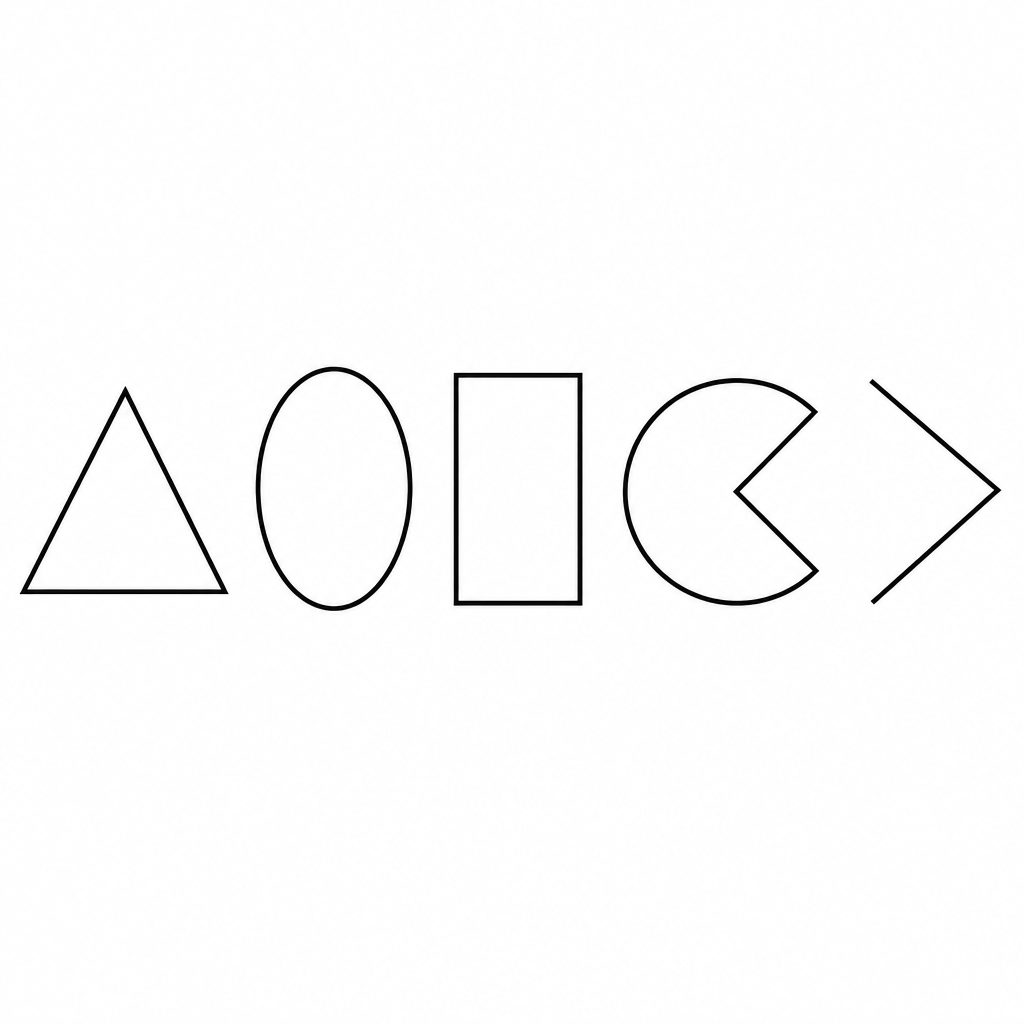
Regular polygon: a polygon in which all the sides are equal and all the interior angles are equal as well.
A rectangle has all its angles equal, but only its opposite sides are equal, so it is not regular. An isosceles triangle has only its base angles equal, so it is not regular either. An equilateral triangle is the regular triangle, and a square is the regular quadrilateral. Beyond four sides the regular figures are named regular pentagon, regular hexagon and so on.
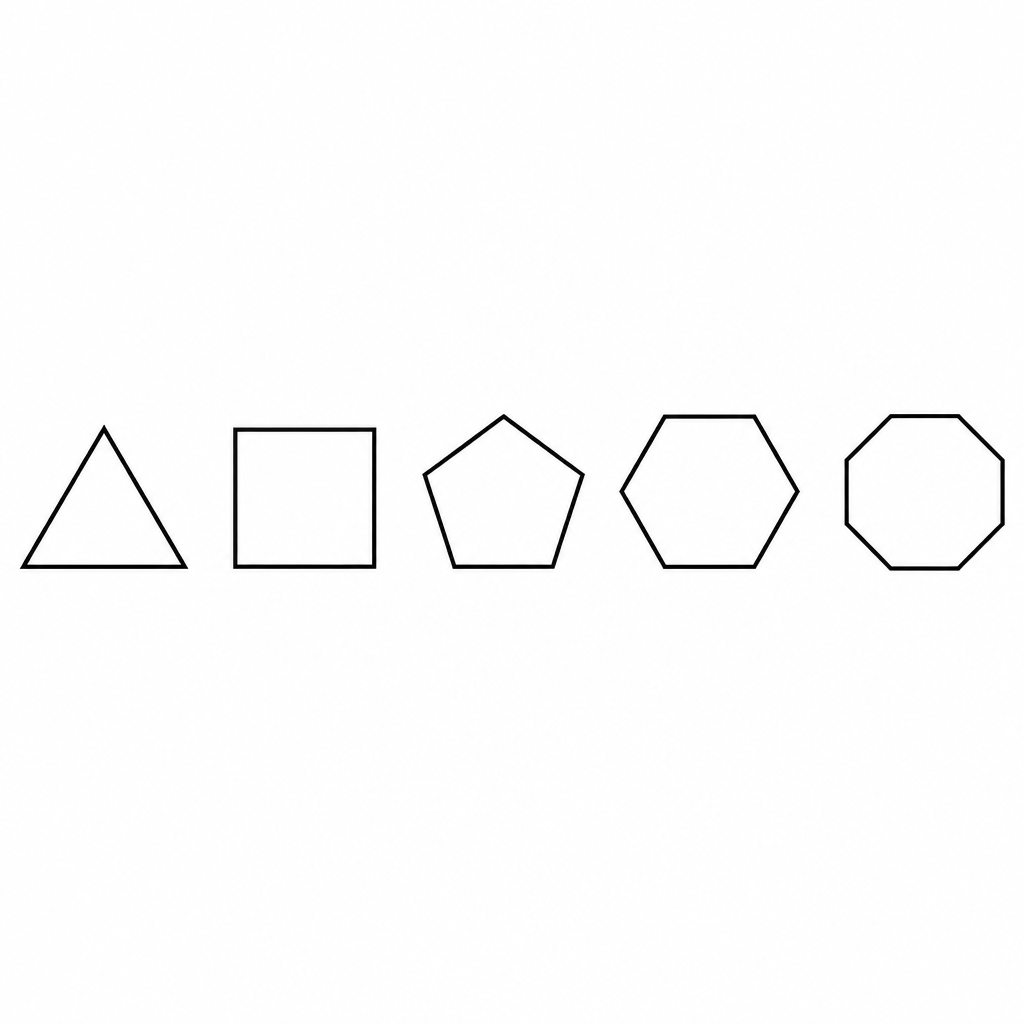
The Interior Angles of a Polygon
Draw every diagonal of a polygon from one single vertex. A quadrilateral splits into 2 triangles, a pentagon into 3 and a hexagon into 4. Each time the number of triangles is 2 less than the number of sides, so a polygon of n sides gives \( n - 2 \) triangles. Every one of those triangles holds 180 degrees, so the interior angles of the whole polygon add up to that many lots of 180 degrees.
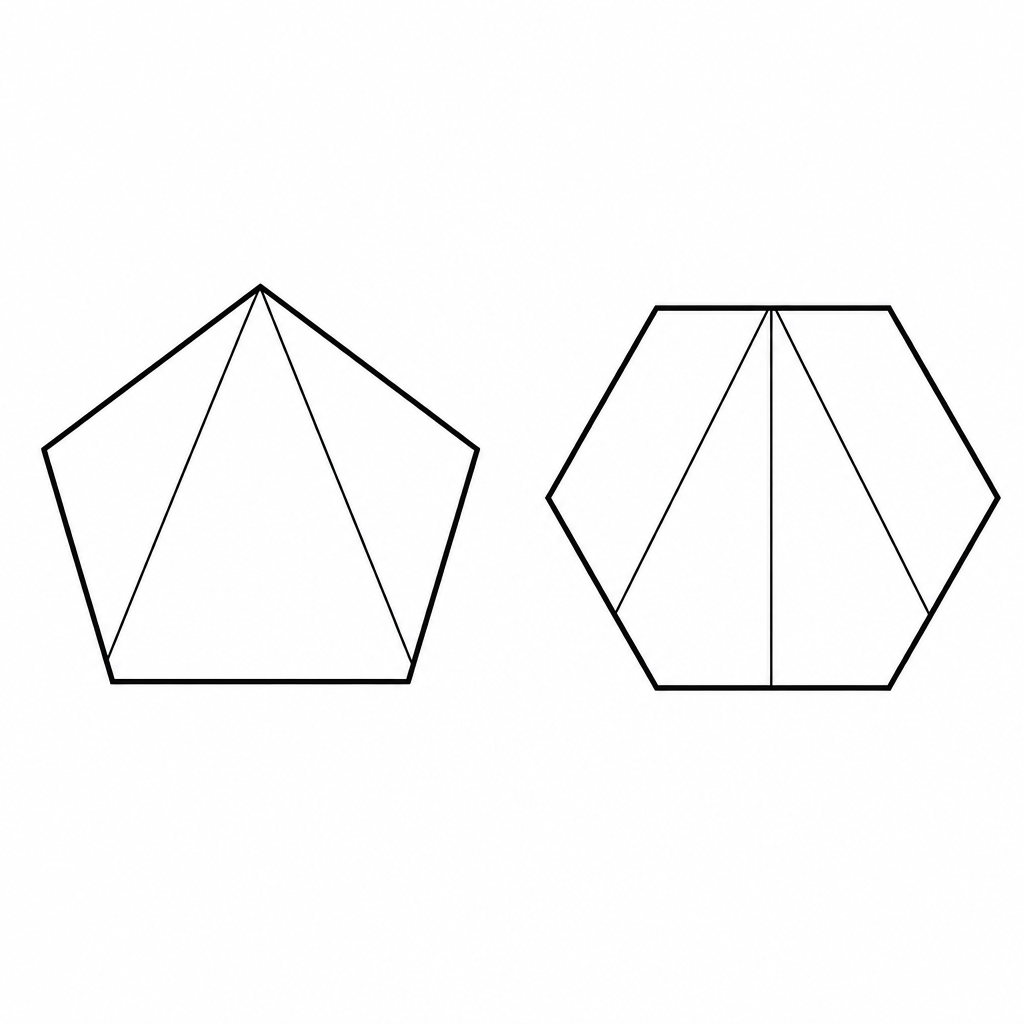
Writing S for the sum of the interior angles of a polygon with n sides:
\[ S = (n - 2) \times 180^\circ \]
In a regular polygon all the interior angles are equal, so dividing the total by the number of sides gives the size of one angle:
\[ \frac{(n - 2)}{n} \times 180^\circ \]
| Name | n | Triangles | Angle sum | Each angle |
| Triangle | 3 | 1 | 180° | 60° |
| Quadrilateral | 4 | 2 | 360° | 90° |
| Pentagon | 5 | 3 | 540° | 108° |
| Hexagon | 6 | 4 | 720° | 120° |
| Octagon | 8 | 6 | 1080° | 135° |
The Exterior Angles of a Polygon
Exterior angle: the angle formed between one side of a polygon and the next side extended beyond the vertex.
Extend every side of a regular polygon the same way round, making one exterior angle at each vertex, then measure them with a protractor. An equilateral triangle gives three exterior angles of 120 degrees, which total 360 degrees. A square gives four of 90 degrees, totalling 360 degrees again. A regular pentagon gives five of 72 degrees, and the total is 360 degrees once more. However many sides the polygon has, this total never changes.
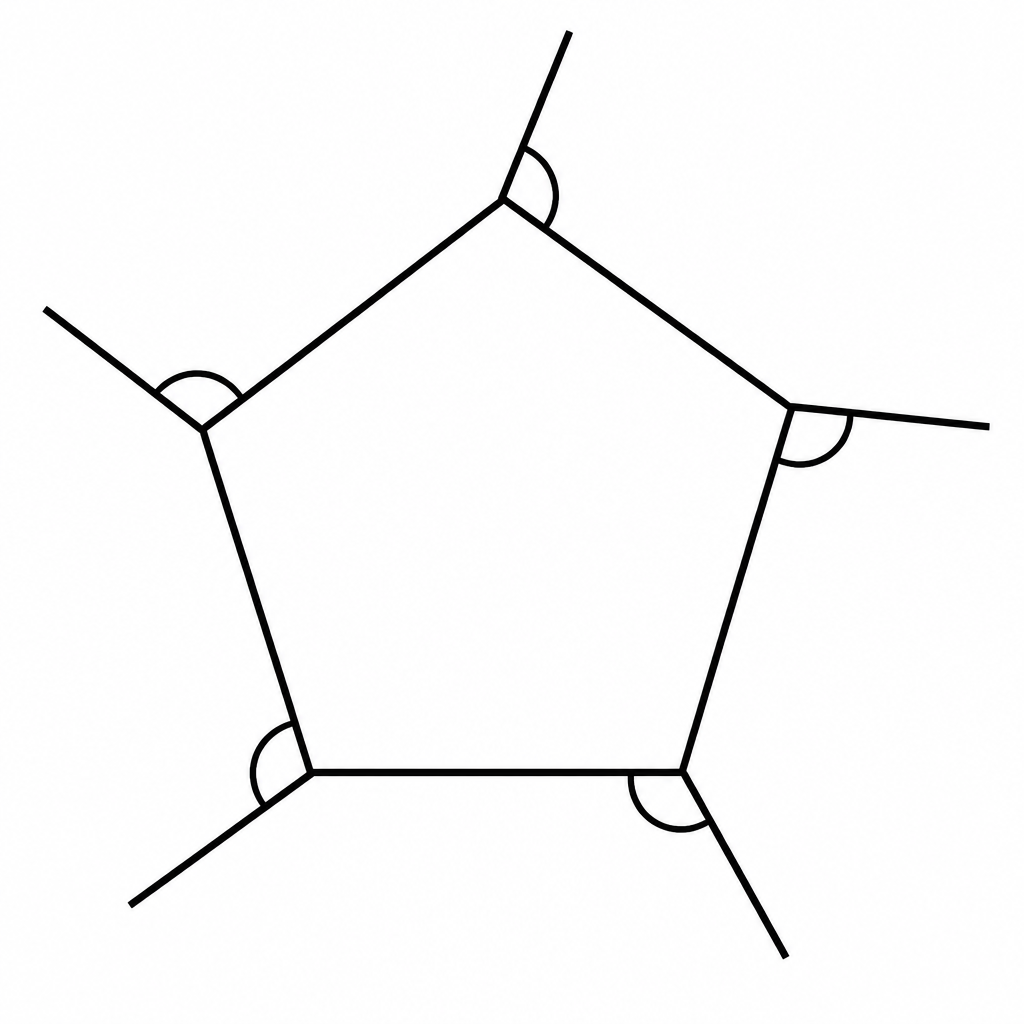
So the exterior angles of a polygon with n sides always total 360 degrees, and one exterior angle of a regular polygon measures:
\[ \frac{360^\circ}{n} \]
Let us find the sum of the interior angles and of the exterior angles of a polygon with 5 sides. Here the number of sides is \( n = 5 \).
Step 1: Putting the value of n into the rule for the interior angle sum:
\[ S = (5 - 2) \times 180^\circ \]
Step 2: Doing the subtraction inside the bracket:
\[ S = 3 \times 180^\circ \]
Step 3: Carrying out the multiplication:
\[ S = 540^\circ \]
Step 4: The sum of the exterior angles does not depend on the number of sides, so:
\[ 360^\circ \]
The full lesson is waiting for you
The notes are free to read in full. A free account opens the rest of the practice, and tracks your progress and confidence score for every subject. Presentations and videos need approval from Learn Yeti.