Parallel Lines Around Us
Many things we see every day have two straight edges that keep the same distance apart all the way along. The two banks of a river, the two edges of a road, the two edges of a bridge and the opposite edges of a table are good examples. The two upright edges of a door run the same way. However far you imagine those edges being stretched, they never meet each other.



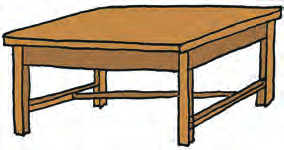
In all four of these pictures the gap between the two edges never widens and never narrows. That steady gap is what parallel lines are built on. When we measure the gap between two lines we always measure the perpendicular distance, that is, the distance taken at exactly 90 degrees from one line across to the other.
Parallel lines: if two straight line segments are extended endlessly in both directions and still never intersect, and the perpendicular distance between them stays the same everywhere, the lines are called parallel lines.
When line AB and line CD are parallel we write it in symbols as \( AB // CD \) and read it as "AB is parallel to CD". The idea also works the other way round. If the perpendicular distance between two lines is found to be the same at every place, then those two lines are parallel to each other.
But not every object with two edges gives us parallel lines. The edge of a round garden bends all the way, so there is no straight line there at all. Before two lines can be parallel, both of them must first be straight.

The Transversal
Now let us bring in a third line beside two others. One straight line can cut two or more straight lines. When it does, the cutting line is given the name transversal, but one condition has to be met. The points where it cuts must be different points.
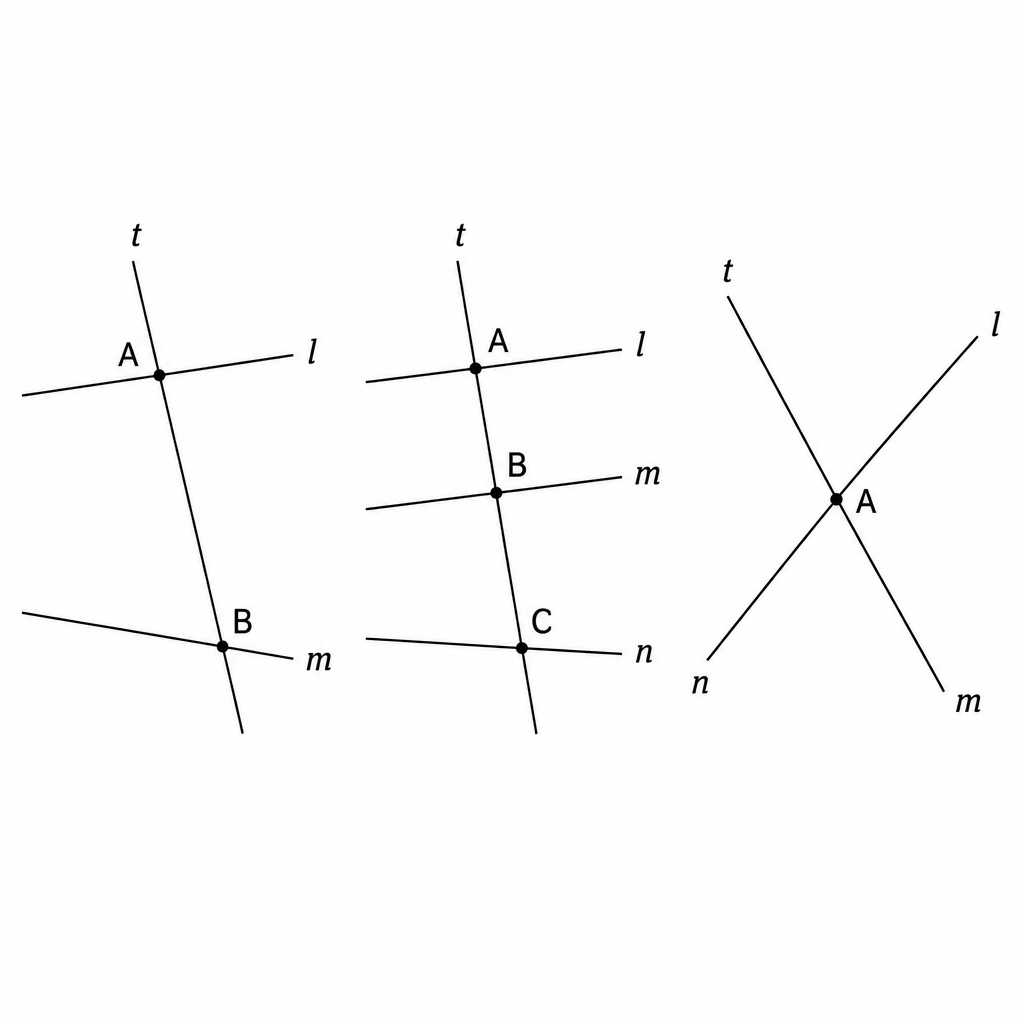
In the first picture l and m are two straight lines and t cuts them at the separate points A and B, so t is a transversal. In the second picture l, m and n are three straight lines and t cuts them at the three separate points A, B and C, so t is a transversal here too. In the third picture, though, every line passes through the single point A. Nothing is cut at separate points there, so t is not a transversal.
Transversal: a line that cuts two or more straight lines at different points is called a transversal.
If several lines all pass through one single point, there is no transversal there. Cutting is not enough on its own; the cuts must happen at different points.
The Eight Angles Made by a Transversal
When a transversal cuts two lines, four angles are made at each crossing, so eight angles are made in all. To give these angles names we put letters at the ends of the two lines and letters at the points where the cuts happen.
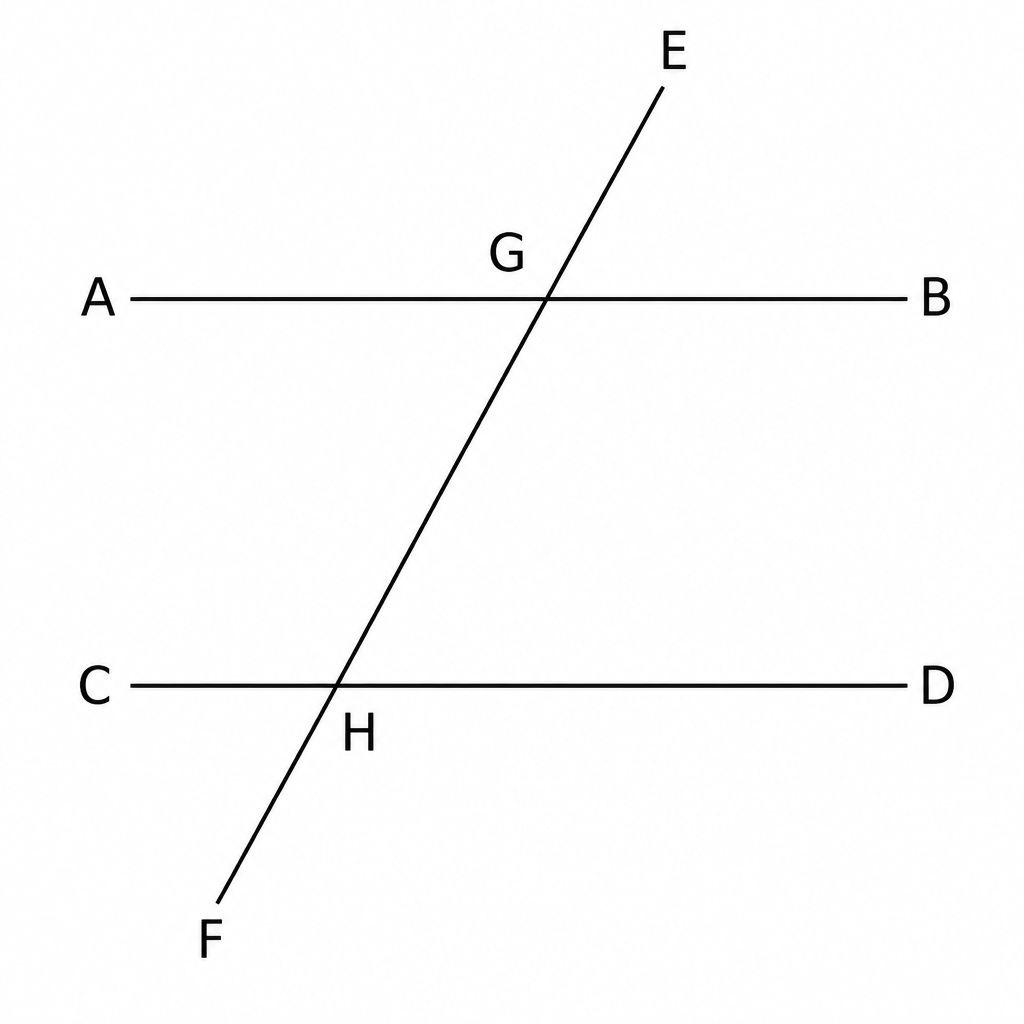
An angle that lies in the space between the two lines is called an interior angle, and an angle that lies outside the two lines is called an exterior angle. Telling these apart matters, because the names of the angle pairs are built on interior and exterior.
- Interior angles: ∠AGH, ∠BGH, ∠CHG and ∠DHG.
- Exterior angles: ∠AGE, ∠BGE, ∠CHF and ∠DHF.
- Angles on the left of the transversal: ∠AGE, ∠AGH, ∠CHG and ∠CHF.
- Angles on the right of the transversal: ∠BGE, ∠BGH, ∠DHG and ∠DHF.
Two angles that sit side by side at the same crossing are called adjacent angles. Angles that are at different crossings and are not side by side are called non adjacent angles. All three named pairs below are pairs of non adjacent angles.
The Three Named Pairs of Angles
Alternate angles: when two straight lines are cut by a transversal, the non adjacent interior angles lying on opposite sides of the transversal are called alternate angles. ∠AGH and ∠DHG, and also ∠BGH and ∠CHG, are alternate angles.
Corresponding angles: when two straight lines are cut by a transversal, a non adjacent pair lying on the same side of the transversal with one angle exterior and the other interior is called a pair of corresponding angles. ∠AGE and ∠CHG, ∠BGE and ∠DHG, ∠CHF and ∠AGH, and ∠BGH and ∠DHF are corresponding angles.
Co-interior angles: when two straight lines are cut by a transversal, the non adjacent interior angles lying on the same side of the transversal are called co-interior angles. ∠AGH and ∠CHG, and also ∠BGH and ∠DHG, are co-interior angles.
Two questions are enough to tell the three names apart. First question: are the two angles on the same side of the transversal or on opposite sides? Second question: are both angles interior, or is one interior and the other exterior? The two answers together name the pair.
| Name of the pair | Side of the transversal | Where the angles lie | Relation when the lines are parallel |
| Alternate angles | Opposite sides | Both interior, non adjacent | Equal in measure |
| Corresponding angles | Same side | One exterior, one interior | Equal in measure |
| Co-interior angles | Same side | Both interior, non adjacent | They add up to 180° |
Spotting the Pairs by Z, C and F Shapes
With eight angles in one figure it is easy to mix the pairs up. A useful habit is to look for the shape of a capital letter. Where the two lines and the transversal make the shape of a Z, the two angles in its corners are alternate angles. Where they make the shape of an F, its two angles are corresponding angles. Where they make the shape of a C, its two angles are co-interior angles.
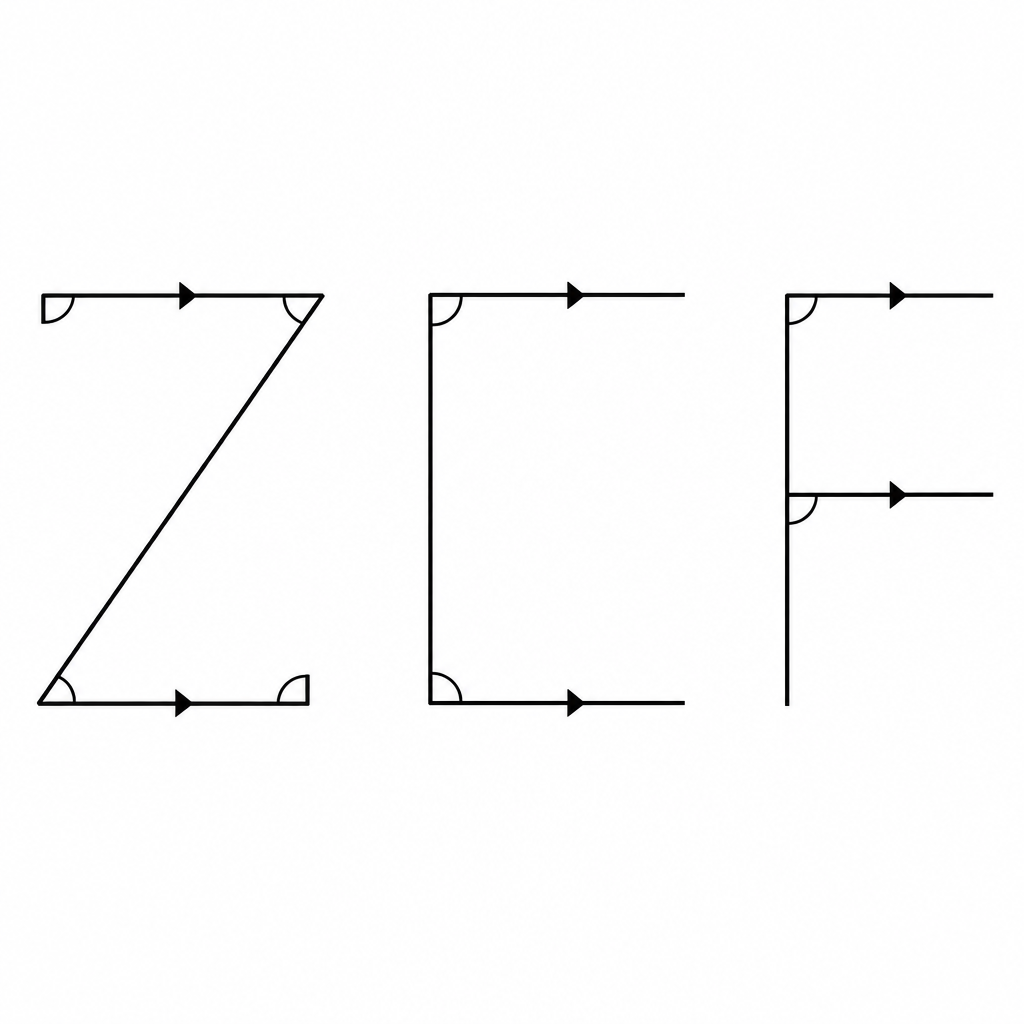
These letters may turn up reversed, upside down or rotated. Turning the letter round does not change the name of the pair, because the name comes from the side of the transversal and from interior or exterior, not from the letter itself.
Alternate Angles Are Equal When the Lines Are Parallel
When two lines are parallel and their alternate angles are measured, the two angles in each pair come out equal. When the lines are not parallel, that equality breaks.
When two parallel lines are cut by a transversal, the alternate angles are equal in measure.
Read the same rule backwards and it becomes a test for parallel lines. Take two lines AB and CD cut by a transversal, where a pair of alternate angles measures 73 degrees and 73 degrees, and decide whether the lines are parallel.
Step 1: Comparing the measures of the two alternate angles that are given:
\[ 73^\circ = 73^\circ \]
Step 2: The alternate angles are equal, so the lines are parallel:
\[ AB // CD \]
Now take the case where the alternate angles measure 120 degrees and 130 degrees.
Step 1: Comparing the measures of the two angles:
\[ 120^\circ \neq 130^\circ \]
Step 2: The alternate angles are not equal, so AB and CD are not parallel.
Working through four such cases in the same way gives the results below.
| Pair of alternate angles | Equal or not | Is AB // CD |
| 73° and 73° | Equal | Yes |
| 120° and 130° | Not equal | No |
| 95° and 100° | Not equal | No |
| 105° and 105° | Equal | Yes |
Corresponding Angles Are Equal When the Lines Are Parallel
A pair of corresponding angles lies on the same side of the transversal, with one angle exterior and the other interior. When the two lines are parallel, these pairs also come out equal in measure.
When two parallel lines are cut by a transversal, the corresponding angles are equal in measure.
Suppose a transversal cuts two lines and a pair of corresponding angles measures 70 degrees and 70 degrees. Here is how the decision is made.
Step 1: Comparing the measures of the corresponding angles:
\[ 70^\circ = 70^\circ \]
Step 2: The corresponding angles are equal, so the lines are parallel:
\[ AB // CD \]
When the measures are 70 degrees and 75 degrees we get \( 70^\circ \neq 75^\circ \), so those lines are not parallel. When they are 110 degrees and 110 degrees the lines are parallel, and when they are 85 degrees and 95 degrees they are not. Whether the pair is equal is the one thing that settles the answer.
Co-interior Angles Add Up to Two Right Angles
In a pair of co-interior angles both angles are interior and both lie on the same side of the transversal. These pairs are not equal in measure. When the two lines are parallel, the two angles add up to two right angles, that is, to 180 degrees.
When two parallel lines are cut by a transversal, the co-interior angles add up to two right angles, which is \( 180^\circ \).
Treating co-interior angles as equal is a very common slip. They are not equal; they add to 180 degrees. If both angles are 95 degrees the sum is 190 degrees and the lines are not parallel.
Step 1: Adding the co-interior angles in the case where they are 100 degrees and 80 degrees:
\[ 100^\circ + 80^\circ = 180^\circ \]
Step 2: The sum is 180 degrees, so the lines are parallel:
\[ AB // CD \]
Step 3: Adding the two angles in the case where both are 95 degrees:
\[ 95^\circ + 95^\circ = 190^\circ \]
Step 4: The sum is not 180 degrees, so those lines are not parallel. In the same way, 95 degrees with 85 degrees adds to 180 degrees and the lines are parallel. For 110 degrees with 70 degrees the sum is again 180 degrees, so those lines are parallel too.
Finding Every Angle from One Given Angle
Once the three rules are in hand, one given angle is enough to work out the other seven in a figure of parallel lines. Let AB and CD be parallel, with one interior angle measuring 53 degrees. Name the remaining angles a, b, c, d, x, y and z, and take them one at a time.
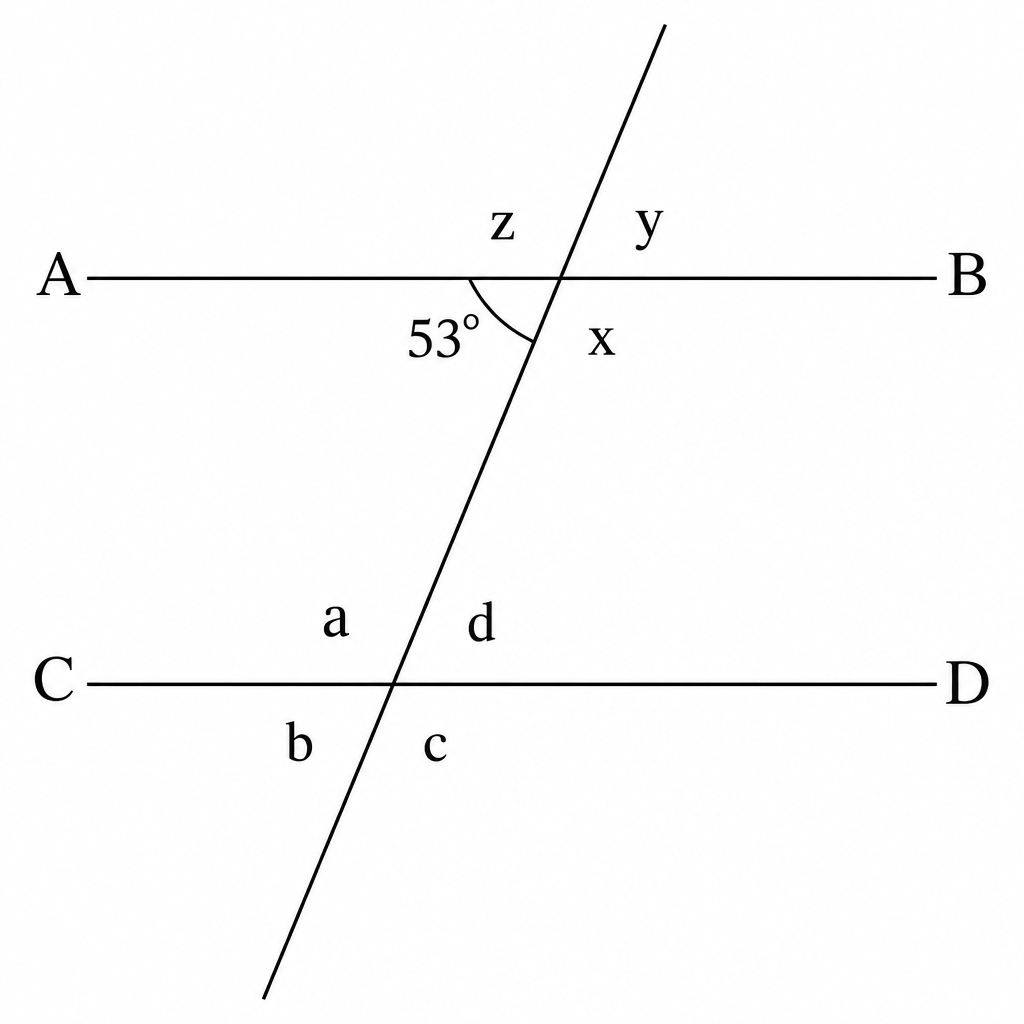
Step 1: The angle b and the 53 degree angle lie on the same side of the transversal, one exterior and one interior, so they are corresponding angles:
\[ b = 53^\circ \]
Step 2: The angle d and the 53 degree angle are non adjacent interior angles on opposite sides of the transversal, that is, alternate angles:
\[ d = 53^\circ \]
Step 3: The angles y and d are corresponding angles, so they are equal:
\[ y = d = 53^\circ \]
Step 4: The angle a and the 53 degree angle are co-interior angles, so their sum is 180 degrees:
\[ a + 53^\circ = 180^\circ \]
Step 5: Subtracting 53 degrees gives the measure of a:
\[ a = 127^\circ \]
Step 6: The angles z and a are corresponding angles, so they are equal:
\[ z = a = 127^\circ \]
Step 7: The angles x and a are alternate angles, so they are equal:
\[ x = a = 127^\circ \]
Step 8: The angles c and a are vertically opposite angles at the same crossing, so they are equal:
\[ c = a = 127^\circ \]
Notice the result: the eight angles take only two different measures, 53 degrees and 127 degrees, and those two add up to 180 degrees.
Problems Where the Angles Carry an Unknown
An angle may be given not as a number but with an unknown in it, such as \( 3x - 50^\circ \). In that case we first name the pair, then use the rule to build an equation, and finally solve the equation. Let AB and CD be parallel with \( \angle ABC = 3x - 50^\circ \) and \( \angle DCB = x + 10^\circ \), and find the measure of both angles.
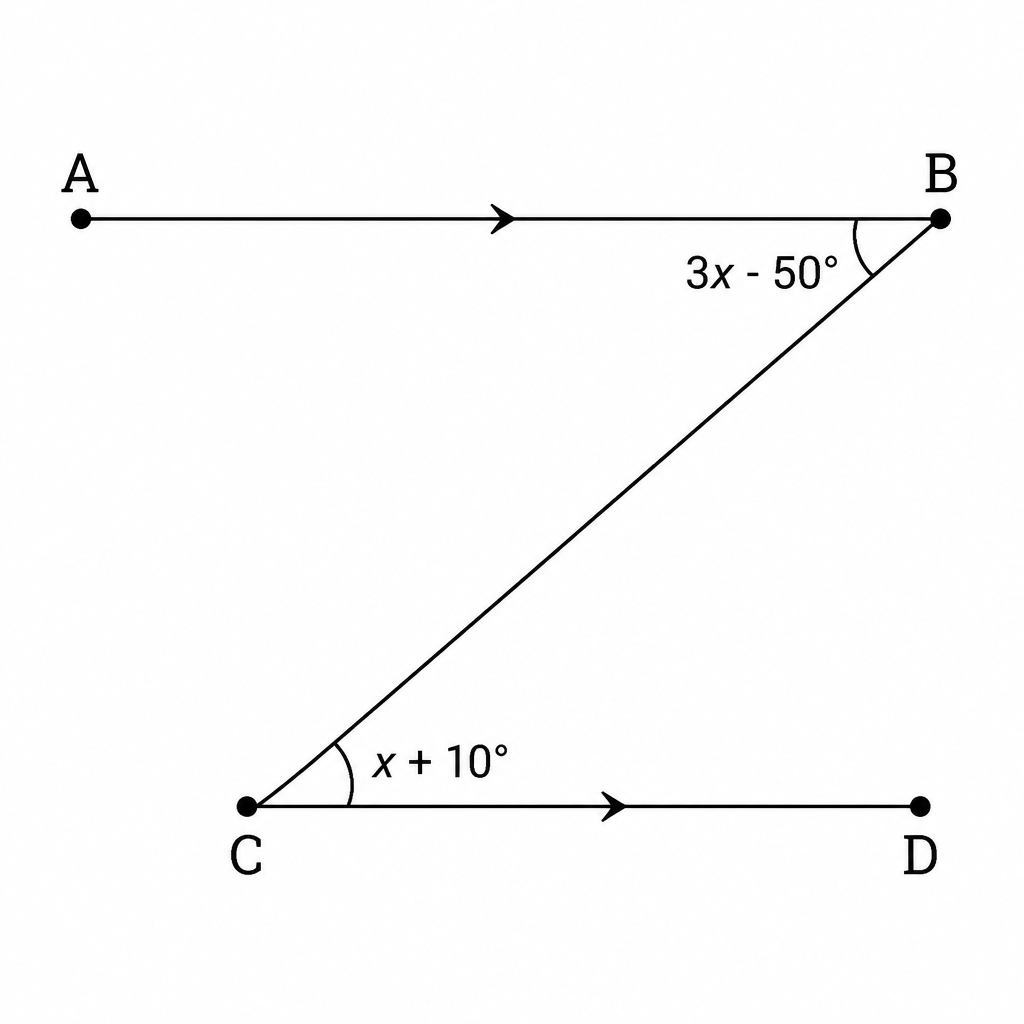
Step 1: BC is the transversal and these two angles are alternate angles, so putting their measures equal:
\[ 3x - 50^\circ = x + 10^\circ \]
Step 2: Moving the terms in x to one side and the numbers to the other:
\[ 3x - x = 50^\circ + 10^\circ \]
Step 3: Carrying out the subtraction and the addition:
\[ 2x = 60^\circ \]
Step 4: Dividing both sides by 2:
\[ x = 30^\circ \]
Step 5: Putting this value of x into \( \angle ABC \):
\[ \angle ABC = 3 \times 30^\circ - 50^\circ = 40^\circ \]
Step 6: The alternate angles are equal, so the other angle has the same measure:
\[ \angle ABC = \angle DCB = 40^\circ \]
Now turn the question round and ask which value makes the lines parallel. A transversal cuts AB and CD. At the upper crossing the interior angle is 70 degrees; at the lower crossing the interior angle on the same side is a, and the angle vertically opposite it is \( 2x \). What must x be for AB and CD to be parallel?
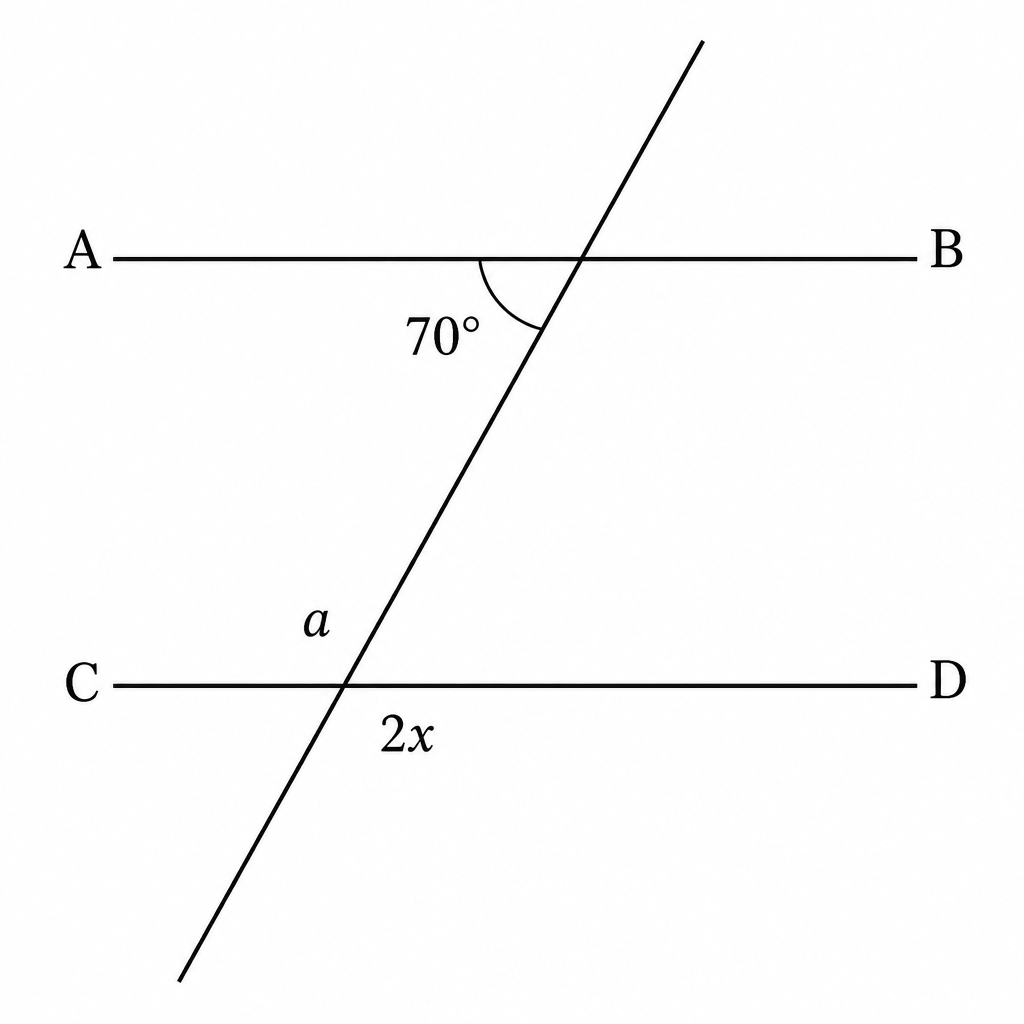
Step 1: The angles a and \( 2x \) are vertically opposite, so they are equal:
\[ a = 2x \]
Step 2: For AB and CD to be parallel, a and the 70 degree angle are co-interior angles, so their sum must be 180 degrees:
\[ a + 70^\circ = 180^\circ \]
Step 3: Replacing a by \( 2x \):
\[ 2x + 70^\circ = 180^\circ \]
Step 4: Taking 70 degrees from both sides:
\[ 2x = 110^\circ \]
Step 5: Dividing both sides by 2:
\[ x = 55^\circ \]
So AB and CD are parallel when \( x = 55^\circ \). Every problem of this kind works the same way: if the pair is corresponding or alternate, set the two expressions equal, and if the pair is co-interior, set their sum to 180 degrees. Once the pair is named correctly, the equation writes itself.
The full lesson is waiting for you
The notes are free to read in full. A free account opens the rest of the practice, and tracks your progress and confidence score for every subject. Presentations and videos need approval from Learn Yeti.