Writing an Equation and Reading Its Possible Solutions
Sandesh picks some oranges and some guavas from his own garden. Let the number of oranges be \( x \) and the number of guavas be \( y \). He brings home 12 fruits altogether, and that ordinary sentence turns into a mathematical statement:
\[ x + y = 12 \]
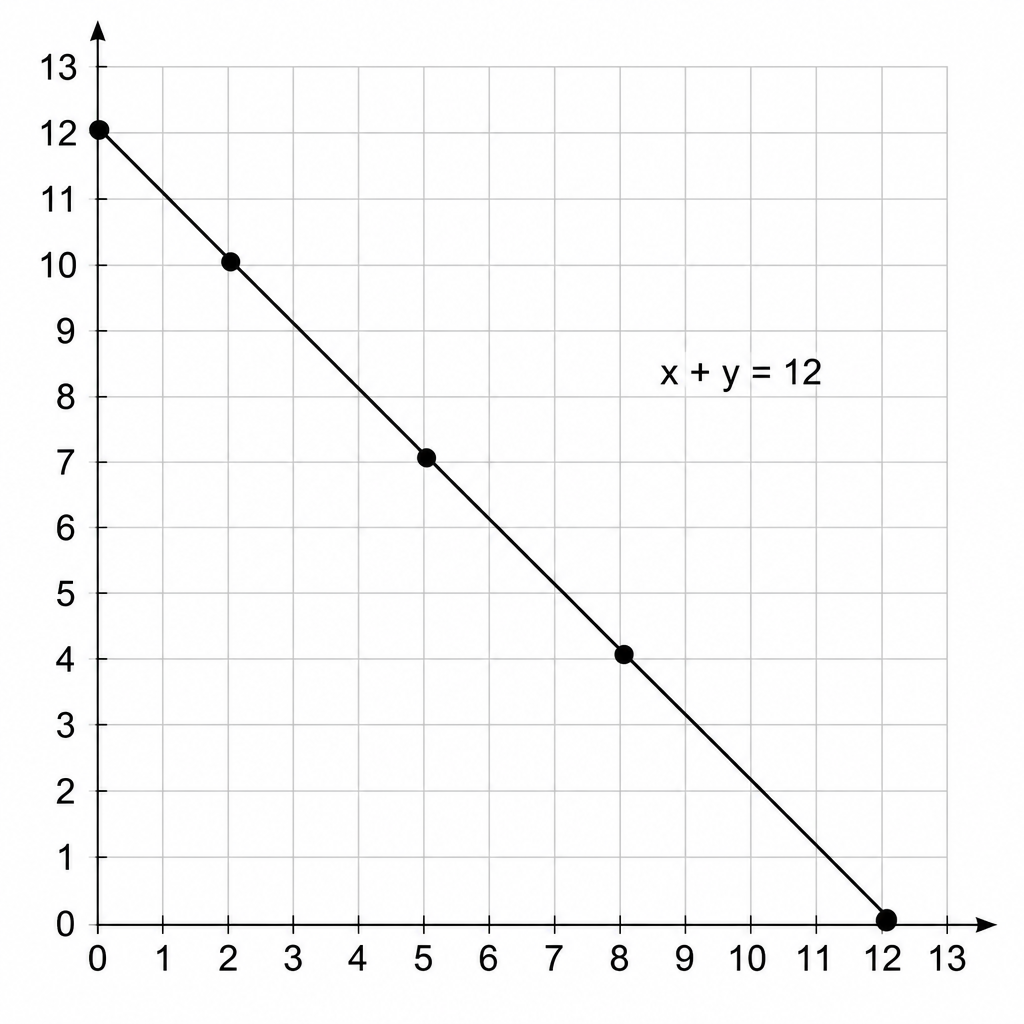
This single equation carries two variables. Here \( x \) does not have one fixed value. If there are 2 oranges there must be 10 guavas, and if there are 5 oranges there must be 7 guavas. Many pairs satisfy the same equation. A few of them are set out below:
| Oranges (x) | Guavas (y) |
| 0 | 12 |
| 2 | 10 |
| 5 | 7 |
| 8 | 4 |
| 12 | 0 |
Plot each pair as the point \( (x, y) \) and every one of them lands on the same straight line. So one linear equation in two variables has endlessly many solutions, and a single line carries all of them at once. Everything that follows rests on this one fact.
Two Conditions That Must Be True at the Same Time
Nirmala buys 6 mangoes. She has to share them between her two daughters, Asmi and Anisha. Let the number Asmi gets be \( x \) and the number Anisha gets be \( y \). There are several ways of sharing, but in every one of them the total stays 6.
| Asmi (x) | Anisha (y) | Total mangoes |
| 5 | 1 | 6 |
| 4 | 2 | 6 |
| 3 | 3 | 6 |
| 2 | 4 | 6 |
| 1 | 5 | 6 |
In every row of that table the total is 6. So the first condition is:
\[ x + y = 6 \]
Now a second condition is added. Nirmala wants Asmi to get 2 mangoes more than Anisha. The pairs that obey this second condition are set out separately:
| Anisha (y) | Asmi (x) | Total mangoes |
| 0 | 2 | 2 |
| 1 | 3 | 4 |
| 2 | 4 | 6 |
| 3 | 5 | 8 |
| 4 | 6 | 10 |
Asmi's number is always 2 more than Anisha's, so \( x = 2 + y \). Rearranged, the second condition reads:
\[ x - y = 2 \]
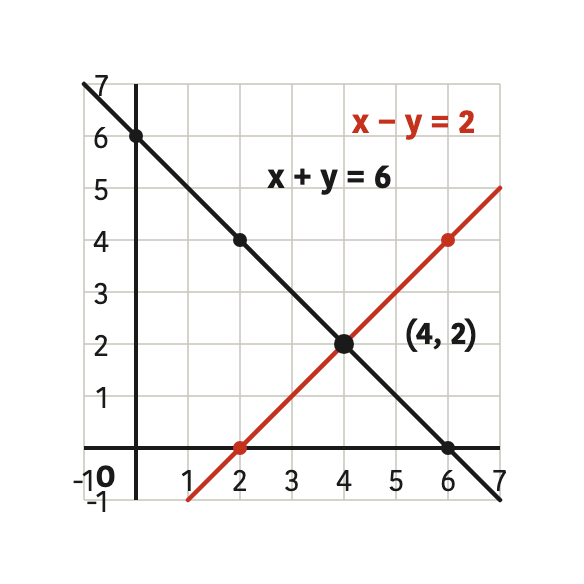
The first table shows every way of sharing 6 mangoes and the second shows every way of giving Asmi 2 extra. Only one pair appears in both tables, and that is \( x = 4 \) and \( y = 2 \). It is the one pair that satisfies both conditions at the same moment. Drawn on a graph, the two lines cut each other at exactly \( (4, 2) \).
What Simultaneous Equations Are
When two linear equations are drawn on a graph and the lines representing them cut each other at exactly one point, the two equations are called simultaneous equations. The value at that cutting point is the solution of both equations together.
The method of drawing linear equations on a graph and solving them from the picture is called the graphical method.
A single line holds countless points, but two lines share just one. That shared point is the only place where both equations are true together, which is exactly why it is the solution.
The Steps of the Graphical Method
Once a pair of equations in two variables is given, the order of work never changes. Learn this order and use it every time.
- Rewrite each equation so that one variable stands alone on one side.
- Put three easy values into the first equation, work out the matching values of the other variable, and write the pairs in a table.
- Do the same with the second equation and collect three more pairs.
- Plot both sets of pairs on graph paper and draw the two straight lines.
- Read the coordinates of the point where the lines cut. Those coordinates are the solution.
- Put the values back into both equations and check that each one balances.
When you read the crossing point, the first number always belongs to \( x \) and the second to \( y \). Reading \( (4, 2) \) as \( x = 2 \) and \( y = 4 \) spoils the whole answer. Also plot three points for each line, because with only two points a wrong one never shows itself.
A Pair Solved by the Graphical Method
Take \( 3x - y = 7 \) and \( x - 2y = -1 \). Solve them by the graphical method and then check the answer.
Step 1: Name the two equations. Equation (i) is:
\[ 3x - y = 7 \]
Step 2: Equation (ii) is:
\[ x - 2y = -1 \]
Step 3: Rearranging equation (i) so that \( y \) stands alone gives:
\[ y = 3x - 7 \]
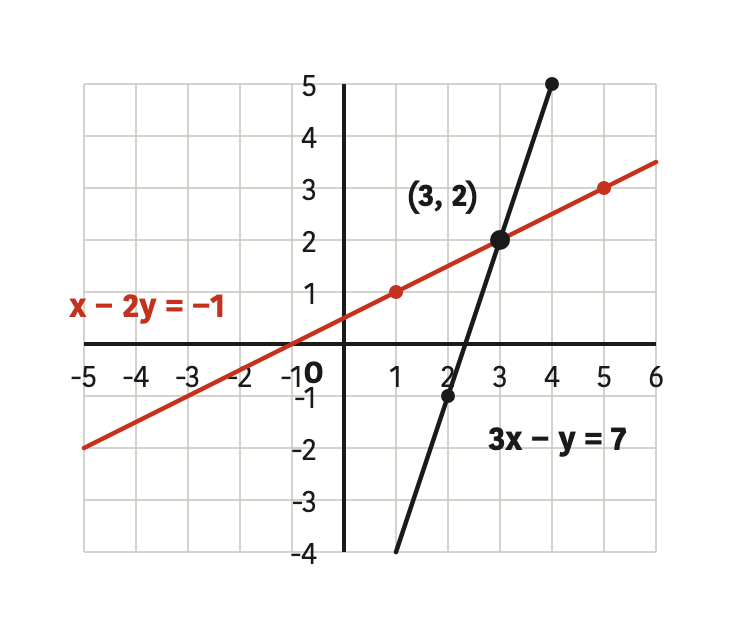
Step 4: Putting \( x = 2, 3 \) and \( 4 \) into it gives \( y \) values of \( -1, 2 \) and \( 5 \):
| x | y |
| 2 | −1 |
| 3 | 2 |
| 4 | 5 |
Step 5: So equation (i) passes through \( (2, -1) \), \( (3, 2) \) and \( (4, 5) \). Rearranging equation (ii) so that \( x \) stands alone gives:
\[ x = 2y - 1 \]
Step 6: Putting \( y = 1, 2 \) and \( 3 \) into it gives \( x \) values of \( 1, 3 \) and \( 5 \):
| x | y |
| 1 | 1 |
| 3 | 2 |
| 5 | 3 |
Step 7: Equation (ii) passes through \( (1, 1) \), \( (3, 2) \) and \( (5, 3) \). Plot both sets, draw the two straight lines, and they cut at \( (3, 2) \). So \( x = 3 \) and \( y = 2 \) is the solution.
Step 8: Now check. Putting \( x = 3 \) and \( y = 2 \) into equation (i), the left hand side becomes:
\[ 3 \times 3 - 2 = 9 - 2 = 7 \]
Step 9: That matches the right hand side, 7. Putting the same values into equation (ii), the left hand side becomes:
\[ 3 - 2 \times 2 = 3 - 4 = -1 \]
That matches the right hand side, \( -1 \). Both equations balance, so \( x = 3 \) and \( y = 2 \) is correct.
Turning a Word Problem into Two Equations
A father's present age is 10 years more than twice his daughter's age. The difference between their ages is 25 years. How old is each of them? In a problem like this the words have to be turned into equations first.
Step 1: Give the two unknown quantities letters. Let the father's present age be \( x \) years and the daughter's be \( y \) years. The first condition gives equation (i):
\[ x = 2y + 10 \]
Step 2: Their ages differ by 25 years, which gives equation (ii):
\[ x - y = 25 \]
Step 3: Putting \( y = 0, 5 \) and \( 15 \) into equation (i) gives \( x \) values of \( 10, 20 \) and \( 40 \):
| x | y |
| 10 | 0 |
| 20 | 5 |
| 40 | 15 |
Step 4: Writing equation (ii) as \( x = y + 25 \) and putting \( y = 0, 5 \) and \( 10 \) into it gives \( x \) values of \( 25, 30 \) and \( 35 \):
| x | y |
| 25 | 0 |
| 30 | 5 |
| 35 | 10 |
Step 5: Plot these points and draw the two straight lines. They cut at \( (40, 15) \). Since ages are large numbers, mark both axes in steps of 5.
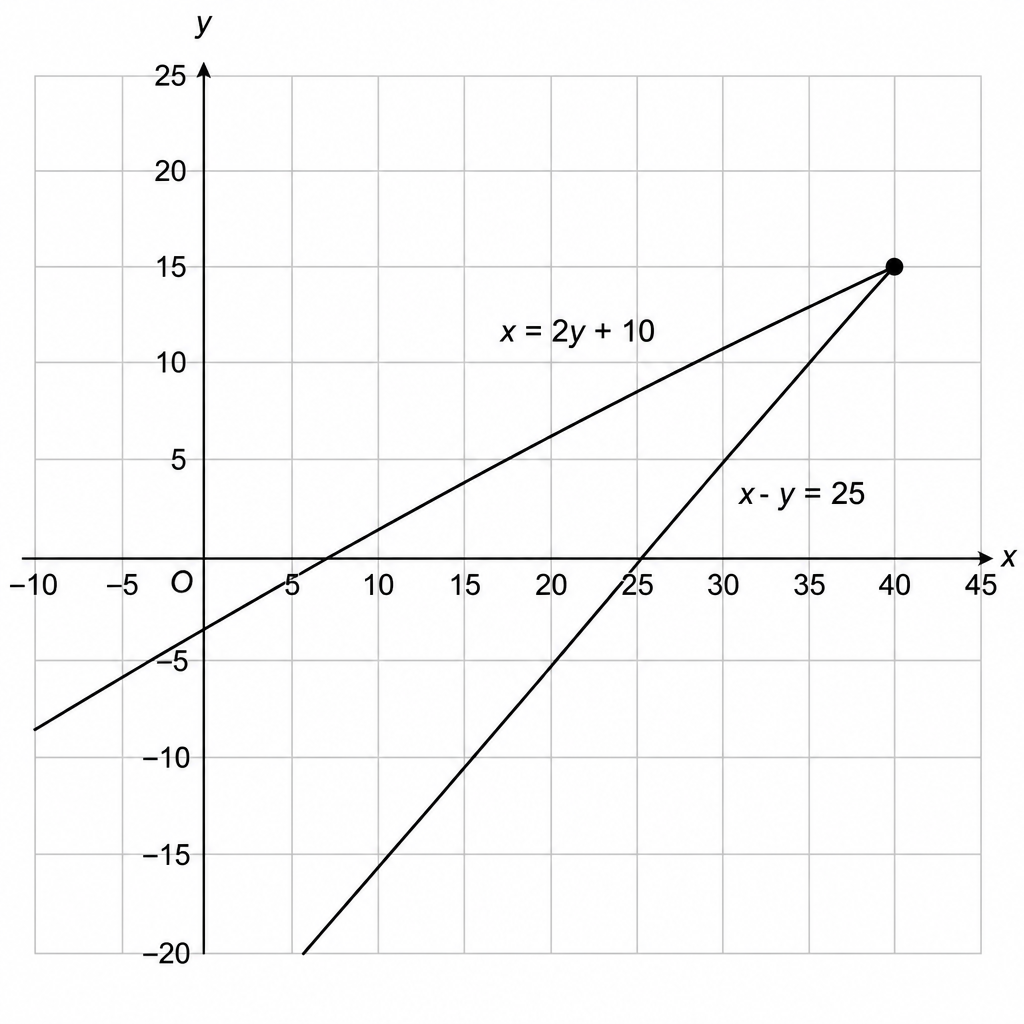
Step 6: So the father is 40 years old and the daughter is 15. Checking, twice the daughter's age is 30, and 30 plus 10 is 40. Also 40 minus 15 is 25. Both conditions hold.
When two unknown numbers in a word problem are to be found by the graphical method, keep these points in mind:
- Read the given problem carefully, choose letters for the unknowns, and build the equations.
- In each equation assume a value for one variable, work out the other, and set the pairs in a table.
- Plot the tables on the graph and draw the two straight lines from them.
- The coordinates of the point where the two straight lines cut are the numbers being looked for.
Reading the Highest Power of the Variable
Now look carefully at these three equations.
- (a) \( x - 4 = 0 \)
- (b) \( x^2 - 2x - 3 = 0 \)
- (c) \( x^2 - 25 = 0 \)
All three carry the same variable, \( x \). But in the first one the highest power of \( x \) is 1, while in the other two it is 2. The first, with power 1, is a linear equation in one variable and it has a single value, \( x = 4 \). The other two, with power 2, are quadratic equations, and in these the variable takes two values. The highest power in an equation is called its degree.
Quadratic Equations and the Zero Product Rule
An equation in one variable whose degree is 2 is called a quadratic equation. It has the form \( ax^2 + bx + c = 0 \), where \( a \neq 0 \). For example, \( x^2 + 5x + 6 = 0 \). In a quadratic equation the variable has two values.
If the product of two factors is 0, then one of those two factors must itself be zero. This is the zero product rule. So if \( (x - 3)(x + 1) = 0 \), then either \( x - 3 = 0 \) or \( x + 1 = 0 \).
The whole idea of the factorization method rests on this one rule. Once a quadratic is written as a product of two brackets, setting each bracket equal to zero turns it into two easy linear equations.
Factorizing by Splitting the Middle Term
In an equation of the form \( x^2 + bx + c = 0 \), the middle term is split into two parts so that the product of the two numbers equals the last term and their sum equals the coefficient of the middle term.
Step 1: Solve \( x^2 - 2x - 3 = 0 \). The given equation is:
\[ x^2 - 2x - 3 = 0 \]
Step 2: The two numbers with product \( -3 \) and sum \( -2 \) are \( -3 \) and \( 1 \). Splitting the middle term gives:
\[ x^2 - 3x + x - 3 = 0 \]
Step 3: Taking \( x \) out of the first two terms and \( 1 \) out of the last two gives:
\[ x(x - 3) + 1(x - 3) = 0 \]
Step 4: Since \( (x - 3) \) is common to both parts:
\[ (x - 3)(x + 1) = 0 \]
Step 5: The product is zero, so one factor must be zero. If \( x - 3 = 0 \), then:
\[ x = 3 \]
Step 6: If \( x + 1 = 0 \), then:
\[ x = -1 \]
So the values of \( x \) are 3 and \( -1 \).
Step 1: Take a second example. The given equation is:
\[ x^2 - 6x + 8 = 0 \]
Step 2: The two numbers with product 8 and sum \( -6 \) are \( -4 \) and \( -2 \). Splitting the middle term gives:
\[ x^2 - 4x - 2x + 8 = 0 \]
Step 3: Taking out the common factors gives:
\[ x(x - 4) - 2(x - 4) = 0 \]
Step 4: Since \( (x - 4) \) is common:
\[ (x - 4)(x - 2) = 0 \]
Step 5: Setting each bracket equal to zero gives \( x = 4 \) and \( x = 2 \). So the values of \( x \) are 4 and 2.
From \( (x - 3)(x + 1) = 0 \) many students simply copy the number inside the bracket. But \( x + 1 = 0 \) gives \( x = -1 \), not \( x = 1 \). Always set the bracket equal to zero and solve it as a small equation of its own.
Equations That Are a Difference of Two Squares
Some quadratic equations have no middle term at all. In such a case write both terms as squares and use the rule \( a^2 - b^2 = (a + b)(a - b) \).
Step 1: The given equation is:
\[ x^2 - 25 = 0 \]
Step 2: Writing 25 as the square of \( 5 \) gives:
\[ (x)^2 - (5)^2 = 0 \]
Step 3: Applying the difference of squares rule gives:
\[ (x + 5)(x - 5) = 0 \]
Step 4: Setting each bracket equal to zero gives \( x = -5 \) and \( x = 5 \). So the values of \( x \) are 5 and \( -5 \).
Step 1: Now take a slightly different example. The given equation is:
\[ 4x^2 - 25 = 0 \]
Step 2: Writing \( 4x^2 \) as the square of \( 2x \) and 25 as the square of \( 5 \) gives:
\[ (2x)^2 - (5)^2 = 0 \]
Step 3: Applying the difference of squares rule gives:
\[ (2x + 5)(2x - 5) = 0 \]
Step 4: If \( 2x + 5 = 0 \), then:
\[ x = -\frac{5}{2} = -2\frac{1}{2} \]
Step 5: If \( 2x - 5 = 0 \), then:
\[ x = \frac{5}{2} = 2\frac{1}{2} \]
So the values of \( x \) are \( \pm 2\frac{1}{2} \). The two values of a quadratic equation are not always whole numbers, but there are always two of them.
Building a Quadratic Equation from Its Roots
The work can also be done backwards. Find the quadratic equation whose values of \( x \) are 2 and 3.
Step 1: One value of \( x \) is 2, so \( x = 2 \), and moving it to one side gives:
\[ x - 2 = 0 \]
Step 2: The other value is 3, so \( x = 3 \), and moving it to one side gives:
\[ x - 3 = 0 \]
Step 3: Since each of these factors is zero, their product is zero too:
\[ (x - 2)(x - 3) = 0 \]
Step 4: Opening the brackets gives:
\[ x(x - 3) - 2(x - 3) = 0 \]
Step 5: Multiplying out gives:
\[ x^2 - 3x - 2x + 6 = 0 \]
Step 6: Collecting like terms gives the required quadratic equation:
\[ x^2 - 5x + 6 = 0 \]
Linear and Quadratic Equations Side by Side
Two kinds of equation have been met here. Their differences are collected in one table.
| Point | Linear equation | Quadratic equation |
| Degree | 1 | 2 |
| Form | \( ax + b = 0 \) | \( ax^2 + bx + c = 0 \) |
| Number of values | One | Two |
| Example | \( x - 4 = 0 \) | \( x^2 - 5x + 6 = 0 \) |
| Way of solving | Moving terms across | Factorization |
When two linear equations in two variables are given together they are called simultaneous equations, and the graphical method finds their one shared solution. An equation in one variable of degree 2 is a quadratic equation, and it is solved by factorization.
The full lesson is waiting for you
The notes are free to read in full. A free account opens the rest of the practice, and tracks your progress and confidence score for every subject. Presentations and videos need approval from Learn Yeti.