Fractions and Algebraic Expressions
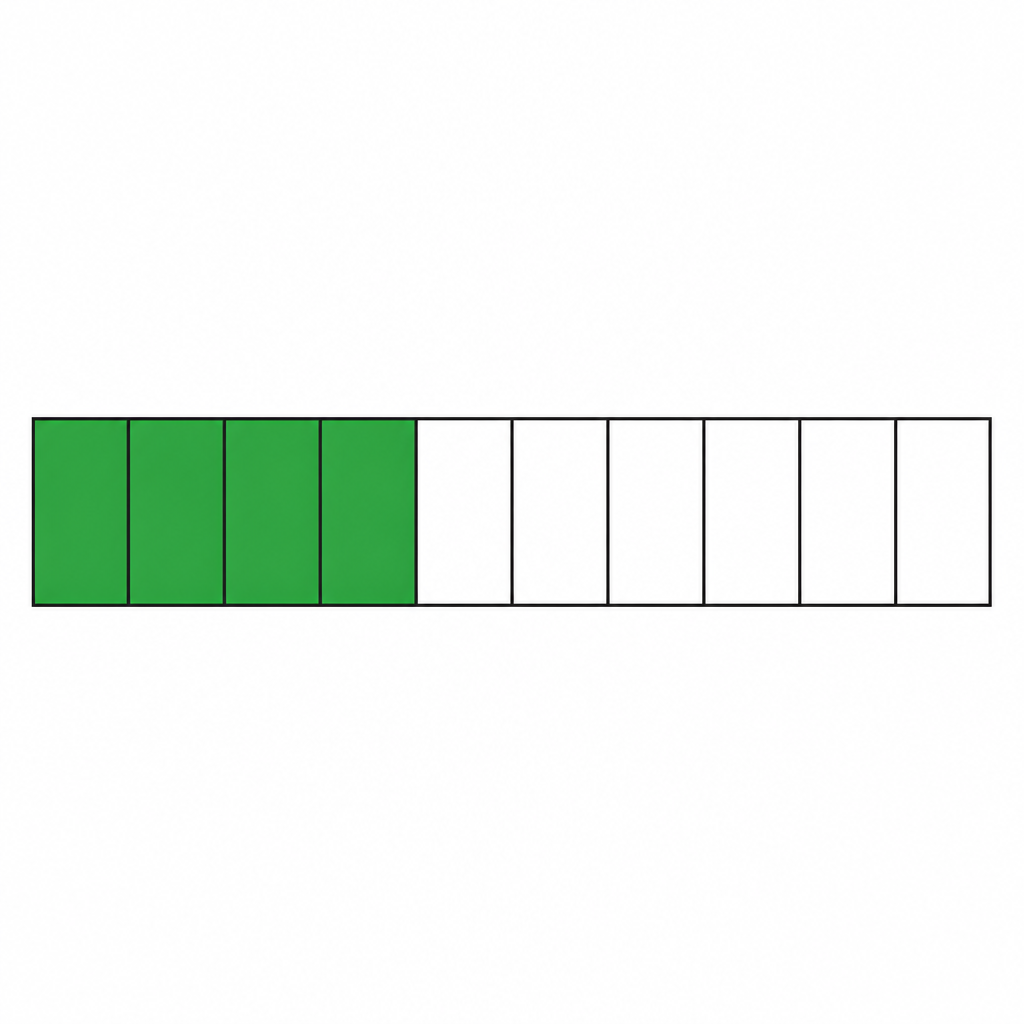
When one whole thing is cut into equal parts and we take some of those parts, the number that names what we have taken is a fraction. A fraction has two storeys. The bottom number says how many equal parts the whole was cut into, and the top number says how many of those parts we are talking about.
Fraction: a number written in the form \( \frac{a}{b} \), where the top part \( a \) is called the numerator and the bottom part \( b \) is called the denominator.
In \( \frac{1}{2} \) the numerator is 1 and the denominator is 2. In \( \frac{2}{3} \) the numerator is 2 and the denominator is 3. In \( \frac{5}{12} \) the numerator is 5 and the denominator is 12. In all three, the numerator and the denominator are plain numbers with no letters in them.
Now bring letters in. A form built from letters and numbers joined by the signs of addition, subtraction, multiplication and division is called an algebraic expression. \( 3a \), \( x+1 \), \( 2x^2-5x+6 \) and \( a^2-b^2 \) are all algebraic expressions.
All through this topic we will have to write algebraic expressions as products of factors, so three forms must be at your fingertips.
\[ a^2-b^2=(a+b)(a-b) \]
\[ a^2+2ab+b^2=(a+b)^2 \]
\[ a^2-2ab+b^2=(a-b)^2 \]
These forms pay off at once. If a square field has area \( x^2+2xy+y^2 \) square units, that area is \( (x+y)^2 \), and since the area of a square is the square of its side, the field is \( x+y \) units long.
Splitting the middle term is needed just as often. In \( x^2-5x+6 \), write \( -5x \) as \( -3x-2x \) to get \( x^2-3x-2x+6 \), group the terms to get \( x(x-3)-2(x-3) \), and finish with \( (x-3)(x-2) \).
What an Algebraic Fraction Is
Numbers like 3, 5, \( \frac{2}{3} \) and \( \frac{6}{7} \) are rational numbers. Now look at \( \frac{a}{b} \) and \( \frac{x}{x+1} \). They have the same shape as a fraction, but an algebraic expression has been used in the numerator and in the denominator.
Algebraic fraction: a fraction in which an algebraic expression is used both in the numerator and in the denominator.
Every rule you already use for ordinary fractions still holds for algebraic fractions. The only change is that expressions now stand where numbers stood, so you must factorise them before you can simplify.
Bringing an Algebraic Fraction to Its Lowest Terms
To simplify \( \frac{12}{18} \) you removed the factor 6 that sat above and below, and wrote \( \frac{2}{3} \). An algebraic fraction is simplified in exactly the same way. The work goes like this.
- Write the numerator fully as a product of factors.
- Write the denominator fully as a product of factors as well.
- Cancel the factors that appear both above and below.
- What is left is the answer, in its lowest terms.
For a first example, simplify \( \frac{x^3-x}{x^2+x} \).
Step 1: Both the numerator and the denominator contain \( x \), so take it out of each:
\[ \frac{x^3-x}{x^2+x}=\frac{x(x^2-1)}{x(x+1)} \]
Step 2: Since \( x^2-1 \) is a difference of two squares, apply \( a^2-b^2=(a+b)(a-b) \):
\[ =\frac{x(x+1)(x-1)}{x(x+1)} \]
Step 3: Cancel the common factors \( x \) and \( (x+1) \):
\[ =x-1 \]
For a second example, simplify \( \frac{x^2-5x+6}{x^2-2x} \). Here the middle term of the numerator has to be split.
Step 1: Write \( -5x \) as \( -3x-2x \) and group the terms:
\[ x^2-5x+6=x(x-3)-2(x-3) \]
Step 2: Taking the common bracket \( (x-3) \) out gives the numerator in factors:
\[ =(x-3)(x-2) \]
Step 3: The denominator has \( x \) in common, so take it out:
\[ x^2-2x=x(x-2) \]
Step 4: Now cancel the common factor \( (x-2) \):
\[ \frac{(x-3)(x-2)}{x(x-2)}=\frac{x-3}{x} \]
You may cancel only a factor, never a term. In \( \frac{x+2}{2} \) the 2 below and the 2 above cannot be struck out, because the 2 on top is a term that is added on, not a factor that is multiplied. The answer is not \( x \).
Adding and Subtracting When the Denominators Are the Same
To add \( \frac{2}{3}+\frac{4}{3} \) you kept the denominator 3 as it was, added only the numerators, and got \( \frac{6}{3}=2 \). The same rule holds when letters are involved, which is why \( \frac{a}{x}+\frac{b}{x}=\frac{a+b}{x} \).
When the denominators are the same, only the numerators are added or subtracted. The denominator is kept as it is, and at the end the answer is brought to its lowest terms.
Simplify \( \frac{3a}{a+3}+\frac{9}{a+3} \).
Step 1: Keeping the one denominator and adding the numerators:
\[ =\frac{3a+9}{a+3} \]
Step 2: The numerator has 3 in common, so take it out:
\[ =\frac{3(a+3)}{a+3} \]
Step 3: Cancelling the common factor \( (a+3) \):
\[ =3 \]
Subtraction works the same way. Simplify \( \frac{x^2}{x+y}-\frac{y^2}{x+y} \).
Step 1: Keeping the one denominator and subtracting the numerators:
\[ =\frac{x^2-y^2}{x+y} \]
Step 2: The numerator is a difference of two squares, so write it in factors:
\[ =\frac{(x+y)(x-y)}{x+y} \]
Step 3: Cancelling the common factor \( (x+y) \):
\[ =x-y \]
When you subtract, put the whole second numerator in brackets. Taking \( \frac{6a+9}{a-3} \) away from \( \frac{a^2}{a-3} \) gives the numerator \( a^2-(6a+9) \), not \( a^2-6a+9 \).
Adding and Subtracting When the Denominators Are Different
When the denominators are different you cannot add the numerators straight away. The denominators must first be made the same. There are two routes. On the first, the denominator of one fraction multiplies both the numerator and the denominator of the other. On the second, you find the lowest common multiple of the denominators and use it as the common denominator. Both give the same answer.
Lowest common multiple: the smallest expression that every one of the given denominators divides into exactly. This is what becomes the common denominator.
Look at numbers first. In \( \frac{2}{3}+\frac{4}{5} \), the lowest common multiple of 3 and 5 is 15.
Step 1: Writing both with 15 as the denominator:
\[ \frac{2\times 5}{3\times 5}+\frac{4\times 3}{5\times 3} \]
Step 2: The denominators now match, so add only the numerators:
\[ =\frac{10+12}{15}=\frac{22}{15} \]
Do \( \frac{x}{3}+\frac{x}{2} \) in exactly the same way. The lowest common multiple of 3 and 2 is 6.
Step 1: Writing both with 6 as the denominator:
\[ \frac{x\times 2}{3\times 2}+\frac{x\times 3}{2\times 3} \]
Step 2: Keeping the one denominator and adding the numerators:
\[ =\frac{2x+3x}{6}=\frac{5x}{6} \]
Now take an example whose denominators are brackets. In \( \frac{x+3}{x-2}-\frac{x+2}{x-3} \), the lowest common multiple of \( (x-2) \) and \( (x-3) \) is \( (x-2)(x-3) \).
Step 1: Using that as the denominator and multiplying each numerator by the bracket it needs:
\[ =\frac{(x+3)(x-3)-(x+2)(x-2)}{(x-2)(x-3)} \]
Step 2: Expanding both products:
\[ =\frac{(x^2-9)-(x^2-4)}{(x-2)(x-3)} \]
Step 3: Removing the bracket changes the signs inside it, so:
\[ =\frac{x^2-9-x^2+4}{(x-2)(x-3)} \]
Step 4: Collecting the terms of the numerator:
\[ =\frac{-5}{(x-2)(x-3)} \]
Sometimes the denominators can themselves be factorised. Factorise them first and the lowest common multiple becomes obvious. Simplify \( \frac{x}{x^2+3x+2}-\frac{2}{x^2-1} \).
Step 1: Factorising the first denominator:
\[ x^2+3x+2=(x+1)(x+2) \]
Step 2: The second denominator is a difference of two squares, so:
\[ x^2-1=(x+1)(x-1) \]
Step 3: Their lowest common multiple is \( (x+1)(x+2)(x-1) \). Writing both over it:
\[ =\frac{x(x-1)-2(x+2)}{(x+1)(x+2)(x-1)} \]
Step 4: Expanding the products in the numerator:
\[ =\frac{x^2-3x-4}{(x+1)(x+2)(x-1)} \]
Step 5: Splitting the middle term of the numerator into factors:
\[ =\frac{(x-4)(x+1)}{(x+1)(x+2)(x-1)} \]
Step 6: Cancelling the common factor \( (x+1) \):
\[ =\frac{x-4}{(x+2)(x-1)} \]
Multiplying Algebraic Fractions
To multiply \( \frac{3}{4} \) by \( \frac{2}{3} \) you wrote \( \frac{3\times 2}{4\times 3}=\frac{1}{2} \). That rule, numerator times numerator and denominator times denominator, holds for algebraic fractions too. The easy road is to write every part in factors before multiplying, and cancel whatever matches.
When fractions are multiplied, numerator multiplies numerator and denominator multiplies denominator.
Multiply \( \frac{a^2-b^2}{a^2+ab} \) by \( \frac{a^2}{ab-b^2} \).
Step 1: Writing all four parts in factors:
\[ \frac{(a+b)(a-b)}{a(a+b)}\times\frac{a\times a}{b(a-b)} \]
Step 2: Multiplying numerator by numerator and denominator by denominator:
\[ =\frac{(a+b)(a-b)\times a\times a}{a(a+b)\times b(a-b)} \]
Step 3: Cancelling the common factors \( (a+b) \), \( (a-b) \) and one \( a \):
\[ =\frac{a}{b} \]
Dividing Algebraic Fractions
To divide \( \frac{4}{5} \) by \( \frac{2}{3} \) you change the division sign to a multiplication sign and turn the dividing fraction upside down, getting \( \frac{4}{5}\times\frac{3}{2}=\frac{6}{5} \). Turning it upside down means multiplying by its reciprocal.
Reciprocal: the fraction formed by swapping the numerator and the denominator. The reciprocal of \( \frac{2}{3} \) is \( \frac{3}{2} \).
To divide one fraction by another, change the division sign into a multiplication sign and turn the dividing fraction over, so its denominator becomes the numerator and its numerator becomes the denominator.
Simplify \( \frac{4}{x^2+3x+2}\div\frac{2}{x^2-1} \).
Step 1: Multiplying by the reciprocal of the divisor:
\[ =\frac{4}{x^2+3x+2}\times\frac{x^2-1}{2} \]
Step 2: Writing both expressions in factors:
\[ =\frac{4}{(x+2)(x+1)}\times\frac{(x+1)(x-1)}{2} \]
Step 3: Dividing 4 by 2 and cancelling the common \( (x+1) \):
\[ =\frac{2(x-1)}{x+2} \]
Take a bigger example. In \( \frac{x^2-6x+9}{x^2+3x+2}\div\frac{x^2-5x+6}{x^2-x-2} \), all four expressions have to be written in factors.
Step 1: Changing the division sign and turning the divisor over:
\[ =\frac{x^2-6x+9}{x^2+3x+2}\times\frac{x^2-x-2}{x^2-5x+6} \]
Step 2: Factorising all four expressions:
\[ =\frac{(x-3)(x-3)}{(x+1)(x+2)}\times\frac{(x-2)(x+1)}{(x-3)(x-2)} \]
Step 3: Cancelling \( (x-3) \), \( (x-2) \) and \( (x+1) \):
\[ =\frac{x-3}{x+2} \]
Finding the Length of a Rectangle
The area of a rectangle is its length times its breadth. So dividing the area by the breadth gives the length, and that division is nothing but the simplifying of an algebraic fraction. One rectangle has breadth \( x-2 \) units and area \( x^2+3x-10 \) square units.
Step 1: For the length, divide the area by the breadth:
\[ \frac{x^2+3x-10}{x-2} \]
Step 2: Writing \( 3x \) as \( 5x-2x \) and factorising:
\[ x^2+3x-10=(x+5)(x-2) \]
Step 3: Cancelling the common factor \( (x-2) \) gives the length of the first rectangle:
\[ =x+5 \]
Another rectangle of the same breadth has area \( x^2+x-6 \) square units. Its length comes out in the same way.
\[ \frac{(x+3)(x-2)}{x-2}=x+3 \]

Placing the two rectangles together along their breadths, the total length is \( (x+5)+(x+3) \), which is \( 2x+8 \) units.
The full lesson is waiting for you
The notes are free to read in full. A free account opens the rest of the practice, and tracks your progress and confidence score for every subject. Presentations and videos need approval from Learn Yeti.