The Area and Perimeter of a Field Written in Letters
A rectangular field has been measured. The two sides did not come out as whole numbers, so they are written with letters: the length is (2x + y) m and the breadth is (x + 2y) m. Letters change none of the rules. Area is still length times breadth, and perimeter is still the distance right round the edge. Only the multiplying and the adding are now done the algebraic way.

Step 1: The mathematical statement for the area is:
\[ A = (2x + y)(x + 2y) \]
Step 2: Each term of the first bracket multiplies each term of the second bracket:
\[ A = 2x^2 + 4xy + xy + 2y^2 \]
Step 3: Since 4xy and xy are like terms, they are added:
\[ A = 2x^2 + 5xy + 2y^2 \]
For the perimeter the length and the breadth are added and the sum is doubled. Step 1: The mathematical statement is:
\[ P = 2\{(2x + y) + (x + 2y)\} \]
Step 2: Adding the like terms inside the bracket:
\[ P = 2(3x + 3y) = 6x + 6y \]
Now suppose a small flower bed of length (x + 2y) m and breadth y m is made inside the same field. Its area comes out like this:
\[ A_1 = y(x + 2y) = xy + 2y^2 \]
To find how much smaller the bed is than the whole field, one area is subtracted from the other:
\[ A - A_1 = 2x^2 + 4xy \]
Now put x = 10 and y = 2 into these results. Step 1: Substituting into the area of the field:
\[ A = 2(10)^2 + 5(10)(2) + 2(2)^2 \]
Step 2: Working out each term:
\[ A = 200 + 100 + 8 = 308 \]
Step 3: Substituting into the area of the flower bed:
\[ A_1 = (10)(2) + 2(2)^2 = 28 \]
So the field measures 308 square metres and the flower bed measures 28 square metres. The unit must always be written, because a bare number does not state an area.
What Factorization Means
Above, brackets were opened to reach a product. Now the same road is walked backwards. Multiplying x by (x + 2) gives this:
\[ x(x + 2) = x^2 + 2x \]
This means that both x and (x + 2) divide x² + 2x exactly, leaving no remainder. For that reason x and (x + 2) are called factors of x² + 2x. In the same way, since (x + 2)(x + 3) = x² + 5x + 6, the expressions (x + 2) and (x + 3) are factors of x² + 5x + 6.
Factor: an algebraic expression that divides a given algebraic expression exactly, leaving no remainder, is called a factor of that expression.
Factorization: writing a given algebraic expression as a product of its own factors is called factorization.
Opening brackets and factorizing are one statement read in two directions. That gives an easy check on every answer: multiply your factors back together and the original expression must reappear.
Taking Out a Common Factor and Grouping Terms
Algebraic tiles let the eye see this. The large square tile has area x², the long tile has area x and the small square tile has area 1. Green stands for positive and red stands for negative.

The tiles on the left have total area x² + 3x, and pushed together they make a rectangle of length x + 3 and breadth x. So:
\[ x^2 + 3x = x(x + 3) \]
The tiles on the right have total area x² - 3x, and they make a rectangle of length x - 3 and breadth x. So:
\[ x^2 - 3x = x(x - 3) \]
In both cases the same thing was done. What is common to every term was taken outside the bracket and what was left stayed inside. Now factorize 2x² + 4x. Step 1: The mathematical statement is:
\[ 2x^2 + 4x \]
Step 2: The first term is 2x times x and the second term is 2x times 2, so 2x is common to both and is taken outside:
\[ 2x^2 + 4x = 2x(x + 2) \]

Sometimes no single factor is common to all the terms. Then the terms that do share something are collected together. Take 2xy + 3 + 6x + y. Step 1: The mathematical statement is:
\[ 2xy + 3 + 6x + y \]
Step 2: The terms are rearranged so that the ones sharing a factor stand side by side:
\[ = 2xy + 6x + y + 3 \]
Step 3: Taking 2x out of the first pair and 1 out of the second pair:
\[ = 2x(y + 3) + 1(y + 3) \]
Step 4: Now (y + 3) is common to both parts, so it is taken outside:
\[ = (2x + 1)(y + 3) \]
Here is a second example of the same method. Step 1: The mathematical statement is:
\[ a^2 - 15b - 5a + 3ab \]
Step 2: The terms carrying a are put together and the terms carrying b are put together:
\[ = a^2 - 5a + 3ab - 15b \]
Step 3: Taking a out of the first two terms and 3b out of the last two terms:
\[ = a(a - 5) + 3b(a - 5) \]
Step 4: The repeated bracket (a - 5) is taken outside:
\[ = (a - 5)(a + 3b) \]
When a common factor is taken out and a term seems to vanish, a 1 has been dropped. The factorization of x + x³ is not x(x²) but x(1 + x²). The bracket must always end up with as many terms as you started with.
Factorizing Expressions of the Form a² - b²
Take a square sheet of paper whose side is a units. Its area is a² square units. Now cut a square of side b units out of one corner. The area of the piece that is left is a² - b².

Cutting the remaining piece in two and sliding one part across makes a rectangle whose length is a + b and whose breadth is a - b. Cutting and sliding paper cannot change its area, so:
\[ a^2 - b^2 = (a + b)(a - b) \]
Difference of two squares: an expression that is one square subtracted from another is always equal to the sum of the two quantities multiplied by their difference.
Now factorize a² - 16. Step 1: Both terms are written as squares:
\[ a^2 - 16 = a^2 - 4^2 \]
Step 2: Applying the difference of two squares:
\[ = (a + 4)(a - 4) \]
The next example is 25x² - 36y². Step 1: Writing both terms as squares:
\[ 25x^2 - 36y^2 = (5x)^2 - (6y)^2 \]
Step 2: Applying the rule:
\[ = (5x + 6y)(5x - 6y) \]
A fraction does not change the rule. Step 1: Writing both terms as squares:
\[ p^2 - \frac{1}{49q^2} = p^2 - \left(\frac{1}{7q}\right)^2 \]
Step 2: Applying the rule:
\[ = \left(p + \frac{1}{7q}\right)\left(p - \frac{1}{7q}\right) \]
This rule works only for a subtraction. The expression a² + b² cannot be factorized this way. Look for the minus sign before you reach for the brackets.
Factorizing Perfect Square Trinomials
The expanded form of (a + b)² is a² + 2ab + b², and the expanded form of (a - b)² is a² - 2ab + b². Read backwards, these two statements become two rules for factorizing:
\[ a^2 + 2ab + b^2 = (a + b)^2 \]
\[ a^2 - 2ab + b^2 = (a - b)^2 \]
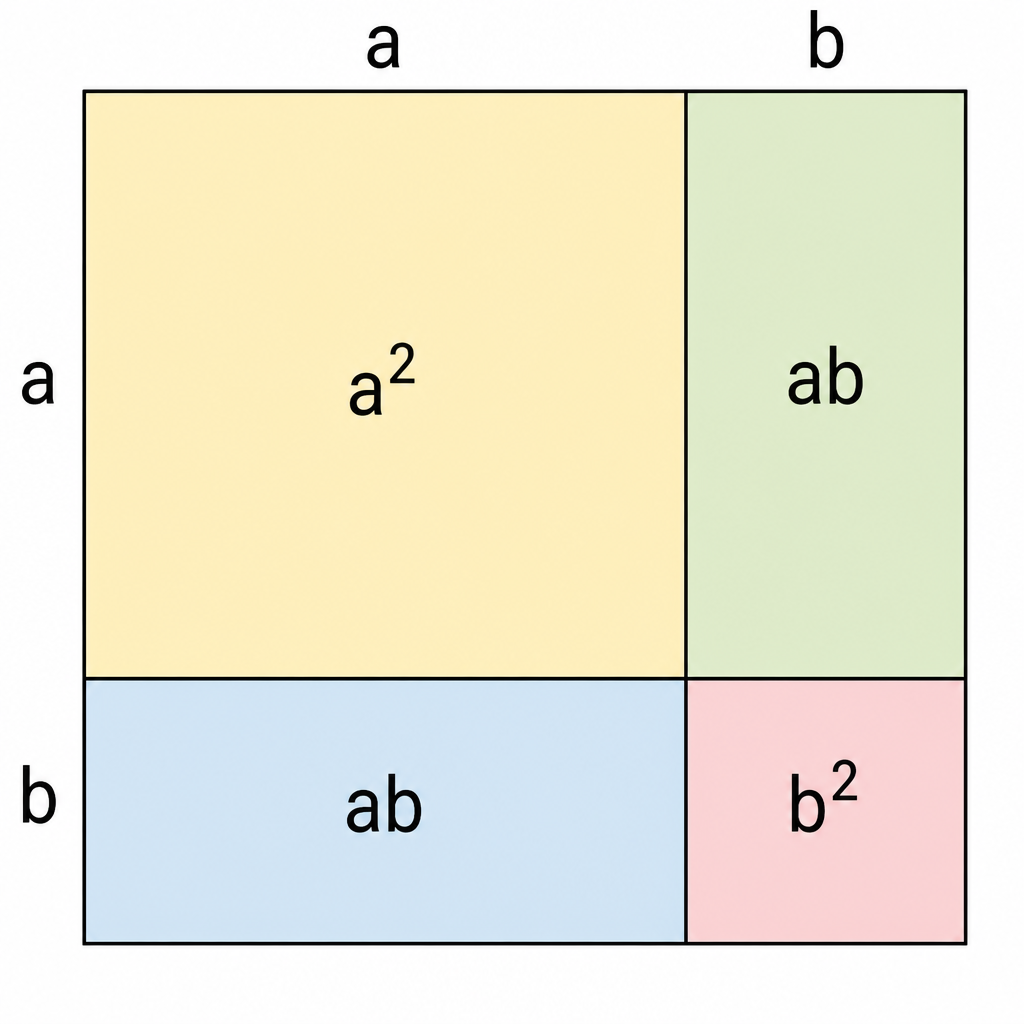
The first use of these rules is filling in a missing middle term. What must go in the gap to make x² + . . . + 16 a perfect square? Step 1: The first and the last term are written as squares:
\[ x^2 + \ldots + 4^2 \]
Step 2: Here a is x and b is 4. The middle term must be 2ab, so:
\[ 2 \times x \times 4 = 8x \]
Step 3: With that term in place the expression is a perfect square:
\[ x^2 + 8x + 16 = (x + 4)^2 \]
The same working fits 9a² - . . . + 49b². Here the two quantities are 3a and 7b, so the missing term is:
\[ 2 \times 3a \times 7b = 42ab \]
\[ 9a^2 - 42ab + 49b^2 = (3a - 7b)^2 \]
Now factorize 4x² + 12x + 9. Step 1: The first and last terms are written as squares and the middle term is tested:
\[ = (2x)^2 + 2 \times 2x \times 3 + 3^2 \]
Step 2: The middle term does match 2ab, so:
\[ = (2x + 3)^2 = (2x + 3)(2x + 3) \]
In 36a² - 48ab + 16b² a common factor comes out first. Step 1: All three terms share 4, which is taken outside:
\[ = 4(9a^2 - 12ab + 4b^2) \]
Step 2: Inside the bracket the terms are written as squares:
\[ = 4\{(3a)^2 - 2 \times 3a \times 2b + (2b)^2\} \]
Step 3: Applying the rule:
\[ = 4(3a - 2b)^2 \]
Sometimes one question needs both rules. Take 16x² + 40x + 25 - y². Step 1: The first three terms are kept together and written as squares:
\[ = (4x)^2 + 2 \times 4x \times 5 + 5^2 - y^2 \]
Step 2: The first three terms form a perfect square, so:
\[ = (4x + 5)^2 - y^2 \]
Step 3: This is now a difference of two squares, so:
\[ = (4x + 5 + y)(4x + 5 - y) \]
Do not call an expression a perfect square just because its first and last terms are squares. Test the middle term against 2ab first. In x² + 5x + 16 the outer terms are squares, but the middle term is not 8x, so it is not a perfect square.
Factorizing Expressions of the Form ax² + bx + c
One x² tile, four x tiles and three unit tiles are given. All of them together can be pushed into one rectangle.
The tiles have total area x² + 4x + 3, and the rectangle they make has length x + 3 and breadth x + 1. So:
\[ x^2 + 4x + 3 = (x + 1)(x + 3) \]
To reach the same answer without tiles, the middle term is broken into two parts. Here 4 is written as 1 + 3, because 1 and 3 multiply to 3 and add to 4. Step 1: Splitting the middle term:
\[ = x^2 + x + 3x + 3 \]
Step 2: Taking x out of the first pair and 3 out of the second pair:
\[ = x(x + 1) + 3(x + 1) \]
Step 3: Taking out the repeated bracket:
\[ = (x + 1)(x + 3) \]
Now look at a case where the middle term is negative. One positive x² tile, seven negative x tiles and six positive unit tiles are given.

The total area is x² - 7x + 6. Step 1: The numbers 6 and 1 multiply to 6 and add to 7, so the middle term is split:
\[ = x^2 - 6x - x + 6 \]
Step 2: Taking x out of the first pair and -1 out of the second pair:
\[ = x(x - 6) - 1(x - 6) \]
Step 3: Taking out the repeated bracket:
\[ = (x - 6)(x - 1) \]
Now look at a case where the last term is negative. One positive x² tile, five positive x tiles and six negative unit tiles will not close into a rectangle at first.

Adding equal numbers of positive and negative tiles changes nothing, because they cancel each other. The total area stays x² + 5x - 6. Step 1: The numbers 6 and 1 multiply to 6 and differ by 5, so:
\[ = x^2 + 6x - x - 6 \]
Step 2: Taking the common factor from each pair:
\[ = x(x + 6) - 1(x + 6) \]
Step 3: Taking out the repeated bracket:
\[ = (x + 6)(x - 1) \]
In the next example there is one positive x² tile, one negative x tile and twelve negative unit tiles.

The total area is x² - x - 12. Step 1: The numbers 4 and 3 multiply to 12 and differ by 1, so the middle term is split:
\[ = x^2 - 4x + 3x - 12 \]
Step 2: Taking the common factor from each pair:
\[ = x(x - 4) + 3(x - 4) \]
Step 3: Taking out the repeated bracket:
\[ = (x - 4)(x + 3) \]
All of these examples follow one method, which can be written out in order.
- Multiply the coefficient of the first term by the last term.
- List the pairs of numbers that give that product.
- If the last term is positive, choose the pair that adds to the middle coefficient.
- If the last term is negative, choose the pair whose difference is the middle coefficient.
- Use the chosen pair to split the middle term into two terms.
- Take a common factor out of the first two terms and out of the last two terms separately.
- The bracket that repeats is one factor, and what is left outside is the other factor.
Finding Two Numbers from Their Product and Sum
The most important step of that method is choosing the two numbers. The easiest way is to write down every pair that gives the product P and then look for the pair whose sum is S.
| Product (P) | Pair | Sum (S) |
| 12 | 1 and 12 | 13 |
| 12 | 2 and 6 | 8 |
| 12 | 3 and 4 | 7 (the one wanted) |
| 24 | 1 and 24 | 25 |
| 24 | 2 and 12 | 14 |
| 24 | 3 and 8 | 11 (the one wanted) |
| 24 | 4 and 6 | 10 |
When the last term of the trinomial is negative, the difference is looked at instead of the sum. That table looks like this.
| Product (P) | Pair | Difference (D) |
| 12 | 2 and 6 | 4 |
| 12 | 4 and 3 | 1 (the one wanted) |
| 24 | 3 and 8 | 5 |
| 24 | 12 and 2 | 10 (the one wanted) |
Now factorize x² + 5x + 6. Step 1: The numbers 2 and 3 multiply to 6 and add to 5, so the middle term is split:
\[ = x^2 + 2x + 3x + 6 \]
Step 2: Taking the common factor from each pair:
\[ = x(x + 2) + 3(x + 2) \]
Step 3: Taking out the repeated bracket:
\[ = (x + 2)(x + 3) \]
When the coefficient of the first term is not 1 the method does not change, but the product must be taken from that coefficient and the last term together. In 3x² + 11x + 6 the product of 3 and 6 is 18, and the pair adding to 11 is 9 and 2. Step 1: Splitting the middle term:
\[ = 3x^2 + 9x + 2x + 6 \]
Step 2: Taking 3x out of the first pair and 2 out of the second pair:
\[ = 3x(x + 3) + 2(x + 3) \]
Step 3: Taking out the repeated bracket:
\[ = (x + 3)(3x + 2) \]
In 2x² - 5x - 18 the product of 2 and 18 is 36, and the pair with difference 5 is 9 and 4. Since the last term is negative, the larger number takes the minus sign. Step 1: Splitting the middle term:
\[ = 2x^2 - 9x + 4x - 18 \]
Step 2: Taking x out of the first pair and 2 out of the second pair:
\[ = x(2x - 9) + 2(2x - 9) \]
Step 3: Taking out the repeated bracket:
\[ = (2x - 9)(x + 2) \]
If the last term is positive, both numbers carry the same sign, and the middle term decides which sign that is. If the last term is negative, the two numbers carry opposite signs, and the larger of them takes the sign of the middle term.
The Highest Common Factor of Algebraic Expressions
To find the highest common factor of 12 and 18, both numbers are first written as products of prime factors:
\[ 12 = 2 \times 2 \times 3 \]
\[ 18 = 2 \times 3 \times 3 \]
The factors common to both are 2 and 3, so the highest common factor is 2 times 3, which is 6. Letters behave in exactly the same way. Look at x³ and x⁵:
\[ x^3 = x \times x \times x \]
\[ x^5 = x \times x \times x \times x \times x \]
Three x factors are common to both, so the highest common factor is x³.
Highest Common Factor: the largest factor shared by all the given algebraic expressions is called their highest common factor, written HCF for short. It is found by multiplying together every factor the expressions share.
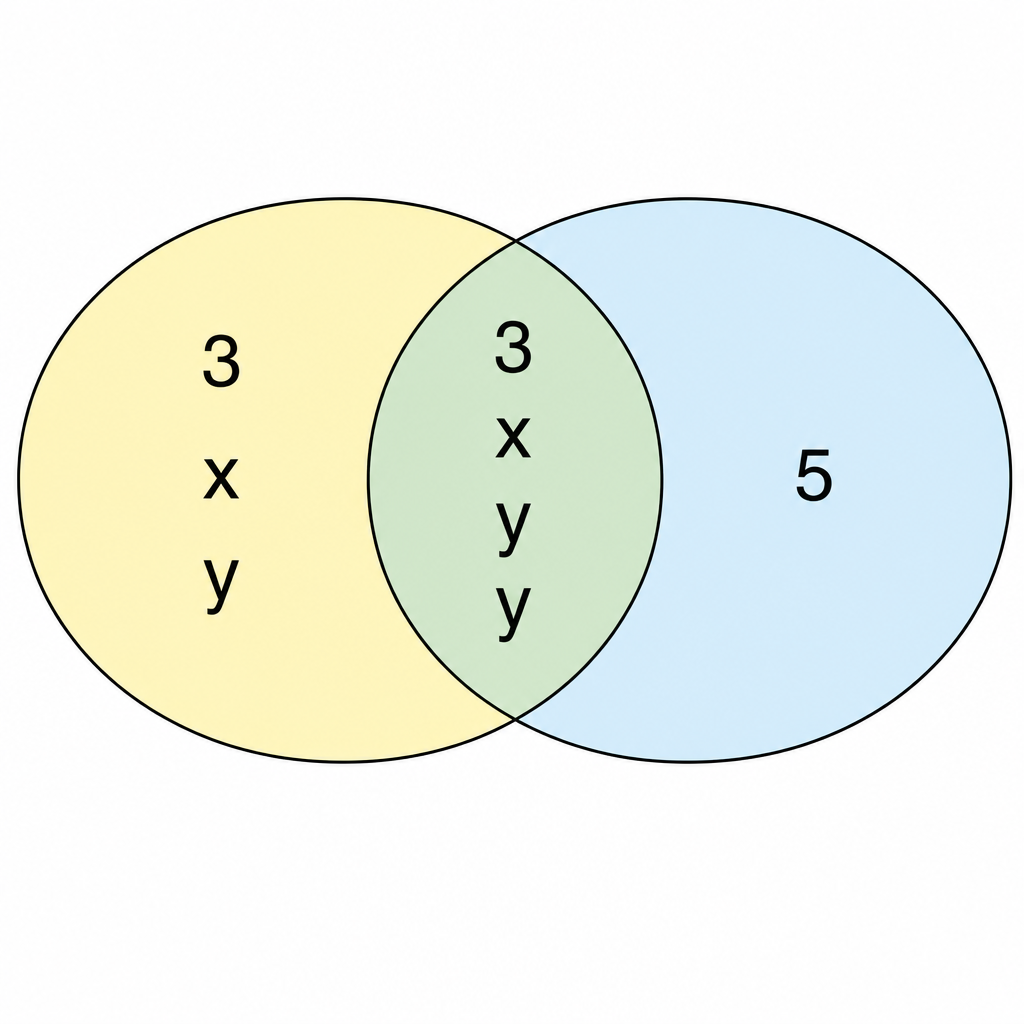
Now find the HCF of 9x²y³ and 15xy². Step 1: Writing the first expression in factors:
\[ 9x^2y^3 = 3 \times 3 \times x \times x \times y \times y \times y \]
Step 2: Writing the second expression in factors:
\[ 15xy^2 = 3 \times 5 \times x \times y \times y \]
Step 3: The factors common to both are 3, x, y and y. Multiplying them gives an HCF of 3xy².
When the expressions contain additions or subtractions, they must be factorized first. Find the HCF of x² + 2xy + y² and x² - y². Step 1: The first expression is a perfect square, so:
\[ x^2 + 2xy + y^2 = (x + y)(x + y) \]
Step 2: The second expression is a difference of two squares, so:
\[ x^2 - y^2 = (x + y)(x - y) \]
Step 3: Only one factor is shared by both, so the HCF is (x + y).
Three expressions are handled in the same way. Factorizing x² + 6x + 8, x² - 4 and x² + 4x + 4 gives:
\[ x^2 + 6x + 8 = (x + 4)(x + 2) \]
\[ x^2 - 4 = (x + 2)(x - 2) \]
\[ x^2 + 4x + 4 = (x + 2)(x + 2) \]
The only factor present in all three is (x + 2), so the HCF is (x + 2).
The Lowest Common Multiple of Algebraic Expressions
To find the lowest common multiple of 12 and 18, each shared factor is taken once and then every leftover factor is taken as well. Here the shared factors are 2 and 3, and the leftovers are 2 and 3. So the lowest common multiple is 2 times 3 times 2 times 3, which is 36.
Letters follow the same pattern. For x² and x³ the shared factor is x² and the leftover factor is x, so the lowest common multiple is x² times x, which is x³.
Lowest Common Multiple: the smallest algebraic expression that every one of the given expressions divides exactly is called their lowest common multiple, written LCM for short. It is found by multiplying the shared factors by all the leftover factors.
Find the LCM of 3xy² and 6x²y. Step 1: Writing both in factors:
\[ 3xy^2 = 3 \times x \times y \times y \]
\[ 6x^2y = 2 \times 3 \times x \times x \times y \]
Step 2: The shared factors give 3xy and the leftover factors give 2xy. Multiplying them:
\[ 3xy \times 2xy = 6x^2y^2 \]
Now find the LCM of 3x³ - 15x² and 2x³ - 50x. Step 1: Taking the common factor out of the first expression:
\[ 3x^3 - 15x^2 = 3x^2(x - 5) \]
Step 2: After 2x is taken out of the second expression, the bracket is a difference of two squares:
\[ 2x^3 - 50x = 2x(x + 5)(x - 5) \]
Step 3: The shared factors give x(x - 5) and the leftover factors give 6x(x + 5). Multiplying them:
\[ \text{LCM} = 6x^2(x - 5)(x + 5) \]
In the last example both expressions must be factorized. Step 1: Factorizing the first expression:
\[ x^2 + x - 20 = (x + 5)(x - 4) \]
Step 2: Factorizing the second expression:
\[ x^2 - 25 = (x + 5)(x - 5) \]
Step 3: The shared factor is (x + 5) and the leftover factors are (x - 4) and (x - 5). Multiplying them:
\[ \text{LCM} = (x + 5)(x - 4)(x - 5) \]
Choosing the Right Method
Students who get stuck on factorization are usually not looking at the shape of the expression. Counting the terms and looking at their form picks the method almost by itself.
| Shape of the expression | Method | Example |
| Every term shares something | Take out the common factor | 2x² + 4x |
| Four terms, nothing common to all | Group the terms | ax + bx + ay + by |
| One square subtracted from another | Write (a + b)(a - b) | 25x² - 36y² |
| Three terms and the middle one matches 2ab | Write it as a perfect square | 4x² + 12x + 9 |
| Three terms but not a perfect square | Split the middle term | x² + 5x + 6 |
Whatever the question, the first move is always to look for a common factor. Once it is outside the bracket, what is left inside is smaller, and the remaining method becomes much easier to see.
The full lesson is waiting for you
The notes are free to read in full. A free account opens the rest of the practice, and tracks your progress and confidence score for every subject. Presentations and videos need approval from Learn Yeti.