Writing a Set by Listing and by Describing
There are two ways of writing a set. Writing the members one by one inside braces is the listing method. Writing the property that all the members share is the describing method. Suppose the set of counting numbers up to 10 is called U. Then \( U = \{1, 2, 3, 4, 5, 6, 7, 8, 9, 10\} \). Other sets can now be built out of what U holds.
- (a) The set of prime numbers, \( A = \{2, 3, 5, 7\} \)
- (b) The set of odd numbers, \( B = \{1, 3, 5, 7, 9\} \)
- (c) The set of multiples of 3, \( C = \{3, 6, 9\} \)
- (d) The set of factors of 8, \( D = \{1, 2, 4, 8\} \)
- (e) The set of composite numbers, \( E = \{4, 6, 8, 9, 10\} \)
Every member of those five sets already lies inside U. The set that holds all the members under discussion is called the universal set, and here U is that universal set. Since A, B, C, D and E all fit inside U, each of them is a subset of U.
Universal set: the set that contains every member of all the sets being discussed. It is written as U.
The Venn Diagram
A relation between sets is grasped faster in a picture than in a sentence. The universal set U is drawn as a rectangle, and the subsets inside it are drawn as circles or ovals. The members are written inside their own shape. This way of drawing sets was used in 1880 by the mathematician John Venn, and the picture carries his name.
A Venn diagram is a picture that shows a set, or the relation between two or more sets.
When you draw a Venn diagram, draw the rectangle first and write U at its corner, then draw the circles inside it. No member is ever written outside the rectangle.
Disjoint and Overlapping Sets
In one classroom, make a set of the students who play football and a set of the students who play volleyball. If no student plays both games, the two sets have no member in common at all. But if some students play both, those students belong to both sets, and the two circles have to cut across each other. That difference splits sets into two kinds.
Now look at numbers. Inside \( U = \{1, 2, 3, 4, 5, 6, 7, 8, 9, 10\} \) take the set of even numbers \( A = \{2, 4, 6, 8, 10\} \) and the set of odd numbers \( B = \{1, 3, 5, 7, 9\} \). No number is both even and odd, so A and B share nothing. Next take the set of multiples of 3, \( C = \{3, 6, 9\} \). Here 6 is even and it is also a multiple of 3, so 6 is a member of both sets.
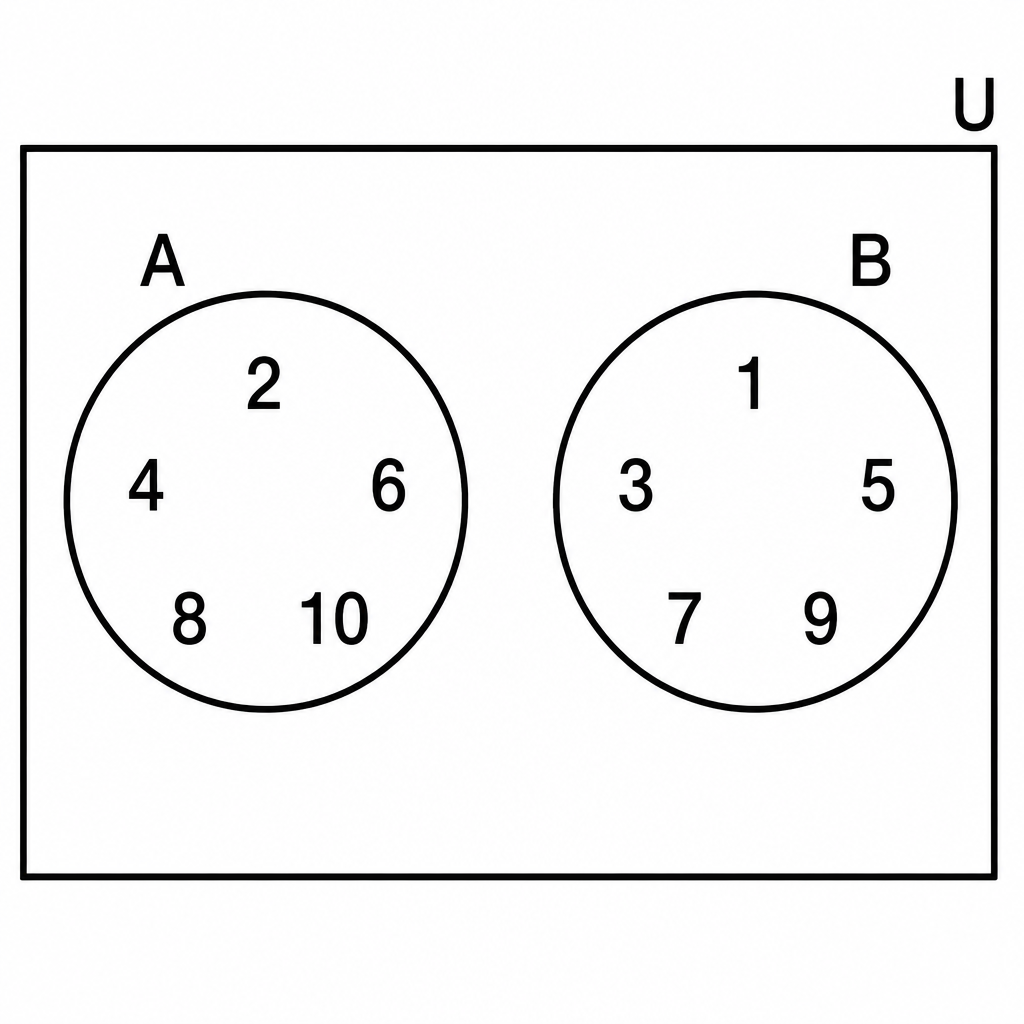
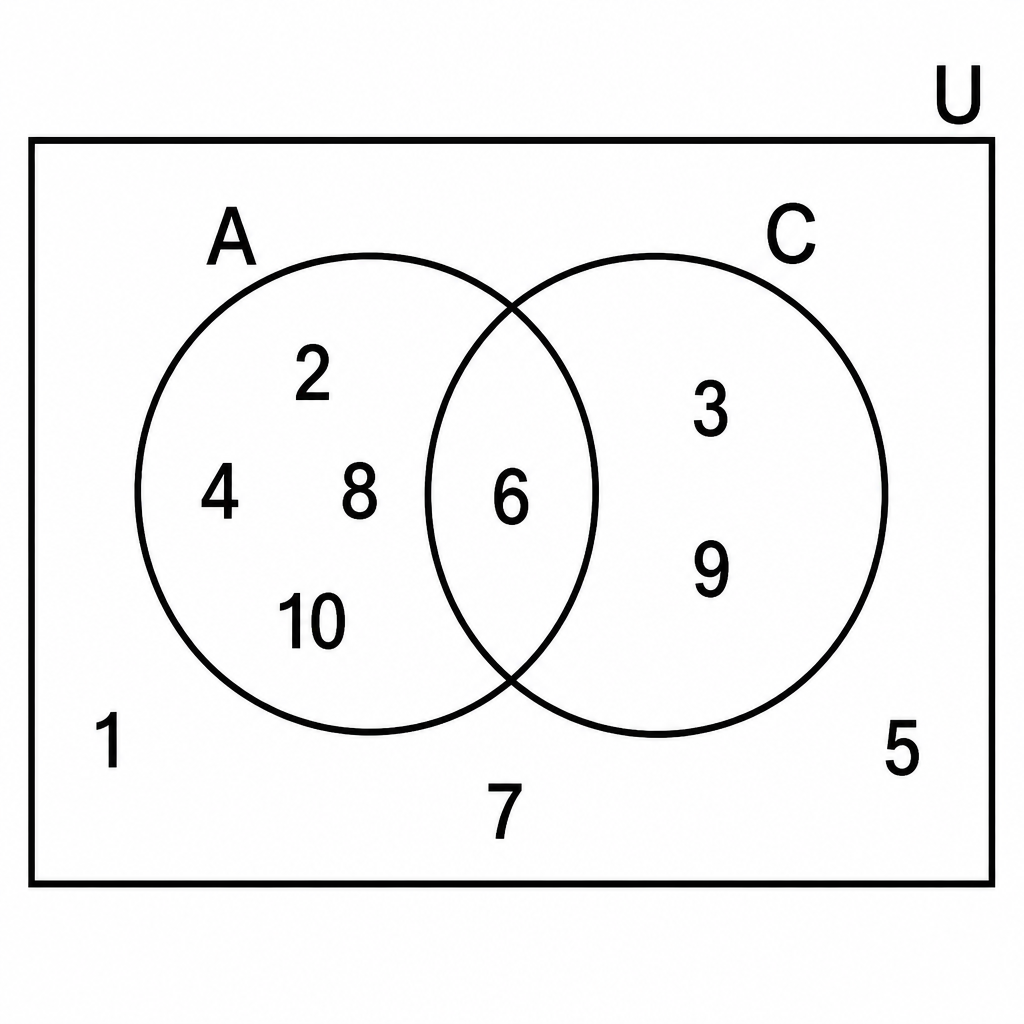
If two or more sets have at least one member in common and at least one member that is not common, those sets are called overlapping sets.
If two or more sets have no member in common at all, those sets are called disjoint sets.
| Point of comparison | Disjoint sets | Overlapping sets |
| Common members | None at all | At least one |
| Different members | Every member differs | At least one member differs |
| Shape of the Venn diagram | Circles stay apart | Circles cut across each other |
| Example | \( \{2, 4\} \) and \( \{1, 3\} \) | \( \{2, 4\} \) and \( \{4, 5\} \) |
Do not call two sets overlapping the moment you spot a shared member. In \( \{a, e, i\} \) and \( \{i, e, a\} \) every member is shared and not one member differs. Those are equal sets, neither disjoint nor overlapping. Overlapping needs a shared member and a different member, both.
Worked Example: Reading a Venn Diagram
The Venn diagram below shows two sets M and N inside the universal set U. Let us write M and N by listing and by describing, build U, and then decide what kind of sets M and N are.
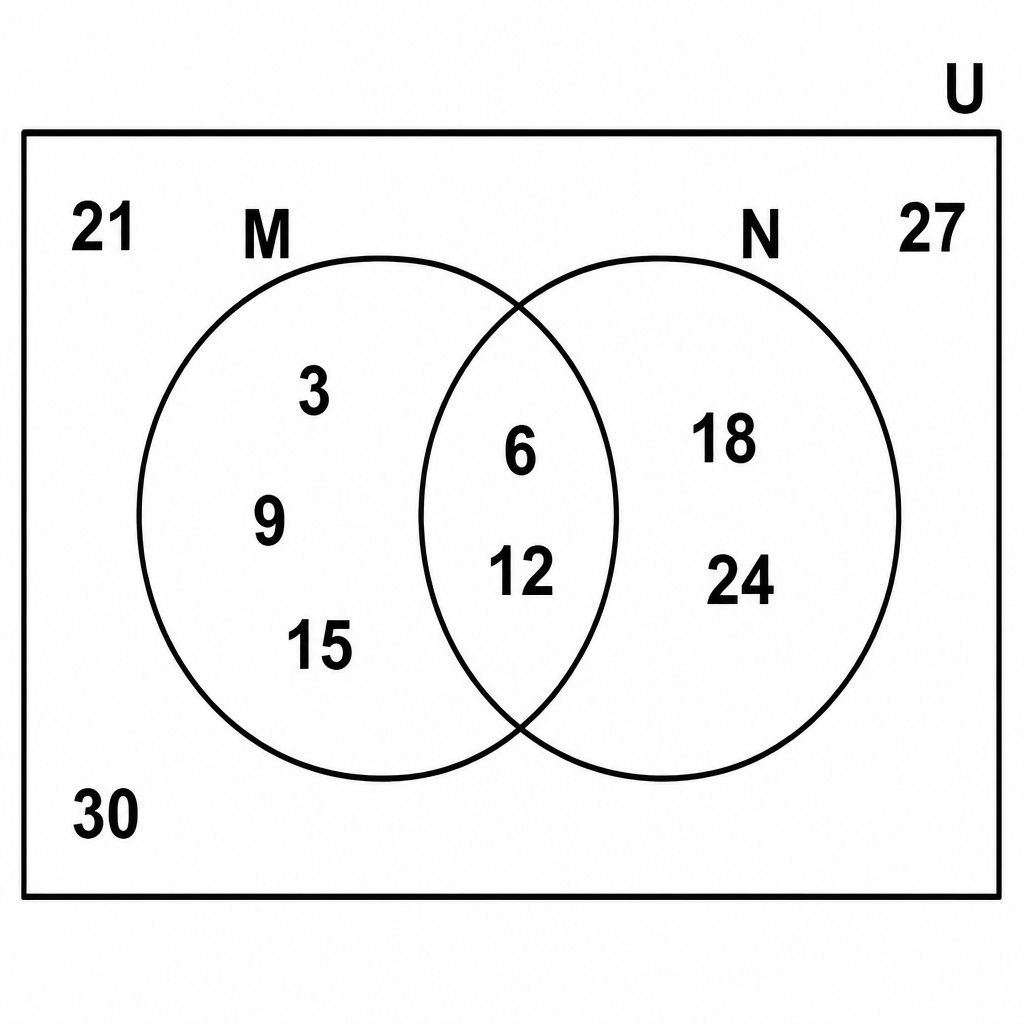
Step 1: Taking the numbers in M's own region together with those in the shared middle region, M in listing method is:
\[ M = \{3, 6, 9, 12, 15\} \]
Step 2: Taking N's own region together with the same shared region:
\[ N = \{6, 12, 18, 24\} \]
Step 3: Every member of M is a multiple of 3, and they are the first five of them in order. So in describing method \( M = \{\text{first five multiples of } 3\} \).
Step 4: In the same way the members of N are multiples of 6, so \( N = \{\text{first four multiples of } 6\} \).
Step 5: Every number inside the rectangle, including the ones lying outside both circles, makes up U:
\[ U = \{3, 6, 9, 12, 15, 18, 21, 24, 27, 30\} \]
Step 6: M and N share 6 and 12, while M keeps 3, 9 and 15 of its own and N keeps 18 and 24 of its own. Since there are shared members and different members, M and N are overlapping sets.
Worked Example: Showing Two Relations in Venn Diagrams
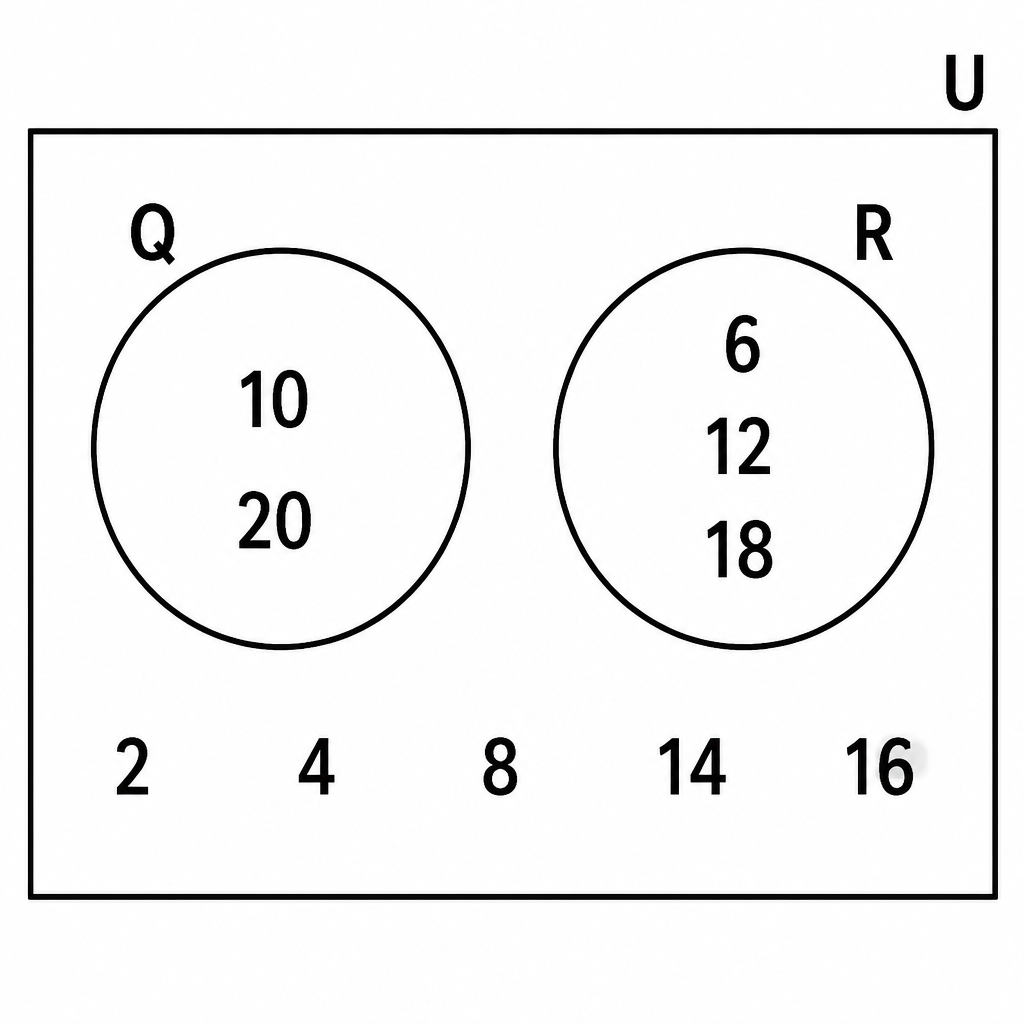
P, Q and R are subsets of the universal set U. Here \( U = \{\text{multiples of } 2 \text{ up to } 20\} \), \( P = \{\text{factors of } 10\} \), \( Q = \{\text{multiples of } 5\} \) and \( R = \{\text{multiples of } 6\} \). Let us show the relation of P with Q, and of Q with R, in Venn diagrams.
Step 1: Writing the multiples of 2 up to 20 gives the universal set:
\[ U = \{2, 4, 6, 8, 10, 12, 14, 16, 18, 20\} \]
Step 2: The factors of 10 are 1, 2, 5 and 10, but P is a subset of U, so only the ones lying in U are taken:
\[ P = \{2, 10\} \]
Step 3: Taking the multiples of 5 that lie inside U:
\[ Q = \{10, 20\} \]
Step 4: Taking the multiples of 6 that lie inside U:
\[ R = \{6, 12, 18\} \]
Step 5: P and Q share 10, while P keeps 2 of its own and Q keeps 20 of its own. So P and Q are overlapping sets.
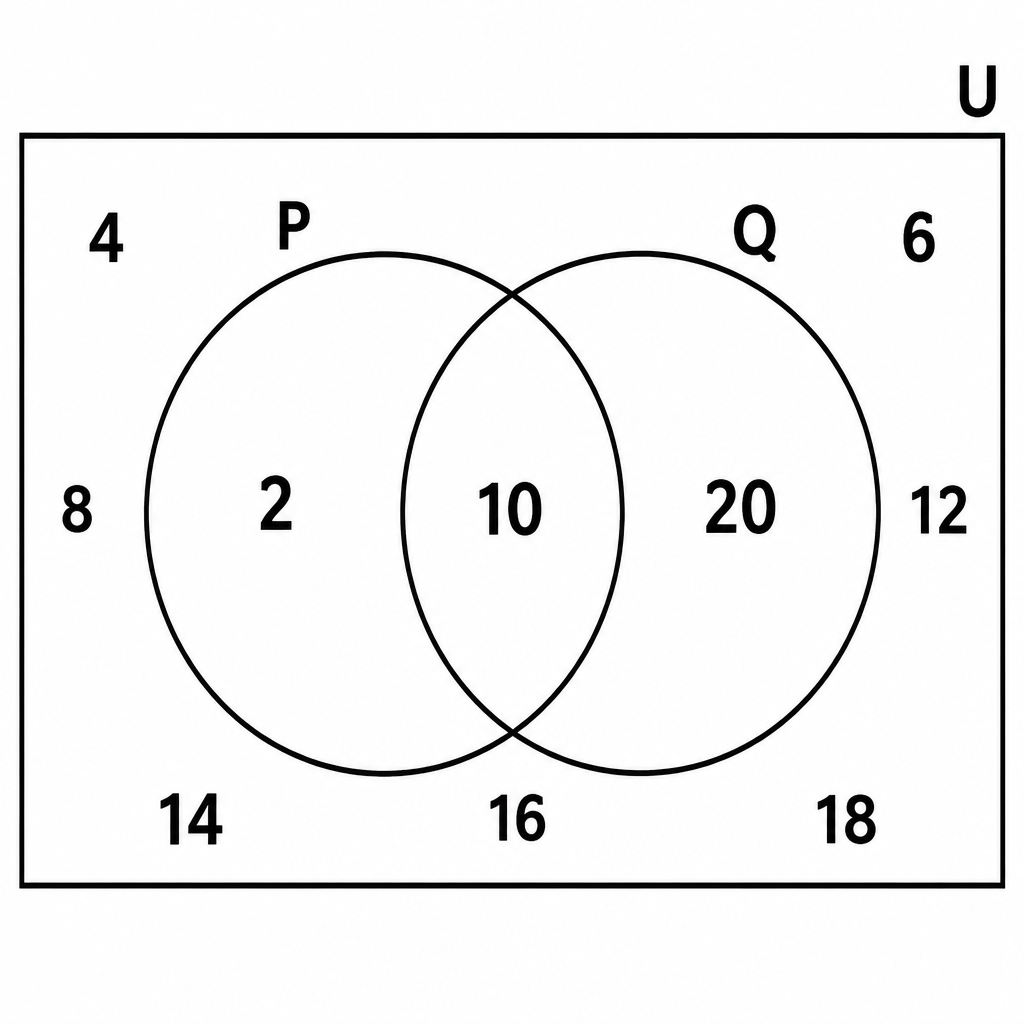
Step 6: Comparing the members of Q and R, the numbers 10, 20 and 6, 12, 18 have nothing in common. So Q and R are disjoint sets.
Subsets
Shanti invited Dolma, Rakesh and Lakshmi to her birthday. The set of friends who came is \( F = \{\text{Dolma, Rakesh, Lakshmi}\} \). Now make a group of two friends, say \( \{\text{Dolma, Rakesh}\} \). Both of its members are also in F, so it is a subset of F. Whenever every member of a smaller set is also found in a larger set, the smaller one is a subset of the larger one.
If A and B are two sets and every member of A is also a member of B, then A is called a subset of B. In symbols this is written \( A \subset B \) or \( B \supset A \).
Proper and Improper Subsets
A subset can be built in two ways. If you take only some of the members, the subset ends up with fewer members than the original set. If you take all of the members, the subset you build is equal to the original set itself. That difference is what separates a proper subset from an improper one.
If a subset B is built by taking only some of the members of A, then B is called a proper subset of A. In symbols it is written \( B \subset A \) or \( A \supset B \).
If a subset B is built by taking all of the members of A, then B is called an improper subset of A. In symbols it is written \( B \subseteq A \) or \( A \supseteq B \). Equal sets are improper subsets of each other.
The empty set is a proper subset of every set, leaving aside the empty set itself. The subset you build by taking no member at all is always \( \{\ \} \).
The symbols \( \subset \) and \( \subseteq \) do not say the same thing. Writing \( B \subset A \) means B is smaller than A, while \( B \subseteq A \) allows B to be equal to A. Treating them as interchangeable turns a correct answer into a wrong one.
Worked Example: Listing Every Subset of a Set
Let us write every subset that can be built from \( M = \{s, k, y\} \), give each one a name, and say which are proper and which is improper. Starting from zero members and going up one at a time makes sure no subset is missed.
Step 1: The subset built with no member at all is the empty set:
\[ A = \{\ \} \]
Step 2: Taking one member at a time gives three subsets:
\[ B = \{s\},\ C = \{k\},\ D = \{y\} \]
Step 3: Taking the members two at a time gives three more subsets:
\[ E = \{s, k\},\ F = \{s, y\},\ G = \{k, y\} \]
Step 4: Taking all the members gives a subset equal to the original set:
\[ H = \{s, k, y\} \]
Step 5: A, B, C, D, E, F and G each hold only some of M's members, so those seven are proper subsets of M. H holds all of M's members, so H is the improper subset. That makes eight subsets in all.
How Many Subsets a Set Has
For a small set you can write every subset out one by one, but as the members grow that becomes hard to count. Putting the number of members beside the number of subsets in a table shows a clear pattern.
| Set | Number of members (n) | Number of subsets |
| \( \{\text{mango}\} \) | 1 | 2 |
| \( \{\text{radish, pumpkin}\} \) | 2 | 4 |
| \( \{\text{bus, jeep, ship}\} \) | 3 | 8 |
| \( \{\text{dog, cat, horse, cow}\} \) | 4 | 16 |
| \( \{\text{pigeon, crow, eagle, parrot, heron}\} \) | 5 | 32 |
Each time one more member is added, the number of subsets doubles. So for a set with n members the total number of subsets is:
\[ 2^n \]
Exactly one of them is the improper subset, so the number of proper subsets is \( 2^n - 1 \). Check it: for \( M = \{s, k, y\} \) we have \( n = 3 \), so \( 2^3 = 8 \) subsets and \( 8 - 1 = 7 \) proper subsets, which matches the list written out above.
Worked Example: A Subset Drawn Inside Its Set
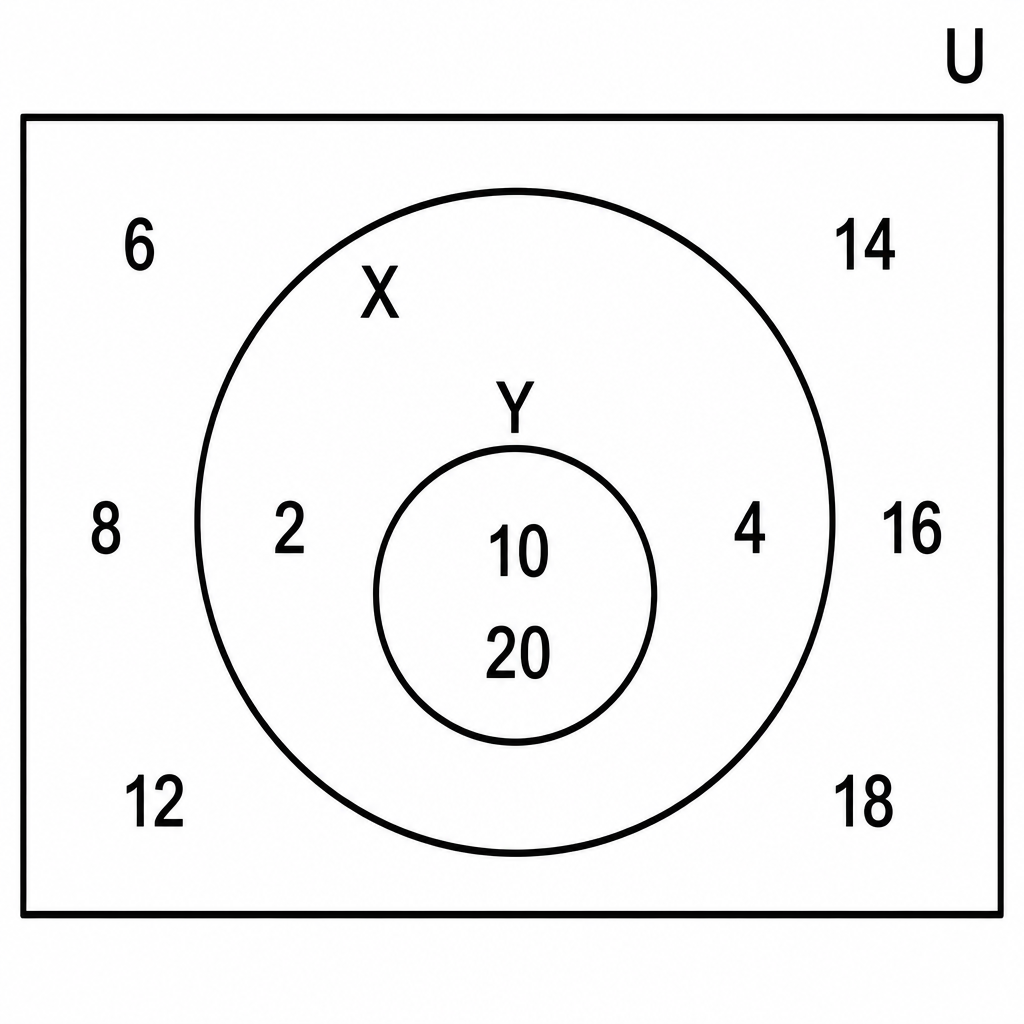
X and Y are subsets of the universal set U. Here \( U = \{y : y \text{ is a multiple of } 2 \text{ up to } 20\} \), \( X = \{\text{factors of } 20\} \) and \( Y = \{\text{multiples of } 5\} \). Let us show the relation between X and Y in a Venn diagram.
Step 1: Writing the multiples of 2 up to 20:
\[ U = \{2, 4, 6, 8, 10, 12, 14, 16, 18, 20\} \]
Step 2: The factors of 20 are 1, 2, 4, 5, 10 and 20, and taking only those found in U:
\[ X = \{2, 4, 10, 20\} \]
Step 3: Taking the multiples of 5 found in U:
\[ Y = \{10, 20\} \]
Step 4: Both members of Y, that is 10 and 20, are also in X, and X carries 2 and 4 besides. Y also has fewer members. So Y is a proper subset of X, written \( Y \subset X \). In the Venn diagram the circle for Y is drawn completely inside the circle for X.
The full lesson is waiting for you
The notes are free to read in full. A free account opens the rest of the practice, and tracks your progress and confidence score for every subject. Presentations and videos need approval from Learn Yeti.