Talking About Yesterday
When something is finished, we talk about it with a past tense verb. The question is "What did you do yesterday?" and the answer uses the past form of the verb: I went hiking. I watched a film. I ate rice and curry. Notice that the question uses "did" plus the base verb, but the answer puts the verb itself into the past: go becomes went, watch becomes watched, eat becomes ate. This whole unit is about talking, reading and writing in the past tense.
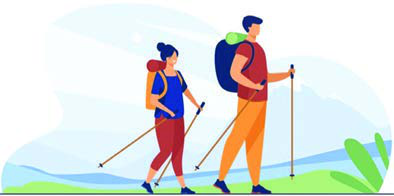
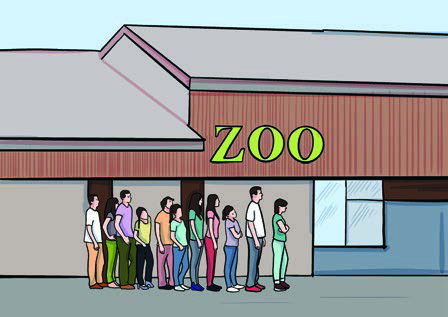


Practise this with a friend. One of you asks "What did you do yesterday?" and the other answers with a real sentence in the past. Then swap. Every answer must carry a past verb, because the action is over.
A Song About a Letter
This short song tells a small sad story, and every line of it uses past tense verbs. Read it aloud and listen for them.
I gave a letter to the postman,he put it in his sack.But in early next morning,he brought my letter back.She wrote upon it:Return to sender, address unknown.No such number, no such zone.
Four past verbs carry the whole song. None of them ends in -ed, because they are all irregular verbs. Their past forms have to be learnt one by one.
| Present form | Past form used in the song |
| give | gave |
| put | put |
| bring | brought |
| write | wrote |
Reading: A Trip to a Village
Last year, three friends decided to spend a holiday in a village in the mountains. They set off by car early in the morning, and by late afternoon they had almost reached the village where they planned to stay. They stopped for a quick cup of tea at a wayside cafe, then set off again along the winding road that led into the mountains. They had a map with them, and according to the map the village was only about fifteen miles away.

Then their luck turned. It got dark and it began to rain, so it became difficult to see the road clearly. After driving about fifteen miles they still saw no sign of the village. Obviously, their map was not a very good one. They went on for another five miles, and then the car suddenly stopped. At first they thought they had run out of petrol, but on examination they found that this was not the problem. Something else was wrong with the car. Since they could not start it again, they decided to spend the night inside it. They had very little food, and there was not much room for three people, so it was an uncomfortable night.
Early in the morning a car came along the road. They stopped the driver and asked him where the village was. He told them it was just on the other side of the hill. He tied their car to his and pulled them to the top, and from there their car ran all the way downhill to the village. They found a hotel and had a good breakfast. If they had walked up the hill the night before, they would not have had to spend that uncomfortable night in the car.
The story is told entirely in the past tense: decided, set off, stopped, thought, found, asked, told, tied, pulled, ran. When you retell any finished event, these are the verb forms you reach for.
The Three Sounds of -ed
Regular past verbs are all spelt with -ed, but the -ed is not always said the same way. There are three sounds, and which one you hear depends on the last sound of the base verb, not on its spelling.
The -ed ending is pronounced /t/ after voiceless sounds like p, k, s, sh, ch and f, pronounced /d/ after voiced sounds like b, g, l, m, n, r, v and all vowel sounds, and pronounced /id/ as an extra syllable after the sounds t and d.
| /t/ | /d/ | /id/ |
| reached | pulled | decided |
| stopped | cheered | wanted |
| asked | enjoyed | demanded |
| walked | played | nodded |
| pumped | turned | planted |
| practised | ||
| jumped | ||
| finished | ||
| hatched | ||
| briefed |
Do not say every -ed as a new syllable. "Walked" is one syllable, said like "walkt", and "played" is one syllable too. Only verbs ending in the sounds t or d, like wanted and decided, gain the extra /id/ syllable.
Joining Sentences: and, but, although, however
Short sentences can be joined so that the reader sees how two ideas are related. This unit teaches four joining words. Two of them add or contrast inside one sentence, and two of them show contrast in a stronger, more formal way.
And joins two ideas that go in the same direction. Example: They went on for another five miles and then the car suddenly stopped.
But joins two ideas that pull in opposite directions. Example: They thought they had run out of petrol, but they found that this was not the problem.
Although introduces the surprising or weaker idea, usually at the start of the sentence, and a comma follows its clause. Example: Although they had very little food with them, they decided to spend the night there.
However shows contrast between two full statements and sits between commas. Example: They had very little food with them, however, they decided to spend the night there.
Although and however both show contrast, but they sit in different places. Although starts a clause and never takes a comma straight after it. However stands between the two statements and needs a comma on each side. Writing "Although it was raining, however we went out" doubles the contrast and is wrong. Use one or the other.
Listening: A Weekend Conversation
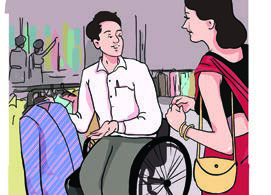
The listening task plays a conversation between people talking about their weekend. Before the audio starts, read the questions so you know what to catch. You are listening for what Mary did at the weekend, who went with her to the restaurant, why Peter did not go out, and who the speakers are. On the second listening you complete sentences, and every blank in them wants a past tense verb, because the weekend is finished.
- Read all the questions and blanks before the audio begins, and underline the names: Mary, Peter, Tom, and the place called the Green Stake.
- On the first listening, do not write. Just follow who did what.
- On the second listening, fill each blank with the exact past verb you hear. Predict its shape first: "She went home and .......... a shower" clearly wants a past verb.
- Check your answers against the questions: does each one really answer what was asked?
Writing About Your Last Vacation
A good paragraph about a past trip answers five questions in order. Ask them of yourself, then ask them of four friends and write their answers in complete sentences. Answering in full sentences forces you to use the past tense correctly, which is the point of the exercise.
- When was your last vacation or trip?
- Where did you go?
- How did you get there?
- Who did you go with?
- What did you do?
When you have your five answers, join them into one paragraph. Use and, but, although or however where two of your ideas connect, so the paragraph reads as one story rather than five separate lines. A model paragraph is worked out in the examples.
Reading: Anuradha Koirala
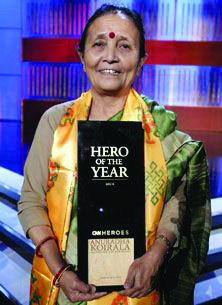
Anuradha Koirala was born on 14th April, 1949 to Colonel Pratap Singh Gurung and Laxmi Gurung. She studied at St. Joseph Convent School in Kalimpong, India, and it was at school that her devotion to social work began. Mother Teresa has always been her largest source of inspiration. She spent more than 20 years teaching children at various schools around Kathmandu. Teaching brought her great satisfaction, but she realised that she had a bigger personal calling to fulfill. Children, girls and women were being trafficked within and from Nepal for sexual exploitation. Therefore, in 1993, she founded Maiti Nepal, with the aim of providing services for children and women who have endured untold pain and suffering, often in silence.
Her first work after establishing Maiti Nepal was setting up a home. Today Maiti Nepal has three prevention homes, eleven transit homes, two hospices and a formal school, and more than 1000 children receive direct services from it every day. Its activities include organising awareness campaigns, community sensitisation programmes, rescue operations, apprehending traffickers, providing legal support and women empowerment programmes. Her determination and leadership made all of this possible.
So far she has received 38 national and international awards for her courageous acts. Among them are the Prabal Gorkha Dakshin Bahu Medal, Nepal 1999, the Trishaktipatta Award 2002, the Best Social Worker of the Year Award, Nepal 1998, the German UNIFEM Prize 2007, the Queen Sofia Silver Medal Award 2007, and The Peace Abbey Courage of Conscience 2006. Because of her continuous struggle, the Government of Nepal now recognises 5th September as an anti-trafficking day. In 2010 she was declared CNN Hero, the result of her fight against the social evil of human trafficking. She calls that victory a pride and honour to the whole nation, not only to herself.
| Number, date or year | What it refers to |
| 1949 | Anuradha Koirala was born. |
| 20 | She spent more than 20 years teaching children around Kathmandu. |
| 1993 | She founded Maiti Nepal. |
| 1000 | More than 1000 children receive direct services from Maiti Nepal every day. |
| 38 | She has received 38 national and international awards. |
| 1999 | She received the Prabal Gorkha Dakshin Bahu Medal, Nepal. |
| 2006 | The Peace Abbey honoured her with the Courage of Conscience award. |
| 2010 | She was declared CNN Hero. |
| 5th Sep. | The Government of Nepal recognises it as an anti-trafficking day. |
Grammar: used to
Anuradha Koirala used to teach school children, but now she doesn't. That sentence tells you two things at once: teaching was her habit in the past, and the habit has stopped. That is exactly the job of "used to".
Used to + base verb describes a habit or state that was true in the past but is not true now. Example: I used to play marbles when I was a child, but now I don't. The negative is did not use to, or didn't use to. Example: People did not use to work in factories 500 years ago.
Compare it with the plain past simple. "I played football yesterday" describes one finished action at one time. "People used to travel on foot 300 years ago, but now they can travel by bus" describes something people did regularly over a long past time and no longer do. If the sentence is about a single event, use the past simple. If it is about a repeated old habit or a past state, use used to.
| Form | What it says | Example |
| used to + base verb | a past habit or state, finished now | My sister used to have short hair. |
| did not use to + base verb | the habit was never there | Nitu did not use to wear jeans. |
| past simple | one finished action at one time | She established Maiti Nepal in 1993. |
After did, the d disappears: write "did not use to", never "did not used to". The did already carries the past, so the verb goes back to its base form, just as in every other did question or negative.
Speaking About Past Habits
Work in pairs and take turns to talk about your past habits. Each of you names at least five things you used to do or didn't use to do. For example: I used to sleep in the afternoon. I used to be afraid of dogs. I didn't use to drink tea. Your partner listens and then asks a question about one habit.
Then talk about last week. Make a small table with the days on one side and what you did on the other, and take turns asking and answering in the past tense. The exchange goes like this.
- Student A: Last Sunday, I went to the market and bought some books. What did you do?
- Student B: I went to the field with my father.
The Crane and the Crab
These six pictures make one story. Read them in order first, then read the story written below them in the past tense. This is also the story the writing task asks you to write, so study how each picture becomes one or two past tense sentences.
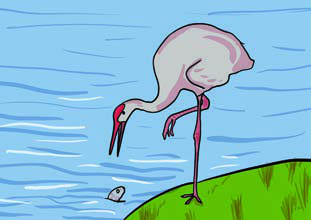
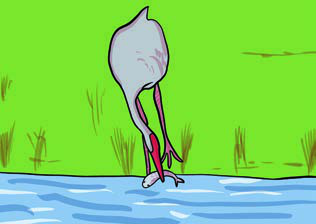
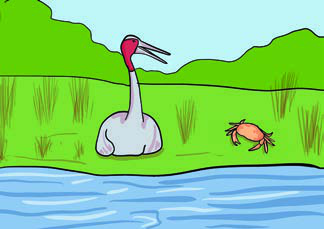
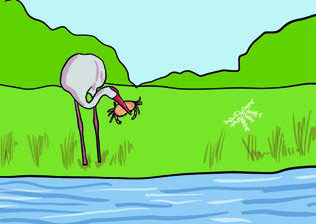
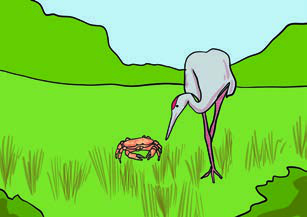
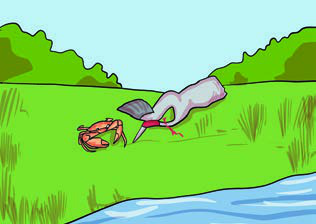
Once there was an old crane who could no longer catch fish. He was starving, so he found an idea. He told the fish of the pond that a fisherman would soon come and catch them all. The frightened fish asked the crane to help them, and he offered to carry them, one by one, to another pond. But he did not take them anywhere. He ate every fish he carried. One day a crab asked the crane to take him to the other pond too, and the crane agreed. Along the way, the crab noticed a pile of fish bones in the grass. He asked the crane what he had done with the fish, and the crane said that he ate them all. The crab understood everything. He caught the crane's neck with his strong pincers and killed him. The cheat who tricked the weak was finished by the one passenger who could fight back.
Project Work
Visit an elderly person in your neighbourhood. Ask what they used to do and what they did not use to do when they were young. Write their answers as a list of used to sentences, such as: She used to fetch water from the well. She didn't use to watch television. Then share your list with your friends. This is the grammar of the unit working on a real person's memories.
The full lesson is waiting for you
The notes are free to read in full. A free account opens the rest of the practice, and tracks your progress and confidence score for every subject. Presentations and videos need approval from Learn Yeti.