Facts and Opinions
Look at these four pictures. A tall school building. Two friends studying together at a table. A man with big muscles. A boy reading quietly on his own. Now ask yourself some questions. Is a big school always a good school? Is studying with a friend better than studying alone? Is a strong body more important than a sharp mind? Different people will give different answers, and none of them can point to a measurement to prove they are right. That is because these answers are opinions.
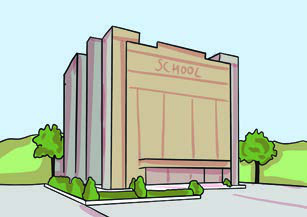
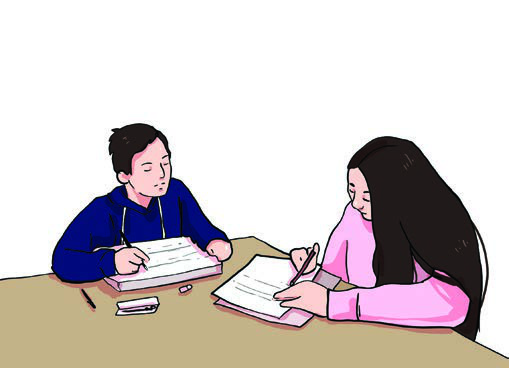
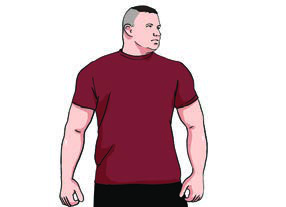
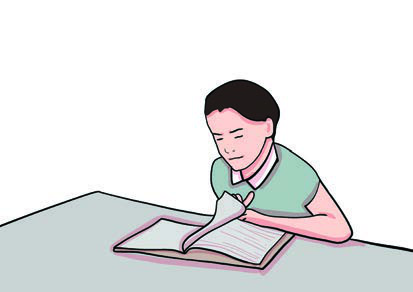
A fact is something that is true whether or not anyone agrees with it. The earth is round is a fact.
An opinion is what a person thinks, feels or believes about something. Studying alone is better than studying in a group is an opinion.
You can disagree with an opinion, but you cannot disagree with a fact. A fact stays true even when someone argues loudly against it.
The Song of the Stubborn Arguer
This short poem by Wendy Cope is about a boy and a girl who argue about the shape of the earth. Read it aloud and listen to its rhythm.
He tells her that the earth is flat -He knows the facts, and that is that.In altercations fierce and longShe tries her best to prove him wrong.But he has learned to argue well.He calls her arguments unsoundAnd often asks her not to yell.She cannot win, he stands his ground.The planet goes on being round.
The boy insists that the earth is flat. He is a skilled arguer. He calls the girl's arguments unsound, he tells her not to shout, and he never gives up. The girl knows the earth is round, but she cannot make him accept it, so she loses the argument. Then comes the last line, and it is the whole point of the poem. The planet goes on being round. However well the boy argues, his opinion does not change the fact. Winning an argument is not the same as being right.
Reading: Fast Food
The first reading of this unit is a writer's opinion about junk food, supported by facts. People around the world are getting fat because they eat too much junk food. Junk food fills you with energy but gives your body almost nothing it actually needs.
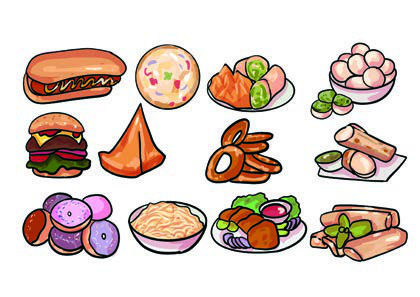
Junk food is food that has a lot of calories but not many nutrients.
Nutrients are the things your body needs to stay alive and grow, such as vitamins, minerals and fibre.
Most fast food, especially food sold in packets, is junk food. It is made in factories, where refined sugar, salt and vegetable oil are added to make it taste good. The factories do this to make money. They do not look after your health. That job belongs to you.
Here is the strange part. Junk food tastes so good that people drink huge cups of sweet iced tea and cola, and finish a whole bag of potato chips, and still feel hungry. Why? The brain keeps sending the message to eat, because it knows the body still has not received the nutrients it needs. The stomach is full, but the body is still empty.
Humans grew up eating three main kinds of food: meat, vegetables and fruits. These are called real foods. Refined sugar, refined flour and vegetable oil are not part of a human's natural diet. In America, which has the most obese people, real food is hard for poor people to find, because fresh vegetables and meat cost more than junk food. So in America more poor people are obese than rich people. Even people in prisons are obese. In Nepal we are lucky, because real food is still easy to find. But junk food is easy to find too, so the choice is ours. Your body is the most valuable thing you will ever own, so treat it like a temple, not like a garbage bin.
Notice how the text mixes facts and opinions. Junk food has few nutrients is a fact. You should not eat junk food is the writer's opinion. A good reader can tell the two apart.
Saying the New Words
Five words from the reading have sounds that are easy to get wrong. The symbols between the slashes show the sounds, and the small raised mark shows which part of the word is said with force.
| Word | Sounds | Listen for |
| nutrient | /ˈnjuːtriənt/ | the force is on NEW, and the first sound is nyoo |
| refined | /rɪˈfaɪnd/ | the force is on FINED, which rhymes with kind |
| obese | /əʊˈbiːs/ | the force is on BESE, said like beece with a long ee |
| valuable | /ˈvæljuəbl/ | the force is on VAL, and the word has no double u sound in the middle |
| garbage | /ˈɡɑːbɪdʒ/ | the ending is bij, never baaj |
Grammar: To + Verb for Purpose
Read this sentence. She studies hard to get better grades. The first part tells us what she does. The part beginning with to tells us why she does it. Getting better grades is her purpose.
The infinitive of purpose is to + verb used after an action to say why the action is done. He goes to the gym to be healthy.
The test is simple. Ask why about the action, and the to part is the answer. Why did I go to the cinema? To see the new film. Why does she go to the park? To play with her friends. Why do I play computer games? To have fun. One action can have many possible purposes, and the purpose tells you a lot about the person. We learn English to travel, to speak to other people, to get a good job, to understand films and music, and to get good grades. We do exercise to keep fit, to be healthy, to run faster, and to play with other friends. Same pattern, different purposes.
Do not put for in front of the purpose. She studies hard for to get better grades is wrong, and She studies hard for get better grades is also wrong. Purpose takes to + verb and nothing else.
Listening: Good Habits and Bad Habits
A habit is a routine behaviour, something you do again and again without thinking. Brushing your teeth every morning is a habit. Biting your nails is a habit too. Before you listen, make a list of five of your own habits and decide with a friend which are good and which are bad.
The audio for this task is a speaker talking about people's bad habits. Your job is to listen and write True or False for six statements. The statements ask whether all people have bad habits, what smokers think about smoking, whether making a noise while eating is a bad habit in England, whether the speaker wants other people to stop their bad habits, how he feels about people arriving late for meetings, and what he wants motorists to do about their driving.
- Read all six statements before the audio starts, so you know exactly what to listen for.
- On the first listening, catch the speaker's main idea and mark the answers you are sure of.
- On the second listening, check the ones you missed. Listen for words like all, some, never and always, because one small word can turn a statement from true to false.
- After listening, list the habits the speaker talked about and tell a friend which of them you have.
Writing: Punctuation That Changes Meaning
Punctuation is not decoration. It tells the reader where a sentence ends, what kind of sentence it is, and which words were actually spoken. Look at four sentences that students often get wrong, each shown here in its correct form.
- I know what you want. A statement ends with a full stop. Do not split the verb from its object with a comma, and do not add a question mark to a sentence that is not asking anything.
- You don't know me well, do you? A tag question takes a comma before the tag and a question mark at the end. Both are needed.
- He said, "I am a student." The exact spoken words sit inside quotation marks, and a comma comes after said, before the quotation opens.
- Ugh! Why are you yelling at me? The exclamation Ugh gets an exclamation mark of its own, and the question that follows gets a question mark. One sentence, two marks, each doing its own job.
Now watch punctuation repair a whole paragraph. Written with no capital letters and no stops, a description of a boy called Winston is almost unreadable. Corrected, it looks like this.
Winston is one of the most laid-back people I know. He is tall and slim with black hair, and he always wears a T-shirt and black jeans. His jeans have holes in them, and his baseball boots are scruffy too. He usually sits at the back of the class, and he often seems to be asleep. However, when the exam results are given out, he always gets an "A". I don't think he's as lazy as he appears to be.
- Every sentence begins with a capital letter, and the name Winston is always capitalised.
- Every sentence ends with a full stop, so one long stream of words becomes six clear sentences.
- The word I is always a capital, and the apostrophes go back into don't and he's.
- A comma follows However at the start of a sentence, and commas join the pairs of ideas inside the longer sentences.
Reading: The Pen is Mightier than the Sword
The second reading is a speech. A speaker stands before an audience and argues for a well known proverb. Notice the shape of the speech as much as its content, because you will write and deliver speeches yourself.
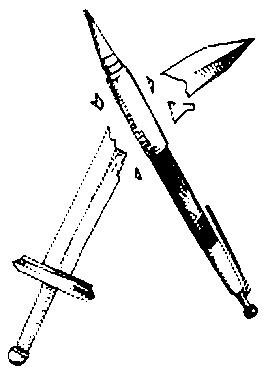
A proverb is a short, well known saying that carries a piece of wisdom or advice. The pen is mightier than the sword is a proverb.
The speaker begins by thanking the audience and naming the topic. Then come the arguments, one after another. A sword gives enormous power to the person holding it. With a sword you can make people bow down to you and establish your supremacy. But that power has a limit. You can enslave a person's body, and you can never enslave their mind and heart. Reaching the mind and heart is the power of the pen.
History supplies the proof. Military power does not last. Alexander the Great, Napoleon Bonaparte and Hitler are examples of rulers whose power ended. The teachings of great writers, on the other hand, are remembered forever. Writers, poets and scientists never really die, because they live on in people's hearts through their exemplary works. And what makes human beings superior to animals in the first place? Not physical strength. It is our mental faculty, our ability to think and to put thoughts on paper. So it is the pen, not the sword, that makes humans what they are. The speaker closes with the conclusion that violence never helps, urges everyone to adopt the path of non-violence and influence the world with the pen, and thanks the audience.
A good speech has a shape: greet the audience, name the topic, give your arguments one by one, state your conclusion, and thank the listeners.
Speaking: Giving Your Opinion Politely
When you give an opinion in English, you signal it with a special opening phrase. The phrase tells your listener that what follows is your view, not a fact, and it makes disagreement polite instead of rude. Learn these five openers and use them every time.
- I think junk food should not be sold near schools.
- I believe the speaker is right about the pen.
- In my opinion, studying with a friend works better than studying alone.
- I strongly believe that we should keep our rivers clean.
- I'm sure that regular exercise makes you healthier.
Now practise on real situations. Look at each picture below, say what is happening, and say whether you think it is right or wrong, starting with one of the openers. An old man is crossing a busy road alone with his stick. A girl is feeding fresh grass to a goat. Children are cleaning rubbish from a river bank. An old woman is sitting on the ground begging with a bowl in her outstretched hand. Some of these will feel clearly right, some clearly wrong, and some will divide the class. That is exactly what opinions do.
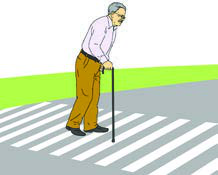
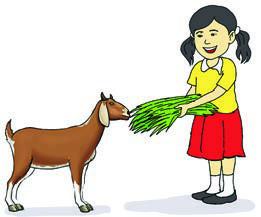
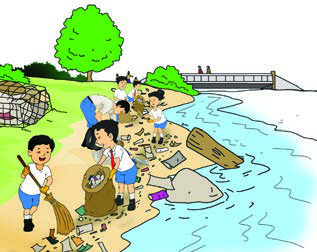

Finish with a debate. Some people say life is much easier in the city than in the village. Do you agree or disagree? Give your opinion with reasons, and listen to a partner who takes the other side.
Grammar: Present Continuous and Present Simple
Read these sentences. I'm just leaving my office. Please be quiet, the children are sleeping. Mina is going to a new school next month. Are they coming to the party? All of them use the same tense, the present continuous, but they do two different jobs.
The present continuous is am, is or are + verb-ing. It describes an action happening right now, and it also describes a future arrangement that is already fixed. The children are sleeping. Mina is going to a new school next month.
The present simple describes habits, routines and things that are generally true. They go to a restaurant every Saturday.
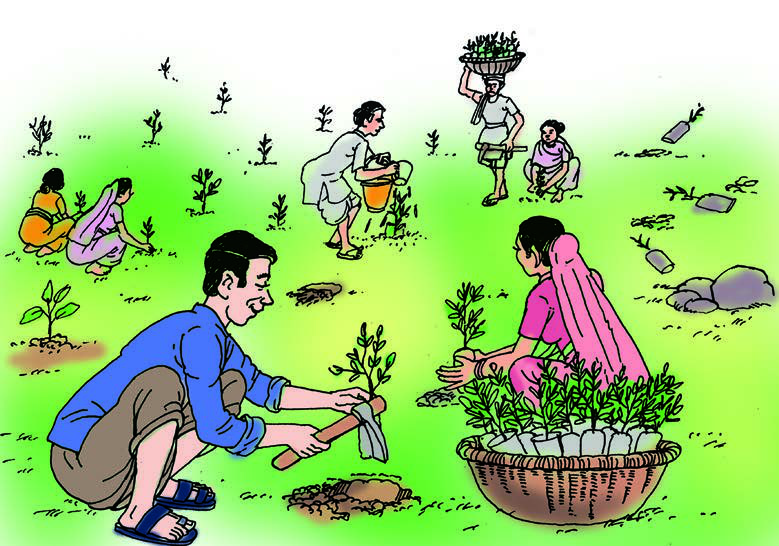
This picture is perfect practice for the present continuous, because everything in it is happening right now. The man in the blue shirt is planting a small tree. The woman in pink is taking seedlings from a basket. A woman at the back is carrying a basket of saplings on her head. Two women on the left are working on the ground. They are all making their village greener.
To choose between the two tenses, look at the time words. Words like every day, often, very often and every Saturday point to a routine, so they take the present simple. Words like now, at the moment, these days, next week and next month point to an action in progress or a fixed arrangement, so they take the present continuous. Compare: Does he eat rice every day? I am working at the moment. They are not coming to the party tomorrow. She does not go to the cinema very often.
Never mix the two forms. I am go home and She going to school are both wrong. The present continuous always needs both parts: the helping verb am, is or are, and the verb with -ing. I am going home. She is going to school.
Writing: A Paragraph That Gives Your Opinion
Some students think that having a lot of homework is good, while others do not like doing homework at all. What do you think? An opinion paragraph answers a question like this in a few clear sentences, and it always has the same three parts.
- State your opinion in the first sentence, using an opener such as In my opinion or I believe.
- Support it with two or three reasons, and give a real example if you can.
- Close by repeating your opinion in different words.
Here is a model. In my opinion, a small amount of homework every day is good for students. Homework makes us revise what we learned in class, so we do not forget it. It also teaches us to work on our own, without a teacher standing beside us. However, too much homework leaves no time for play and rest, and a tired student learns nothing. I strongly believe that homework is useful when there is not too much of it.
Project: Hold a Speech Competition
This unit ends with something you do together. With your English teacher, set a topic for a speech competition and organise the event in your class.
- Agree on a topic with your teacher, for example Junk food should be banned in schools, or Books teach us more than television.
- Write your speech using the shape you studied: greet, name the topic, argue, conclude, thank.
- Practise saying it aloud, slowly and clearly, before the day of the competition.
- Hold the competition in class, listen to every speaker, and decide together what made the best speeches good.
Punctuation Marks at a Glance
Keep this table for revision. It shows the ten punctuation marks you are expected to use, each with a sentence that uses it correctly.
| Mark | Name | Example |
| . | Full stop | Jane and Jack went to the market. |
| ? | Question mark | When did he leave for the market? |
| ! | Exclamation mark | What a beautiful flower! |
| , | Comma | Thanks for all your help, Nita. |
| ; | Semicolon | He was hurt; he knew she only said it to upset him. |
| : | Colon | She bought four things: a shirt, a pair of shoes, a scarf and a story book. |
| - | Hyphen | I have a part-time job. |
| ' | Apostrophe | He's done the work on time. |
| " " | Quotation marks | "Don't go outside," she said. |
The full lesson is waiting for you
The notes are free to read in full. A free account opens the rest of the practice, and tracks your progress and confidence score for every subject. Presentations and videos need approval from Learn Yeti.