Festivals and the Wishes We Make
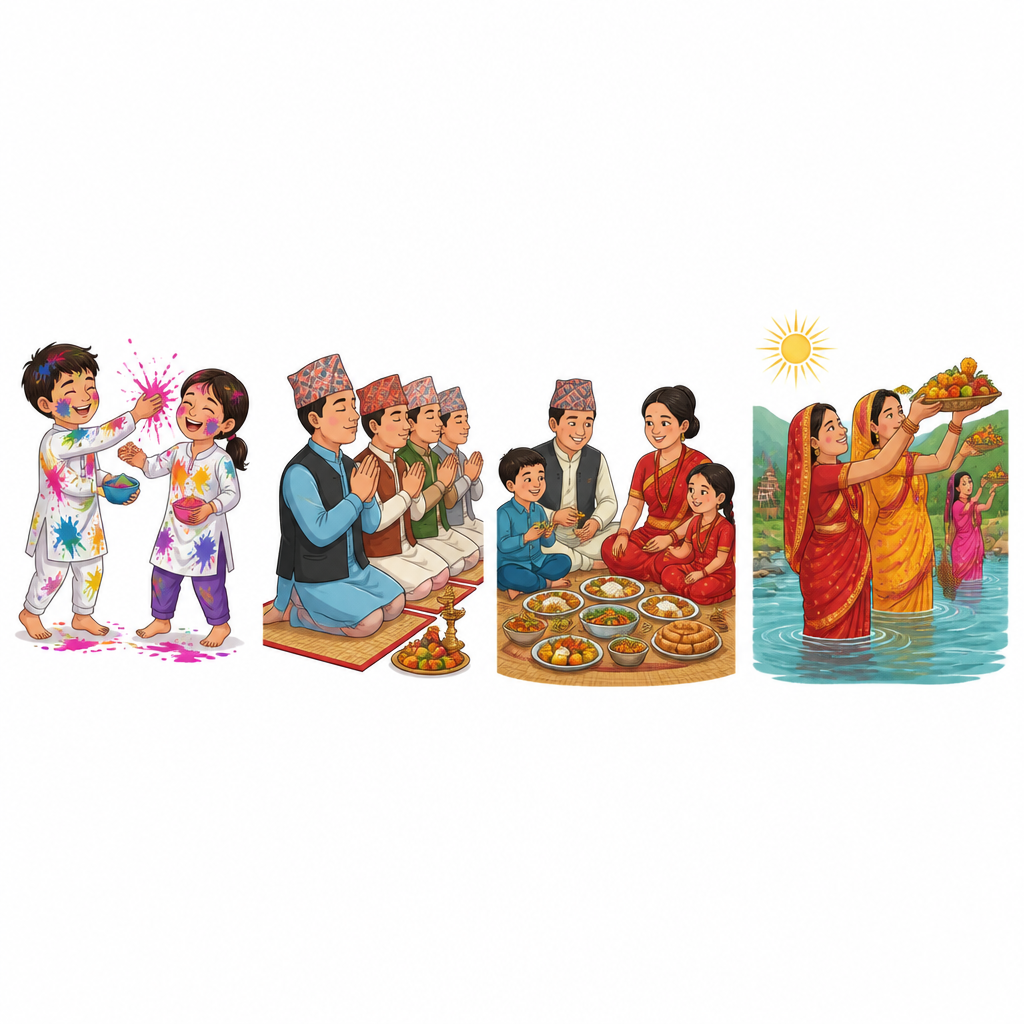
Festivals fill the Nepali year, and each one has its own things that people do. At Fagu Purnima, children chase each other with coloured powder and water until every shirt is a rainbow. During Eid, men kneel in long rows on mats and pray together. At Dashain time, families sit down to big shared meals and children fly high on bamboo swings. At Chhath, women stand in the river holding trays of fruit and flowers up to the sun. Different actions, but the same heart: people gather, share food, and wish each other well.
A wish is a hope you speak out loud for someone else, or for yourself. Festivals are full of wishes, and so is this song. Notice that almost every line begins with a wish.
I wish you good friends that always treat you fair.Wanna wish you ribbons to tie around your hair.I wish you truckloads of cheers and many happy years.Wanna wish you freedom to do the things you love.Wanna wish you blessings and kindness from above.Wanna wish you sunlight through the clouds.And I hope you laugh out loud.
Why do people make wishes at all? Because a wish shows love and hope. It costs nothing, yet it tells the other person that their happiness matters to you. That is why so many festival greetings are really wishes: Happy Dashain means I wish you a happy Dashain.
Some Festivals of Nepal
Lhosar is the combination of two words. Lho means year and sar means new, so Lhosar is a new year festival. It is one of the most popular festivals of Nepal, and different communities celebrate it on different days. Tamu Lhosar is celebrated by the Gurung community. Sonam Lhosar is celebrated by the Tamang and Yolmo communities. Gyalbo Lhosar is observed by the Tibetan and Sherpa communities. The new year begins with dancing, singing and family meet-ups where people exchange greetings and gifts. Families pray together and enjoy special foods.
| Kind of Lhosar | Who celebrates it |
| Tamu Lhosar | The Gurung community |
| Sonam Lhosar | The Tamang and Yolmo communities |
| Gyalbo Lhosar | The Tibetan and Sherpa communities |
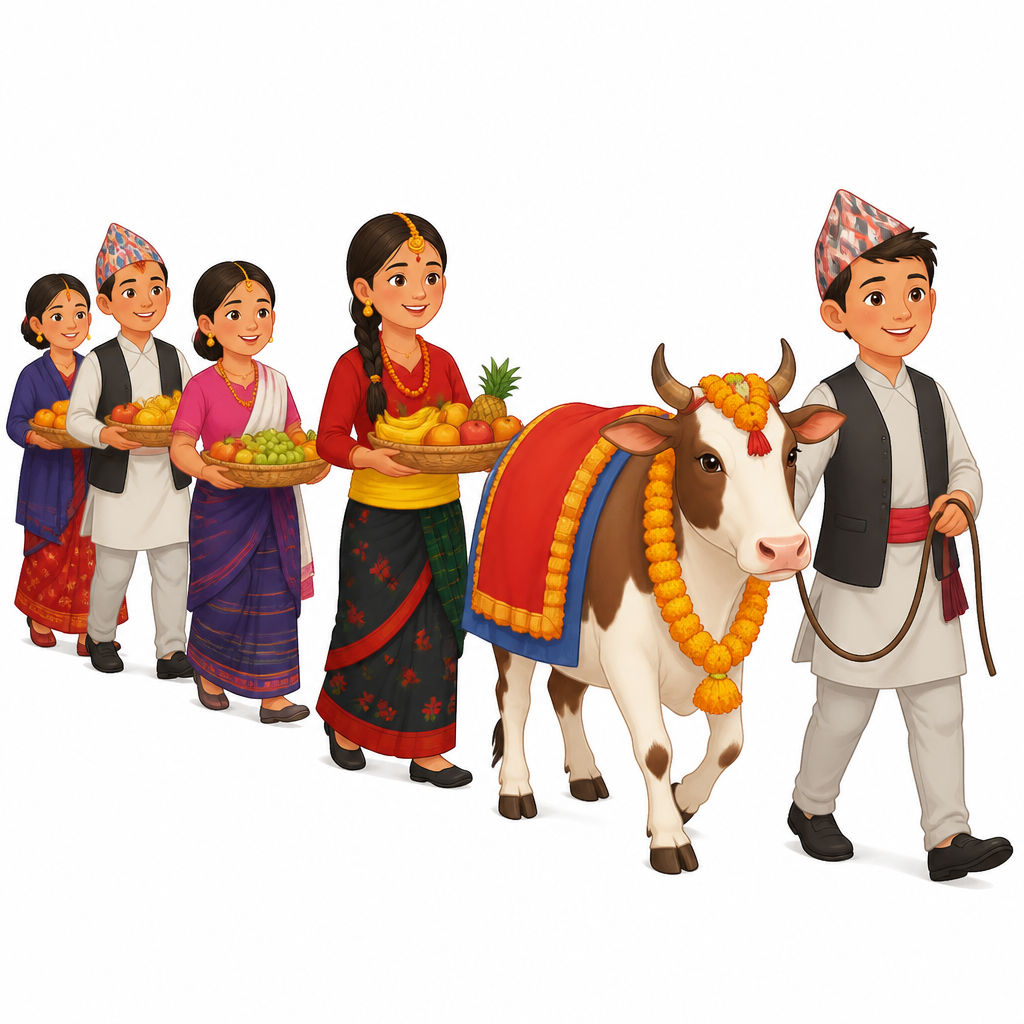
Gai Jatra, the festival of cows, is celebrated to commemorate the people who died during the year. Local people believe that cows can help the deceased reach Yama, the God of death. It is one of the most unique festivals of Nepal. Cows are decorated and led through the streets and lanes, and the families of the deceased join the procession, distributing food packets and fruits to others. To lower the sorrow and grief of the departed souls, local people join in rallies, menfolk wear women's dresses and enjoy songs. The Lakhe dance is also seen during Gai Jatra. So a festival about death becomes, on purpose, a day of laughter that comforts the grieving.
Buddha Jayanti is a national festival of Nepal. Lord Buddha was born in Lumbini on this day, so Buddhists from all over the world visit Nepal during the ceremony. Places like Boudhanath, Swayambhunath and Lumbini are decorated with prayer flags. Monks gather to offer prayers and chant Buddhist mantras, and people visit stupas to observe the day. Kheer, which is sweet porridge, is cooked in every household during Buddha Jayanti.
Three festivals, three purposes. Lhosar welcomes a new year, Gai Jatra remembers those who died during the year, and Buddha Jayanti honours the birth of Lord Buddha in Lumbini.
Saying Good Wishes Aloud
English keeps a set of short, ready-made expressions for giving wishes. Each one belongs to its own moment, and each ends with an exclamation mark, which tells your voice to be warm and lively. A wish is a small gift, so it should sound like one, never flat or mumbled.
- Happy Eid! Happy Dashain! Happy Lhosar! You say these on the festival day itself, naming the festival.
- Happy birthday to you! For someone whose birthday it is.
- Good luck! For someone facing a test, a match or an interview.
- Have a nice journey! For someone setting out on a trip.
- Have a wonderful holiday! For someone starting their holiday.
- Enjoy the meal! For someone who is about to eat.
I Wish I Had: Wishing for What Is Not Real
Read these sentences. I wish I had more money. I wish I had more friends. I wish I had a smartphone. In every one, the speaker does not have the thing. The money, the friends and the smartphone exist only in the speaker's imagination. English marks that gap between real and imagined with the verb.
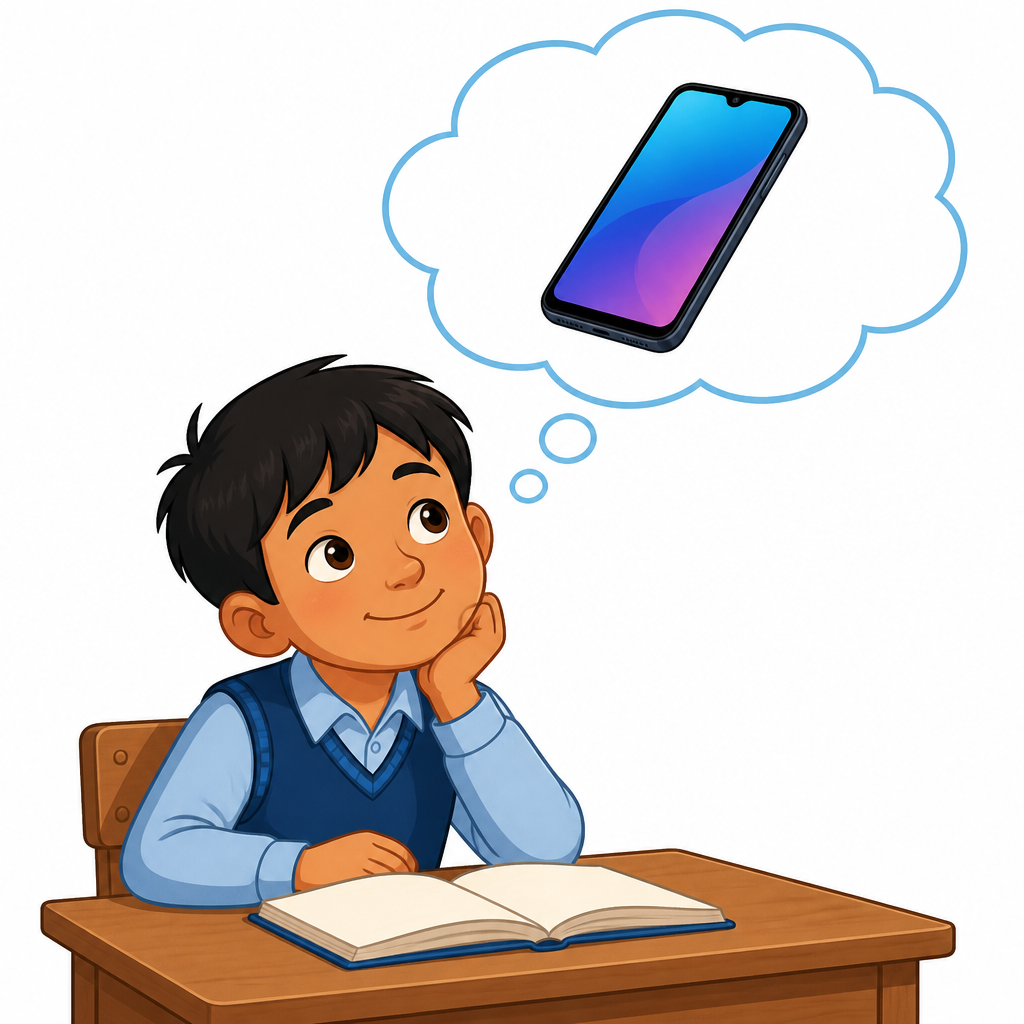
After wish, use the past simple form of the verb even when the wish is about now. The past form here does not mean past time. It is a signal that the situation is imagined, not real. I wish I had a car means I do not have a car now, and I want one.
You can turn any true sentence about yourself into a wish. Follow these steps.
- Write the true situation. For example: I don't have a car.
- Flip it. A negative becomes positive, and a positive becomes negative, because the wish is for the opposite of what is true.
- Move the verb into its past form. Have becomes had, can becomes could, and am, is and are become were.
Watch it work. I don't have a car becomes I wish I had a car. I can't play the piano becomes I wish I could play the piano, because could is the past of can. It's winter becomes I wish it were not winter. In careful English, were is used after wish for all persons, so I wish I were taller is the best form, though you will also hear was in everyday speech.
Do not keep the present tense after wish. I wish I have a bicycle is wrong. Write I wish I had a bicycle, even though you are wishing for the bicycle right now. The past form is what shows the wish is not real.
Listening for Birthday Details
The listening task plays three speakers, Martha, Kenji and Sun-Hyi, each telling how they celebrate their birthdays in their own countries. For each speaker there is a table to complete: where the person is from or lives, when the birthday falls, who they celebrate with, where they go, and what they are given. Every answer must be no more than two words, and every answer comes from the audio itself, never from guessing.
- Read the whole table before the audio starts, so you know exactly what to catch: a country, a date, a family word, a gift.
- Listen for the small facts. Names of places, dates, people and presents are the words that fill the blanks.
- Write no more than two words in each blank. Long answers lose marks even when they are true.
- If you miss one answer, let it go and stay with the speaker. Catch the missed one on the second play.
After the table is complete, there is a talking task: compare what the three speakers do on their birthdays with what you do on yours, and tell your friends how you would like to celebrate.
Niru's Birthday Email
Niru writes a friendly email to Sangita to tell her about her most memorable birthday. It was 15th Jeth 2078, the day she turned 12. She woke up early at 6:30 a.m. because her family sang a special song for her and gave her gifts. Her cousins Sunita and Arun arrived to surprise her, and their presence made the day even more special. They gifted her a big box full of chocolates and a CD of her favourite singer. Mum made breakfast, Dad bought a big cake which Niru cut, and calls started coming from relatives and friends.
At 6 p.m., while Niru was out with her family to celebrate the occasion, a message came from her friend Heena, who said she had been busy planning the surprise and wanted Niru to come to her house. Heena picked her up at about 7:30 p.m. in a beautiful car. When the door opened, all of Niru's friends were inside with balloons and flowers, and they shouted in chorus, Happy Birthday, Niru! Everyone hugged her one by one and gave her gifts and roses. They sang her favourite song, she cut the cake again, and they had a delicious meal, danced and enjoyed themselves. Niru ends by saying she missed Sangita and asking her to visit soon.
An informal email is a friendly message to someone you know well. It opens with a friendly greeting such as Hi Sangita, tells its news in short paragraphs, closes warmly with a line like See you soon! and ends with the writer's name. It needs no addresses and no formal phrases.
A reply to an email like this does two jobs. First it answers the news it received: say what you enjoyed reading and how it made you feel. Then it adds a little news of its own and answers any request, such as the invitation to visit.
The Past Simple Tense
Niru's email describes a finished day, so nearly every verb in it is in the past simple. This is the tense English uses for actions that started and finished at a definite time in the past.
The past simple tense describes actions completed in the past. Regular verbs form it by adding d or ed, as in dance, danced. Irregular verbs change their form in their own way and must be learnt one by one, as in buy, bought and sing, sang.
| Base form | Past simple | Regular or irregular |
| celebrate | celebrated | regular |
| dance | danced | regular |
| hug | hugged | regular |
| ask | asked | regular |
| arrive | arrived | regular |
| is | was | irregular |
| are | were | irregular |
| have | had | irregular |
| buy | bought | irregular |
| give | gave | irregular |
| sing | sang | irregular |
| cut | cut | irregular |
| come | came | irregular |
| say | said | irregular |
| see | saw | irregular |
| make | made | irregular |
| know | knew | irregular |
| tell | told | irregular |
Statements simply use the past form: I met him in 2015 AD. We went to Pokhara for our last holiday. They got home very late last night. For questions and negatives, the helper did steps in: Did you meet my father? Where did you go yesterday? They didn't go to Pokhara last year.
Did and didn't already carry the past, so the main verb after them goes back to its base form. Did you go, never did you went. She didn't buy, never she didn't bought.
Never put two past forms in one verb. Did you went to school is wrong because did is already past. Write Did you go to school. The same rule holds after didn't: she didn't buy anything, not she didn't bought anything.
Choosing the Right Wish for the Moment
Speaking well means picking the wish that fits the situation. A greeting expression fits a moment in someone else's life. An I wish sentence fits a want of your own.
| Situation | What you say |
| Your friend's birthday is today | Happy birthday to you! |
| Your friend is going on a week's holiday | Have a wonderful holiday! |
| Your brother is attending an exam today | Good luck! |
| Your friend is celebrating Lhosar tomorrow | Happy Lhosar! |
| Someone is setting out on a trip | Have a nice journey! |
| Someone is about to eat | Enjoy the meal! |
For your own wants, the grammar of wishes does the work. You are short and want to be taller, so you say I wish I were taller. You want to be rich, so you say I wish I were rich. You want a big house, so you say I wish I had a big house. You want to pass the exam, so you say I wish I could pass the exam. Notice the pattern holding every time: wish, then a past form.
Writing About a Celebration
This unit gives two writing tasks, and the difference between them is the tense. To describe a festival and what people do at it every year, use the present simple: people fly kites, elders bless the young, families share food. To recall one event that happened last year, such as Children's Day, Democracy Day or School Day at your school, use the past simple: the teachers decorated the hall, we sang, the head teacher gave a speech.
- Name the event and say when it happens or when it happened.
- Give two or three things people do, or did, using strong action verbs.
- Say how people feel, or felt, during it.
- End with why you like it, or with the moment you remember most.
Choose the tense before you write the first sentence. A festival that comes every year takes the present simple. One event from last year takes the past simple, from the first line to the last.
A Card and a Story of Three Wishes
The project brings the whole unit together. In a group of up to five, make colourful greeting cards to express wishes to friends and relatives on an occasion your group chooses. A good card carries three things: a greeting expression on the front, such as Happy Lhosar!, a sentence of wish inside, such as I wish you truckloads of cheers and many happy years, and decoration that suits the occasion.
The unit closes with a story about wishes used badly. A poor man and his wife were lamenting their poverty when a fairy appeared and granted them three wishes. Hungry over a supper of plain potatoes, the wife wished for a banana, and one flew onto her plate. The first wish was gone. Her husband, furious at the waste, wished the banana was hanging on her nose, and there it hung. The second wish was gone. Nothing could pull it off, so the third wish had to be spent sending the banana a thousand miles away. They ended exactly as poor as they began.
The story's lesson is simple. Wishes made in haste or in anger are wishes wasted. Think before you wish, in stories and in life.
The full lesson is waiting for you
The notes are free to read in full. A free account opens the rest of the practice, and tracks your progress and confidence score for every subject. Presentations and videos need approval from Learn Yeti.