Showing Surprise
Somebody tells you news you did not expect. Your eyes open wide, your mouth drops open, and a short expression jumps out before you can think. English has a whole set of these small expressions, and this unit teaches you to use them: Really? Wow! How amazing! Oh my gosh! I can't believe it! Are you kidding? Are you joking? Incredible! Each one is short, each one is said with strong feeling, and each one tells the speaker that their news has truly reached you.
An expression of surprise is a short phrase we say when something unexpected and usually pleasant happens, such as Wow!, Really? or How amazing!
Dismay is the unhappy, worried feeling we get when something unexpected and bad happens. We show it with expressions such as Oh no!, Oh dear! and That's terrible!

Say these expressions aloud, not silently. The voice matters as much as the words. Really? rises at the end like a question. Wow! comes out in one strong burst. A flat, bored Really tells the listener you do not care at all, which is the opposite of what the word means.
A Song About a Clever Pig
The unit begins with a funny song by Roald Dahl about a wonderfully clever pig that lived in England. Everyone could see that this pig had a huge brain. He could do sums in his head, he had read every book there was, and he understood how airplanes fly and how engines work. Yet one question defeated him completely. He could not work out what life was really about, why he had been born, or why he had been placed on this earth. His giant brain went round and round, and no answer could be found.
Notice what the song does to you as a listener. A pig that reads books? Really? A pig that does sums in its head? Incredible! The song is placed at the start of this unit exactly because it makes you want to use expressions of surprise.
Fair Shares: A Story of Two Brothers
Ali and Abraham were brothers. Their mother died when they were very young, and soon after that their father died too. He left his sons two things: a cow and a date-tree. Ali, the elder, was cunning and greedy. Abraham, the younger, was kind and honest, and he trusted his elder brother. When they divided the property, Ali offered what sounded like a fair deal. Abraham would get the front portion of the cow, and Ali would take the hind portion, and each brother would take his profit only from his own share. The tree was divided the same way: the upper part went to Ali and the lower part to Abraham. Abraham thought it was a wonderful idea and agreed.
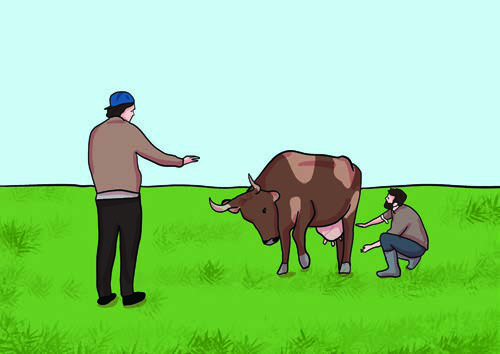
Now see how the trick worked. Abraham fed the cow well, so the cow grew healthy and gave a lot of milk. But milk comes from the hind part, so Ali took all the milk, sold it, and kept all the money. When Abraham asked for his share, Ali pointed to the agreement. Abraham was shocked, but he said nothing. Then a villager gave him an idea. The next day, while Ali was milking, Abraham began to beat the cow, and the cow started kicking. When Ali shouted at him, Abraham calmly replied that the front portion was his and he could do anything with it. That was their agreement. Ali could hardly utter a word. He agreed at once to share the money, and Abraham made him share the work of feeding and caring for the cow as well.
The cow was resolved, but the tree was still intact. Ali made holes in his upper part of the tree, and a sweet-smelling juice seeped out. He hung small pots under the holes, sold the juice, and earned a huge sum of money, feeling very pleased with his own cleverness. A friend then advised Abraham. The next day, while Ali was up in the tree fixing his pots, Abraham started chopping the lower part, because the lower part was his and Ali could not interfere. At last Ali saw his own trick turned against him. He cried that he had been foolish, said he was ashamed of his selfishness, and begged Abraham to pardon him. He promised never to hurt his brother again, and he kept that promise. The brothers shared the profit and lived happily.
The story teaches that a cunning trick can always be turned back on the person who invented it. Fair sharing keeps a family happy; clever cheating destroys trust.
Words That Show Surprise or Dismay
Practise saying these phrases aloud with real feeling: Oh, really? Are you serious? No way! What a nice song you wrote! How amazing you are! My goodness! Oh, my gosh! That's amazing! Each phrase does a slightly different job, and the table below shows when to use the most common ones.
| Expression | When we use it | Example |
| Really? | A short response that shows interest or surprise | I don't like chocolate. Really? |
| Are you for real? | Strong surprise and disbelief | I got an A+ in Maths! Are you for real? |
| No way! | Refusing to believe something because it is so incredible | Can I borrow your car? No way! |
| What a ... ! | Surprise about a noun | What a wonderful day! |
| How ... ! | Surprise about a quality | How amazing you are! |
| Wow! | When the surprise seems almost unreal | Wow! You are great. |
What goes with a noun and How goes with an adjective. Say What a surprise! and How amazing!, never How a surprise! or What amazing! Mixing the two is the commonest error with these expressions.
Here is a short conversation that uses both surprise and dismay. Read it aloud with a partner and let your voice do the work.
Notice the pattern in B's replies. First B repeats the surprising part as a question, Four goals?, and then adds an expression, Wow! Repeating the key words and then reacting is exactly how English speakers show they are listening. Use this pattern when a friend does not understand the homework, when someone is sick in hospital, when there has been an accident, or when someone has had a lovely holiday. Good news gets Wow! and How wonderful!, while bad news gets Oh no! and I'm so sorry to hear that.
Grammar: Past Simple and Past Continuous
The past simple tells us that an action started and finished in the past. It uses the second form of the verb: I saw him. She went to the post office. The plane took off at 10 pm.
The past continuous tells us that an action was going on, and not yet finished, at a moment in the past. It is made with was or were and the ing form of the verb: He was dancing. I was washing dishes.
The two tenses do their best work together in one sentence: When I saw him, he was dancing. The dancing is the long action. It had already started, and it was still going on. The seeing is the short action that happened in the middle of it. The diagram below draws exactly this.
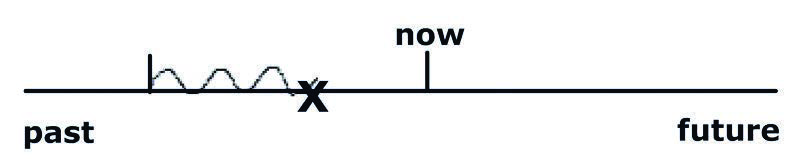
Use this picture to choose the right tense every time. Ask which action was long and which was short. The long, background action takes the past continuous, and the short action that interrupts it takes the past simple. So we say: He was hit by a car when he was cycling to school. The cycling was going on; the accident cut into it. We say: When I saw her, she was singing, and: The phone rang while I was washing dishes.
A quick, finished action with a fixed time takes the past simple, not the past continuous. Say: The plane took off at 10 pm, and: Yesterday she went to the post office. Writing was taking off or was going here is wrong, because these actions were complete, not going on.
Grammar: The Past Perfect
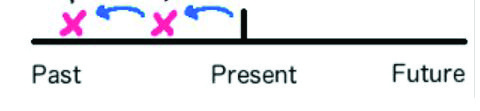
The past perfect shows that one past action finished before another past action happened. It is made with had and the third form of the verb: He had slept before I reached home.
In the sentence He had slept before I reached home, both actions are finished and both are in the past. The sleeping happened first, so it takes had slept. The reaching home happened second, so it takes the ordinary past simple. The past perfect is the tense that points further back.
The past perfect often explains a past feeling or situation. She was exhausted because she had worked hard. We were very hungry because we had not eaten anything. Everything was white because it had snowed. The passengers were angry because the airline had lost everyone's bags. In each sentence, the because part happened first, so it takes had and the third form.
When two past actions are in one sentence, ask which happened first. The earlier action takes had plus the third form of the verb, and the later action takes the past simple.
Listening for Details
The listening task in this unit plays a recording about people who have won a prize, and asks you to complete a table while you listen. The table wants to know what prize was won, what the prize includes, the date by which the prize has to be used, the place called John and Charlotte's that they have to go to, and the thing they do not know who could use. You cannot fill any of that from guessing. You fill it by listening the right way.
- Before the recording starts, read every row of the table. Now you know exactly what to listen for: a prize, its contents, a date, a place, and a problem.
- Listen for the key words. When you hear the word prize or won, the first answer is coming. When you hear a month or a date with 20th, that is the deadline row.
- Write short answers, one or two words, while the recording plays. Do not try to write full sentences.
- Use the second listening to check what you wrote and to fill any row you missed.
Before the recording, the class also talks about prizes. Have you or your friends ever won one? How do people feel when they win? Usually they feel delighted, proud and excited, and they often react with the very expressions this unit teaches: Wow! I can't believe it!
At the Hotel
The second reading is a conversation between a guest and a hotel receptionist, and it is full of real, polite hotel English. The guest asks whether any rooms are vacant and says he would like a double room. The receptionist has a double room on the second floor, but the guest wants one on the ground floor or the first floor. There is no such room free at the moment, so the receptionist asks him to wait until the check-out time, when there will be two vacancies, and offers to book one in advance.
Check-out time is the fixed time by which guests must leave their rooms so that the hotel can give those rooms to new guests. In this conversation it is 12 noon.
Then comes the small drama about time. The receptionist says it is already a quarter past eleven, so the wait will be less than an hour. The guest is surprised: How come? His watch shows ten minutes to eleven, which would mean more than an hour of waiting. The receptionist explains that the guest's watch is a little slow, because her own watch, set only a few minutes ago, makes it 11:20. The guest accepts this: Oh, dear! There's something wrong with my watch. He agrees to wait on the sofa. The receptionist gives him a brochure, a small book giving all the information about the hotel, and tells him that page ten describes the rooms and facilities. After some time the guest cries: Oh, no! The rooms are really expensive. The receptionist answers that compared with other hotels around, hers is not expensive, and that it provides the best quality services.
Read the conversation again hunting for expressions of surprise or dismay. How come? shows surprise at unexpected information. Oh, dear! and Oh, no! show dismay, first about the broken watch and then about the expensive rooms. This is the unit's theme appearing inside an everyday conversation, which is exactly where you will meet it in real life.
Writing It Correctly
The writing task gives you a passage from the Fair Shares story with all its capital letters and full stops removed, and asks you to put them back. A passage without punctuation is one long breathless line, and fixing it is a skill you can follow step by step.
- Read the passage aloud slowly. Wherever one complete thought ends, your voice naturally wants to stop. That stop is where a full stop belongs.
- Put a full stop at each of those places.
- Begin the word after every full stop with a capital letter, and give the very first word of the passage a capital letter too.
- Check every name of a person or place. Ali and Abraham always take capital letters, wherever they appear in the sentence.
The unit also asks you to complete a conversation where some lines are missing, and to compose a whole dialogue of your own about planning a picnic. For a missing line, read the line before the blank and the line after it. The line after is the answer to your missing line, so your line must be the question or remark that fits it. For your own picnic dialogue, plan the place, the food and the day, and make your speakers react to each other with the unit's expressions: Really? What a great idea! Oh no, not Saturday!
For project work, watch a suitable movie of your choice and listen closely to how the characters express surprise or dismay. Write down as many of these expressions as you hear, and present your list to the class. Films are full of Wow!, No way! and You must be kidding, and hearing them in real speech fixes them in your memory far better than any list.
The full lesson is waiting for you
The notes are free to read in full. A free account opens the rest of the practice, and tracks your progress and confidence score for every subject. Presentations and videos need approval from Learn Yeti.