Saying What People Look Like
Every person you meet looks different from every other person. One is tall and one is short. One has long hair and one has almost none. One walks and one uses a wheelchair. English gives you a small set of questions for talking about this. When you want to know about a person's appearance, you ask: What does he look like? What does she look like? The answer describes the body and the face: He is tall and thin. She has black hair. He wears sandals.
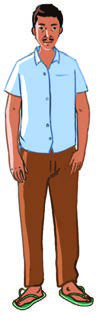
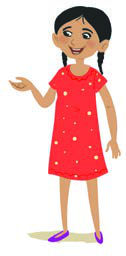

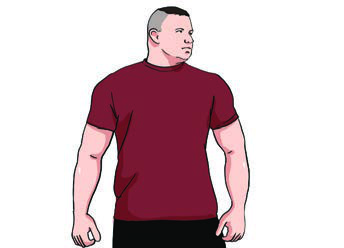
Practise on the four people above. The first man is tall and slim. He has short black hair and a moustache. The girl is young and small. She has two plaits and wears a red dress. The woman has long brown hair and sits in a wheelchair. The last man is big and strong, and his hair is very short. Notice the pattern: we use is or has, and then the describing word. Now sing this song aloud. It asks the questions this whole unit is about.
What does he look like?Is he big or small?What colour are his eyes?Is he short or tall?He has short black hair,And his eyes are brown.What does she look like?Is her hair long or short?Are her ears small or big?Does she wear glasses at all?She is short, with a small nose,And a smile wherever she goes.
Differences between People
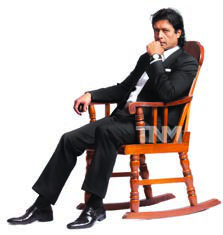
Look at the man in the picture. We can describe him with exact facts: he is 188 cm tall, he weighs 78 kg, his eyes are brown, his hair is black and his face is oval. Where do such differences come from? People begin to differ from the moment of conception, the moment a new life starts inside the mother's body. The differences only become visible after birth. Eye colour, skin colour and the texture of hair all depend on the genes we inherit from our parents and grandparents.
Hair changes through life. A baby born with ginger hair may have fair hair a few months later, because the birth hair falls out. Hair can be fine, thick, straight or curly, and it becomes thinner as we grow older. Some people lose their hair early, whilst others keep a full head of hair all their lives. People with dark hair may see it turn grey or even white before they reach their forties. Skin differs too. European people generally have paler skin than people whose ancestors come from Africa or Asia, and skin exposed to strong sunlight becomes darker.
We also grow at different speeds. The biggest differences appear at puberty, the stage when a child's body starts to become an adult's. At about the age of 12, girls are usually much taller than boys of the same age. But at about 16, boys shoot up and usually overtake girls in height and strength. The body is not shaped by physical changes alone. The mind plays a large part in what the body can do. Anyone who wants to become a skilful footballer, a long distance runner or a strong swimmer needs stamina and years of practice. Food matters as well. What we eat helps to decide how we grow and gives us strong bones. Too little activity and too much sugary food make people gain excessive weight, though it can seem unfair that one person eats fattening food and stays slim while another puts on kilos very easily.
The Sounds of the Final -s
The letter s at the end of a word is not always the same sound. English speakers say it in three ways, and the sound before the s decides which.
Say /s/ after quiet (voiceless) sounds like t, p, k and f. Say /z/ after voiced sounds and vowels, like l, n, r, b and y. Say /ɪz/ after hissing sounds like s, z, sh, ch and ge, which adds an extra syllable.
| Sound | When it comes | Words |
| /s/ | after t, p, k, f | results, amounts |
| /z/ | after voiced sounds and vowels | falls, others, turns, girls, bones, boys |
| /ɪz/ | after s, z, sh, ch, ge | differences, changes, processes |
Test yourself by touching your throat. When you say the sound before the s, your throat buzzes for voiced sounds, so the s buzzes too and becomes /z/. Say girls and feel the buzz. Say amounts and feel that the t is quiet, so the s stays quiet as /s/. Say changes and hear the extra syllable at the end: that is /ɪz/.
Look and Look Like
look + adjective describes the appearance or state of a person or thing: He looks tired. She looks beautiful. You look smart.
look like + noun says that one person or thing is similar to another: He looks like his father. That house looks like a palace.
The word that comes after the verb tells you which one to use. An adjective such as tall, handsome, stressed or healthy follows look alone: Rajesh Hamal looks tall. He looks handsome. A noun such as a princess, her mother or a palace needs look like: My little sister always says she looks like a princess. Ann looks like her mother. We can also use look like before a whole sentence to make a guess: It looks like it's going to rain. And do not forget the s: with he, she or it the verb is looks, and in negatives and questions we use do or does, as in You don't look cheerful and Does she look happy?
Never put like before an adjective. She looks like beautiful is wrong. Say She looks beautiful. Use like only when a noun follows: She looks like her mother.
Four Questions about a Person
Four questions in English sound almost the same but ask completely different things. Learn them as a set, because mixing them up is the commonest error in this whole topic.
| Question | It asks about | A good answer |
| What does she look like? | appearance | She's tall and has long black hair. |
| What is she like? | character and personality | She's very friendly and a little shy. |
| Who does she look like? | resemblance to another person | She looks like her mother. |
| What does she like? | things she enjoys | She likes sports cars and science fiction. |
Match the answer to the question, not to the person. If someone asks What's Naresh like?, they want his character: He's very talkative. If they ask What does he look like?, they want his appearance: He's tall and blue eyed. Who's Ann like? asks which person she resembles in nature: Like her mother, very talkative. And the everyday greeting How are you? is different again. It asks about health and mood, so the answer is Not bad, thanks, and How's your mother? can be answered with She's better, she left hospital yesterday.
What is she like? and What does she look like? are not the same question. The first asks about her nature. The second asks about her body and face. Answering He's kind to What does he look like? is a wrong answer, even though it is a true sentence.
Listening for Descriptions
First learn the two bold phrases the listening task depends on. In My brother and I both play sports. He's like me, the word like means similar to. In What does Sam look like? He's tall and wears glasses, the phrase look like asks for a description of appearance.
The recording is a conversation in which a boy named Tom and his father talk about Tom's friends. Before you press play, read the questions, because they tell you exactly what to catch. You need to hear how Patrick's hair is described, so listen for words about hair such as short, brown, straight or curly. You need to decide who is called talkative, so listen for that word next to a name: the teacher, Patrick or Marcel. You need what Tom says about Marcel, whether he is short, is tall, or likes him. One friend is said to look like Harry Potter, so listen for that comparison and the name beside it. One person likes to talk about video games with Tom at lunch. And at the end, listen for what Tom and his Dad decide to do next. After listening, write down as many describing words from the conversation as you can remember. Good listeners do not try to hear every word. They hunt for the words the questions need.
Words for Describing People
A good description moves through the person in an order: the general impression first, then age, build and height, then the parts of the face. This table holds the words you need for each part.
| Feature | Words |
| General appearance | beautiful, pretty, funny, cute, handsome, attractive |
| Age | young, middle-aged, old |
| Build | thin, slim |
| Height | short, medium-height, tall |
| Eyes | blue, brown, small |
| Face | round, oval, square |
| Nose | straight, hooked, long, small |
| Mouth | large, small |
| Ears | large, small |
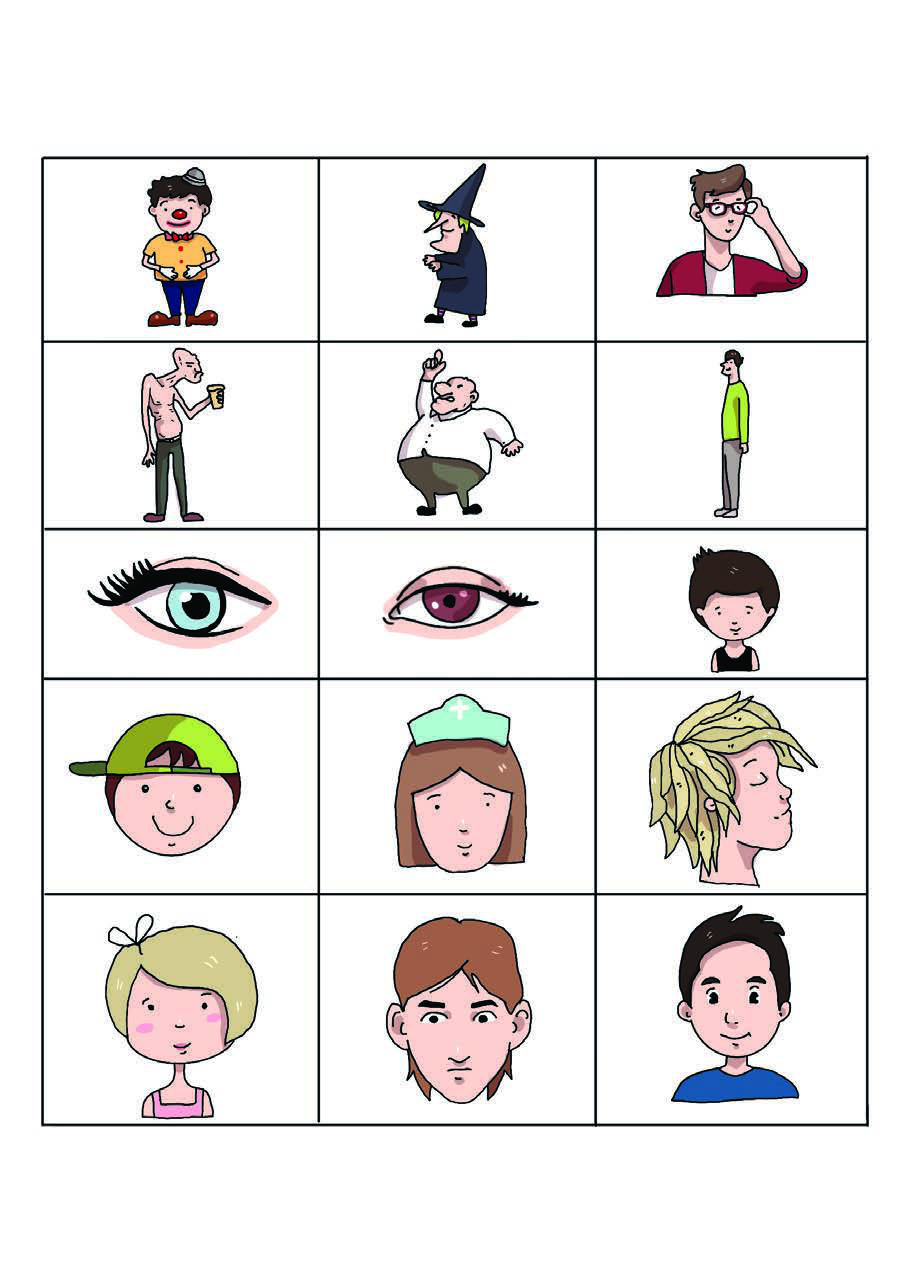
Look at the pictures and describe each one in full sentences. The clown is young and funny, with a round red nose. The witch is old and thin, with a hooked nose and a pointed hat. The first eye is blue with long eyelashes; the second eye is brown. The boy in the green cap has a round face and a small mouth. Then turn to a real person: take turns with a partner to describe one friend in your class, talking about height, ears, nose, eyes, face and build, and let your partner guess who it is. There are three sentence shapes to build with. Use be with an adjective: She is tall. Use have or has with an adjective and a noun: He has small brown eyes. Use wear or wears for glasses and clothes: He wears glasses.
Writing about a Friend
Now put the whole skill onto paper. Write one paragraph about a friend. Include the friend's height, hair colour and type (long or short; straight, curly or wavy), age and facial features, then describe the friend's personality, and finish by saying why you like him or her. Here is a model to learn the shape from, not to copy. My best friend is Sunita. She is thirteen years old and quite tall for her age. She has long, straight black hair and big brown eyes, and her face is round. She wears glasses for reading. Sunita is cheerful and very helpful, and she never gets angry quickly. I like her because she always shares what she knows and makes everyone laugh. Count what the model does: appearance first, personality second, reason last.
Wonderful World
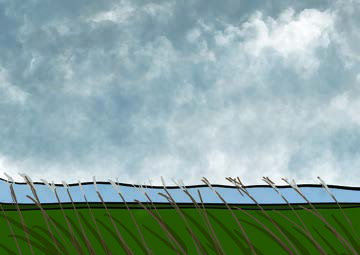
Look at the picture before you read. The grass is leaning because wind is pushing it, and that invisible pusher is one of the heroes of this poem. Wonderful World was written by W. B. Rands, an English poet who wrote many poems for children. In it, a small child looks at the huge Earth and wonders at it, and then hears a surprising answer from inside.
Great, wide, beautiful, wonderful World,With the wonderful water round you curled,And the wonderful grass upon your breast,World, you are beautifully dressed.The wonderful air is over me,And the wonderful wind is shaking the tree,It walks on the water, and whirls the mills,And talks to itself on the tops of the hills.You friendly Earth, how far do you go,With the wheat-fields that nod and the rivers that flow,With cities and gardens, and cliffs, and isles,And people upon you for thousands of miles?Ah! you are so great, and I am so small,I tremble to think of you, World, at all;And yet, when I said my prayers today,A whisper inside me seemed to say,"You are more than the Earth, though you are such a dot:You can love and think, and the Earth cannot!"
The poet dresses the Earth like a person: water is curled round it, grass lies upon its breast, so the world is beautifully dressed. The wind is treated the same way. It shakes the tree, walks on the water, whirls the mills and talks to itself on the hilltops. Giving human actions to things that are not human is a favourite trick of poets, and it makes the wind feel alive. In the third stanza the child asks the friendly Earth how far it goes, past nodding wheat-fields, flowing rivers, cities, gardens, cliffs and isles. In the last stanza the child feels tiny beside all this greatness and trembles. But a whisper inside gives the poem its message: a human being is more than the whole Earth, because a person can love and think, and the Earth cannot.
Rhyming words are words that end with the same sound, like small and all. Poets place them at the ends of lines to give a poem its music.
Read the poem aloud and listen for the pairs: breast rhymes with dressed, me with tree, mills with hills, go with flow, isles with miles, small with all, and today with say. Every stanza is built on two such pairs.
The Simple Present Tense
Look again at what the wind does in the poem. It walks on the water. It whirls the mills. It talks to itself. All three verbs are in the simple present tense, and each ends in s because the doer is it.
The simple present tense describes habits, repeated actions, general facts and timetables: I work at a bank. She lives with her parents. Cows feed on grass. With he, she or it, the verb takes -s or -es: she earns, he wants, it walks.
Use it for things that happen again and again or are always true. My father works in a bank. Ramila lives with her grandparents. The sun rises in the east. It also carries timetables, even future ones: The plane arrives at 6.30 p.m. every day. The next term begins this Monday. And it follows time words such as when and unless, even when the meaning is future: I will phone you when he comes back. Unless we start now, we can't be there on time.
After when and unless, do not use will even if the action is in the future. I will phone you when he will come back is wrong. Say when he comes back.
Questions in the simple present need do or does. Take the pieces Where / you / live and build Where do you live? With he, she or it, use does and the verb loses its s: Why / he / play football becomes Why does he play football?, and What time / the film / start becomes What time does the film start?
Writing about Your Day
The simple present is exactly the tense for a typical day, because a typical day is a set of habits. Write a paragraph describing what you do from morning to evening, keeping every verb in the simple present. A model shape: I get up at six o'clock and wash my face. I eat dal bhat at nine and walk to school with my friend. Classes start at ten. After school I play volleyball, and in the evening I do my homework and help my mother in the kitchen. I go to bed at nine o'clock. Notice that every sentence names a habit, and the verbs with I take no -s while classes start keeps its plain form because classes is plural.
Project: A Wall of Appearance Words
Work in a group of five. Hunt for more words that describe people's physical appearance beyond the ones in this unit, such as words for hair, skin, build and face. Draw a picture to illustrate each word, label it, and stick the pictures on the classroom wall so the whole class can learn from your collection.
The Stag and its Reflection
This unit ends with a story that turns everything you have learnt about appearance upside down. A stag lived in a dense forest and looked beautiful because of his horns. One day he was thirsty and went to a pool to drink. The water was so clear that he could see his reflection. He admired his antlers and felt very proud of their beauty. Then he noticed his fore legs, thin and slender, and felt sad about them, forgetting that those legs gave him his great speed. When he raised his head, he saw a lion coming near. He ran, and his fast legs left the lion far behind. But then his beautiful antlers caught in a thick bush. He struggled and could not pull free. Only now did he understand his mistake: he had praised his horns and condemned his legs. It was too late. The lion arrived, caught him and tore him to pieces.
The lesson of the story: do not judge things by their looks. What looks beautiful may be useless in danger, and what looks plain may save your life.
The full lesson is waiting for you
The notes are free to read in full. A free account opens the rest of the practice, and tracks your progress and confidence score for every subject. Presentations and videos need approval from Learn Yeti.