The Materials Around Us
Take one look around a kitchen. There is water in a jug, salt in a jar, iron in the pan, wood in the spoon and air filling the whole room. Every one of these things has its own weight, and every one of them takes up space. Anything with weight and volume like this is called matter. Soil, salt, water, wood, iron and air are all matter.
Matter: anything that has its own weight and takes up space is called matter.
All matter is not of one kind. Some kinds of matter are pure and some are not. Water, salt, iron and copper are pure substances, because each of them is made of one substance only. Soil, milk and air have several substances lying together inside them, so they are impure substances. An impure substance is what we call a mixture.
Mixture
Think about what goes into a glass of tea in the morning. Water, milk, tea leaves and sugar all go into the same pot. When it is ready you see one hot drink in the glass, but four different substances are sitting inside it. When two or more substances come together physically like this, the substance that is formed is called a mixture.
Mixture: a substance formed when two or more substances come together physically is called a mixture.
Components of mixture: the substances a mixture is made from are called its components. If tea is the mixture, then water, milk, tea leaves and sugar are its components.
Once you start looking, mixtures are everywhere. Muddy water has soil, sand and bits of rubbish carried inside it. The air we breathe is not a single gas either. It is a mixture of nitrogen, oxygen, carbon dioxide and other gases. Soil has sand, clay, rotted leaves and water in it, and that is exactly why soil counts as a mixture.
Types of Mixture
The components of a mixture do not always come together in the same way. In dirty rice you can pick out the stones, the bits of brick and the pieces of glass with your fingers. In air you cannot pick out the nitrogen from the oxygen at all. Because of this difference in the way things mix, mixtures are divided into two kinds. The activity below shows the difference for itself.
Activity: salt and sand in two glasses of water
- Take two glass tumblers and half fill each one with water.
- Put one spoon of salt into the first glass and one spoon of sand into the second.
- Stir both glasses well with a spoon or a thin glass rod.
- Now look closely into both glasses. In which glass can you still see what you put in, and in which one can you not?
- Leave both glasses standing still for some time, then look again.
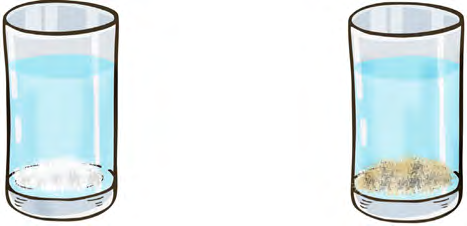
The salt dissolves and vanishes into the water. You cannot see the salt or point to it with your naked eye, because it has spread evenly through every part of the water. The sand does not mix evenly at all. Within a short time it separates from the water, settles at the bottom of the glass, and stays there in plain sight.
Homogeneous mixture: a mixture in which all the substances have mixed evenly with one another, so that the separate components cannot be seen or picked out with the naked eye.
Heterogeneous mixture: a mixture in which the substances have not mixed evenly, so that the separate components can be seen and picked out with the naked eye.
| Basis | Homogeneous mixture | Heterogeneous mixture |
| Way of mixing | Evenly mixed in every part | Not evenly mixed |
| Seeing the components | Cannot be seen or identified by eye | Can be seen and identified by eye |
| Examples | Salt solution, sugar solution, soda water, different kinds of drinks, air | Water with sand in it, muddy river water, rice with stones or paddy seeds or husk in it |
A homogeneous mixture is not a pure substance made of one thing only. Salt water still has both salt and water in it, but they are mixed so evenly that you cannot tell them apart. That is why salt water is a homogeneous mixture and not a pure substance.
Try the same thing with salt, sugar, alcohol, camphor, copper sulphate, soil and chalk dust, putting each one into water on its own. Watch which of them disappear into the water and which of them stay visible. That single observation tells you whether the mixture is homogeneous or heterogeneous.
Forms of Mixture
Mixtures are made from substances of different kinds. The components of a mixture may be solids, liquids or gases. Going by the state of the components, mixtures take the following forms:
- (a) Solid mixed with solid, such as camphor, soil and dirty rice
- (b) Solid mixed with liquid, such as salt water and sugar water
- (c) Solid mixed with gas, such as dust particles floating in air
- (d) Liquid mixed with liquid, such as milk and water, or kerosene and water
- (e) Liquid mixed with gas, such as soda water and other fizzy drinks
- (f) Gas mixed with gas, such as the air around us
Methods of Separating a Mixture
Every mixture has two or more components in it, but not all of those components are wanted or useful. The stones, brick pieces and glass chips in rice, along with the paddy seeds and husk, are unwanted components. Only after those unwanted components are taken out do you get clean rice. So a mixture often has to be separated, depending on what we need from it.
One single method will not separate every kind of mixture. The method is chosen from the properties of the substances that are mixed together. Filtering, letting the heavy part settle, evaporating and distilling are among the methods used to separate mixtures.
Evaporation: to take a dissolved solid out of a solution
Distillation: to take a liquid out of a mixture
Paper chromatography: to separate different colours in a mixture
Centrifuging: to separate lighter and heavier substances
Evaporation
How can the salt be taken back out of salt water? When water is heated it turns into vapour and goes away, but salt does not. That one difference is what the method uses. Try the activity below and watch it happen.
- Make about a glassful of salt water in a pan or any vessel that can be heated.
- Put the vessel on the stove and heat the salt water slowly.
- Keep watching as the level of the water falls.
- When the vessel is dry, stop heating and look at what has been left behind.
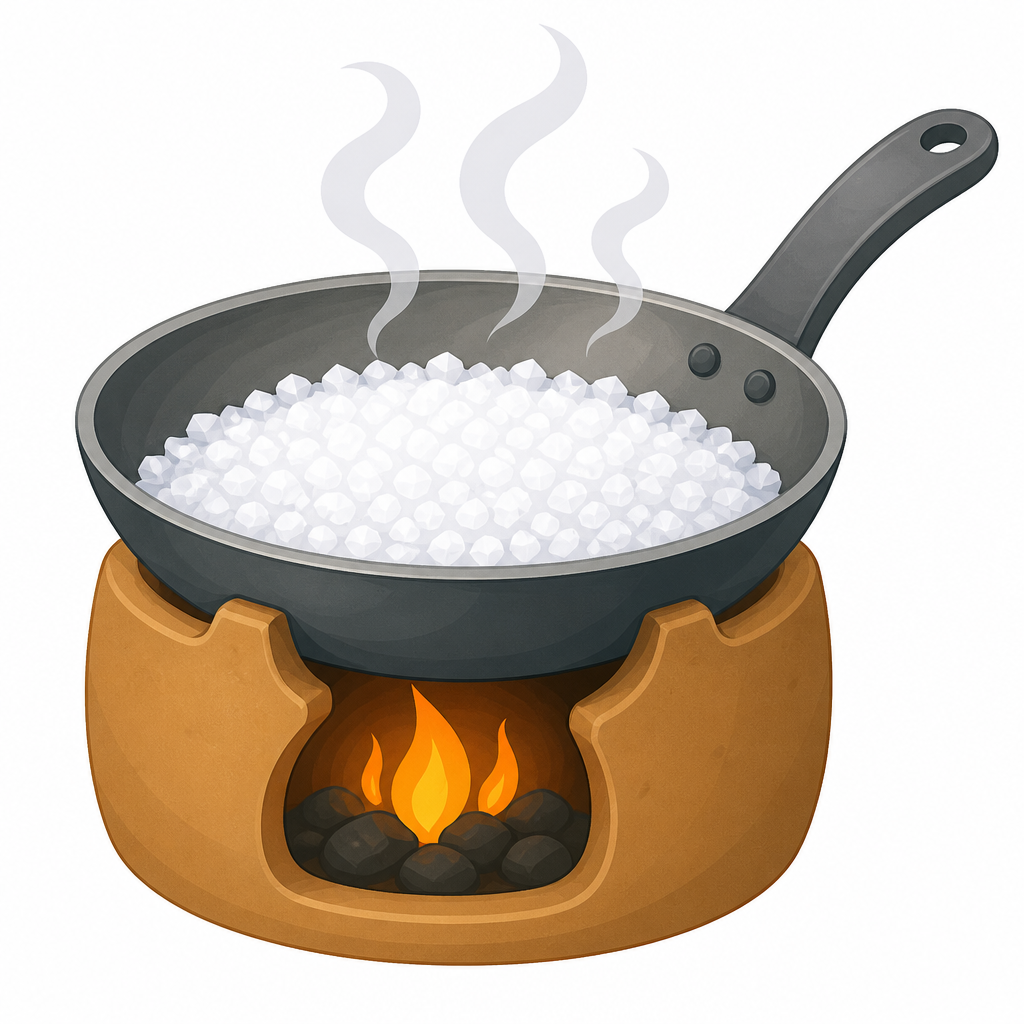
On heating, the water evaporates and goes into the air, and at the end white flaky salt is left in the pan. Salt needs a far higher temperature before it will boil away, so the salt stays behind in the vessel while only the water leaves.
Evaporation: the method of heating a solution so that the dissolved solid is separated from the liquid it was dissolved in.
Hold a hot vessel only with tongs or a thick cloth. Never lean your face over a boiling pan, because the hot steam coming off it will scald your skin.
Distillation
Evaporation gives back the salt, but the water is lost into the air. Sometimes it is the water we want. When water is heated it boils at a fixed temperature and turns into steam, and when that steam is cooled it turns back into water again. So the water in a mixture can be carried away as steam and collected in another vessel.
Distillation: the method of separating a liquid from a mixture by heating it into vapour and then cooling that vapour back into a liquid.
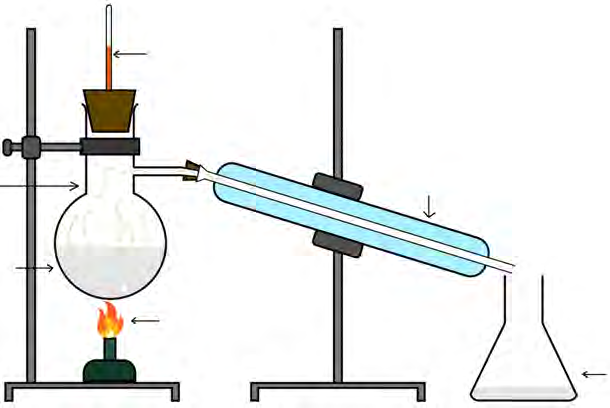
This is how pure water is separated from a salt solution in the laboratory:
- Half fill a distillation flask with the salt and water solution.
- Fit a thermometer at the mouth of the flask, join the flask to the condenser, and arrange for cold water to flow through the condenser.
- Heat the flask slowly. The water turns to vapour and travels into the condenser.
- Watch pure water collect in the conical flask or measuring cylinder kept at the far end of the condenser. The salt stays behind in the distillation flask.
Condenser: the cooling tube used to chill vapour and turn it back into a liquid.
Distillation is not only for mixtures that contain water. Some liquids boil at a lower temperature than water does. Alcohol boils at a lower temperature than water. When a mixture of alcohol and water is heated, the alcohol turns to vapour and leaves before the water does, and only water is left in the vessel. In this way a mixture can be separated by heating, in the order of the boiling temperatures of the liquids in it.
Distillation as a Local Technology
In some communities people make liquor at home. Millet or another grain is kept with water and a fermenting starter, and this mixture is then heated. On heating, the alcohol in the mixture turns to vapour sooner than the water does. That vapour is brought into contact with cold water and collected in a separate vessel as liquor. As the heat rises, water vapour mixes in as well, which is why the liquor collected is not pure alcohol. This is one everyday example of separating the components of a mixture by distillation.
Distillation is also used to draw scented oils out of different kinds of plants. People living near the sea use the same process to get clean drinking water out of salty sea water.
Chromatography
Have you ever seen writing from a fountain pen run on the page until the letters cannot be read? The water in a mixture of colours can carry those colours along through paper, cloth or chalk. When a mixture of colours is put on a material that colour can travel through, the different colours travel at different rates. Some coloured substances spread quickly through the paper and others spread slowly, and that is what pulls the colours apart.
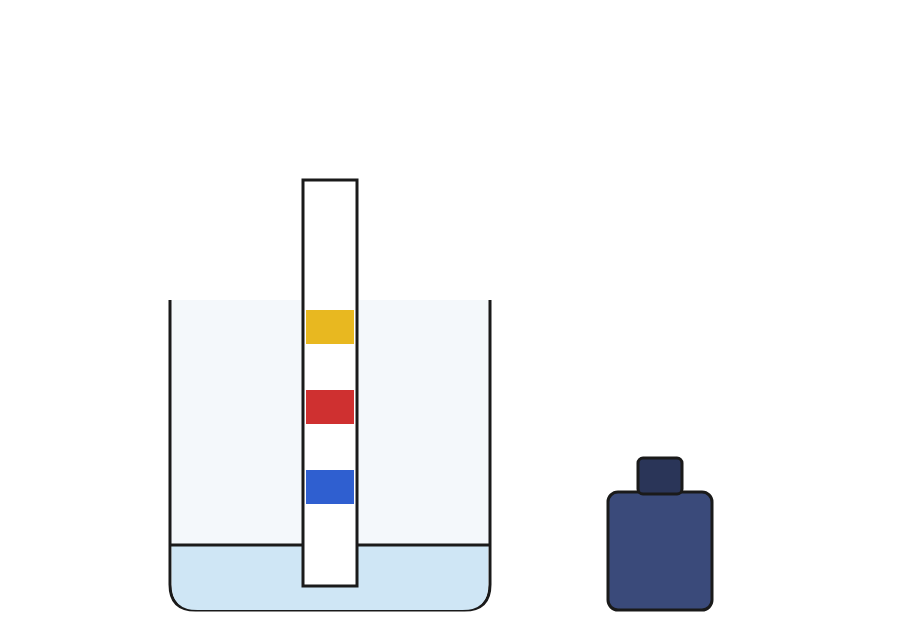
You can do this in the classroom. Take a small beaker of water. On a strip of filter paper put one drop of blue ink about 2 cm above where the water surface will be, and stand the strip so that the ink drop itself does not dip into the water. After some time the blue ink is seen creeping up the filter paper. Drops of ink of other colours can be separated in the same way.
Paper chromatography: the method of using paper to separate colours that travel quickly from colours that travel slowly.
Uses of Chromatography
Chromatography is used in hospitals, laboratories and research centres. Its uses include the following:
- In laboratories and research centres, chromatography is used to separate different chemicals and identify them.
- In hospitals, chromatography is used to separate and identify the chemicals present in urine and in blood.
- It is used to separate different colours out of a mixture and identify each of them.
Crush a rose flower and its leaves in a mortar and take out the juice. Filter that juice and then use paper chromatography on it to see the colours inside it come apart.
Centrifuging
A mixture holds substances of different kinds, and some of them are heavier than others. That difference in weight can itself be used to separate a mixture. The activity below shows how.
- Put sand, chalk dust and water into a plastic bottle and close the mouth of the bottle tightly.
- Tie a string firmly round the neck of the bottle.
- Go to an open space where nobody is standing nearby and whirl the bottle round hard for a few minutes.
- Now look carefully at the bottle and see where the sand has gone and where the chalk dust has gone.
Before you whirl the bottle, make sure nobody is standing near you and check that the lid is shut tight. A bottle that slips out of the hand flies a long way and can hit someone.
The sand is heavier, so it gathers at the bottom of the bottle, while the chalk dust is lighter than the sand and settles in a separate layer above it. When water is added to a mixture of heavy and light substances that do not dissolve, and the whole thing is whirled hard, the heavy substance stays at the bottom and the light one stays towards the top, so the two come apart.
Centrifuging: the method of whirling a mixture of a liquid and a solid at speed so that the lighter and the heavier substances in it are separated.
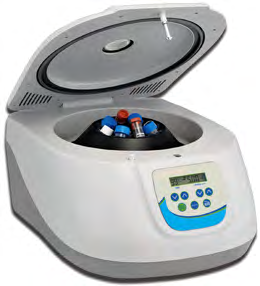
Laboratories today use a special machine for this. It has an electric motor fitted to spin it, and the machine is called a centrifuge. The mixture to be separated is put into a test tube, and the test tube is set into a special holder inside the machine. The motor then spins the centrifuge at high speed. After the spinning, the heavier substances in the mixture lie at the bottom of the test tube and the lighter ones stay above them, so the two are separated. Modern laboratories use exactly this method when blood is tested.
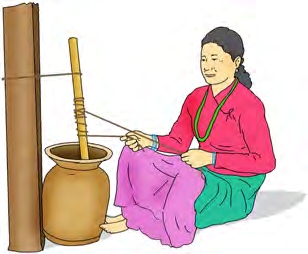
The same method has long been used in village homes. Curd is collected in a wooden churning pot and churned with a wooden churner. After some time butter appears. Water is then poured into the pot so that the butter floats up, and the butter is lifted out by hand. The liquid that is left once the solid butter has been taken out is called buttermilk. In towns today, motor driven machines shake milk or curd hard to get the butter out in the same way.
Solution, Colloid and Suspension
Take three beakers. Put salt water in the first, milk in the second and muddy water in the third. Observe and test all three mixtures, fill in the table below, and discuss what you find with the class.
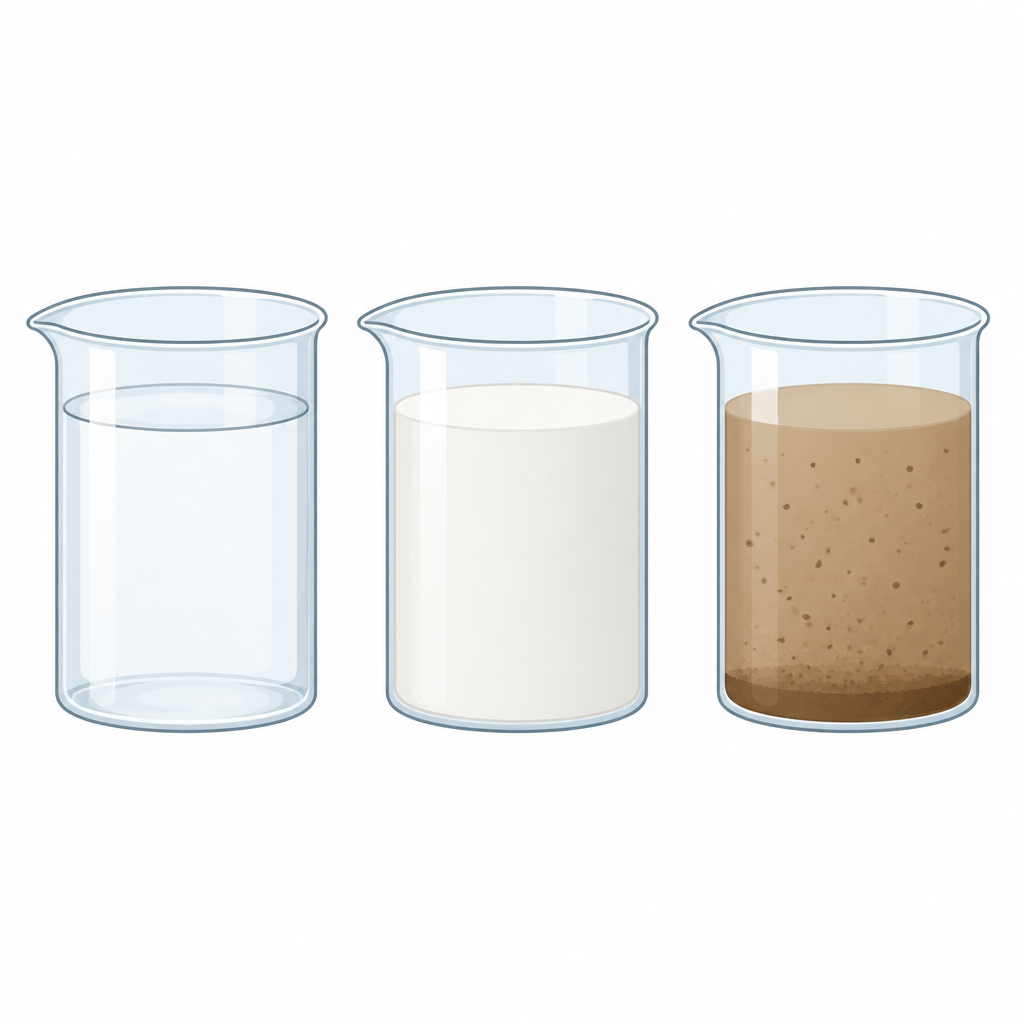
| Mixture | Particles with naked eye | Particles with hand lens | Light | Separating with filter paper |
| Salt water | Cannot be seen | Cannot be seen | Passes through | Cannot be done |
| Milk | Cannot be seen | Cannot be seen | Does not pass through | Cannot be done |
| Muddy water | Can be seen | Can be seen | Does not pass through | Can be done |
Going by the size of the particles in them, mixtures like these can be sorted into three kinds: solution, colloid and suspension.
Solution
Half fill a glass with water, put in a spoon of sugar and stir it well until it dissolves. Leave the glass standing for a while and look at it. Can you see the sugar anywhere? The sugar seems to have gone, yet the water has turned sweet, which tells you the sugar has spread evenly through every part of it.
Solution: a mixture formed when two or more substances mix evenly with one another. The substances in a solution cannot easily be seen or separated.
Solute and solvent: in a solution, the substance that dissolves is called the solute and the substance that does the dissolving is called the solvent. In a solution of sugar and water, sugar is the solute and water is the solvent.
\[ \text{Solution} = \text{Solute} + \text{Solvent} \]
More than one solute can be put into the same solvent. Sugar, water and lemon juice together, for instance, still make one solution. Here the water is the solvent, while the sugar and the lemon juice are both solutes.
| S.N. | Solution | Solute | Solvent |
| 1 | Sugar solution | Sugar | Water |
| 2 | Salt solution | Salt | Water |
| 3 | Liquor | Alcohol | Water |
| 4 | Copper sulphate solution | Copper sulphate | Water |
Colloid
Milk, gum and blood are all familiar things, and each of them is a kind of mixture called a colloid. In a solution the dissolved particles are extremely small, less than \( 10^{-7} \) cm across. In a colloid the particles are somewhat bigger, from \( 10^{-7} \) cm to \( 10^{-5} \) cm across.
Colloid: a mixture in which the particles are between \( 10^{-7} \) cm and \( 10^{-5} \) cm across, and which cannot be separated with ordinary filter paper.
From the outside a colloid looks like a homogeneous mixture, because its particles cannot be seen with the naked eye. Its particles are large enough, though, that it is really a kind of heterogeneous mixture.
Suspension
Half fill a beaker with water. Stir in some chalk dust, flour or lime and watch what kind of mixture you get. In a suspension the particles are larger than in a colloid, more than \( 10^{-5} \) cm across. Particles this size can be strained out with ordinary filter paper.
Suspension: a mixture whose particles are more than \( 10^{-5} \) cm across and which can be strained with ordinary filter paper.
| Mixture | Particle size | Filter paper | Example |
| Solution | Less than \( 10^{-7} \) cm | Cannot strain | Salt water |
| Colloid | \( 10^{-7} \) cm to \( 10^{-5} \) cm | Cannot strain | Milk |
| Suspension | More than \( 10^{-5} \) cm | Can strain | Muddy water |
Solutions in Our Daily Life
Ask at home which of the things used every day are solutions, and make a list of them. We have all seen fertiliser being put around plants. Does the plant eat that fertiliser the way we eat rice? It certainly does not. A plant takes its nutrients in as a solution, through its roots. People and animals also take in many of the substances they need in the form of a solution.
- Plants draw the water and mineral salts they need for making food out of the ground, in the form of a solution.
- The food and the medicine we take are absorbed after digestion as a solution and mix into the blood.
- Animals and plants that live in water breathe using the oxygen that is dissolved in the water.
- Many medicines, drinks and juices are themselves solutions.
Recognising a mixture and knowing how to separate it is an everyday skill. Cleaning rice, churning curd and taking salt out of sea water are all examples of methods for separating mixtures.
The full lesson is waiting for you
The notes are free to read in full. A free account opens the rest of the practice, and tracks your progress and confidence score for every subject. Presentations and videos need approval from Learn Yeti.