What Energy Is
From morning to evening we write, read, walk and play. Without food we cannot keep doing these things for long. In the same way a bus, a tractor or an aeroplane will not move without diesel or petrol, and a computer, a radio or a television will not work without electricity. Every piece of work needs something behind it.
We get our energy from food, a vehicle gets it from fuel, and electrical appliances get it from electricity. Energy supplies the force to do work. So the capacity to do work is called energy.
Energy: the capacity to do work is called energy. Energy is measured in the unit joule (J).
The Forms of Energy
Many different kinds of work go on around us, and each needs energy in a different form. The energy that warms us in the sun is not the same form as the energy that lights a bulb.
Mechanical energy: the energy linked with the motion or position of an object.
Heat energy: the energy that gives us the feeling of hotness.
Sound energy: the energy made by vibration that reaches our ears.
Light energy: the energy that helps us to see things.
Magnetic energy: the energy a magnet uses to pull iron.
Electrical energy: the energy that flows in wires and runs appliances.
Chemical energy: the energy stored inside food, a battery and fuel.
Nuclear energy: the energy held inside the centre of an atom.
Mechanical Energy and Its Two Kinds
Some objects are moving and some are standing still. The energy produced by the motion of an object, or by a change in its position, is called mechanical energy. It is divided into two kinds: potential energy and kinetic energy.
Mechanical energy: the energy produced because of the motion of an object or a change in its position.
There is energy in the muscles of our arm. When we pull back a catapult, that energy goes into the stretched rubber and is stored there. The moment the rubber is released, the stored energy sends the pebble far away. The energy held in that stretched rubber is potential energy.
Potential energy: the energy stored in an object because of its place, or because of a change in its position.
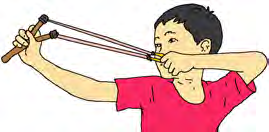
Potential energy is stored in many other things too. Water, stones or bricks kept at a height have potential energy because of where they are. When a spring is squeezed, stretched, bent or coiled, its shape changes and potential energy is stored in it. A wound clock spring and the water collected behind a dam also hold potential energy.
Now look at things that are moving. A ball thrown gently is easy to catch, but the same ball thrown hard is difficult to catch. This tells us that every moving body carries energy, and that energy is called kinetic energy.
Kinetic energy: the energy produced in an object because of its motion.
- A ball rolling along the ground
- A bird flying overhead
- Water running down a stream
- Wind blowing across a field
- A motor car moving on the road
What Kinetic Energy Depends On
Take one cricket ball and one tennis ball out to an open field with a friend and try this yourself:
- One of you throws the cricket ball gently and the other catches it.
- Now throw the same cricket ball hard and catch it.
- Then throw the tennis ball at that same speed and catch it.
- Talk with your friend about how the three catches felt different.
The ball thrown faster stings the hand more, and at the same speed the cricket ball is harder to stop than the tennis ball. This shows that kinetic energy depends on the mass of the object and on its speed.
A heavier object carries more kinetic energy and a lighter one carries less. In the same way, the faster an object moves, the more kinetic energy it has. That is why a crash caused by a fast moving vehicle does far more damage than one caused by a slow moving vehicle.
| Basis | Potential energy | Kinetic energy |
| Cause | Stored because of place or a change of position. | Produced because the object is moving. |
| State | Can be present even when the object is still. | The object must actually be moving. |
| Example | Water behind a dam, a stretched catapult | Running water, a flying bird |
Transformation and Conservation of Energy
The water in a tank on the roof has potential energy. The moment the tap is opened in the bathroom, that water starts to flow and its potential energy turns into kinetic energy. Energy changes from one form to another like this, but it is never destroyed.
Law of conservation of energy: energy is neither created nor destroyed. It only changes from one form into another.
In daily life we sometimes need potential energy and sometimes kinetic energy, sometimes light and sometimes heat. So we use machines to change the energy we have into the form we need, and that is transformation of energy. From the water stored in a dam to the bulb glowing in a house, the energy passes through these stages:
| Stage | Form of energy |
| Water held in the dam | Potential energy |
| Water falling from the dam | Kinetic energy |
| Falling water turning the turbine | Electrical energy |
| The bulb glowing at home | Light energy |
| Device | Changes energy from and into |
| Solar panel | Solar energy into electrical energy |
| Electric bulb | Electrical energy into light energy |
| Heater | Electrical energy into heat energy |
| Torch | Electrical energy into light energy |
Do not think that energy is finished when a light goes out or when food has been digested. Energy is never destroyed. It has simply moved on in another form.
Heat and the Way It Flows
In the hot season we feel warm and in winter we feel cold. The main reason behind feeling hot or cold is heat. Heat is a form of energy and its SI unit is the joule. Heat always moves from a hotter object to a colder one. When we touch something hotter than our skin, heat moves from that object into the skin and we feel warmth. When we touch something colder, heat moves out of the skin into that object and we feel cold.
Heat: heat is a form of energy that gives us the feeling of hotness. Its SI unit is the joule (J).
Never touch a hot iron, a hot pot or boiling water with bare hands. Do any work with hot water only when a teacher or an adult is beside you.
Heat Absorption and What It Depends On
Sitting in the sun or in front of a heater for a while makes us feel warm. A pot left in the sun feels hot, and a quilt dried in the sun feels cosy. The reason behind all of this is that our body or the object has taken in heat energy.
Heat absorption: the process by which an object takes in heat energy from the hotter things around it.
How long does the giving and taking of heat go on? Try this and find out:
- Take hot water in glass A and cold water in glass B.
- Measure the temperature of each with a thermometer and write it down.
- Pour both together into a third glass C and mix them.
- Measure the temperature of the mixture and compare it with the two you noted earlier.
The mixed water is cooler than the hot water was and warmer than the cold water was. The hot water gave heat away and the cold water took heat in. This goes on until both are at the same temperature.
Not every object absorbs heat equally well. It depends mainly on the surface area of the object and on its colour. Put the same amount of water in a wide plate and in a glass and leave both in the sun, and the water in the plate becomes hotter, because its surface area is much larger. So heat absorption increases as surface area increases.
- Wet or washed clothes are spread out to dry.
- Grain left in the sun is spread thinly.
- The surface of a solar heater is made large.
- The base of a pot for boiling water or cooking rice is made wide.
- When warming our hands at a fire we spread the fingers instead of making a fist.
Now look at what colour does. Take a black cloth and a white cloth of the same size, wrap each around a separate thermometer, and leave both in the sun for the same time. The thermometer in the black cloth shows the higher temperature. Black objects absorb a lot of heat, while white objects absorb much less.
That is why people in hot places usually wear white clothes, while in cold places dark clothes suit better. The surface of a solar heater is painted black so that it soaks up as much sunlight as possible, and the outer bottom of a cooking pot is blackened so that food cooks quickly and fuel is saved.
Light and How It Travels
On the way to school we see houses, vehicles, trees and animals. In the daytime we see them because of light from the sun, and at night because of light from a lamp. We see an object only when light bounces off it and reaches our eyes. Light is a form of energy that helps us to see the things around us.
Light moves from one place to another. Light travelling from the sun reaches the earth in this way. In one second light can travel about three hundred thousand kilometres.
\[ 300000\ \text{km/s} \]
Transmission of light: the process by which light from a source travels from one place to another.
Light Travels Only in Straight Lines
In the morning, watch the sunlight that slips into a room through a small hole in the window. Specks of dust show up along it and you can see clearly that the light has come in a straight line. Try this and be sure of it:
- Take a piece of black plastic pipe about half a metre long.
- Light a candle and stand it on the table.
- Look at the candle through one end of the straight pipe. The flame is seen.
- Now bend the pipe and look again in the same way. The flame is not seen.

The same thing shows up with three equal pieces of cardboard, each with a small hole in the middle, stood upright on a table. When the three holes are lined up straight, a burning candle can be seen from the other end. Slide any one card a little to the side and the flame disappears.
Rectilinear propagation of light: the property by which light always travels in a straight line, in the very direction it leaves its source.
Walking at night with a torch, or watching a vehicle with its headlights on, we see light reaching far ahead. Light travelling like this is called a beam of light. Because light goes straight, a ray is drawn as a straight line, with an arrowhead showing the direction it is going.
Ray: the smallest part of a beam of light is called a ray.
Beam of light: a group of many rays together is called a beam of light.
The Pinhole Camera
A pinhole camera is a very simple camera that forms a picture with no lens at all, working only on the rule that light travels in straight lines. You can build one at home:
- Roll two tubes from thick black paper, one small and one large, so that the small tube slides easily inside the large one.
- Close one end of the small tube by pasting tracing paper over it.
- Close one end of the large tube with black paper and make one small hole in its middle with a pin.
- Slide the small tube into the large one, tracing paper end first.
- Now turn the pinhole end towards a tree, a person or a house and look in through the open end.
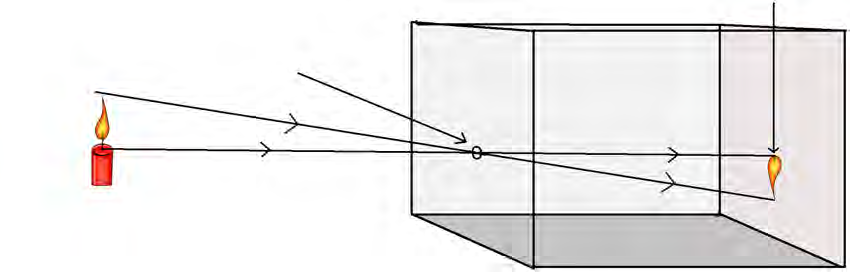
An upside down picture of the object appears on the tracing paper, which is doing the work of a screen. The rays cross at the hole, so the top goes to the bottom and the bottom goes to the top. Pulling the small tube outwards makes the picture taller, and pushing it in makes it shorter.
Keep a burning candle away from paper, curtains and clothes, and blow it out as soon as the work is over. Never leave a lit candle unattended.
Shadow and the Sundial
Objects are of three kinds: transparent, translucent and opaque. Light passes easily through a transparent object, so it casts no shadow. Light cannot pass through an opaque object, so a shadow forms. Three things are needed for a shadow: a source of light, an opaque object, and a screen or wall for the shadow to fall on.
Shadow: the dark patch formed behind an opaque object, where light cannot reach because the object has blocked it.
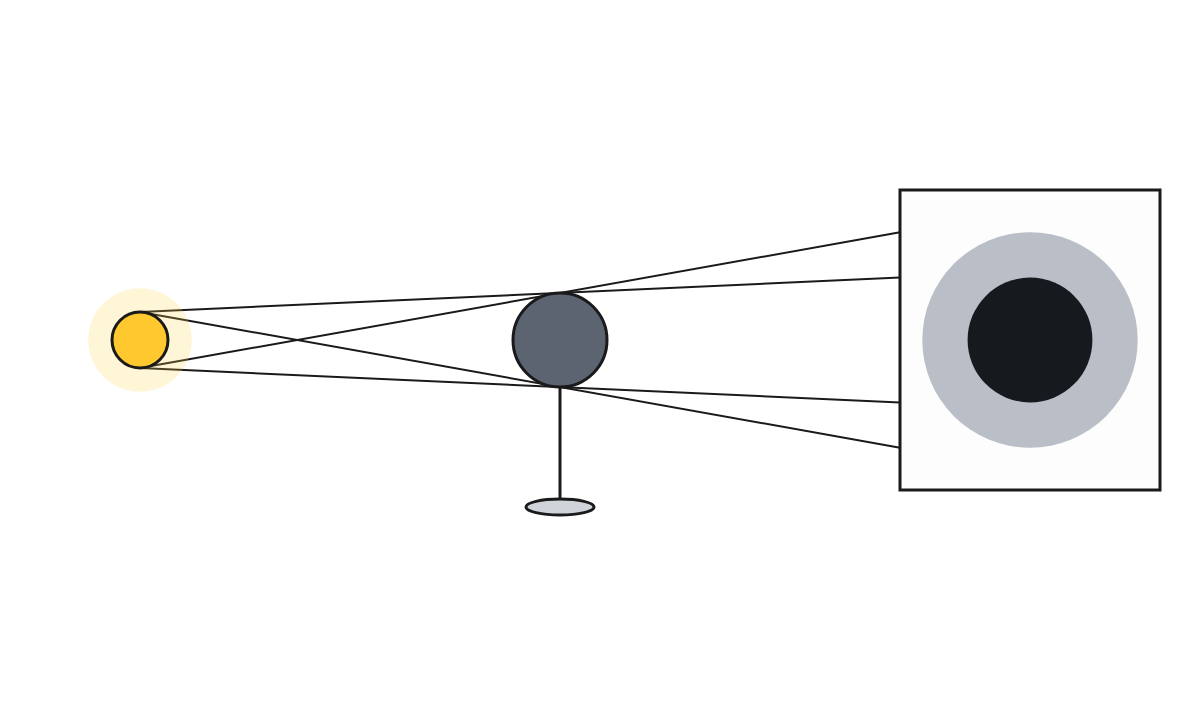
Umbra: the completely dark shadow formed where the light is blocked altogether.
Penumbra: the faint shadow formed where the light is blocked only partly.
The size of a shadow depends on the distance between the object and the source of light, and also on the distance between the object and the screen. Here is how changing those distances changes the shadow:
- Move the object away from the screen and towards the source, and the shadow grows larger.
- Move the source closer to the object, and the shadow again grows larger.
- Move the object towards the screen or wall, and the shadow becomes smaller.
- Move the source further away, and the shadow becomes smaller too.
Stand in the sunshine in the morning, at midday and in the evening and look at the length and direction of your own shadow. It is different every time. Early and late in the day the sun shines from low down at the side, so the shadow is long. At midday the sun is almost overhead, so the shadow is at its shortest.
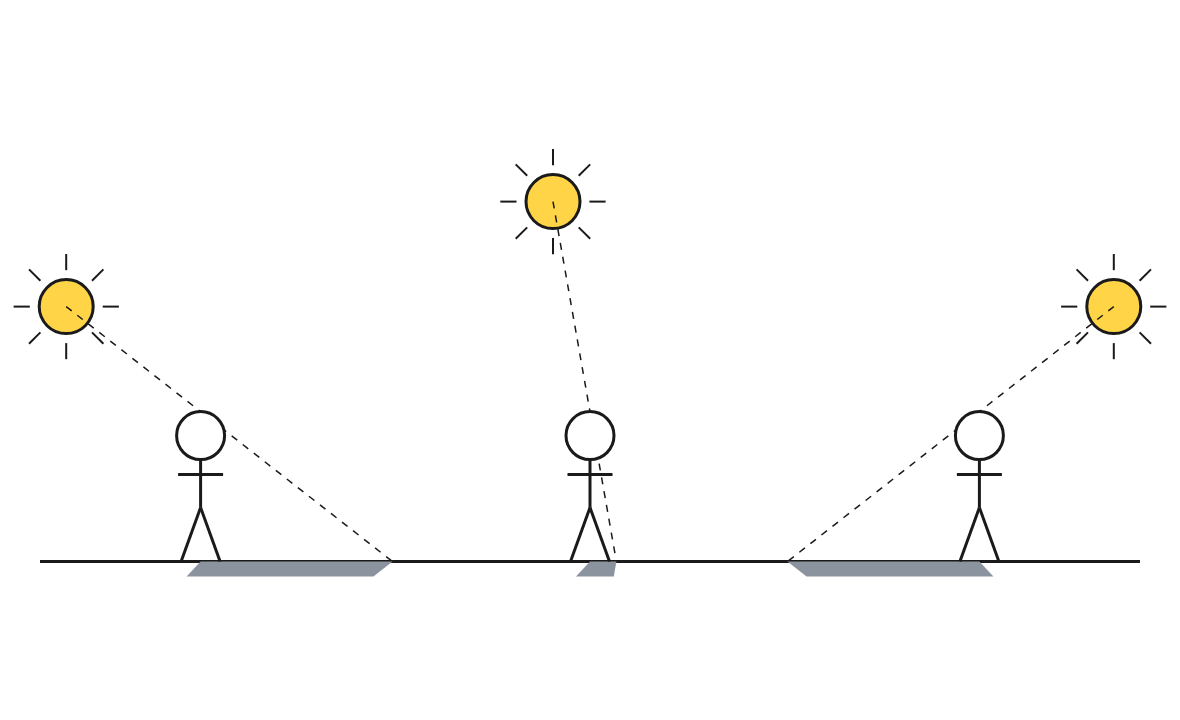
| Time of day | Length of the shadow |
| 8 in the morning | Long |
| 12 at midday | Shortest |
| 3 in the afternoon | Growing long again |
| 5 in the evening | Very long |
Before clocks of different kinds were invented, people used a simple instrument called a sundial to tell the time. The length and direction of the shadow cast by its upright piece told them the hour. You can make your own by standing a wooden stick upright in a sunny spot and marking the tip of its shadow every hour.
While measuring shadows, never look straight at the sun. It harms the eyes. Keep your eyes on the shadow only.
Sound, Waves and How They Travel
Sound is a form of energy. It is produced by the vibration of an object, in the form of waves, and those waves reach our ears. Throw a stone into still water and the ripples spreading towards the bank are waves too. As the wave spreads, the water itself stays where it was. Flick one end of a stretched rope and the same kind of wave runs to the other end.
Wave: the process by which energy travels through a medium when an object vibrates.
Strike a steel plate gently with a spoon and then touch it. The plate is vibrating and a sound is heard. Grip it tightly to stop the vibration and the sound stops at once. The vibration makes waves in the air, and those waves reach the ear. Even if the object vibrates, no sound wave is made and nothing is heard unless there is a medium around it.
Source of sound: the object from which a sound is produced. A drum, a guitar, a bell and a flute are all sources of sound.
Two people stretch a long spring, hold both ends, and one of them taps an end gently. The coils do not swing sideways. They move to and fro along the spring. As they do, the coils bunch close together at some places and spread apart at others, and this pattern travels from one end to the other.
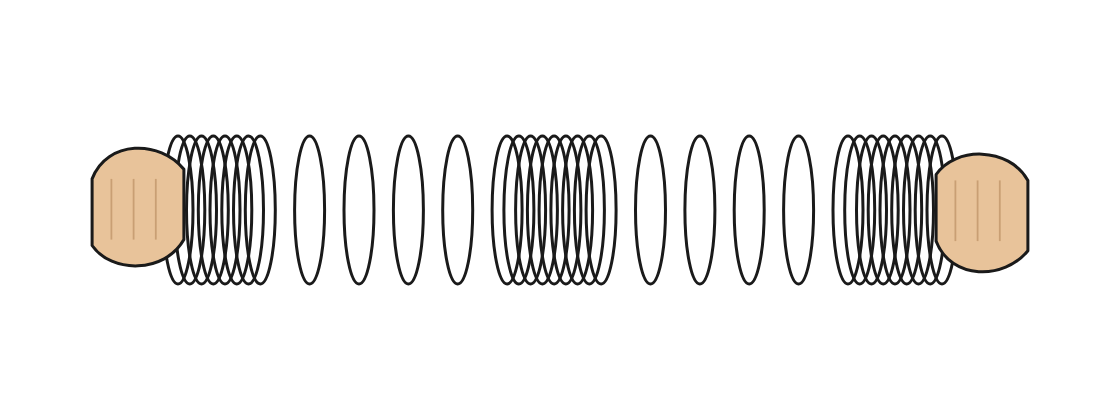
Longitudinal wave: a wave in which the particles of the medium vibrate in the same direction as the wave travels. A sound wave is a longitudinal wave.
Sound travels through all three media, solid, liquid and gas, but its speed is different in each. In a solid the particles sit very close, so a push passes quickly from one particle to the next. In a liquid the particles are looser, so it takes a little longer, and in a gas they are looser still, so it takes longer again.
| Medium | How the particles sit | Speed of sound |
| Solid | Very close together | Fastest, about 5200 m/s in steel |
| Liquid | A little loose | About 1500 m/s in water |
| Gas | Very loose | Slowest, about 332 m/s in air |
\[ 5200\ \text{m/s} > 1500\ \text{m/s} > 332\ \text{m/s} \]
Put an ear against one end of a wall while a friend scratches the other end gently and the sound is heard, which shows sound passes through a solid. Strike a plate with a spoon inside a bucket of water and the sound is heard outside, which shows it passes through a liquid. But sound cannot travel through a vacuum, where there is no matter at all. The huge space between the sun and the earth is a vacuum, which is why the enormous explosions on the sun never reach our ears, and there is no air on the moon, so people cannot talk there without special equipment.
Sound needs two things: a vibrating object and a medium. With no medium there is no sound, however hard the object vibrates.
The full lesson is waiting for you
The notes are free to read in full. A free account opens the rest of the practice, and tracks your progress and confidence score for every subject. Presentations and videos need approval from Learn Yeti.