Force in Everyday Work
We do many jobs during a day. Walking, running, playing, digging a field, carrying a load, opening a door and turning the page of a book are all work. None of it happens on its own. Every one of these jobs needs something to be pulled or pushed, and that pull or push is what we call force. Force sets things going, makes them roll, stops them, and sometimes changes their shape altogether. So force and motion are not two separate lessons. They are two ideas that have to be learnt side by side.
The State of Motion and the State of Rest
The simple activity below lets you see for yourself what motion really means.
- Put a book on a table.
- Push the book slowly with your hand and watch carefully.
- Say whether the book changed its place or not.
- Say whether the table changed its place or not.
- Discuss with your friends whether the desks, benches and chairs in the room can change their place by themselves.
As the book slides it is changing its place compared with the table. At that moment the book is in the state of motion. The table itself stays exactly where it was, so the table is in the state of rest. The desks, benches and chairs in the room cannot change their place by themselves either, so they are at rest too.
State of motion: the condition of an object that is changing its place compared with the things around it.
State of rest: the condition of an object that is not changing its place compared with the other things around it.
Flowing water, flying birds, a moving bus, walking people and a rolling bicycle are all examples of the state of motion. When we walk from home to school we ourselves are in the state of motion. A house, a bridge and an electricity pole, on the other hand, are examples of things at rest.
| Basis | State of motion | State of rest |
| Place | The place changes compared with nearby objects. | The place does not change compared with nearby objects. |
| Example | A rolling bicycle, a flying bird | An electricity pole, a bench in the room |
| Force needed | Force is needed to bring a resting object into this state. | Force is needed to bring a moving object into this state. |
You can try a good experiment with your friends. Put a plastic sack on the ground, ask one student to sit on it, and let two students pull the sack slowly. The student moving along with the sack is at rest compared with the sack, but in motion compared with the ground.
A passenger sitting inside a moving bus is at rest compared with the seat, but in motion compared with a tree beside the road. So before you call anything moving or at rest, first say what it is being compared with.
Types of Motion
The motion of every object is not of the same kind. Some things travel straight ahead, while others curve and turn as they go. That is why motion is divided into two main types.
- (a) Linear motion
- (b) Curvilinear motion
Tie a small stone with a thread, let it go from a high place, and watch how it falls. The stone does not swing to the left or the right. It comes straight down. Motion like this is called linear motion.
Linear motion: motion that takes place along a straight line.
A bus running along a straight road, a ball rolling across level ground after it is struck, and a bullet leaving a gun are all examples of linear motion.
Now go outside and watch ants and insects moving on the ground. Watch a butterfly and a grasshopper in the air as well. They never travel along one straight line. They keep changing direction as they go forward.
Curvilinear motion: motion that does not follow a straight line but keeps changing its direction.
A bus on a winding road, the moving hands of a clock and a swinging swing are examples of curvilinear motion. When the wind blows, dust, torn leaves and paper fly about. They have no one fixed direction while flying. They keep changing direction as they go, and that too is curvilinear motion.
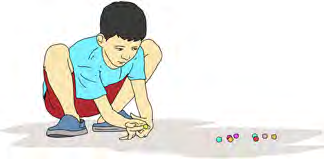
Drop a piece of paper and a small stone together from a high place. The stone comes straight down, but the paper twists and drifts as it falls. This shows that the motion of the two is not of the same kind.
Before dropping a stone from a high place, make sure nobody is standing below, and use only a small stone.
Force and Its Unit
Put a bag with some books in it on a table. Push the bag slowly. It moves from one place to another. Now pull it slowly. It shifts its place again. Left alone the bag stays at rest, but pulling or pushing brings it into motion. This pulling or pushing is force.
Force: the external agent that changes, or tries to change, the state of an object.
Walking, running, carrying a load, playing football, riding a bicycle and opening a door all use force. No work at all is done without force. Force is needed to bring a resting object into motion, and force is needed again to bring a moving object to rest.
Newton: the unit of force is the newton. The size of a force is stated in this unit.
The weight of an object is also a kind of force. The pull that the earth exerts on an object is that object's weight. On the surface of the earth, an object of mass one kilogram has a weight of about \( 9.8\ \text{N} \).
Measuring Force with a Spring Balance
Force cannot be seen, but it can be measured. The instrument used to measure force is the spring balance. Try the two tasks below.
- Put a bag with some books on a table. Hook a spring balance to the strap of the bag and pull it towards you. Note the reading shown by the pointer of the spring balance.
- Hang up a spring balance. Tie a small stone with a thread, hang it from the hook at the end of the spring, and note the reading it shows.
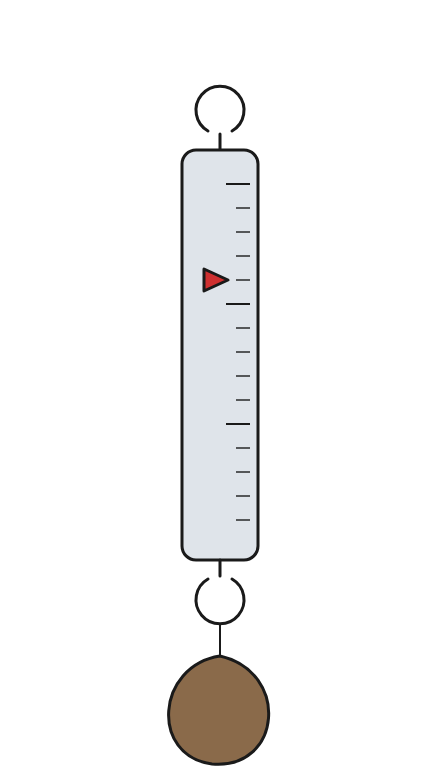
When the stone is hung, the spring inside is stretched and the pointer slides down. The heavier the object, the more the spring stretches and the larger the number the pointer shows. In this way the size of a force can be found with a spring balance.
The Effects of Force
You can find out for yourself what force does to an object by trying the tasks below.
- Take a ball to an open field, put it on the ground, kick it hard so that it rolls, and then ask a friend to stop the rolling ball.
- Roll a small ball towards a friend and ask the friend to block it with a wooden stick or a bat. Watch which way the ball then goes.
- A swing moves slowly at first, but the more force you use the faster it swings. Play on it and watch why this happens.
- Press an inflated balloon and observe what happens to its shape.
- Observe what happens when a brake is applied to a moving bicycle or bus.
| S.N. | Use of force | Effect of the force |
| 1 | Kicking a ball | An object at rest is set into motion. |
| 2 | Stopping a rolling ball | A moving object is brought to rest. |
| 3 | Bouncing a ball off a wall | The direction of the ball changes. |
| 4 | Pushing a moving swing harder | The speed of the swing increases. |
| 5 | Pressing an inflated balloon | The shape of the balloon changes. |
| 6 | Applying a brake to a moving bicycle or bus | The speed falls and the vehicle comes to rest. |
Putting all these experiences together, we see that force has six kinds of effect on an object.
- (a) Force produces motion in an object at rest. A ball lying on the ground moves when it is kicked, and a loaded wheelbarrow starts to roll when it is pushed.
- (b) Force brings a moving object to rest. A bicycle or a bus stops when the brake is applied, and a goalkeeper has to use force to stop the football.
- (c) Force increases or decreases the speed of an object. The harder a swing is pushed the faster it swings, and the faster the pedals of a bicycle are turned the faster the bicycle runs.
- (d) Force changes the direction of an object. A rolling ball changes direction when it strikes something, and a cricketer's bat changes the direction of the ball it hits.
- (e) Force changes the shape of an object. An inflated balloon changes shape when it is pressed, and kneaded dough can be pressed into many shapes to make bread.
- (f) Force changes the size of an object. Blowing into a balloon makes it bigger, and pressing clothes down into a bag makes them smaller.
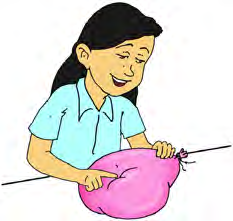
Shape and size are not the same thing. When a balloon is pressed, the air inside stays the same but its form changes, and that is a change of shape. When a balloon is blown into, it grows bigger, and that is a change of size.
Force changes an object's state of motion and its direction, and it also changes the object's shape and size.
Transformation of Force
Watch someone splitting firewood with an axe and someone digging a field with a spade. In these tools the place where force is applied and the place where the work happens are not the same. When wood is cut, the force is applied to the handle of the sickle, the khukuri or the axe, but the cutting is done by the blade. It is because the force applied at the handle is carried to the blade that the blade can cut. The same carrying of force happens when a field is dug with a hoe or a spade.
A brake has to be applied to stop a moving bicycle, motorcycle or bus. When the brake is pressed with the hand or the foot, that force reaches the wheel, and the brake grips the wheel hard and brings it to rest. In an aeroplane too the brake carries force to the wheels and stops them. In this way the brake takes force from one place to another.
This can be seen very clearly with the help of syringes.
- Take two syringes and remove the needle from each of them.
- Fill both syringes about half full with water.
- Join the two open ends tightly with a rubber tube or pipe.
- Now push one syringe and watch the piston of the other syringe move backwards.
- Discuss how that piston was pushed back and write your conclusion.
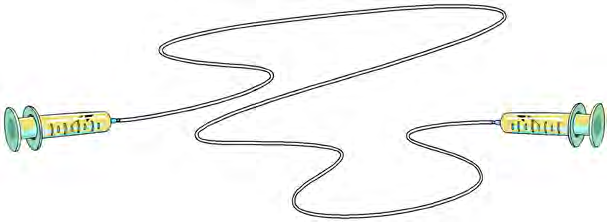
When force is applied at one end of the two water filled pistons, that force is carried through the water in the rubber pipe to the other end. That is why the piston of the second syringe moves back by itself.
Transformation of force: the process of carrying a force from one place to another.
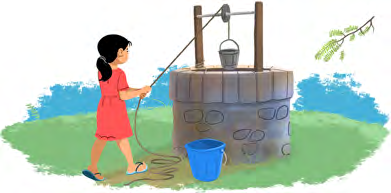
Have you seen water being drawn from a deep well with a pulley? When one end of the rope is pulled down, the bucket tied to the other end rises. By carrying force in this way, quite heavy things can be lifted. In daily life the hoe, the spade and the digger used in the fields, and the sickle, the khukuri, the axe and the chopper used on wood, all carry force in just this way.
Simple Machines
We do many kinds of work in daily life. To do that work easily we bring different tools into use, and such tools make the work easier and quicker. Make a table like the one below, writing down which tool is used at home for cutting vegetables, cutting cloth, digging and ploughing a field, and cutting wood.
| S.N. | Name of the tool | Work it does |
| 1 | Scissors | Cutting cloth and paper |
| 2 | Spade and plough | Digging and ploughing the land |
| 3 | Knife and vegetable cutter | Cutting vegetables and fruit |
| 4 | Sickle and grass knife | Cutting grass and firewood |
| 5 | Pulley | Drawing water from a well |
| 6 | Screwdriver | Tightening or loosening a screw |
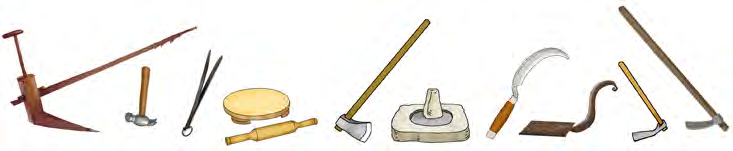
In villages a sickle and a grass knife are used to cut grass and firewood. An axe is used to fell a tree or split logs. A hoe and a spade are used to dig the fields. At home tools such as the vegetable cutter, the knife, the tongs, the nutcracker, the shovel and the spinning wheel are used for different jobs. Heavy goods are pushed up a sloping plank onto a truck. All these tools look plain in build, but with them a job can be finished quickly, neatly and with less force.
Simple machine: a tool of plain construction that lets a job be done easily, quickly and conveniently.
Complex machine: a machine built by putting many small simple machines together. Each of its parts is itself a simple machine.
A simple machine means a single tool on its own. It does not use diesel, coal or any such fuel. In a complex machine, on the other hand, many simple machines work together.
What Simple Machines Do for Us
Simple machines are used for all sorts of jobs in daily life, and they help a great deal in getting the work done. This help is what we call the usefulness of simple machines. Its main points are as follows.
- (a) A heavy load can be lifted by applying only a small force.
- (b) A lot of work can be done in a short time.
- (c) Force can be applied in a comfortable and convenient way.
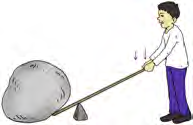
Force is needed for any job, but sometimes we have to work against a very large force. Suppose a stone of about \( 1000\ \text{kg} \) has to be turned over. No one can turn it over alone. Push a long iron rod or a strong piece of wood under the stone and place a small stone underneath the rod as a support. Now press down on the far end of the rod and the big stone rolls over. As the rod goes down the stone goes up, so the rod is also helping by changing the direction of the force.
Scissors are used to cut paper and cloth. A shovel is used to throw soil and sand. A pulley is used to draw water from a deep well. Put some material in a bucket, tie a rope to it and lift it with your hands. Then pass the same rope over a pulley and lift the bucket by pulling downwards. You will feel for yourself the difference between using a pulley and not using one.
A simple machine does not make force for us. It carries the force we apply to an easier place and an easier direction, and that is why the work feels lighter.
The full lesson is waiting for you
The notes are free to read in full. A free account opens the rest of the practice, and tracks your progress and confidence score for every subject. Presentations and videos need approval from Learn Yeti.