Life Processes in Living Things
You know you are alive because things never stop happening inside your body. You breathe. You eat food and digest it. You throw out the waste your body does not need. A plant is doing the same kind of work, quietly, all day. Breathing, nutrition and excretion are needed by animals and by plants alike. The processes that run inside the body of a living thing to keep it alive are called life processes.
Life process: any of the different processes that go on inside the body of a living thing to keep it alive.
These processes are not at the same level in every living thing. In simple, less developed organisms the processes are simple too. In developed organisms the same processes are complex. A single celled organism such as amoeba takes in food, digests it and throws out waste all inside that one cell. In a developed body like ours there are separate organs for each of those jobs, and the organs work together.
To run its life, a living thing needs energy. To get energy, it needs food. Food is the source of a living thing's energy. Green plants prepare their own food. Some animals get their food from plants, and some kill other animals and eat them. In one way or another, every living thing gets its food from some source.
Two Groups, Decided by How Food Is Obtained
A pigeon, a mushroom and a fern are all living things, but not one of them gets its food the way the other two do. That difference splits every living thing into two main groups.
- (a) Autotrophic
- (b) Heterotrophic
Autotrophic organism: a living thing that makes its own food for itself out of non living materials.
Green plants and a few bacteria, such as cyanobacteria, are autotrophic. They take water and mineral salts from the ground and carbon dioxide from the air. From these non living materials they build food inside cells that contain chlorophyll, and then they carry that food to every part of the plant. The energy from it runs their life processes and makes them grow. Green plants that take energy from sunlight and build food are the important source of the food supply for everyone else. Rice, maize and papaya are all autotrophic.
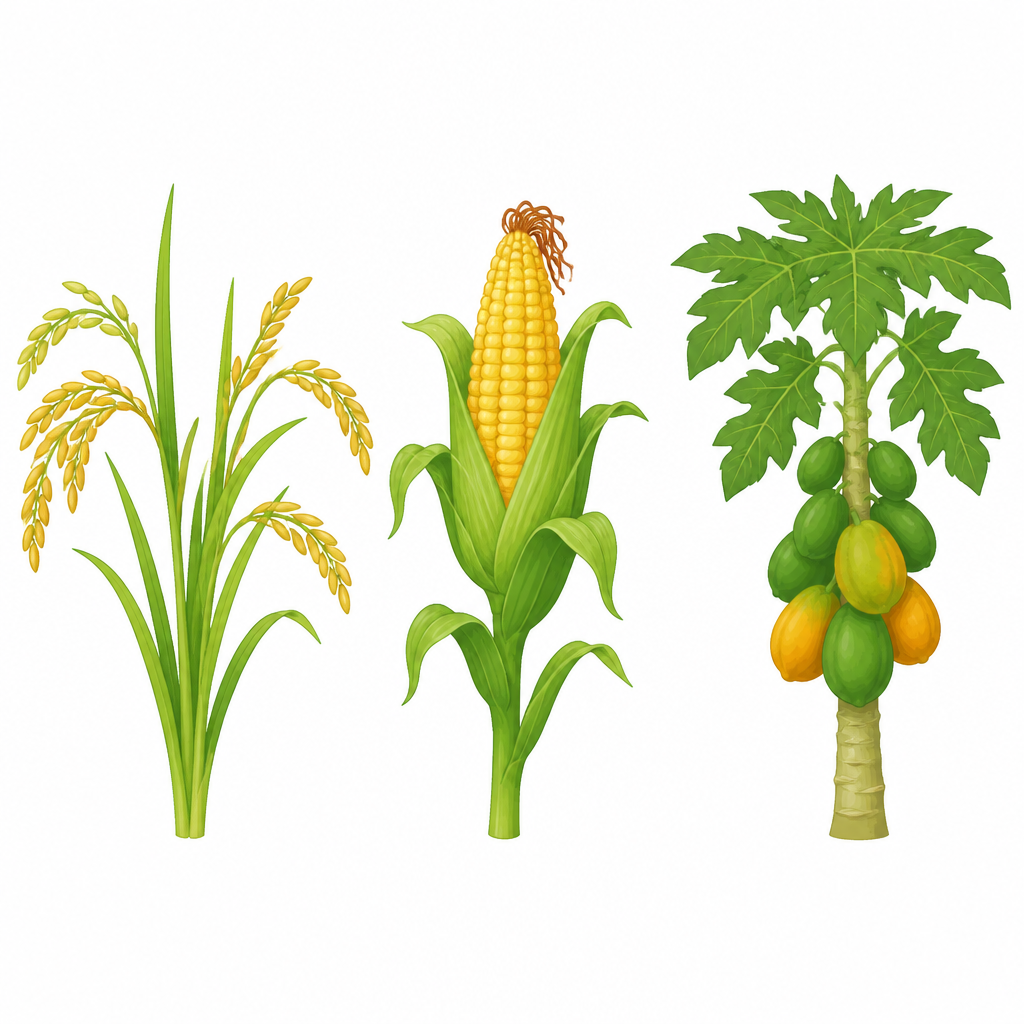
Look carefully at the plants growing around your school and around your home. Make a list of the ones that can build their own food, that is, the autotrophic ones, and present your list to the class.
Heterotrophic organism: a living thing that cannot make its own food and depends on other living things for it.
Heterotrophs depend on plants and on other animals. Some of them take their food from dead bodies. Some suck it straight out of a living body. Some kill another animal and eat it. So heterotrophs themselves are divided further, again by the way they get their food.
The Three Kinds of Heterotroph
Saprophytic: takes food by soaking it up from dead bodies
Parasites: live on or inside another living body and take food from it
Holozoic: swallow the food and digest it inside the body
Saprophyte: a living thing that feeds by soaking up food from the body of something that has died.
You have probably seen mushrooms pushing out of the bark of a fallen tree. Mushrooms and moulds soak their food out of things that have died. That is exactly why mushroom growers spread straw and raise their crop of mushrooms on it. Look at curd that has been left standing too long, or at fruit that has begun to rot, and you will often find mould spreading over it. Mushrooms and moulds have no chlorophyll, so they cannot build food for themselves. Mushrooms, moulds and some bacteria, which all get their food from the bodies of dead things, are saprophytes.
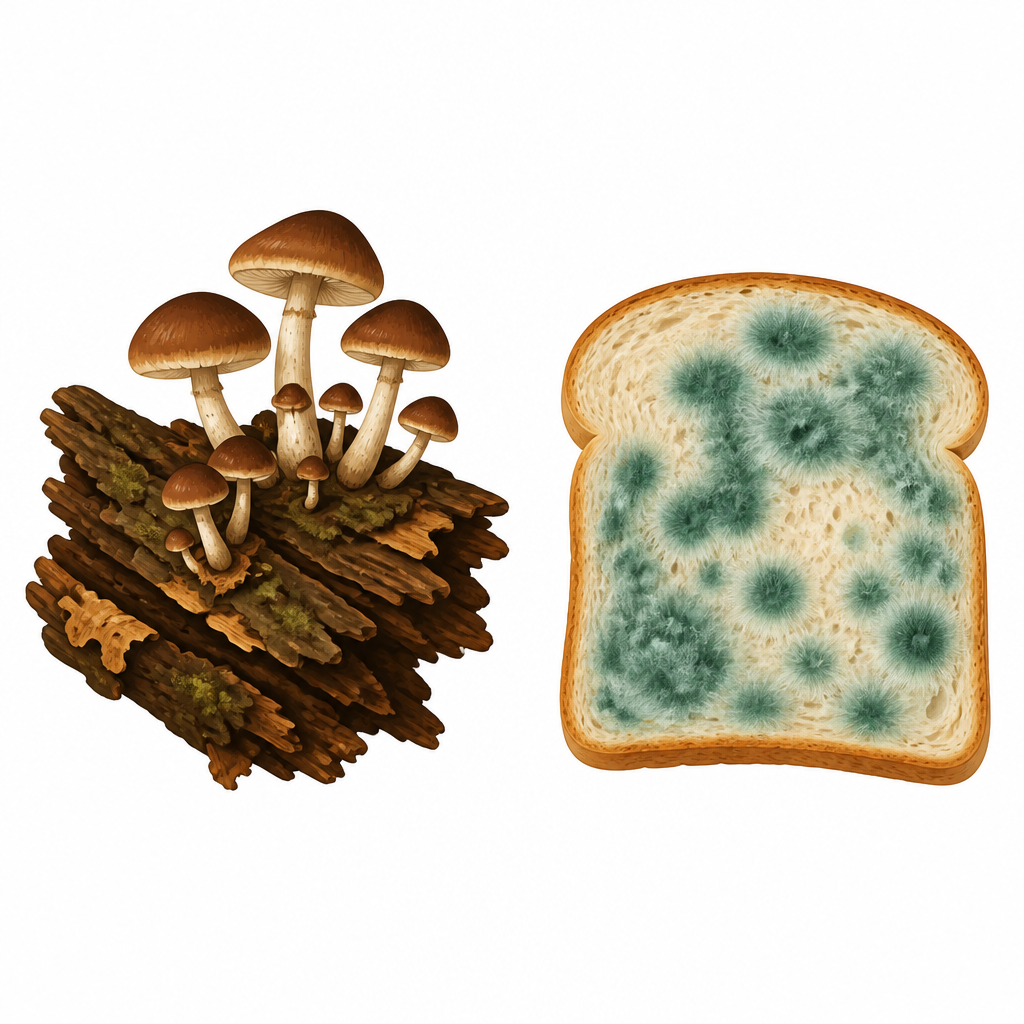
Using the internet, or by asking people who know more than you do, find other living things that are saprophytes besides the ones named here. Write down how each of them gets its nutrition, and discuss your findings.
Parasite: a living thing that stays on or inside the body of another living thing and takes its food from that body.
Some living things pass their whole life on another living body. Lice, ticks, bed bugs and leeches keep themselves alive by sucking the blood of other animals. Plasmodium, pinworm and ascaris stay inside the body of a living thing and get their food there, so they are called endoparasites. Lice, bed bugs, ticks and leeches feed by sucking from the outside, so they are called ectoparasites.
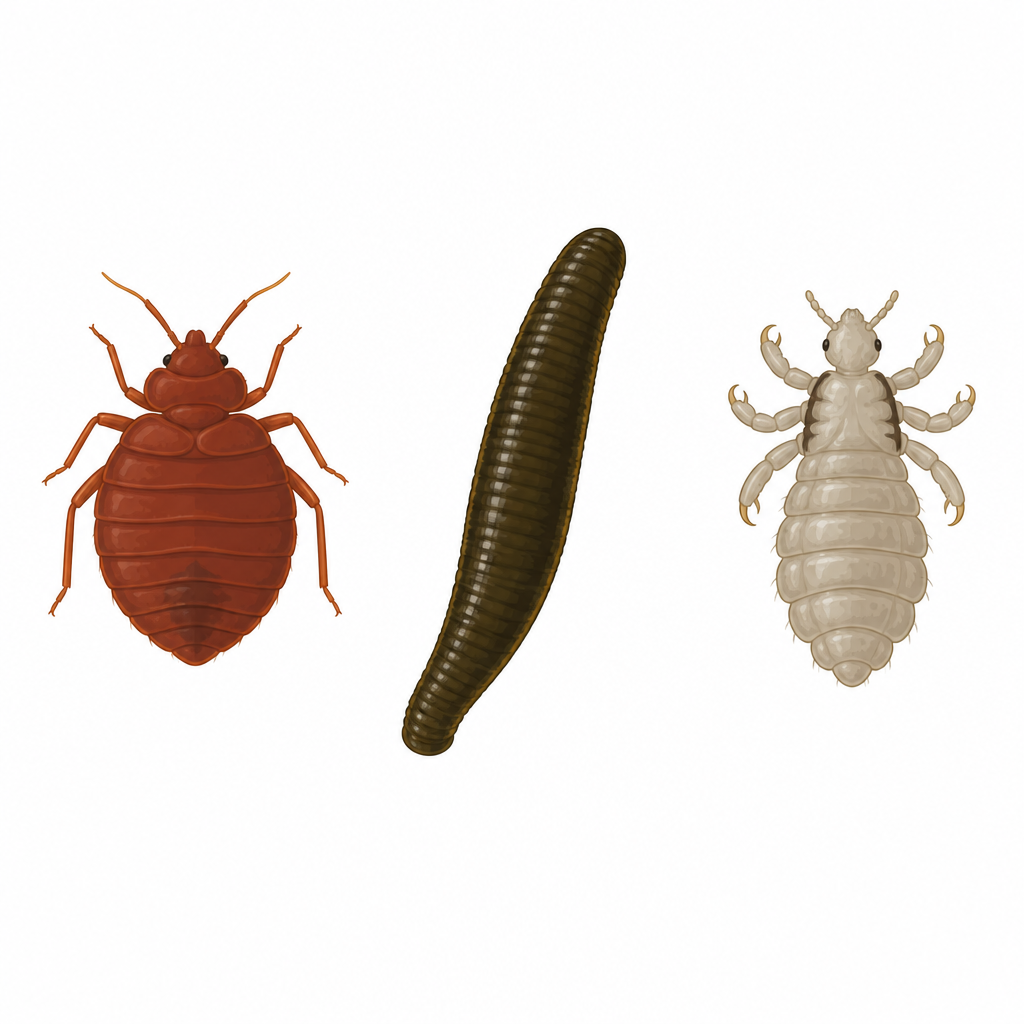
Do not sort a parasite by its shape or its name. A leech and a roundworm are both long and soft, but the leech clings to the skin and sucks from outside, so it is an ectoparasite, while ascaris lives inside the gut, so it is an endoparasite. Where the parasite lives is what decides the name, not what it looks like.
Holozoic organism: a living thing that swallows food taken from another living thing, then digests it and uses it inside its own body.
A holozoic organism does five things, from the moment it takes food in to the moment it throws the waste out.
- Taking the food in from another living thing (Ingestion)
- Breaking that food down inside the body (Digestion)
- Soaking up the substances the body needs (Absorption)
- Using the substances that have been soaked up (Assimilation)
- Throwing out what did not digest and what the body does not need (Egestion)
The way the food is taken in is not the same in every animal. Most animals are holozoic, for example human beings, dogs, cows and amoeba.
Search or ask around, and build three lists: saprophytes, parasites and holozoic organisms. Beside each name write how that organism gets its food, then present the lists to your class.
Photosynthesis
Green plants can build their own food. From the carbon dioxide in the air and the water in the soil, in the presence of sunlight and with the help of chlorophyll, a green plant builds food inside its leaves. This building of food by a plant is called photosynthesis.
Photosynthesis: the process by which a plant makes its food.
This work happens in the green leaf. The energy it needs is taken from sunlight by the chlorophyll sitting in that green leaf. Glucose and oxygen are made in the process. In the presence of light and chlorophyll, the change can be written like this.
Carbon dioxide \( + \) Water \( \longrightarrow \) Glucose \( + \) Oxygen
For photosynthesis a plant draws water from the ground through its roots, and takes carbon dioxide from the air through the tiny pores in its leaves called stomata. The glucose the plant builds is changed into starch and stored in its cells. The oxygen made in the process is let out into the air, and that is where the oxygen we breathe comes from. Plants that grow in water, such as hydrilla, carry out the same process under the water.
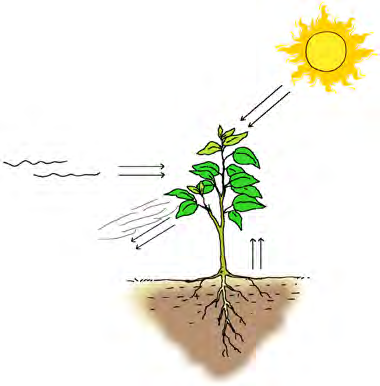
Starch: the food that a plant has made.
Stomata: the tiny pores in the leaves of a plant.
Hydrilla: a plant that grows in water.
The Four Things Photosynthesis Needs
Take away even one of these four and the plant cannot build food at all.
- Chlorophyll: the green colouring inside a green plant. Only a plant that has chlorophyll can carry out photosynthesis. The chlorophyll in the leaves soaks up the sunlight the process needs.
- Carbon dioxide: this is a raw material the process needs. The plant takes carbon dioxide from the air through the tiny pores, the stomata, in its leaves.
- Water: the other important raw material. The plant soaks water out of the ground with its roots and carries it up the stem to the leaves.
- Light: the chlorophyll in the leaves absorbs sunlight and uses it to build food. While a green plant makes food, it turns the energy of sunlight into chemical energy.
Photosynthesis needs light, so it does not go on at night. It also needs chlorophyll, so it happens only in the green parts of the plant. A root or a brown woody stem does not carry it out.
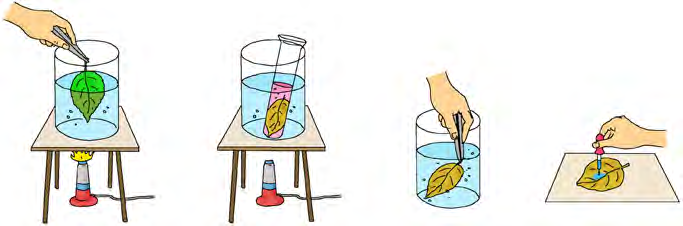
Testing a Green Leaf for Starch
Whether a plant has really built food can be settled by testing its leaf for starch. These are the things you need.
- A green leaf
- Forceps
- A vessel to hold hot water
- 90 per cent ethanol
- Iodine
- A dish and water
- A spirit lamp, a dropper and beakers
Now work through the method in this order.
- Pluck a leaf from a plant and dip it in boiling water for five minutes. This makes the leaf soft.
- Then leave the leaf standing for some time in warm alcohol, that is 90 per cent ethanol.
- Take the leaf out and wash it well in clean water.
- Put iodine solution in a dish and dip the washed leaf into it.
The leaf in the iodine turns a blue black colour. That colour appeared because starch is present in the leaf. The change is proof that the leaf had been making food.
Alcohol catches fire very easily, so never heat it directly on the flame of the spirit lamp. Stand the beaker of alcohol in hot water to warm it. Do not taste the iodine or the alcohol, and lift the hot leaf with the forceps, never with your fingers.
The Human Digestive System
The food we eat is digested, and from it we get energy. That energy is what lets us do everything we do. Food cannot turn straight into energy. Many organs have to work together for that, and the group of organs that helps digest food is called the digestive system.
Digestive system: the group of organs that helps to digest food.
The human digestive system can be divided into two parts, the alimentary canal and the digestive glands. Its main organs are the mouth, the salivary gland, the oesophagus, the stomach, the liver, the gall bladder, the pancreas, the small intestine, the large intestine and the anus.
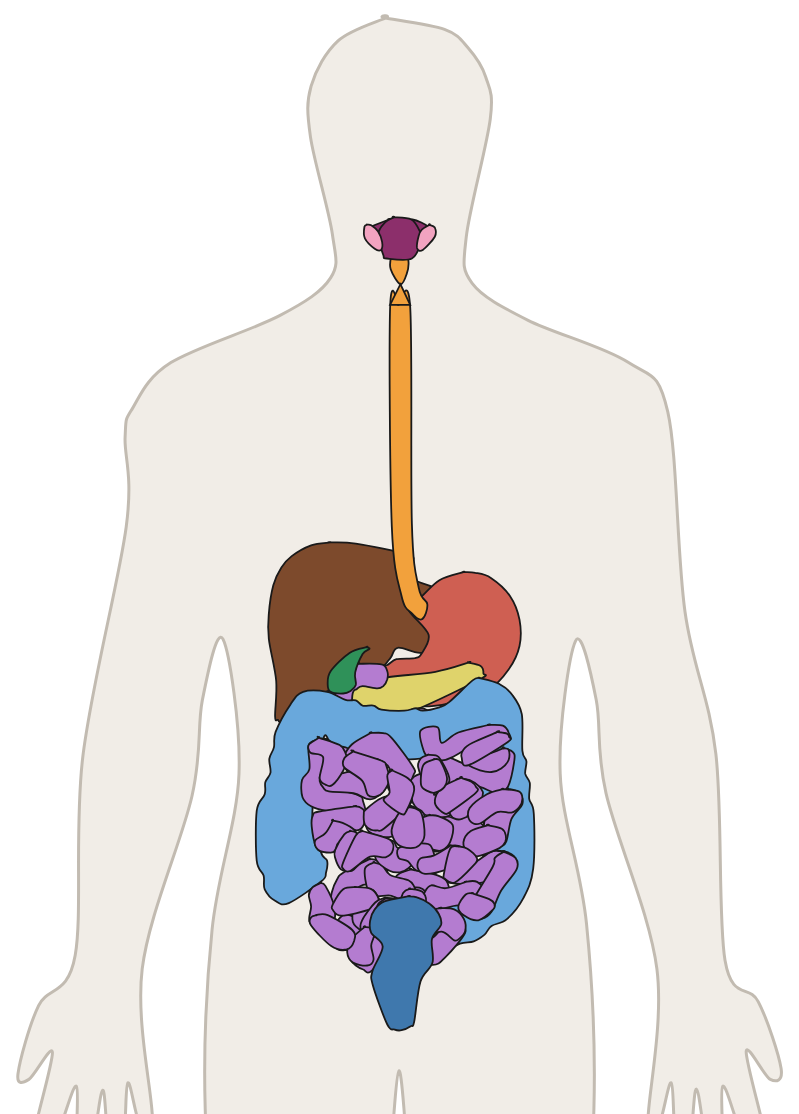
Alimentary canal: the tube that begins at the mouth and ends at the anus. It is wide in some places and narrow in others.
- (a) Mouth
- (b) Oesophagus
- (c) Stomach
- (d) Small intestine
- (e) Large intestine
- (f) Anus
Digesting food takes chemicals of several kinds, and those chemicals are called enzymes. The organs that produce them are called digestive glands. The enzymes made in these glands break the food down into a simple form the body is able to absorb.
Enzyme: a chemical made in a digestive gland that is needed to digest food.
Digestive glands: the organs that produce enzymes.
How Food Is Digested, Mouth to Anus
From the mouthful of rice you swallow to the waste that leaves your body, food travels this road.
- In the mouth, chewing brings saliva out of the salivary glands. The enzyme amylase in that saliva changes starch into glucose.
- The food then passes down the oesophagus and reaches the stomach.
- Once the food is in the stomach it stirs the glands in the stomach wall into action. Hydrochloric acid from the gastric gland makes the food acidic.
- That acid kills many of the germs that came in with the food and stops the food from rotting. The enzyme pepsin helps to digest protein.
- Next the food moves into the small intestine. In the duodenum, which is its first part, bile from the gall bladder mixes with the food and helps to digest fat.
- Pancreatic juice from the pancreas mixes into the duodenum as well. Its enzymes share the work: trypsin digests protein, amylase digests starch and lipase digests fat.
- From the duodenum the food goes on through the small intestine, where intestinal juice also helps to digest it.
- The substances the body needs are soaked up by the villi in the wall of the small intestine and pass into the blood.
- What is left travels on to the large intestine, where most of the water is taken back into the body. At the end, what still remains is thrown out through the anus.
The Glands and the Juices They Make
These are the digestive glands and the juice each one produces.
| Place | Digestive gland | Digestive juice |
| Mouth | Salivary gland | Saliva |
| Stomach | Gastric gland | Gastric juice |
| Chest | Liver | Bile |
| Below the stomach | Pancreas | Pancreatic juice |
| Small intestine | Intestinal gland | Intestinal juice |
What the Digested Food Does in the Body
Digestion turns the food into substances such as glucose, fructose, amino acid and fatty acid. From the small intestine these pass into the blood and reach every cell of the body. Inside a cell, glucose reacts chemically with oxygen and is changed into energy. That energy is what lets you walk, play, read and think.
The different nutrients in food each do a different job in the body.
| Nutrient | Work it does in the body |
| Carbohydrate | Gives the body energy. |
| Fats and oils | Give energy and heat. |
| Protein | Helps cells and tissues to grow and to repair themselves. |
| Minerals | Make bones and teeth strong and keep the body working properly. |
| Vitamins | Protect the body from disease and keep it healthy. |
Draw a chart on which every part of the human digestive system can be seen. You can also knead sticky black clay and shape a model of the whole system. If clay is hard to find, kneaded flour works just as well for the model.
The full lesson is waiting for you
The notes are free to read in full. A free account opens the rest of the practice, and tracks your progress and confidence score for every subject. Presentations and videos need approval from Learn Yeti.