The Variety of Living Things and Biodiversity
Along with people, the Earth carries countless animals, birds, plants and microorganisms too small for the eye to see. They are not all alike. One eats grass, another eats flesh. One lives on a branch, another inside water, another under the soil. One has a body as large as an elephant, while another has a body made of a single cell. This variety in food, in habitat and in body structure is what we call biodiversity.
Biodiversity: the variety found in the genes, the species and the habitats of any plants or animals.
Living things are not the only things around us. There are non-living things too: air, water, soil, stones, sunlight and rock. The whole of these living and non-living things taken together is what makes the environment.
What the Environment Is
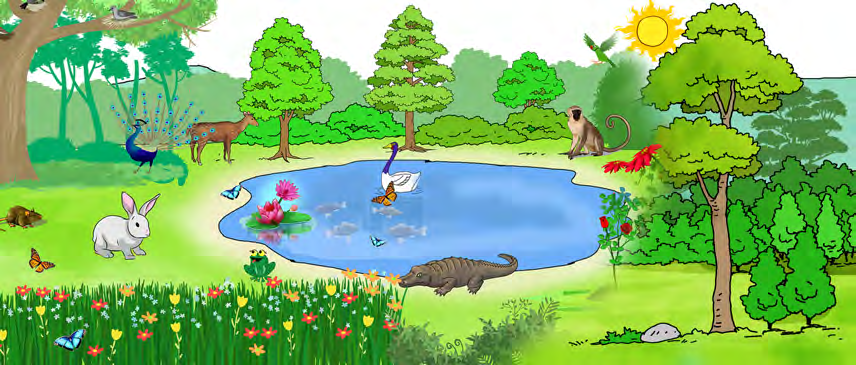
Every animal, plant, microorganism and non-living thing on Earth is tied to the others. A deer eats grass, the grass needs soil and water to sprout, and the soil and water are warmed by the Sun. This give and take between living and non-living things is what creates the environment of any place. Living things survive inside the environment and keep affecting one another. The water, food, energy and nourishment that any creature, people included, needs to keep its life processes running all come from the environment.
Environment: the whole of the living and the non-living things present in a particular place.
Environmental conservation: keeping the components of the environment in good condition even while people are meeting their own needs.
Look carefully at the place around your school or your home. Make two separate lists, one of the living things you find and one of the non-living things, then compare your lists with those of your friends.
Never taste a wild fruit, leaf or mushroom while you are out observing. Do not touch or disturb animals, nests or eggs. Watch from a distance, and go only with a teacher or an elder.
The air, water, soil, energy, plants and animals found in a place are the components of the environment of that place. Air, water, soil and energy are its non-living components, while plants and animals are its living components.
Air: supplies the gases needed for breathing and for making food
Water: keeps the life processes of every creature running
Land: the base on which plants grow and animals live
Energy: gives heat and light, and lets food be made
Plants: give food, oxygen and shelter
Animals: keep the food chain and the feeding of the soil going
The Non-living Components of the Environment
A blanket of air wraps the whole Earth, and this layer of air is called the atmosphere. The air holds nitrogen, oxygen, carbon dioxide and other gases. The oxygen in the air is the gas that carries life, and every animal and plant needs it in order to breathe. When living things breathe, they take in oxygen and give out carbon dioxide. Green plants do the opposite while they make their food: they take carbon dioxide from the atmosphere and release oxygen. Because this taking and giving goes on all the time, the balance of oxygen and carbon dioxide in the atmosphere is kept steady.
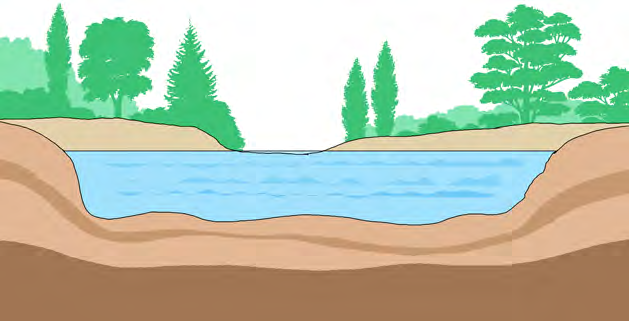
Most of the Earth's surface is covered by water. About \( 71\% \) of the surface is water and about \( 29\% \) is land. Rivers, streams, lakes, ponds, dug wells, natural springs and the sea are the sources of water. No living thing can survive without water.
Land means the surface of the Earth. Soil and rock are found in it. Land takes many forms: flat, high, sloping and low. Land gives plants the base they need to sprout, to grow and to spread, because plants draw the substances they need out of the ground. People plant grain, fruit, vegetables and herbs in the soil. For many animals the soil is home as well.
The Sun is the main source of energy on Earth. From the Sun we get heat and light, and that heat keeps the Earth warm. Plants make their food using sunlight, because without light no plant can make food at all. Living things then survive by eating those plants. Dried plants give us wood and firewood, and burning wood gives back heat and light energy. It is the Sun's heat that turns surface water into vapour and lifts it into the sky. The vapour cools and forms cloud, then falls back to the Earth as rain, hail and snow, and from that water the streams and rivers flow.
The Living Components of the Environment
Everything from the small grasses under our feet to the tall trees above us counts as plants. Plants are the source of food for living things. Beyond food, the timber used to build houses, the herbs used as medicine and the oxygen every creature needs for breathing all come from plants. Forests give shelter to wild animals and birds. The roots of plants grip the soil tightly and so hold back soil erosion. Because they clean the air, protect the soil and give animals both a home and food, plants play a very important part in keeping the environment in balance.
The environment holds animals of every size, from single-celled ones to the largest. They take oxygen from the environment and give out carbon dioxide. For food they depend on plants and on other creatures. When they die at last, decomposers help their bodies rot into the soil, where they change into nitrogen, salts and other substances. Plants then use these again to make their own food. In this way animals carry out an important role in the environment.
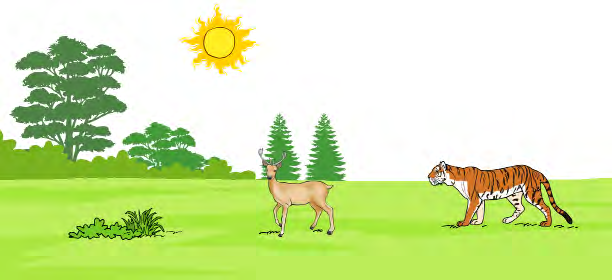
People put different animals to different uses. Cows and buffaloes are kept for milk, goats for meat, and mules and horses for carrying loads. If even one of these kinds of animals is wiped out, the others feel the loss and the environment is thrown out of order. So animals too matter greatly for the balance of the environment. All living things are counted as the biotic components, and the home, the food and the life cycle of every living thing is bound up with the environment.
Environment Friendly Behaviour
Meena is a student in grade six. At her house a cloth bag is always carried to the market, so plastic bags never come into the home at all. Old tins and plastic tubs that would have been thrown away have flowers planted in them. Waste that can rot is collected in a pit and turned into manure, while waste that cannot rot is kept separately and handed over when the collector comes. Water used for washing is poured onto the plants, so no dirty water stands and collects around the house. No pesticide is sprayed on the vegetables in the kitchen garden. A solar panel has been fitted to heat water and light the lamps, and rain water is collected in the wet season and stored. Because of all this, her home and the land around it stay clean and green.
It is from the environment that people meet their needs for food, clothing and shelter. To meet them, people keep increasing their use of natural resources. Farming, animal rearing, collecting firewood and herbs, and running industries and factories all draw on natural resources. When people use these resources far too heavily in order to satisfy their wants, the balance of the environment is damaged. That is why these natural resources must be saved from being destroyed.
Environment friendly behaviour: using the environment properly without causing it any harm or loss.
Clean air, clean water, sound land and safe food are things people simply cannot do without. Environment friendly behaviour helps keep resources such as air, water and soil in their natural state. Stopping pollution, refusing to misuse resources and protecting the environment properly are all examples of it. The practices listed below also count as environment friendly behaviour.
- (a) Do not throw waste just anywhere. Waste must be put only in the place set aside for it. Waste thrown about carelessly spreads a bad smell through the surroundings and can bring on disease. Waste dumped on the ground lowers the fertility of the soil and puts the creatures living in that soil at risk.
- (b) Sort solid waste and manage it. Solid waste should be sorted into the kind that rots and the kind that does not. Waste that rots can be collected and used to make compost manure. Waste that does not rot can be used again, or sent away to be recycled.
- (c) Protect trees and plants. Trees and plants play a large part in keeping the air and the surroundings clean. Planting saplings, raising them, weeding around them and preventing fires are the ways trees and plants can be protected.
- (d) Cut down the use of things that pollute. We should build the habit of using as little as possible of the materials that pollute, such as plastic, chemical fertiliser and pesticide. The use of chemical fertiliser and pesticide in farming should be steadily reduced, and compost manure and organic preparations should be used in their place.
Reuse and Recycling
Reuse: using the very same thing over again.
Recycling: taking old, already used materials, treating them as raw material again, and making new goods out of them.
Using old paper, newspapers, pamphlets and books to hold or wrap goods, filling an empty milk packet with soil and growing a plant in it, and cutting down a drinks bottle to serve as a flower pot are all examples of reuse. Melting down old pieces of metal and casting them into new utensils is an example of recycling.
| Reuse | Recycling |
| The thing keeps its own form | The thing is turned back into raw material |
| Can usually be done at home | Usually has to be done in a factory |
| Cutting a bottle into a flower pot | Melting metal into a new utensil |
Reuse and recycling are not the same thing. Keeping water in an old bottle is reuse, because the bottle is still a bottle. Only when that bottle is melted down and made into something new does it become recycling.
Form groups of three and walk around your own community. Make a list of the efforts being made there for environment friendly behaviour and of the activities that are harming the surroundings, then present it to the class.
The Ecosystem
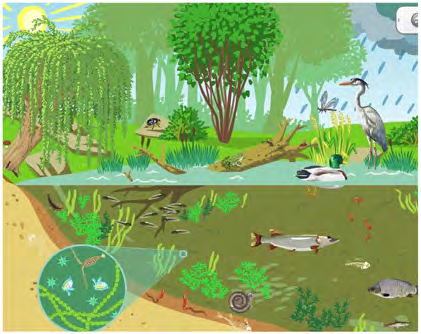
On the surface of the Earth lie stones, soil, rock, rivers, streams, ponds, lakes and seas. Air surrounds all of them. Taken together, these make up the physical world of the Earth. They keep acting upon the life cycle of the animals and plants that live here. Animals and plants draw the air, water, food and minerals they need out of this same physical setting. In this way a working relationship is set up between the living and the non-living things of the environment.
Ecosystem: the self-running system formed by the relationship between the non-living things of a place, such as air, water and soil, and the animals and plants living there.
The parts of an ecosystem can be divided into two main groups. They are the abiotic factors and the biotic factors.
Abiotic Factors
Abiotic factor: the parts of the environment that are not alive, such as air, water, soil, heat and light.
The atmosphere that lies over the whole Earth holds gases such as nitrogen, oxygen, carbon dioxide and water vapour. Water is the substance that animals and plants absolutely cannot live without. Plants draw water up from the ground and use it to make their food. Soil, in the same way, is the shelter of living things. Plants take water and the minerals they need from the soil, and soil is also the home of many animals. Soil itself is formed from rock, from minerals and from the decayed parts of animals and plants. The Sun gives living things their heat and light. So in the environment the biotic factors and the abiotic factors are closely bound to each other.
Biotic Factors and Producers
Biotic factor: the animals, plants and microorganisms of a place. They are divided into three groups according to how they obtain food: producers, consumers and decomposers.
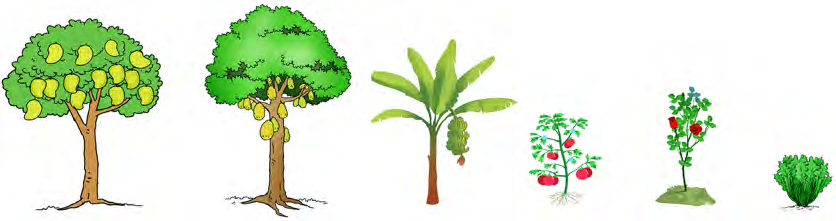
Green plants of many kinds are found on the surface of the Earth. They produce their own food themselves, and for that reason every green plant is called a producer. Paddy, wheat, maize, millet, mustard and buckwheat are producers. Mango, banana, orange, apple and pear are plants as well, so they too are producers. In the presence of sunlight these green plants make the food they need out of the air and the water around them. Because of this they are also called self-feeding organisms.
Consumers and Their Levels
Consumer: an organism that depends on other living things to get the food it needs. All animals are consumers.
We ourselves are consumers, because we live on plants and on the grain and fruit that come from them. Cattle, goats and sheep are consumers in the same way. Consumers may be plant eaters, flesh eaters or eaters of both. They are sorted into three groups: primary, secondary and tertiary consumers.
Animals that stay alive by eating producers are called primary consumers. They are plant eaters. Cattle, sheep, goats, deer and sambar all live on plants and grow on that food.

Insects and grasshoppers that feed on plants are primary consumers, while the frog that eats those insects and grasshoppers is a secondary consumer. Jackals and wolves, which live by eating primary consumers, are secondary consumers too. Some of these are flesh eaters and some eat both plants and flesh.

Animals such as the leopard, the tiger, the python and the kite, which depend on secondary consumers for their food, are called tertiary consumers. They are flesh eaters. A vulture feeds on the flesh of animals that have died. A kite lives by taking other birds and small animals. A tiger lives on deer, sambar and wild boar. From the food they take they get the energy they need, and from that same food their bodies grow and develop.

| Level | What it eats | Examples |
| Primary consumer | Producers, that is, green plants | Cow, buffalo, sheep, goat, deer |
| Secondary consumer | Primary consumers | Frog, jackal, wolf, dog |
| Tertiary consumer | Primary and secondary consumers | Tiger, leopard, kite, python |
Do not decide the level by the size of the animal. A frog is small, yet it is a secondary consumer, because it eats insects, which are primary consumers. A cow is large, yet it is a primary consumer, because it eats grass. The level is fixed by what the animal eats, not by how big it is.
Decomposers
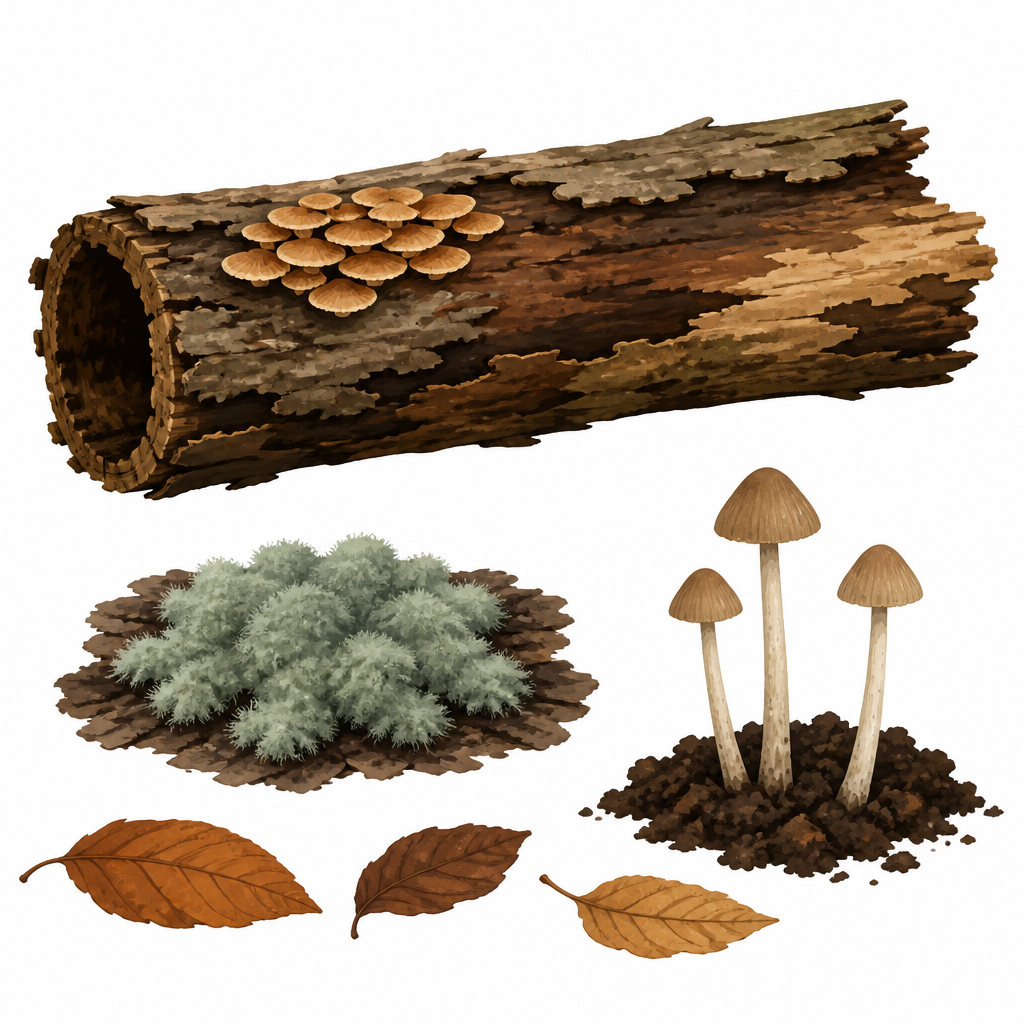
Decomposer: an organism that helps the bodies of dead animals and plants to rot, decay and dissolve into the soil.
Decomposers include microorganisms such as bacteria and fungi. A decomposer uses its enzymes to dissolve the matter it settles on. Some of that it uses as its own food, and most of the rest mixes into the soil. Plants then use the minerals formed in the soil to make their food. In this way a settled relationship is built up between producers, consumers and decomposers. Without decomposers, dead bodies would simply pile up and the soil would never get the nourishment it needs to raise new plants.
Visit a pond, a lake, a field, a meadow or a garden near where you live. Observe which producers, consumers and decomposers you can find there, and write down what you see.
Interrelationship among Plants, Animals and Microorganisms
Green plants are self feeding, because they make their own food. That is why plants are called producers. Animals get their food from plants, so animals are consumers. Plant eating animals such as the cow, goat, sheep, rabbit, deer and sambar are first level consumers. Animals such as the dog, cat, jackal and frog get their food from those first level consumers, and they are called secondary consumers. Animals such as the tiger, leopard, lion, kite, vulture and python get their food from both the first and the second level, and they are called tertiary consumers. These are flesh eaters.
Microorganisms such as bacteria rot and decay the bodies of dead plants and animals, and they are called decomposers. The organic matter that goes into the soil as bodies rot is then used by plants to grow and spread. Between animals and plants there is a constant exchange of carbon dioxide and oxygen. Microorganisms too take in oxygen and give out carbon dioxide when they breathe. In this way a deep relationship between producers, consumers and decomposers is kept going in the environment without a break.
Take a study walk to a meadow, garden, field or forest near your home or school and list the producers, consumers and decomposers found there. Then show the relationship between them on a chart.
Types of Ecosystem
Ecosystems differ from place to place. For that reason they are divided into two main kinds, aquatic and terrestrial.
Aquatic ecosystem: an ecosystem that exists in water. These differ from one another according to the condition of the water source.
Terrestrial ecosystem: an ecosystem that exists on land. Deserts, meadows and forests differ in their conditions, and so the abiotic and biotic factors found in each of them differ too.
The surface of the land is not the same everywhere. Because conditions on the ground vary, the surface itself varies from place to place. In every one of these places a relationship between the biotic and abiotic factors is at work. The grassland and the forest are two examples of such systems.
| Aquatic ecosystem | Terrestrial ecosystem |
| Exists in water | Exists on land |
| Ponds, rivers, the sea | Grassland, desert, forest |
| Algae, water plants, fish | Trees, grass, deer, tiger |
The Forest Ecosystem
Forest ecosystem: the system formed by the relationship between the biotic and abiotic factors present in a forest.
In a forest the abiotic factors are the air, water, soil, rock, minerals, light, heat and moisture. The slope of the ground, how damp it is and its texture all have an effect on the ecosystem as well.
The plants and animals found in a forest are its biotic factors. The grasses, the shrubs and the tall trees are all producers. They draw carbon dioxide from the atmosphere to make their food and release oxygen. On one side these plants supply food to the consumers, and on the other they bring the atmosphere into balance. Insects and grasshoppers, and larger animals such as the deer, sambar, rabbit, elephant and rhinoceros, are first level consumers. Jackals and wolves, which live by eating those first level consumers, are secondary consumers. Leopards and tigers, which live by eating both the first and the second level, are tertiary consumers. When all these creatures die, the decomposers that rot their bodies into the soil, such as bacteria and fungi, are found in that same forest. Once the rotted matter has mixed into the soil, the plants absorb it once more and use it to make their food. By this repeating cycle the ecosystem of the forest stays in balance.
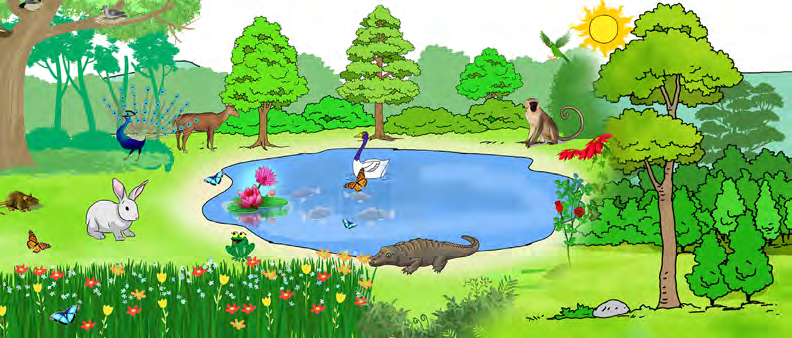
The ecosystem matters greatly for keeping living things on Earth in balance. It is what gives plants and animals of every kind a basis on which to live. The oxygen people breathe and the herbs they use also come from it. For the balance of the environment as a whole, its importance is very great.
The full lesson is waiting for you
The notes are free to read in full. A free account opens the rest of the practice, and tracks your progress and confidence score for every subject. Presentations and videos need approval from Learn Yeti.