The Living Things Around Us
Many kinds of animals and plants live around us. Some hide inside the soil, some swim in water, some fly in the sky and some walk across a wall upside down. Their size, their shape and the build of their bodies are all different. To study so many living things without getting lost, we sort them into groups according to their body structure, the place they live in and the food they eat. Every living thing carries its own special features and body build, and those features let it grow, find food and stay safe in the place where it lives.
Adaptation of Organisms
Different living things live in different surroundings. The build of an animal's body matches the place where it has to survive. A fish lives in water, a mouse lives in a burrow and birds fly in the sky. Each of them has special body parts for that kind of life, and it is those parts that let the animal fit into its surroundings and stay alive there.
Adaptation is the ability of a living thing to fit in with its surroundings and live there. The special features that develop in a living thing so that it can adjust to its surroundings are called adaptive characteristics.
Living things meet all their needs from their surroundings. For that, a suitable body build, suitable processes inside the body and suitable features have developed in them. Put an earthworm on soil that is sunlit at one end and damp and shaded at the other, and it will crawl towards the damp shade every time. That damp place is what suits its soft, moist body. In the same way every living thing chooses the place that suits it, and carries the body build that lets it live there.
Look at the living things near your own home. Note down where each one is found and what feature its body has, in a table like the one below.
| Name of the living thing | Place where it is found | Feature |
| Earthworm | Damp soil | Soft, long body |
| Butterfly | A garden in flower | Light wings and a thin mouth for sucking nectar |
| Fish | Water | Boat shaped body and gills |
| House lizard | Walls of a house | Hooks on its feet |
Look carefully at how an animal is built and you can guess where it lives. Body build and living place always match each other.
Adaptive Characteristics of Animals That Live on Land
Animals that live on land are built in many different ways. An animal that runs fast and hunts has broad paws and strong claws. The paws of a dog, a cat, a tiger and a bear are built so that the animal can grip its prey and run after it. Animals that can run a long way have long, sturdy legs. Strong muscles are what let land animals walk and run.
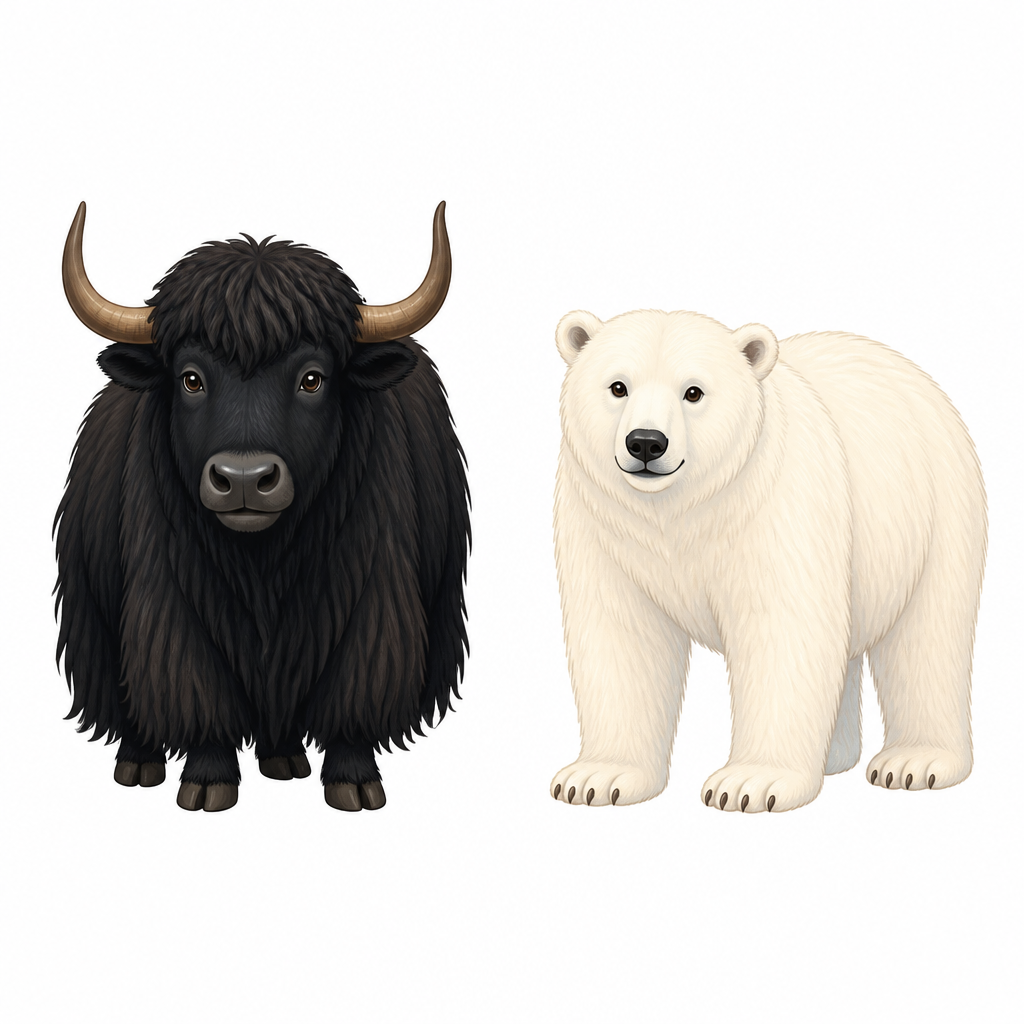
Animals of cold and high mountain places have thick hair or fur on the body. This keeps the body warm and protects it from the cold. Yaks, chauri cattle and polar bears all have thick hair. Animals of hot places, on the other hand, have thin hair so that heat can leave the body.
Animals of the desert have thick, dry skin, so very little water is lost from the body. A camel has a hump on its back where a fatty substance is stored, and the camel gets energy from that store even when it goes without food for a long time. A camel can also drink a great deal of water at one go. Its whole body is built to waste as little water as possible.
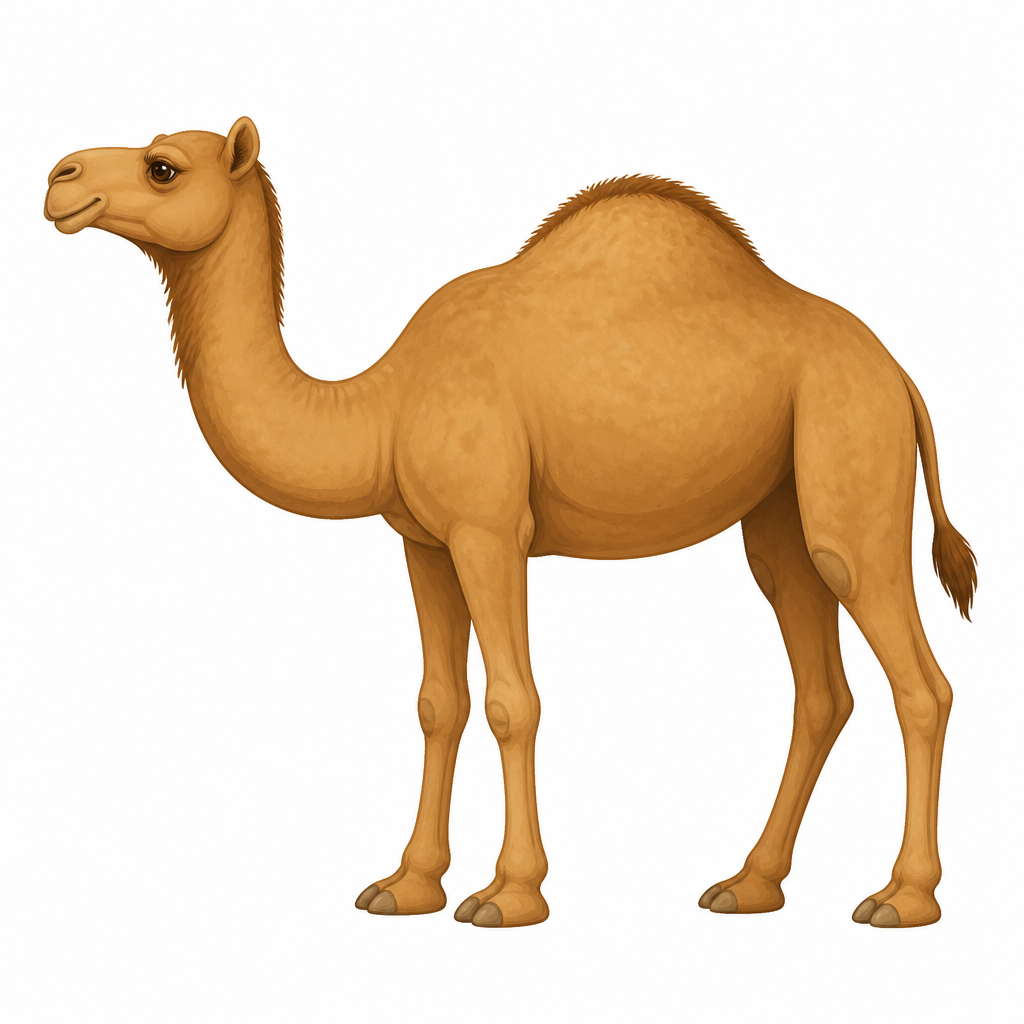
Many students think a camel's hump is full of water. It is not. The hump stores a fatty substance, and it is the camel's thick, dry skin that keeps water from being lost.
Some animals climb trees. Their chest muscles are strong. The fingers and toes of a monkey are shaped so that they can grip a branch tightly. The feet of a house lizard are covered with a thick pad carrying many tiny hooks. These hooks create a suction pressure, and that is how the lizard walks on walls and even along the ceiling. It also leaves its tail behind to escape from an enemy.
| Name of the animal | Adaptive characteristic |
| Sheep, chauri cattle | Thick woolly hair |
| Tiger, leopard | Broad paws and sharp claws |
| Camel | Hump and thick dry skin |
| Monkey | Fingers that can grip a branch |
| House lizard | Hooks on the feet |
Beaks, Wings and Burrows
The light bones and the wings of a bird are what let it fly. Their beaks come in many shapes, each shape suited to a different job. Some beaks are right for picking up grain, some for catching insects and some for eating fruit. A woodpecker has a long, strong beak. A duck has a flat, wide beak that can scoop food out of mud. An eagle has very sharp eyes, so it can spot a small animal far below while it is still high in the air.
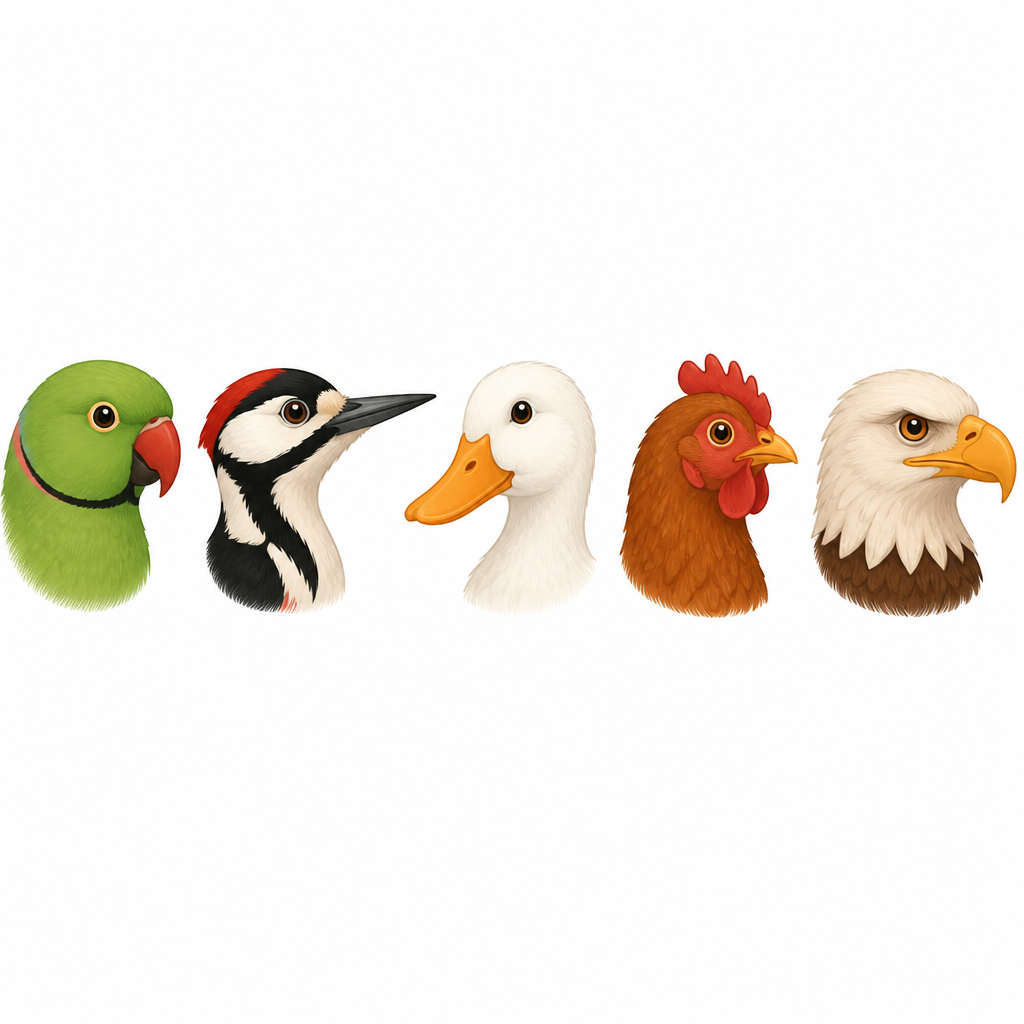
| Name of the bird | Body part | Work it does |
| Hen | Beak | Picks up grains |
| Dove | Wings | Help it to fly |
| Eagle | Sharp eyes | Spot prey from far away |
| Crow | Sharp beak | Tears both flesh and fruit |
| Duck | Flat broad beak | Picks food out of mud |
| Woodpecker | Long strong beak | Drills bark to get insects |
Some animals live in burrows. A few of them dig their own, while others simply move into a burrow that another animal has dug. Mice and rabbits dig their own. Their snouts are pointed and strong and the claws on their feet are sharp, which makes digging the soil easy. A snake does not dig at all. It lives in a burrow made by some other animal.
Adaptive Characteristics of Animals That Live in Water
The body of an animal that lives in water is boat shaped, or streamlined. That shape makes swimming easy. Its outer surface is smooth and slippery. Fins help it to swim and to turn. Many water animals breathe through gills. The temperature of their body rises and falls along with the water around them. Their bodies are covered with scales. Most of them have no lungs at all, though a crocodile and a dolphin do have lungs.
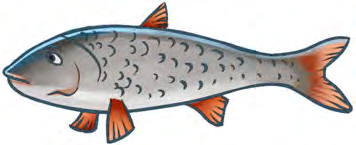
| Adaptive characteristic of a fish | Work it does |
| Streamlined body | Makes swimming easy |
| Slippery scales on the body | Cut down rubbing against water and protect the skin |
| Fins | Help it to turn and to keep balance |
| Gills | Let it breathe the air dissolved in water |
Adaptive Characteristics of Plants That Grow on Land
Just as animals do, plants also grow in two places. Some grow on land and some in water. The size and shape of a plant depend on where it grows. The roots of a plant that grows on land are far better developed than the roots of a water plant, and its stem is hard and strong enough to hold up the whole tree.
Plants of hot places are tall and have hard stems, and their leaves are gathered in a bunch near the top. Mango, coconut and rubber plants grow like this.
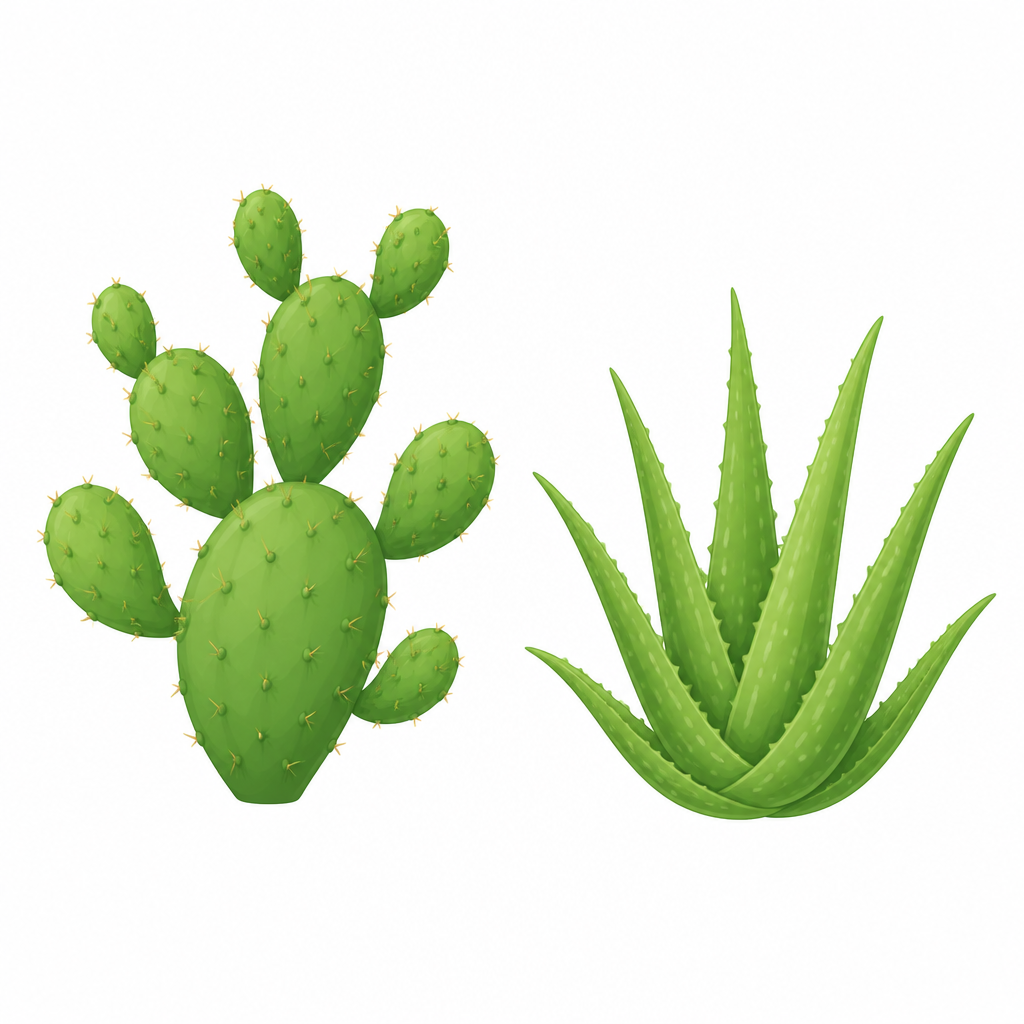
Plants of dry places have thick bark. Their leaves are thick and small, and their stems are thick and green. Their roots reach far down into the soil. These plants can store water inside themselves. In some of them the leaves have turned into thorns. Cactus and aloe vera are plants of this kind.
Where little sunlight falls, only small plants grow. Plants that never bear flowers do well in such places. Ferns and mosses are examples.
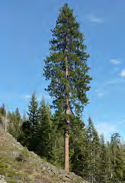
In the high mountains and in places where snow falls, the leaves of plants are narrow and pointed like needles, and the whole tree has a cone shape. Pine and juniper are trees of this kind. Because of that shape, snow slides straight off the branches instead of piling up on them.
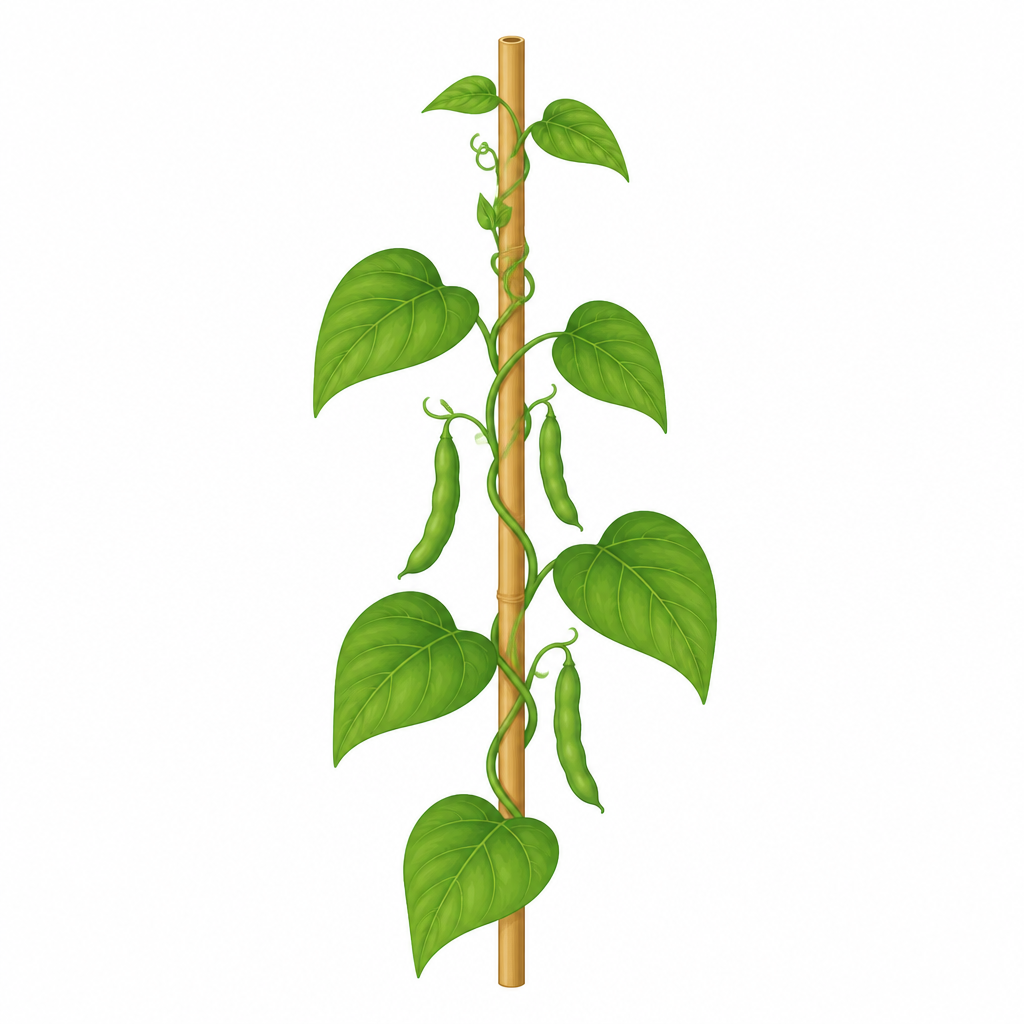
Some plants have creeping stems. With the help of these stems and of tendrils, they wind around another plant or around a pole and climb right to the top. Beans, cucumber and sponge gourd climb like this. In this way they reach the sunlight without having to build a strong stem of their own.
Adaptive Characteristics of Plants That Grow in Water
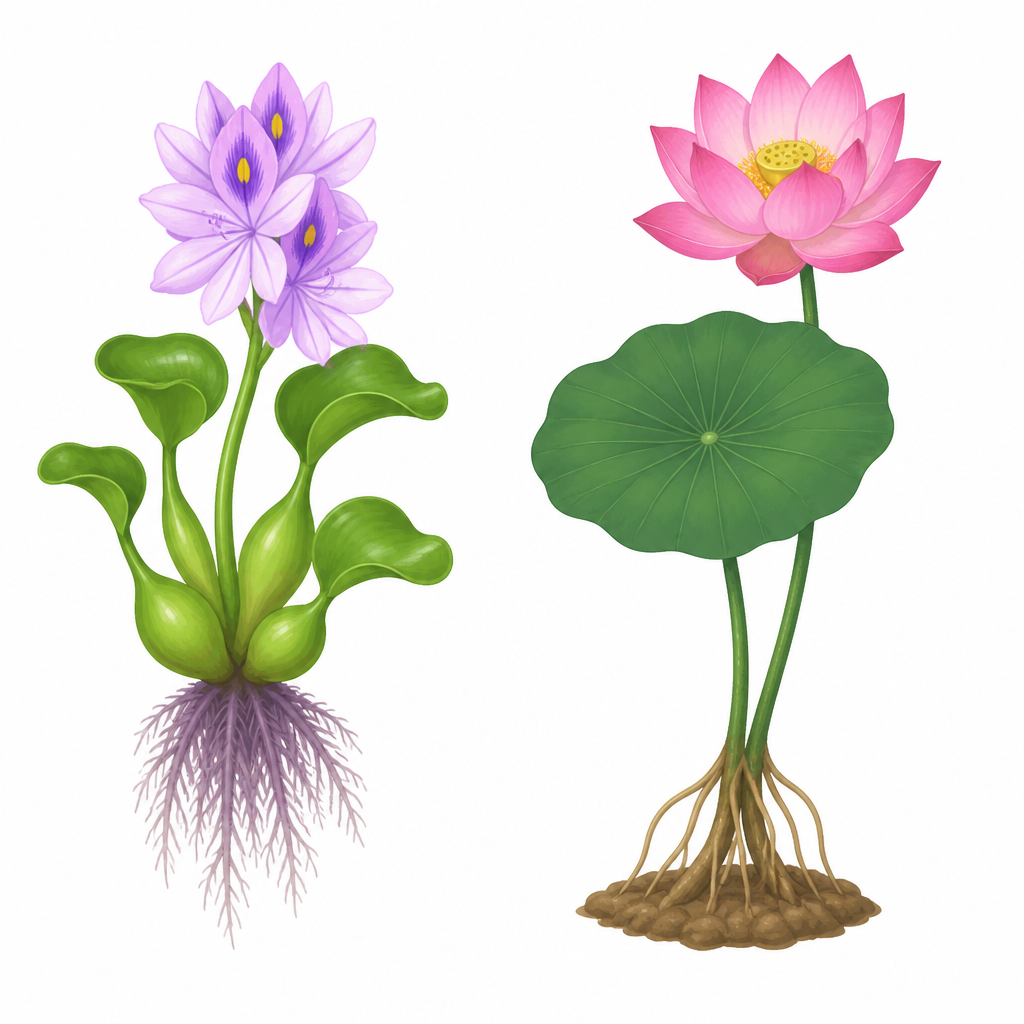
Water plants such as algae have hardly any developed roots. Some float on the surface and others stay under the water. The floating ones may carry light, feathery roots that hang down in the water. Their stems are soft, and because they are soft they bend with the current instead of snapping when the water flows. A water hyacinth floats because the part of its stalk below the leaf is hollow and full of air. A lotus has a large leaf that floats on the surface, but its roots are fixed in the mud at the bottom. Plants that stay under the water have small leaves. So the roots, the stem and the leaves differ from one water plant to another.
A land plant has a hard stem because it must hold up its own weight. A water plant has a soft stem because the water itself holds it up.
Grouping Animals by the Food They Eat
Every living thing needs energy to stay alive, and that is why it eats. Food is digested inside the body and energy is released from it. With that energy the animal runs all its life processes. Animals get their food from different sources and in different ways, and so the body parts they use for eating are built differently too. On the basis of how they take their food, animals are divided into three main groups.
Herbivores are animals that live by eating plants, grain and fruit. Cows, buffaloes, deer, rhinoceros and elephants are herbivores.
Carnivores are animals that live by eating the flesh of other animals. Tigers, leopards, vultures and eagles are carnivores.
Omnivores are animals that live by eating both animals and plants. Bears, human beings and dogs are omnivores.
The mouth and the digestive system of these three groups are built differently too. A herbivore has flat grinding teeth for chewing grain and pulses, and a long digestive tube inside its body. A tiger and a leopard have long, sharp canine teeth in the mouth and strong, sharp claws on the feet, and these parts make it easy to catch other animals. An eagle grips small animals with the claws on its feet, carries them off and tears the flesh with its sharp beak. A vulture also tears the flesh of dead animals with its long beak. A carnivore's digestive tube is shorter than a herbivore's. An omnivore has teeth of both kinds, useful for chewing grain and pulses as well as for eating meat.
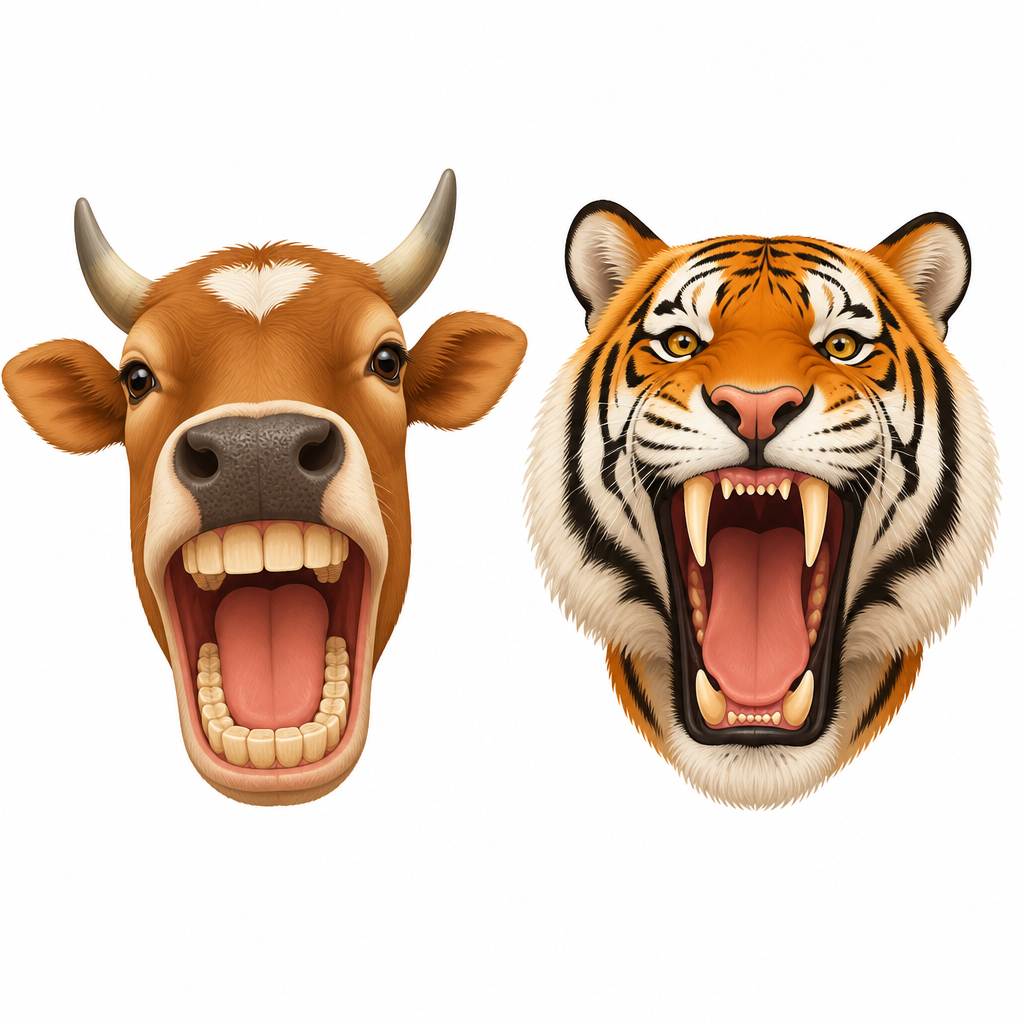
Herbivores: grinding teeth, a long digestive tube, and food taken only from plants. Cow, rabbit, elephant.
Carnivores: sharp canines and claws, a short digestive tube, and food taken only from other animals. Tiger, leopard, vulture.
Omnivores: teeth of both kinds, and food taken from animals as well as plants. Bear, dog, human being.
Animals That Have a Backbone
Put a human being, a cow, a pigeon, a fish, a frog and a snake side by side. All six share one thing inside the body, and that is a backbone. Animals that have a backbone in the body are called vertebrates. The backbone carries the weight of the whole body. Some of these animals live on land, some in water and some in both.
Vertebrates are animals that have a backbone in the body. Human beings, monkeys, cows, buffaloes, hens, birds, fish, frogs and snakes are all vertebrates.
Cold Blooded and Warm Blooded Animals
Vertebrates are further divided into two groups, according to whether the temperature of the body changes with the surroundings or stays the same. This is also the answer to a question you may have asked in winter: where do snakes, lizards and frogs go?
A cold blooded animal is one whose body temperature keeps changing along with the surroundings. Fish, frogs, lizards, tortoises, crocodiles, snakes and house lizards are cold blooded animals.
Hibernation is the long sleep that some cold blooded animals go into during the winter months in order to escape the cold.
A warm blooded animal is one whose body temperature does not change with the surroundings but stays steady. Human beings, cows, buffaloes, tigers, rhinoceroses and all kinds of birds belong to this group.
The body temperature of a warm blooded animal stays the same all the time. For a healthy human being it is always:
\[ 37^\circ\text{C} = 98.6^\circ\text{F} \]
Cold blooded does not mean the blood is always cold. A lizard sitting in the sun has a warm body. The name only means that the body temperature rises and falls along with the surroundings.
The Five Classes of Vertebrates
Vertebrates are divided into five classes according to the way their bodies are built and the features they carry. The five are pisces, amphibia, reptilia, aves and mammalia.
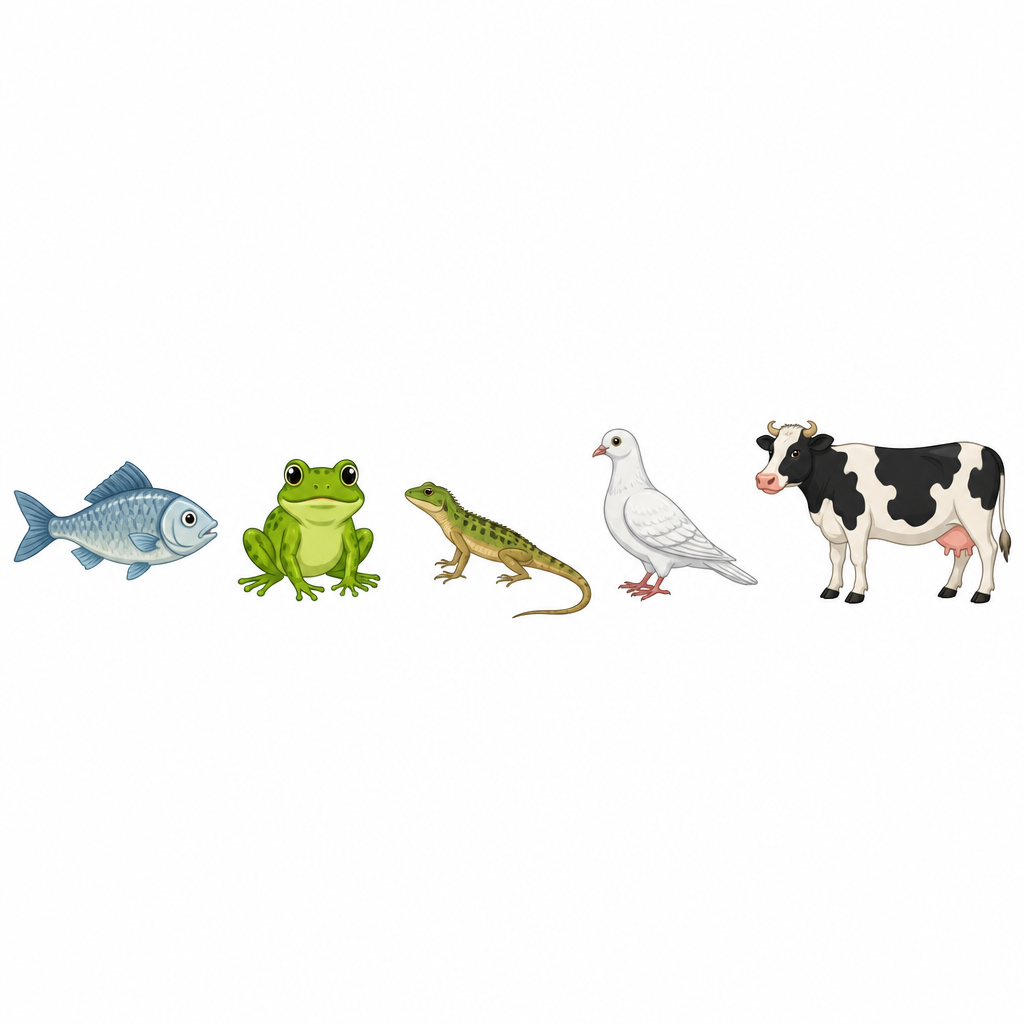
All kinds of fish belong to the class pisces. Their bodies are flat, long and covered with scales. They swim with the help of fins. On both sides of the head there are gills for breathing. Their hearts have two chambers. Fertilisation takes place outside the body and the eggs are laid in water. Asala, rohu and the sea horse are examples.
Animals of the class amphibia can live both in water and on land, and that is where the name comes from. Their life begins in water. Their skin is moist and slippery, their hearts have three chambers and they have four limbs. As tadpoles they breathe through gills, and once grown they breathe through the skin while in water and through lungs while on land. The frog, the salamander and the paha frog are examples.
Animals of the class reptilia usually crawl. Most of them live on land, though a few live in water. Their skin is dry and covered with hard scales. In most of them the heart has three chambers. They breathe through lungs and lay their eggs on land. Snakes, crocodiles, tortoises, garden lizards and house lizards are examples.
All birds belong to the class aves. Their bodies are covered with feathers. They have one pair of wings, one pair of legs and one beak. They breathe through lungs, their hearts have four chambers, and their bones are light and hollow. They lay eggs, and fertilisation takes place inside the body. The front limbs of a bird have been changed into wings. Pigeons, ducks, hens, the danphe, peacocks and crows are examples.
The most highly developed animals belong to the class mammalia. Most mammals live on land, though some live in water and some fly. Whales and dolphins live in water, while the bat flies in the air. Their bodies are covered with hair. They give birth to young ones and feed them on milk. They breathe through lungs, their hearts have four chambers, and most of them have a pair of ears outside the head. Human beings, bats, whales, cows and buffaloes are examples.
| Class | Body covering | Breathing organ | Chambers in the heart | Examples |
| Pisces | Scales | Gills | Two | Asala, rohu, sea horse |
| Amphibia | Moist slippery skin | Gills, skin and lungs | Three | Frog, salamander, paha frog |
| Reptilia | Dry hard scales | Lungs | Three | Snake, crocodile, tortoise, lizard |
| Aves | Feathers | Lungs | Four | Pigeon, duck, hen, danphe |
| Mammalia | Hair | Lungs | Four | Human being, bat, whale, cow |
Plants That Never Bear Flowers
Very many kinds of plants grow on the earth. Some are extremely small and some are huge trees. A few of them can be seen only through a microscope. Some plants bear flowers and some never do.
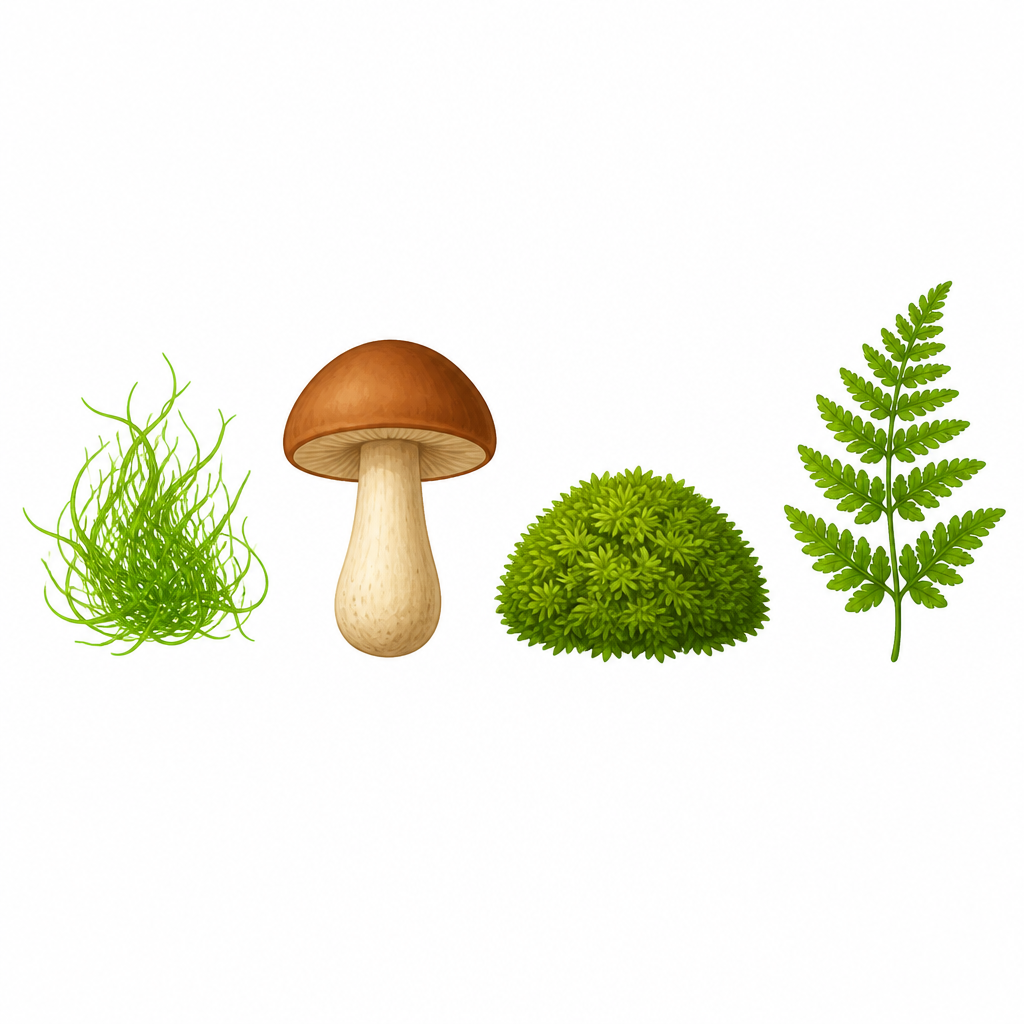
Cryptogams are plants that never bear flowers at any time in their life. They are the less developed plants.
Algae are simple plants that contain chlorophyll but in which root, stem and leaf cannot be told apart. They can make their own food and are found in water and in damp places. Spirogyra and chlamydomonas are examples.
Fungi are simple living things without chlorophyll in which root, stem and leaf cannot be told apart. They cannot make their own food. Mushroom, yeast and mucor are examples of fungi.
Never taste or eat a mushroom or a mould that has grown on its own in a forest, a field or a wall. Many of them are poisonous. Wash your hands well with soap and water after you have looked at them.
Bryophyta is the group of green plants that grow on damp ground and hold on to it with fine hair like threads called rhizoids. Moss and marchantia are bryophytes.
The fern, which grows in cold damp places, belongs to the group pteridophyta. Root, stem and leaf can be told apart in a fern, but it never bears a flower. The young curled shoot of a fern is the one we eat as a vegetable.
Plants That Bear Flowers
The flower is the finest and most attractive part of a plant. Seeds are formed from the flower, and new plants grow from those seeds. Plants of this kind are called phanerogams. In them the root, the stem, the leaf and the flower are all well developed.
In some flowering plants no true fruit is formed and the seeds lie naked. Their leaves are like needles. Such plants belong to the group gymnosperm. Pine, cycas and juniper are examples. Plants that bear a true flower and a true fruit belong to the group angiosperm.
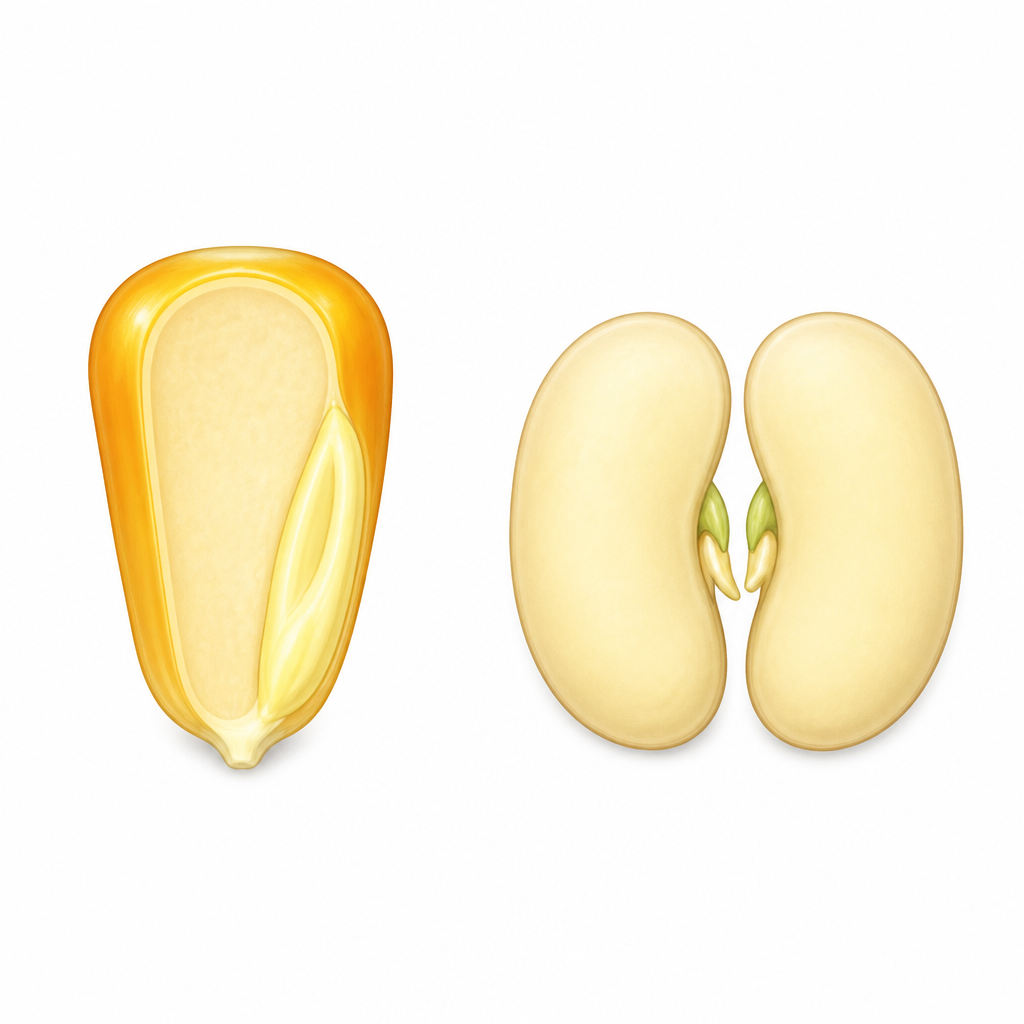
Most flowering plants have seeds. In some plants the seed has only one cotyledon, and such a plant is called monocotyledonous. Its leaves are long and its roots grow in a bunch. Rice, wheat, maize, bamboo and onion are like this. In other plants the seed has two cotyledons, and such a plant is called dicotyledonous. Its leaves are broad and it has one main root going down. Mustard, gram, peas, beans, apple and orange are like this.
| Non-flowering plants | Flowering plants |
| They are less developed. | They are well developed. |
| In some of them root, stem and leaf cannot be told apart, as in algae. | Root, stem, leaf and flower are all developed in them. |
| Some have chlorophyll and some do not, as in mushroom and mould. | All of them have chlorophyll, as in mustard, gram and peas. |
You do not have to wait for a flower to decide what kind of plant you are holding. Whether the root, the stem and the leaf can be told apart already tells you a great deal.
The full lesson is waiting for you
The notes are free to read in full. A free account opens the rest of the practice, and tracks your progress and confidence score for every subject. Presentations and videos need approval from Learn Yeti.