What Soil Is Made Of
Most of the land on the earth is covered by a layer of soil. Soil is an important natural resource, because plants grow in it and countless small living things make their home in it. Soil is not one single substance. It is made when pieces of rock and mineral mix together with organic matter.
To see for yourself what soil is like, collect two samples of soil from two different places near your home or school. Look at them closely with a hand lens if you have one, fill in the table below, and then talk over your findings with your friends.
| Sample | What is in the soil? | How big are the particles? | What colour is it? | Is it damp or dry? |
| Sample 1 | ... | ... | ... | .... |
| Sample 2 | ... | ... | ... | .... |
The rock in soil is present as dust, sand or small stones. When living things die, what is left of them mixes into the soil, and the material formed in this way is called organic matter. Compost manure is a good example of organic matter. Many kinds of germs, fungi, earthworms and insects work together to turn dead remains into organic matter.
Humus: the organic matter formed when the parts of plants rot and break down is called humus. Soil that has plenty of humus is fertile soil.
Soil also holds water and air. The tiny creatures that live in soil survive only because of that air and water. Even soil that looks dry has air trapped between its particles, and you can check this easily. Take some dry soil, half fill a beaker with water and drop the soil in. Bubbles of air rise up through the water. That is proof that there was air inside the soil.
You can test for water in the same way. Put a handful of soil in a beaker, cover the beaker with a watch glass and heat it for a short while. Now let it cool for a few minutes. Drops of water appear on the inside of the watch glass. Those drops are the water that was inside the soil, which turned to vapour on heating and settled again on the cool glass.
Do not hold the hot beaker or the hot watch glass with your bare hands. Use tongs or a thick cloth, and never point the mouth of the beaker towards yourself or towards a friend.
Soil comes in different kinds according to what is in it and how much of each is there. Soil rich in humus is fertile, and crops grow well in it. Sandy soil, on the other hand, has a large amount of sand in it, so it cannot hold water for long.
How Soil Is Formed
Take two pieces of stone and rub them hard against each other, then look at what collects on your hand. The fine powder that comes off the surface of the stone is the very first step in the making of soil. Large rocks break down in just this way, little by little, over a very long time.
Weathering: the process by which the rocks and minerals on the earth's surface are broken into smaller pieces is called weathering. Weathering is caused mainly by air, water and climate.
Soil begins to form when rock is weathered. On the ground, soil is made through the following processes.
- (a) Rivers, streams and waterfalls carry big stones down from the hills. As they are carried along in the water, the stones knock against one another and break. This goes on for a very long time and produces small particles and gravel, and from these the soil is made.
- (b) The heat of the day and the cold of the night make rocks warm up and cool down again and again. When this goes on for many years the rock cracks and breaks into small pieces, and those pieces become soil.
- (c) Water that seeps into the pores and holes of a rock also helps to break the rock apart, and soil is formed.
- (d) Plants that take root in the crack of a rock slowly weaken the rock, and the rock begins to break up. In this way the broken rock helps to make soil.
- (e) When a strong wind blows, it wears away the surface of the rock. Particles like sand come off it and turn into soil.
The Soil Profile
Collect a sample of soil from any one place. Half fill a clear glass jar with water and pour the soil into it. Shake the jar for a while so the soil mixes well with the water, then stand it still and do not disturb it. After some time you will see the soil has separated into layers. The heavy gravel settles at the very bottom, sand rests above it, then silt, then the water, and the light humus floats at the top.
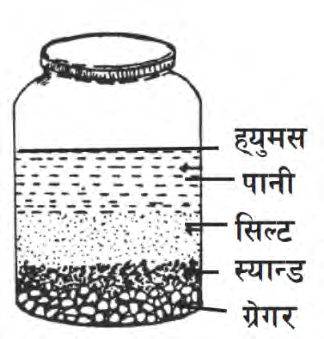
Under the ground the soil is arranged in layers in the same way. Organic matter gathers in the soil, dissolves in water and slowly moves downwards. As it moves down, different layers develop one below the other.
Soil profile: a vertical section of the ground, running from the surface down into the deeper layers, in which all the different layers of soil can be seen, is called the soil profile of that place.
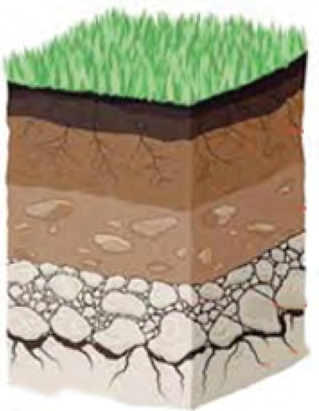
In a soil profile each layer differs from the others in its texture, its colour, its depth and its chemical make up. The main layers of soil are these.
- 1. The first layer, called topsoil or the A horizon. This is the uppermost layer of the soil profile. The soil here is usually dark in colour. It is made of manure, water, air and minerals. The manure in this layer keeps the soil loose and raises its power to hold water. This layer is the useful one for the growth and development of plants.
- 2. The second layer, called subsoil or the B horizon. There is less manure in this layer but more minerals. Water soaking down from the first layer carries minerals into it. This layer is usually well packed and hard.
- 3. The third layer, called the C horizon. This layer has no manure in it. Small chips of rock are mixed through it. It is made mainly from the parent rock, and below it lies a layer of hard bedrock.
Erosion and Deposition
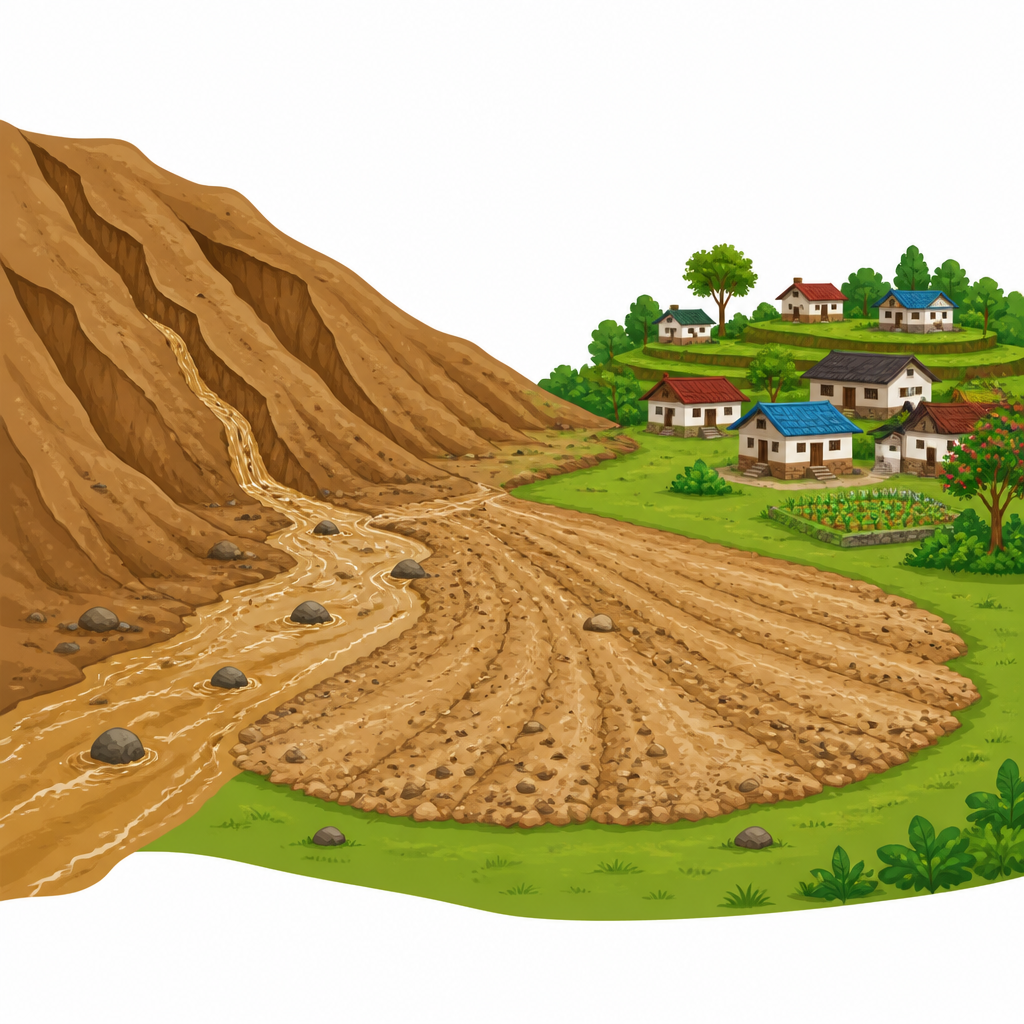
Look around you. In one place you will see soil that has been blown away, washed away or has slipped down, and somewhere else you will see soil piled up. These two things are two halves of the same story.
Erosion: the wearing away or breaking down and carrying off of the surface of the land is called erosion.
Deposition: the process in which soil from one place is carried away and piled up in another place is called deposition.
Land slipping downhill in a landslide, water washing the surface of the ground away, and wind lifting soil from one place and dropping it in another are all examples of erosion. The force of the wind or of running water carries the soil off and piles it up somewhere else. Erosion and deposition are two natural processes that always happen together. Erosion happens most of all in places with sandy soil and on open ground where there are no plants.
Conservation of Soil
In our country the floods of the rainy season and the landslides in the hills cause erosion every year. A fast wind also causes erosion. The work of reducing or stopping this erosion is called conservation of soil. The following measures can be used to conserve soil.
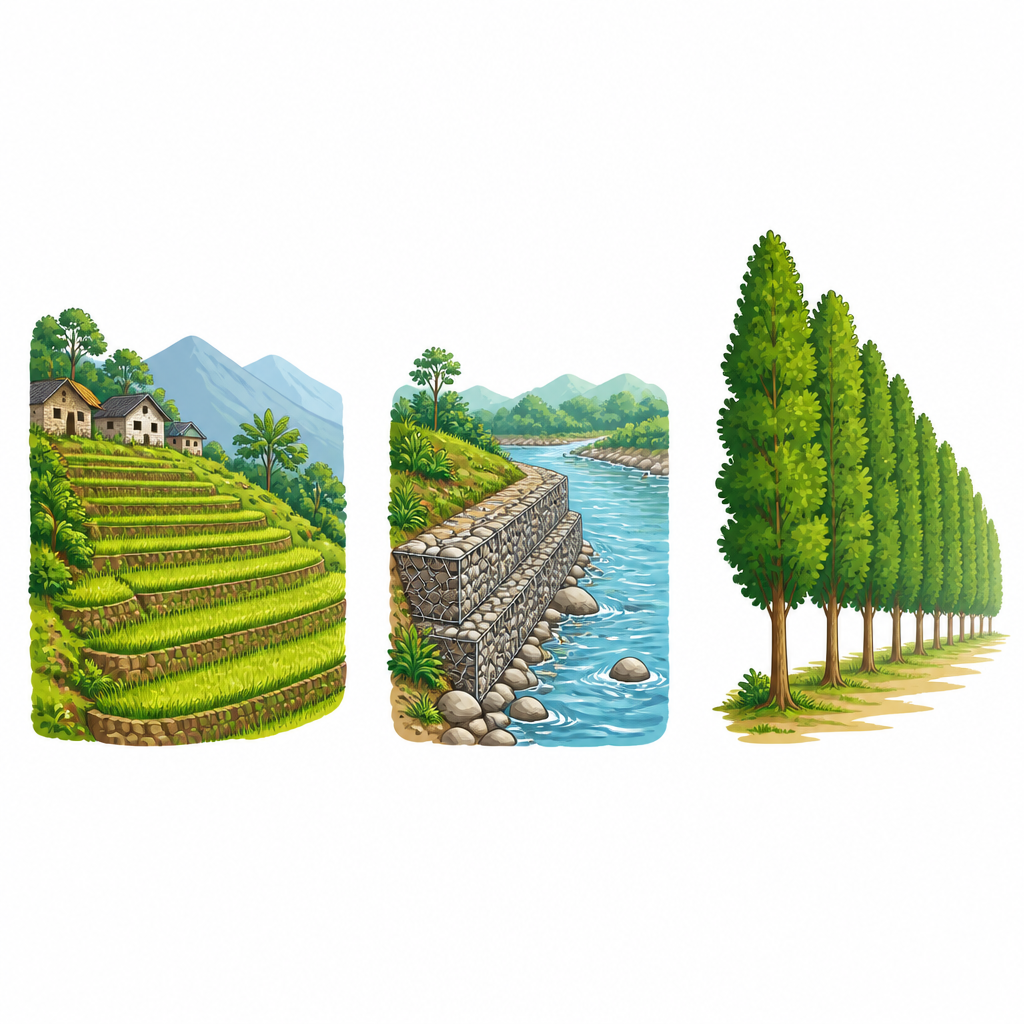
- 1. To stop the erosion caused by a river cutting into its bank, a strong embankment should be built on the land beside the river.
- 2. To stop erosion caused by wind, trees should be planted in a line so that they block the strong wind.
- 3. The roots of plants hold the soil firmly in place. So trees should be planted on bare hills to keep landslides from happening.
- 4. Clearing forest and cutting trees carelessly leaves the soil loose. That raises the chance of erosion, so such work should not be done.
- 5. To reduce the erosion caused by farming on sloping land, the land should be cut into level terraces and farmed step by step.
To understand why and where erosion happens, look at the land around your own home and fill in a table like the one below. Talk in class about the good and the bad sides of deposition as well.
| Cause of erosion | Likely place | Effect it has | Way to prevent it |
| Landslide | Steep hill areas | Soil and crops are swept away | Planting trees and building terraces |
| River cutting its bank | Land beside a river | Fields fall into the river | Building a strong embankment |
| Strong wind | Open land with no plants | The fertile top layer blows off | Planting trees as a wind break |
Soil Pollution
People use many kinds of chemicals on the soil to get a bigger harvest. In everyday life they also let plastics, harmful metals and the chemicals that come out of factories mix into the soil. All of this spoils the quality of the soil.
Soil pollution: the spoiling of the quality of soil when unnecessary chemicals or other substances from outside get mixed into it is called soil pollution.
Look at the soil around you. What kind of waste has been mixed into it, waste that rots or waste that does not? Has cow dung or compost been put on it, or chemical fertiliser? Observing these things will show you where soil pollution comes from. The main cause of soil pollution is human activity itself.
- 1. People use too much chemical fertiliser and pesticide to raise the yield from the soil. These chemicals kill the useful micro organisms found in the soil and leave the soil dry. Eating the crops grown in this way also affects human health. So it is better to cut down the use of chemical fertiliser and pesticide and to use more organic manure and organic pest control instead.
- 2. Throwing factory waste onto the soil lowers its quality. It also harms the creatures that live in the soil. So waste and chemicals from a factory must be made harmless before they are allowed to mix with the soil.
- 3. Throwing polythene bags and other plastics onto the soil kills the creatures living there. Plants cannot sprout and grow properly in such places. That is why the use of polythene bags and other plastic goods should be reduced.
The grain, the vegetables and the fruit we eat all grow in soil. So saving the soil is the same as saving our own food.
The Earth
Where are our houses, cattle sheds, schools, playgrounds, roads and canals built? Where do the plants that give us grain, vegetables and fruit grow? All of these are on the surface of the earth. The earth is the shared home of us all. Its shape is spherical, but it is not perfectly round like a football. It bulges out around the equator and is flattened at the poles.
Lithosphere: the land part of the earth
Hydrosphere: the water part of the earth
Atmosphere: the blanket of air that surrounds the surface of the earth on every side
The Internal Structure of the Earth
Take a boiled egg and cut it into two halves without peeling off the outer shell. You will see three different parts inside: the thin shell on the outside, the white part within it, and the yellow yolk at the centre. The earth is built in much the same way. The lava that pours out of a volcano proves that although the outside of the earth looks hard and cold, the inside of it is hot and molten.
On the outside of the earth we see hills, plains, seas and solid rock, but inside there are molten rock and metals. According to the state and the make up of that rock, the inside of the earth is divided into three layers.
- (a) Crust
- (b) Mantle
- (c) Core
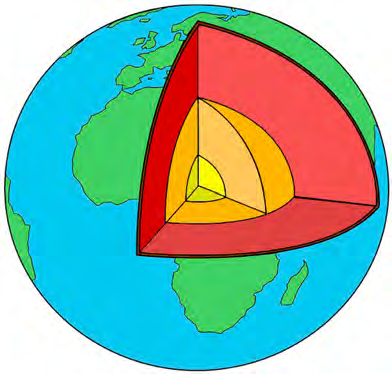
Just as the shell is the outermost part of the egg, the outermost part of the earth is called the crust. It reaches down to about 50 km below the surface. The crust is made of soil and rock, and the minerals in it are mainly silicates. The water that lies under the ground is also held in this layer. It is on top of the crust that we build houses, farm the land, plant trees and make roads. Rivers, seas, forests and hills all sit on the surface of this layer, and the mines of rock, metal, coal and oil are in this part of the earth.
Just as the white lies under the shell, the part of the earth lying below the crust is called the mantle. It is about 2900 km thick, and its temperature can be anywhere from 750 to 2500 degrees Celsius. This part is made of hard silicate, iron and minerals such as magnesium. The rock of this layer is 2 to 3 times denser than the rock of the crust.
The core of the earth can be compared with the yolk of the egg. The core is the innermost part, and it is divided into two. The outer part of it is called the outer core. It is about 2100 km thick and its temperature is about 2500 to 3000 degrees Celsius. Heavy metals such as iron, cobalt and nickel, along with rock, are found here in a molten state.
The innermost part of the earth is called the inner core. It is about 1300 km thick and its temperature is about 3000 to 5000 degrees Celsius. The rock here is up to six times heavier than the rock of the outer core. Because the pressure in the inner core is so enormous, even molten material is squeezed together and stays solid.
| Layer | Thickness | Temperature | State | Materials found |
| Crust | Down to 50 km | Lowest | Solid | Soil, rock, silicate minerals |
| Mantle | About 2900 km | 750 to 2500 °C | Hard, partly molten | Silicate, iron, magnesium |
| Outer core | About 2100 km | 2500 to 3000 °C | Molten | Iron, cobalt, nickel |
| Inner core | About 1300 km | 3000 to 5000 °C | Solid | Very heavy metals and rock |
The Earth in the Solar System
Draw an elliptical loop on a table or on the ground. Put a cricket ball in the middle of that loop. Now roll a marble all the way round the loop. Is the distance between the marble and the cricket ball always the same? Watch carefully to see at which positions it is equal. The earth travels round the sun in just this way, so at times it is nearer the sun and at times it is farther away.
Axis: the imaginary line that passes through the centre of the earth and joins the north pole to the south pole is called the axis.
Orbit: the path along which the earth travels round the sun is called its orbit.
Rotation and revolution are easily mixed up. Rotation is the earth turning about its own axis and it takes about 24 hours. Revolution is the earth travelling once round the sun along its orbit and it takes about 365 days.
The earth turns steadily about its own axis and at the same time travels round the sun along its orbit. It takes about 24 hours to turn once about its axis, and about 365 days to go once round the sun.
Take a globe and a lighted candle. Draw an elliptical loop round the candle. In a dark room, hold the globe near the candle and slowly turn it about its own axis while you move it round the candle along the loop. Treat the globe as the earth and the candle as the sun. The side of the globe facing the candle has day, and the side turned away from it has night.
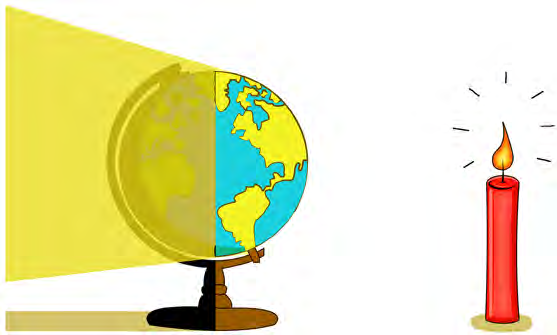
The axis of the earth does not stand upright on the orbital plane. It is tilted, and it makes an angle of \( 66.5^\circ \) with that plane. So the earth travels round the sun leaning over at \( 66.5^\circ \) all the way. This tilted turning has the following effects.
- 1. Except at the equator, day and night are not always of equal length. Sometimes the day is long and the night short, and at other times the day is short and the night long.
- 2. The same season is not felt everywhere on the earth at the same time. The seasons keep changing.
- 3. At any one place on the earth the rays of the sun do not always fall straight down.
Change of Seasons
The earth goes once round the sun along its elliptical orbit in 365 days. As it travels it comes nearer the sun at some times and moves farther away at others. Because it keeps its \( 66.5^\circ \) tilt all the way round, the sun's rays fall straight down on some places and slantwise on others. The part where the rays fall straight gets hotter, and the part where they fall slanting gets less heat. This difference in heating is what brings about the change of seasons.
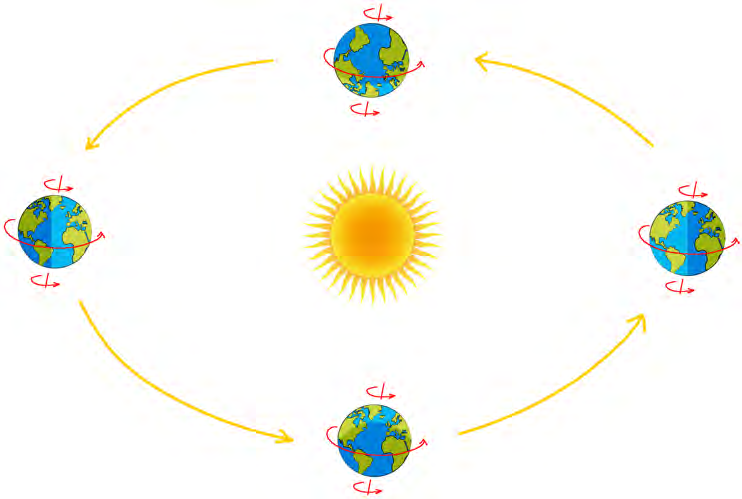
Around the world the year is divided into four seasons.
| Season | Period in the northern hemisphere | Nepali months | Main feature |
| Spring season | March 21 to June 22 | Falgun to Baisakh | Days grow longer, grass and leaves come out |
| Summer season | June 22 to September 23 | Jestha to Saun | Very hot, days long and nights short |
| Autumn season | September 23 to December 22 | Bhadau to Kartik | Contains the time when day and night are equal |
| Winter season | December 22 to March 21 | Mangsir to Magh | Rays fall slanting, nights are long |
In the northern hemisphere spring comes after winter. From the beginning of this season the days grow longer and the nights shorter. On about the seventh of Chaitra, that is March 21, day and night are equal. Once spring begins, the grass and the leaves of plants start to come out.
Summer follows spring. This season is very hot, and through it the days are long and the nights short. On about the seventh of Asar, that is June 21, the day is the longest and the night the shortest of the whole year.
Autumn follows summer. During this period the sun's rays fall equally on the northern and the southern hemispheres, so day and night are equal. On about the seventh of Asoj, that is September 23, day and night are of the same length.
Winter follows autumn. At this time the sun's rays fall slanting on the northern hemisphere, and the days become shorter and the nights longer. On about the seventh of Push, that is December 22, the day is the shortest and the night the longest.
The Six Seasons of Nepal
In Nepal a period of two months is counted as one season, and six seasons are in common use. They are as follows.
| Season | Months |
| 1. Basanta ritu, the spring season | Chaitra and Baisakh |
| 2. Grishma ritu, the summer season | Jestha and Asar |
| 3. Barsha ritu, the rainy season | Saun and Bhadau |
| 4. Sharad ritu, the autumn season | Asoj and Kartik |
| 5. Hemanta ritu, the pre winter season | Mangsir and Push |
| 6. Shishir ritu, the winter season | Magh and Falgun |
The Solar System and the Sun
On a clear night the open sky is full of countless shining bodies. Most of them are stars. The other bodies we can see, besides stars, are planets, satellites, asteroids, meteoroids and comets. The sun we see by day is also a star. It is the star nearest to the earth.
Solar system: the family made up of the sun, the planets, their satellites and the other small heavenly bodies is called the solar system.
Almost every body in the solar system takes the sun as its centre and travels round it in its own orbit. The sun is the chief centre of the solar system. It is the pull of the sun's gravity that keeps the other heavenly bodies going round it. The sun is a medium sized star. It looks large to us only because it is nearer to the earth than the other stars are.
The sun is a gaseous body. An enormous amount of heat and light comes out of it. The temperature at its surface is thought to be about 5700 °C, and at its centre about 1,50,00,000 °C.
The Planets
There are eight planets in the solar system, and the earth is one of them. Every planet turns about its own axis and at the same time travels round the sun. The planets have no light of their own, yet they look bright because they reflect the light of the sun.
Planet: a heavenly body that travels round the sun and has no light of its own is called a planet.
The gravity of the sun keeps all the planets at fixed distances as they go round it. Mercury, Venus, Earth and Mars are the inner planets, and Jupiter, Saturn, Uranus and Neptune are the outer planets.
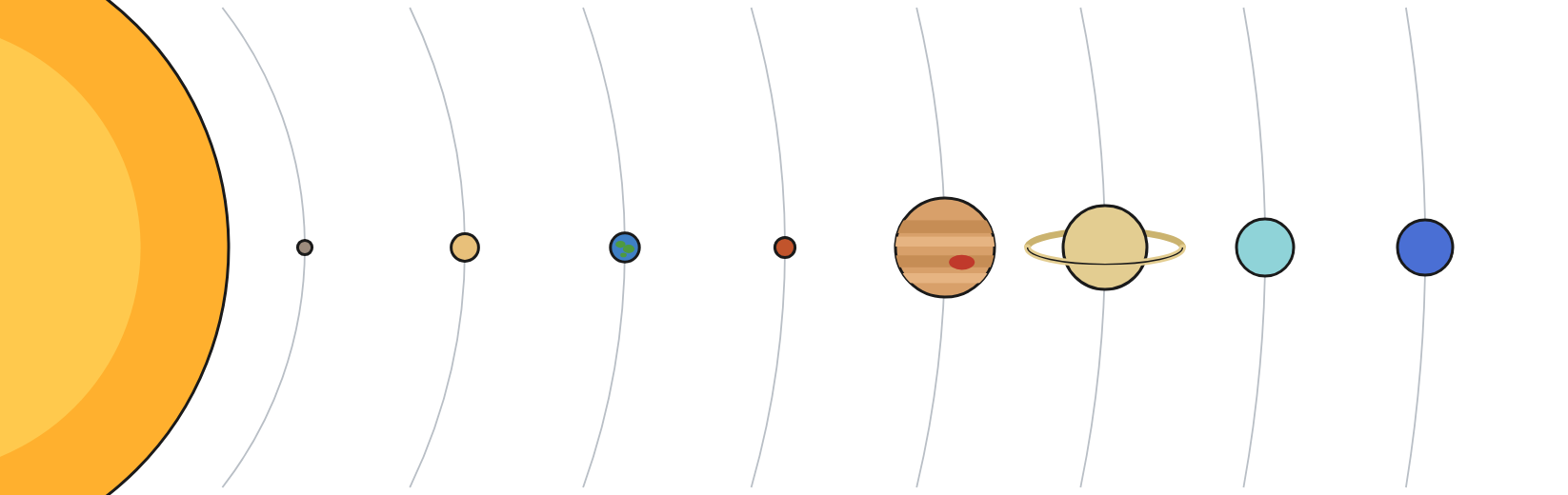
| Planet | Time to turn once on its axis | Time to go once round the sun | Satellites |
| Mercury | About 59 days | About 88 days | None |
| Venus | About 243 days | About 225 days | None |
| Earth | About 24 hours | About 365 days | 1 (the moon) |
| Mars | About 24 and a half hours | About 687 days | 2 (Phobos and Deimos) |
| Jupiter | About 10 hours | About 12 years | 67 |
| Saturn | About 10 hours 30 minutes | About 29.5 years | 62 |
| Uranus | About 17 hours 14 minutes | 84 years | 27 |
| Neptune | About 16 hours | About 164 years | 14 |
Each planet also has features of its own, not just its numbers.
- 1. Mercury is the planet closest to the sun and the smallest of them all. Because it is so near the sun it becomes very hot by day and very cold by night. It has no atmosphere.
- 2. Venus is the planet nearest to the earth. It is about the same size as the earth. It is the brightest planet of all and can be seen in the sky in the evening and again early in the morning.
- 3. Earth is the planet we live on, and it has all the conditions living things need. Life is possible here because the earth has water, an atmosphere and a suitable temperature. Counting outwards from the sun, the earth is the third planet.
- 4. Mars is the planet that looks a faint red in the sky, and it is also called the red planet. Water and oxygen have been found in its atmosphere, so it is thought that there may be life there.
- 5. Jupiter is the largest planet in the solar system. More satellites have been found for Jupiter than for any other planet so far. A large red spot can be seen near the middle of it.
- 6. Saturn is the planet that looks about as big as Jupiter. Round its outside there are three elliptical rings.
- 7. Uranus is made of gas and liquid. It has nearly 14 times more mass than the earth. Being very far from the sun, it is extremely cold.
- 8. Neptune is the farthest planet of all. A dark spot about the size of the earth can be seen on it.
Satellites
You have surely seen the moon at night. Does it have a light of its own? A heavenly body that travels round a planet is called a satellite. Satellites have no light of their own, so like the planets they shine by reflecting the light of the sun. The moon is the only natural satellite of the earth.
Satellites are of two kinds, natural and artificial. Satellites that came into being on their own in the universe are natural satellites, while those built by people and sent up into space are artificial satellites. Every planet except Mercury and Venus has satellites.
Comparing the Size of the Sun and the Earth
When we look up from the earth, the moon and the sun appear to be about the same size. In truth the sun is many times bigger than the moon. The sun is far, far further away from us than the moon is, and that is why the two look about the same size. The further away a thing is, the smaller it looks. To compare the sizes of the sun and the earth properly, we must look at their diameters.
Step 1: Write down the diameter of the sun:
\[ 1400000 \text{ km} \]
Step 2: Write down the average diameter of the earth:
\[ 12735 \text{ km} \]
Step 3: Divide the diameter of the sun by the diameter of the earth:
\[ 1400000 \div 12735 \]
Step 4: The answer this division gives is:
\[ \approx 110 \]
So the sun is about 110 times bigger than the earth. To picture that, think of the earth as a pea and the sun as a basketball. The distance from the earth to the sun is about 150000000 km.
Meteors and Meteorites
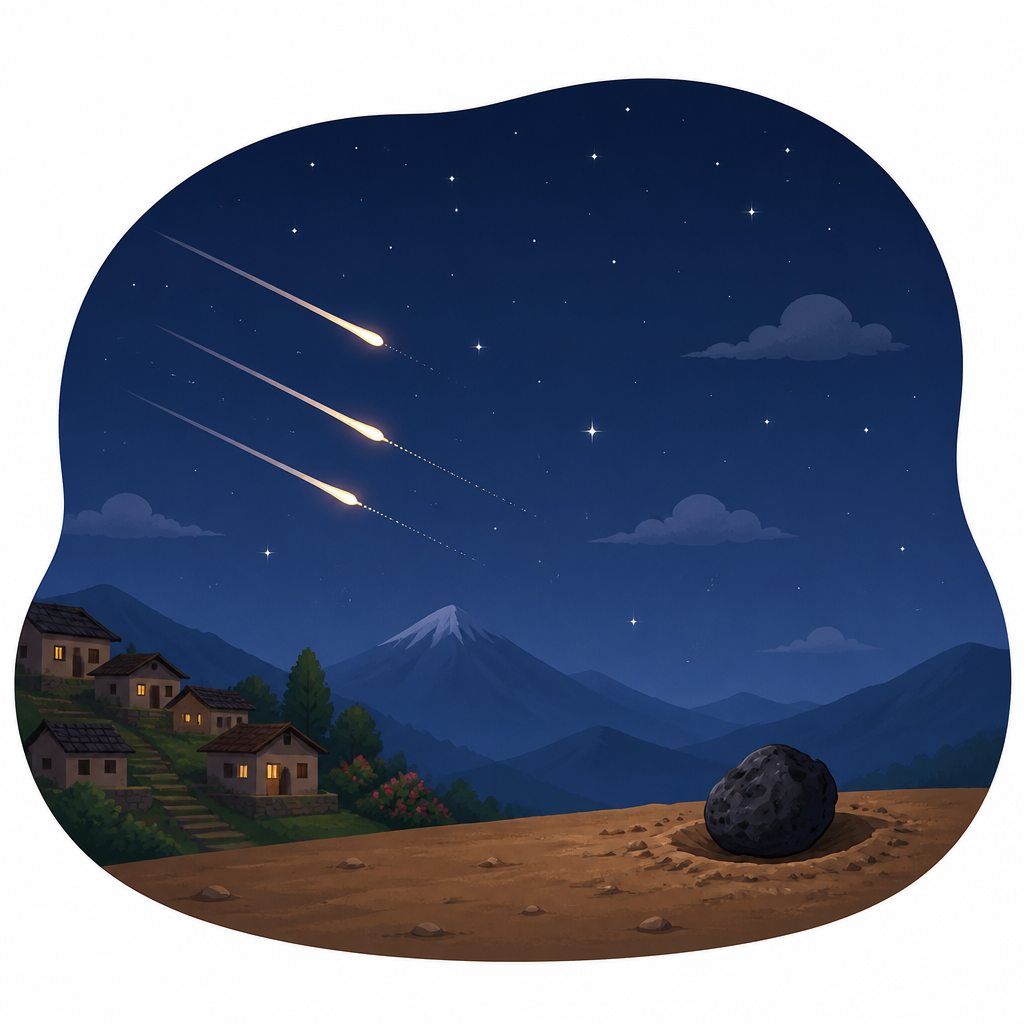
Sometimes on a clear night we see what looks like a star falling out of the sky. That is called a meteor shower. Small heavenly bodies moving through space rush into the earth's field of attraction at great speed. The rubbing of the air against them makes them very hot, and because of that heat they become bright and begin to glow.
Meteor: a body that enters the atmosphere, grows hot and burns as it comes, and whose material turns to gas or vapour and vanishes on the way, is called a meteor.
Meteorite: some meteors are so large that a part of them is left over after the burning and reaches the surface of the earth. Such a body is called a meteorite.
Do not treat a meteor and a meteorite as the same thing. A meteor burns up completely in the atmosphere, while a meteorite is the piece that survives the burning and lands on the surface of the earth.
Comets
Comet: a broom shaped lump of gas and ice that travels round the sun in an oval orbit is called a comet.
Comets have no light of their own. The heat of the sun melts the ice on the outer part of a comet and turns it to vapour, and the solid material comes off as grains of dust. The solar wind blows this gas and these icy grains away in the direction opposite the sun, and when sunlight falls on them they appear from outside as a tail.
The full lesson is waiting for you
The notes are free to read in full. A free account opens the rest of the practice, and tracks your progress and confidence score for every subject. Presentations and videos need approval from Learn Yeti.