The Materials We Use Every Day
Every home has a long list of things that get used each day. Cooking needs salt, oil, cumin, coriander, sugar, rice and lentils. Washing clothes needs soap and detergent. People build houses with iron and aluminium, decorate them with marble and tiles, and wear ornaments to look smart. All of these are materials, and a large number of them are chemical substances.
Some of these chemicals come straight from nature and some are prepared by people. Vinegar is obtained from plants, baking soda is made from a mineral, and ghee comes from the milk of cows and buffaloes. Toothpaste for brushing teeth, soap for cleaning and fertiliser spread on fields are all chemical substances too. The ones we mix into food and the ones we clean with are worth looking at separately, because they behave very differently.
Here is something to do as a class. Split into two groups. One group collects the names of everything that goes into the food cooked in their own kitchen. The other group collects the names of everything used for cleaning, inside the house and outside it. Then put the two lists together in a table like this one.
| Materials used or mixed in while cooking | Materials used for cleaning inside and outside the house |
| Sugar | Soap |
| Vinegar | Handwash |
| Common salt | Detergent |
| Baking soda | Phenol |
| Oil and ghee | Stain remover |
Chemicals Used as Food Materials
Bread, cake and biscuits all make you wonder how they were made so soft. Vegetables and pickles bring the salty, sour and hot tastes to mind, and a glass of squash brings the sweet one. Every one of those tastes comes from some chemical substance in the food. Ask your parents and teachers, make a list of such substances, and then talk about these two questions.
- Apart from chilli, do you know any other food that tastes hot?
- Apart from lemon, tamarind and pomelo, do you know any other sour food?
Baking soda is added to rice flour to make the festival rice bread puff up, and baking soda is a chemical substance. Common salt is a chemical substance as well. The sour taste of lemon, orange and gooseberry comes from a chemical substance, and the sugar stirred into tea is a chemical substance that carries a sweet taste.
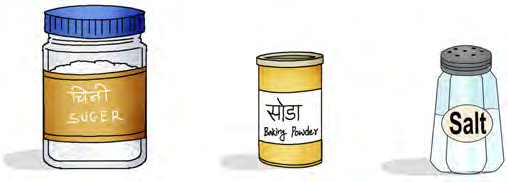
Baking Soda
Baking soda: a white chemical substance made from a mineral. Its chemical name is sodium bicarbonate, and its job in food is to make the food rise.
Whether baking soda really makes dough rise is something you can test yourself. Work through these steps in order.
- Step 1: Take wheat flour, baking soda, water and two bowls.
- Step 2: In one bowl put flour, water and a small amount of baking soda, and knead it well.
- Step 3: In the second bowl knead the same amount of flour with water only, adding no soda at all.
- Step 4: Cover both bowls and leave them for twelve hours.
- Step 5: Look at both bowls and see which lump of dough has grown larger in volume.
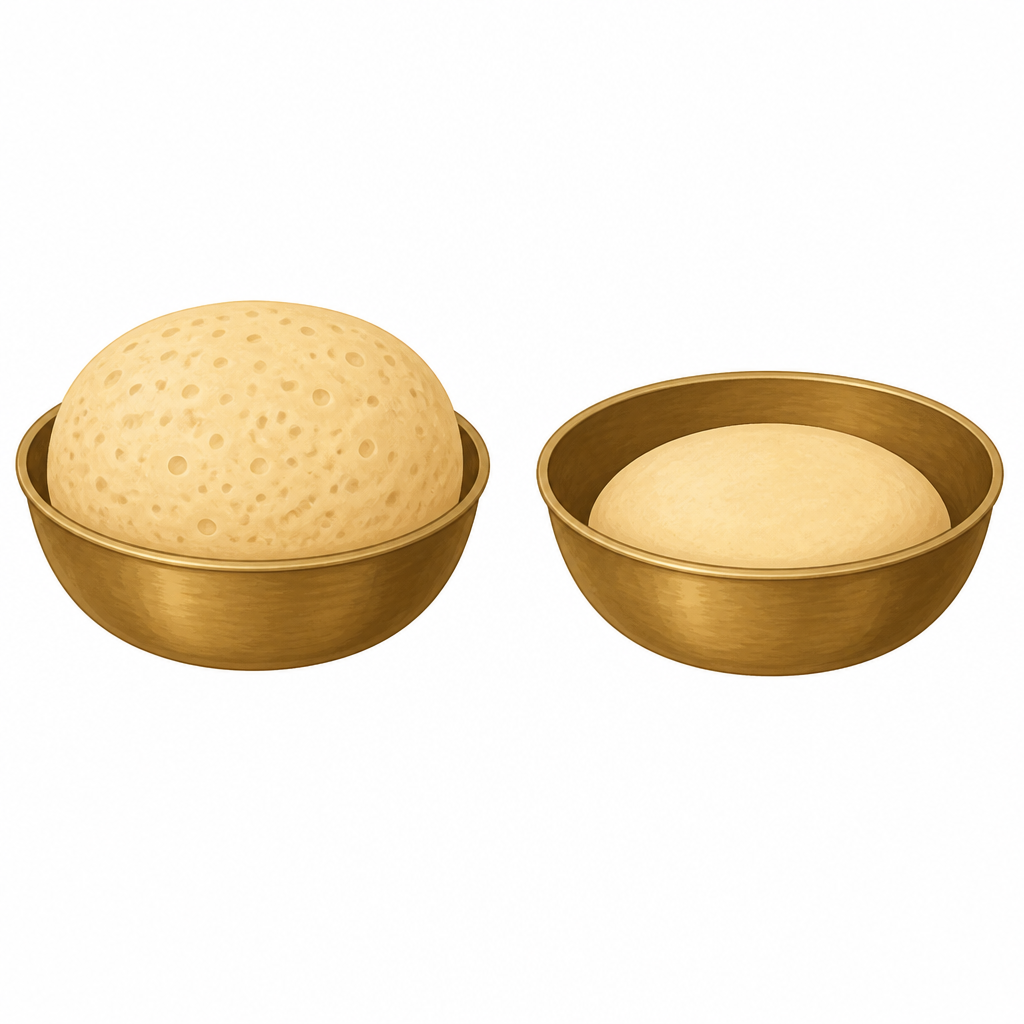
Bread is very light and airy inside. Baking soda is what makes it that way. The same soda goes into cake and biscuits, and it is used in making soft drinks as well. Baking soda is also used as a medicine, because it settles the acidity that builds up in the stomach.
The amount of baking soda matters. Too much of it swells the stomach, and it can bring on vomiting and diarrhoea.
Common Salt
Common salt: a mineral whose chemical name is sodium chloride. It dissolves in water, and it is one of the main sources of the sodium our body needs.
Salt is found in nature in sea water and in underground stores of rock salt. In food it is used for the salty taste. It is also used to keep ready to eat fish, meat and pickles from spoiling. Industry uses salt for making soap and for preparing paper, rubber and glass, and salt is used in cleaning and in medicine too.
Sodium chloride is necessary for the body, but too much of it is harmful. When the amount of sodium rises, a person can get high blood pressure and mental stress, and that can lead on to serious illnesses of the heart and the kidneys.
Iodine is mixed into salt to make iodised salt. Without enough iodine a swelling called goitre appears in the neck, and children can develop mental problems. A proper amount of iodine keeps children alert and keeps goitre away.
Sugar, Ghee and Oil
Sugar tastes sweet, and its chemical name is sucrose. It is prepared from the juice of sugarcane. Some sugar is also present in fruits such as banana, mango, grapes and pineapple. Sugar is added to food for sweetness, and packed food keeps longer because of it. Since sugar dissolves easily in water, it is used in making all kinds of drinks.
Ghee is a kind of fat obtained from the milk of cows and buffaloes. It stays solid or liquid depending on the temperature around it. In the cold season it is solid, and in the hot season it turns liquid. Ghee is used to prepare sweets and tasty dishes, and it is also rubbed on the skin to stop it from drying out.
Oil is a kind of fat obtained by pressing the seeds of plants. Mustard oil, soybean oil, sunflower oil, linseed oil, butter tree oil and olive oil are the ones in common use. Ghee and oil both give us energy and heat.
Oil is not made only from seeds. Olive oil, for example, is pressed from the fruit itself.
Chemicals Used as Cleansers
At home, soap, shampoo and sanitiser get used for washing clothes, bathing and cleaning a cut. Household cleaning today uses a long list of substances. Dirty dishes, window glass, car glass and toilets are cleaned with soap, detergent, phenol and stain remover. Make a list of the cleaning substances used in your own house, and talk in class about the care each one needs.
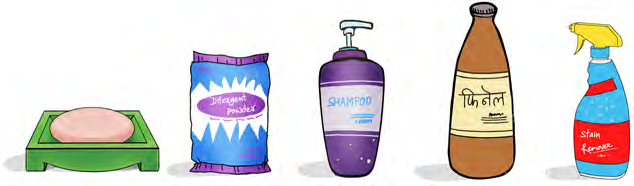
Soap and detergent: soap used for cleaning is a solid chemical substance. The powder or liquid chemical used for washing clothes is called detergent.
Different soaps are made for bathing and for washing clothes. Soap makes foam when it dissolves in water. Detergent dissolves more readily than soap, so clothes washed with detergent come out looking cleaner than clothes washed with soap. The sodium present in both soap and detergent is what lifts the dirt away.
Phenol is a useful chemical. It is used to kill germs and it is used for cleaning the house. It takes away bad smells and drives flies off, and it dissolves easily in water.
Phenol is highly poisonous. Keep it away from the eyes. It burns the skin as well, so gloves must be worn while using it.
An antiseptic is a chemical used in surgery and as a germ killer. It dissolves in water and it leaves the skin free of germs. Babies are bathed with antiseptic soap, and a few drops of antiseptic are often added to the water in which their clothes are washed. Ask your parents or your teacher why that is done.
A stain remover is a chemical used to take out marks and clean a surface. Clothes, bedsheets, floor carpets and nail polish sometimes hold marks that ordinary washing will not lift. A stain remover takes such marks out easily by dissolving the dirt. It is sold both as a powder and as a liquid.
Take three white handkerchiefs and put a mark of paint or grease on each. Clean the first with soap, the second with detergent and the third with stain remover. Then look carefully and decide which chemical did the cleanest job.
Chemicals used as food: salt, cooking oil, sugar, baking soda, ghee and so on
Chemicals used for cleaning: soap, detergent, phenol, stain remover and so on
Introducing Metals and Non-metals
Hold one end of a burning stick and your hand stays cool, but hold one end of a pair of tongs whose other end is in the fire and your hand gets burnt. Electric wires are nearly always made of copper or aluminium. Most cooking vessels are made of iron, copper, aluminium or steel, while shoes and slippers are made of rubber or plastic. Silver, copper, iron, aluminium and steel are hard, and rubber, plastic and wood are soft. Hard or soft, carrying heat or not, carrying electricity or not, ringing when struck or not: on properties like these we sort the materials of daily life into metals and non-metals.
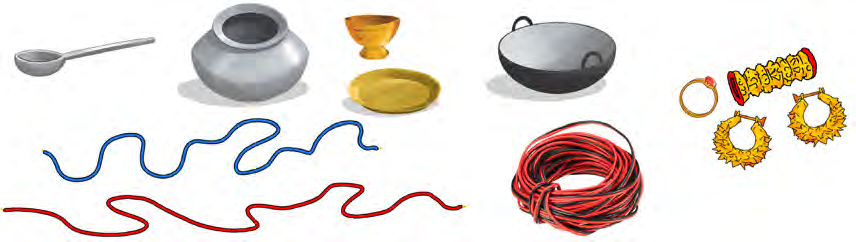
Collect a few things from your house or from around it: pieces of tin sheet, pieces of stone, a copper pot, charcoal, coal, sulphur, graphite, a knife, tongs, a hammer, iron nails, a balance, a metal weight, a wooden block cut to the same size as that weight, soap and wood shavings. Then work through these tests.
- Scratch each object in turn with an iron nail. Note which ones take a deep mark easily and which ones take no mark at all.
- Strike each object with a small rod. Note which ones answer with a ringing sound.
- Put a piece of iron in one pan of the balance and a piece of wood of the same shape and size in the other. Though the sizes match, note which one is heavier.
- Hold an iron nail and a piece of wood near a flame and note which one carries the heat to your fingers.
- Put the tip of an iron nail and then a piece of stone on a hard rock and hammer each one hard. Note which one spreads out thinner and which one breaks into bits.
- Put every object out in the sunlight and note which ones shine and which ones do not.
Metal: a material that carries heat and electricity, can be beaten into thin sheets, can be drawn out into long wire when heated, is generally hard, shines, and gives a special ringing sound when struck. Iron, copper, gold, silver and aluminium are metals.
Physical Properties of Metals
- Metals have lustre, which is a shine of their own.
- Metals are generally hard, dense and solid.
- Metals give out a sharp ringing sound.
- Metals can be beaten into thin sheets.
- Metals can be drawn into wire.
- Metals are good conductors of heat.
- Metals conduct electricity.
Metals reflect light, which is why they look bright and shiny. This shine on the surface of a metal is called lustre. Because some metals look so attractive in the light, people make ornaments out of gold and silver.
Iron and copper are hard metals, but hardness is not the same in every metal. Lithium, sodium and potassium are soft metals, and soft metals can be cut easily while hard ones cannot. At ordinary temperature and pressure most metals are solid. Mercury is the exception, because it is a metal that stays liquid.
Sonority: when a metal vibrates it gives out a sound of its own kind. Striking a hard metal, or letting two metals knock together, sets up a vibration and a special ringing sound is heard. This property of metals is called sonority.
Malleability: most metals can be heated and then hammered out into thin sheets. This property of spreading out thin under a hammer is called malleability.
Ductility: gold, silver, copper, iron and aluminium can be heated and pulled out into long thin wire. This property of stretching out into wire is called ductility.
Because metals flatten under a hammer, they can be turned into sheets of many shapes and sizes, and from those sheets come roofing sheets and cooking vessels. Because they stretch, metals can be turned into rods and wires of many shapes and sizes. That is what makes the copper wire in our houses and the iron rods in our buildings possible.
Metals are good conductors of heat. Because heat passes through them easily, cooking vessels are made of metal, and metal is used in the electrical appliances that are meant to heat things.
Whether a metal lets electricity through can be tested with a small circuit. Take a dry cell, some copper wire, a bulb, a coin and a piece of rubber. Join the dry cell, the wire and the bulb into a circuit. First place the coin into a gap in the wire and see whether the bulb lights. Then place the piece of rubber into the same gap and see whether the bulb lights. A piece of tin sheet, a piece of stone, an iron nail, a piece of soap and a wood shaving can each be tested in the same way.
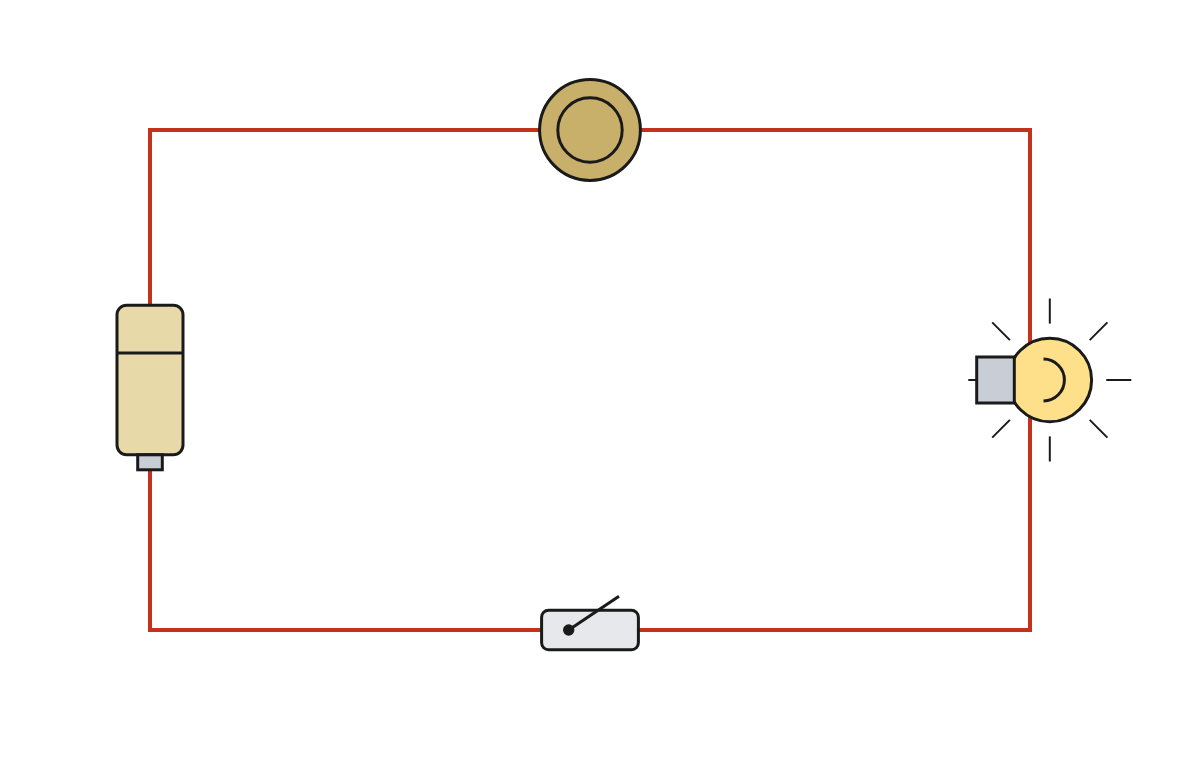
With a piece of tin sheet, a piece of copper, a coin or an iron nail in the gap, the bulb lights, which shows that current flows through metals. Metals are therefore good conductors of electricity. Because current passes through them so easily, copper wire is used for the circuits in our houses, and copper and aluminium wires go into all sorts of electrical appliances.
Physical Properties of Non-metals
Many materials around us do not behave the way metals do. Such materials are called non-metals. Hydrogen, oxygen, sulphur, nitrogen, carbon, charcoal, coal and graphite are non-metals.
Non-metal: a material that is a poor conductor of heat and electricity, is generally soft, has no shine, and gives no special ringing sound when struck is called a non-metal.
- Non-metals are found in the solid, liquid and gaseous states.
- Non-metals are generally softer than metals, and diamond is the exception.
- Non-metals do not give out a special ringing sound.
- Non-metals have no lustre.
- Non-metals cannot be beaten into thin sheets.
- A heated non-metal cannot be pulled or forced out into a long wire.
- Non-metals do not conduct electricity and are poor conductors of heat.
Thinking that every metal is hard and every non-metal is soft is a common mistake. Mercury is a metal that stays liquid, sodium and potassium are soft metals, and diamond is a non-metal that is extremely hard.
Differences Between Metals and Non-metals
| Metals | Non-metals |
| Metals have lustre. | Non-metals have no lustre. |
| Metals are hard, though a few such as sodium are soft. | Non-metals are generally softer than metals. |
| Metals give out a special ringing sound. | Non-metals give out no such ringing sound. |
| Heated metals can be beaten into thin sheets. | Heated non-metals cannot be beaten into thin sheets. |
| Heated metals can be stretched into long wire. | Heated non-metals cannot be stretched. |
| Metals conduct heat and electricity well. | Non-metals do not conduct electricity and conduct heat poorly. |
Environmental Impacts of Chemical Substances
Look around your house, your neighbourhood, the playing field, the road, the stream, the fields and the school, and make a list of the waste you find. Then talk about these questions.
- Did this waste come from homes, from the school, from shops or from a factory?
- Did it come from cleaning, from food, from medicine, from entertainment or from somewhere else? Make a separate list for each source.
- Say which pieces of that waste are chemical substances, which are metals, which are non-metals and which are minerals.
The soap, shampoo, detergent and phenol used in cleaning are man made substances that come from industry. Using too much of them pollutes the soil, the water and the air, and it harms the bodies of people and other living things. The chemicals in soap, for instance, break down in the soil and become harmless, but the ingredients of detergent do not break down. They stay in the soil and spoil its structure. A harmful detergent solution that reaches plants damages their growth, and when such chemicals reach water, aquatic animals can die.
Many of the things we need each day are made from metals. Walking along a road you sometimes find a thrown away blade, iron nails or tin cans. Such things do not rot away in the soil. Throwing away unwanted metal objects carelessly pollutes the environment. To control this, metal waste should be collected in an organised way and then reused or recycled.
Some metals are poisonous. Lead, mercury and cobalt are harmful to human health, and when they mix into water they harm the animals living in it.
Careless use of mineral fuels is one of the main causes of air pollution. Coal, diesel and petrol are burnt in very large amounts today, and burning them raises the amount of smoke and carbon dioxide in the air. To control air pollution, other sources of energy have to be used in place of these fuels. Processing minerals also affects the environment, polluting water, air and soil. Making cement from limestone affects the whole area around a cement factory, and the carbon dioxide leaving the kilns pollutes the air directly.
Words to Know
| Word | Meaning |
| Surgery | A method of treatment done by cutting |
| Stain remover | A chemical that removes colour marks or stains |
| Poisonous | A substance that harms the body on contact |
| Transmission | Moving from one place to another |
| Good conductor | Something that lets heat or electricity pass easily |
| Exception | A case that does not fall under the general rule |
| Unmanaged | Used carelessly, not in an organised way |
The full lesson is waiting for you
The notes are free to read in full. A free account opens the rest of the practice, and tracks your progress and confidence score for every subject. Presentations and videos need approval from Learn Yeti.