Science and Scientific Study
Science gives importance to the systematic study of an object, a subject or an event. When you study in an orderly way the things you have seen, heard and experienced, that is scientific study. It includes looking carefully at what is around you, asking questions, making a guess, carrying out an experiment, and analysing the result of the experiment to reach a conclusion.
To study science you need a set of scientific process skills. Once you have learned these skills, you can use them to study anything at all.
- Observing: looking, listening, smelling and touching carefully to find out what an object or an event is like.
- Classifying: putting things into groups on the basis of the properties they share.
- Measuring: expressing how much of a quantity there is, as a number together with a unit.
- Predicting: saying in advance what is likely to happen.
- Communicating: telling or writing your result in a way that other people can understand.
- Concluding: stating the final finding on the basis of the data you collected.
Scientific study: studying the things you have seen, heard and experienced in an orderly, step by step way is called scientific study.
An apple falling from a tree is an ordinary event. Sir Isaac Newton saw it, asked why it fell, and discovered the force of gravity. James Watt watched steam lift the lid of a kettle of boiling water, and from that observation he built the steam engine. These inventions became possible only through scientific study.
If we carry out scientific study patiently over a long time, we too can make new discoveries.
The Scientific Learning Process
Try this. Collect fruits such as mango, banana, orange, apple, lemon, pomegranate, grapes, gooseberry, cucumber, coconut, walnut and papaya. Observe them by looking at them, touching them, smelling them and tasting them. Then classify them into different groups on the basis of shape, colour, taste and hardness.
| Basis of grouping | Examples of fruits that match |
| Same shape | Orange, pomegranate, apple |
| Same colour | Banana, mango, lemon |
| Same taste | Lemon, gooseberry, grapes |
| Same hardness | Coconut, walnut |
Grouping in this way lets you draw conclusions. For example, fruits have different tastes such as sour and sweet, some fruits have a hard skin while others have a soft one, and fruits of the same colour may still have quite different shapes.
Now try another one. Collect things you find around you: a piece of wood, a small stone, a piece of plastic, an eraser, a piece of ice, an iron nail, a sheet from your exercise book, a leaf, a steel spoon, a piece of brick and some grains of rice. First guess which of them will sink in water and which will not, and write your guesses down. Then take a bucket of water and test them by putting the things in one by one.
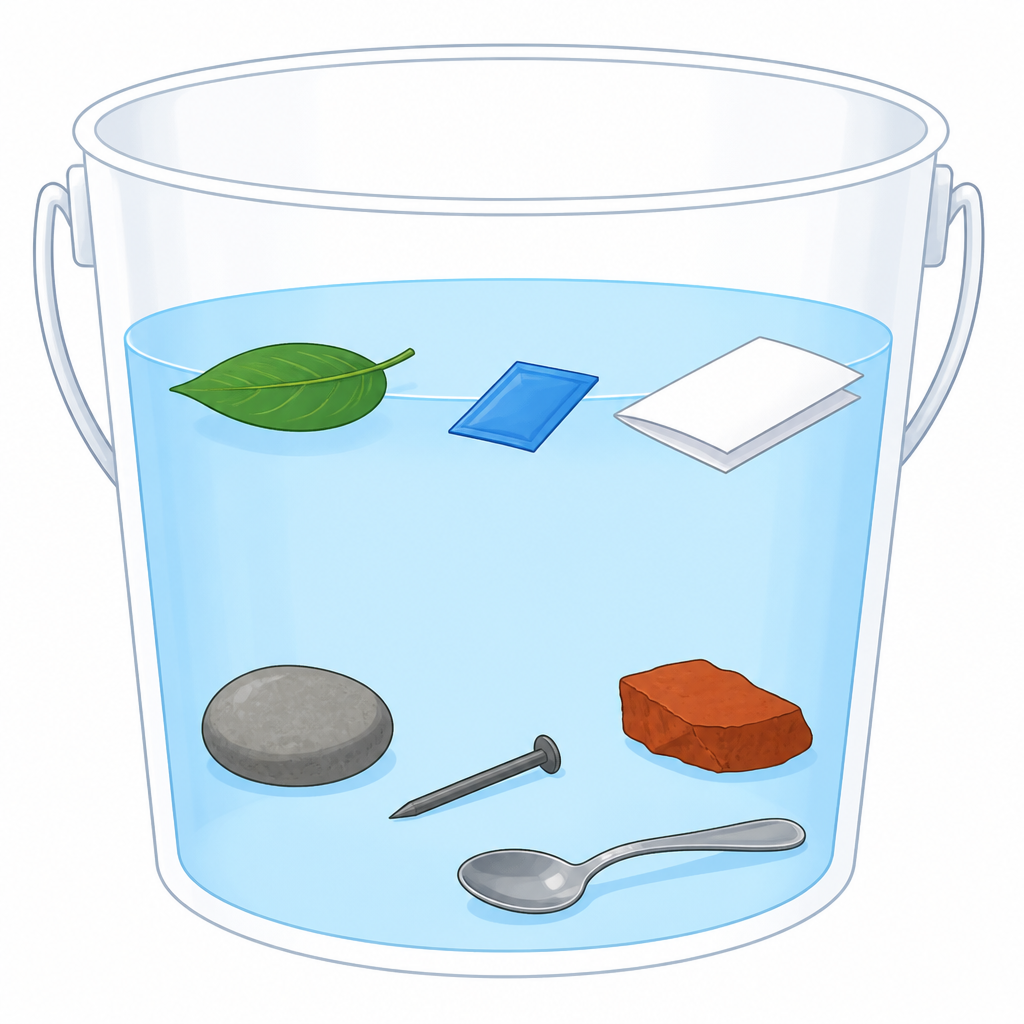
| Name of the thing | Guess | Result of the test |
| Piece of wood | Will not sink | Did not sink |
| Stone | Will sink | Sank |
| Iron nail | Will sink | Sank |
| Leaf | Will not sink | Did not sink |
| Piece of plastic | Will not sink | Did not sink |
| Piece of brick | Will sink | Sank |
Compare your guesses with the results of the test and see whether they matched. Discuss why some of the things did not sink. Observing objects and events around you, guessing, testing, discussing, explaining, drawing a conclusion and then reporting it to others is called the scientific learning process.
Scientific learning process: observing objects or events around us, predicting, testing, discussing and explaining, then drawing a conclusion and communicating it as a report, is called the scientific learning process.
Steps of the Scientific Learning Process
The scientific learning process follows the steps below, one after the other.
- Study the objects or events around you. A fruit falling from a tree, snow melting, or feeling cold in winter are the kinds of events that start the process.
- Ask a question about the object or the event. Newton asking why the apple fell from the tree is an example of this step.
- Guess the possible answers to the question. At this step you look for likely answers and likely causes.
- Carry out the test. Your guess is checked by a suitable method. Because the test is what brings out the real fact, this is treated as the most important step of all.
- Collect the data the test gives. The results that come out of the test are written down in a table.
- Analyse the data and draw the conclusion. The conclusion is reached on the basis of the analysis of the data.
- Make a report of the conclusion and present it. This is the last step. The conclusion is presented both by speaking and in writing.
Setting the sink or float activity against these steps makes the whole process clear.
| Step | What was done in the sink or float activity |
| 1. Study of objects or events | Different things found around us were collected |
| 2. Asking a question | We asked whether these things would sink in water or not |
| 3. Making a guess | A guess about each thing was written before testing |
| 4. Carrying out the test | The things were put one by one into the bucket of water |
| 5. Collecting the data | Which sank and which did not was written down in the table |
| 6. Analysis and conclusion | We concluded that things denser than water sink |
| 7. Presenting the report | The conclusion was written up and presented to the class |
From this a conclusion can be drawn. Things that are denser than water, such as an iron nail, a stone, a piece of brick, a steel spoon and a rubber cork, sink in water. Things that are less dense than water, such as sheets of paper, leaves, pieces of plastic and ice, float on water.
Do not treat a guess and a conclusion as the same thing. A guess is what you think before testing; a conclusion is reached only after analysing the data the test gives. Anything stated without a test is not a conclusion.
You can practise these steps yourself. Do the two activities below, then explain what you did by matching it against the steps above.
- Collect a compass, a geometry box, a pen, a pencil, the metal zip of a jacket, a button, an iron nail and a sheet of aluminium. Guess which of them are magnetic and which are not, and write your guesses in a table. Separate them using a magnet, compare the two tables and draw your conclusion.
- Collect seeds found near your home, such as maize, wheat, barley, gram and pea. Guess which of them are one seed leaf seeds and which are two seed leaf seeds, and note your guesses down. Test each seed by splitting it open, note the result, and see whether it differs from your guess.
Measurement and Unit
Suppose you measure the table in your classroom with your span and find it is 4 spans long. Here the length of the table has been compared with the length of your span, and you learn that the table is 4 times as long as your span. Measurement comes out of comparing one quantity with another quantity you already know.
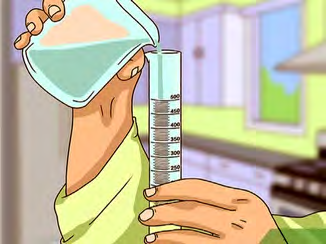
Take a glass of water and pour it slowly into a measuring cylinder. Read how many millilitres (ml) of water there are. At first the volume of water in the glass was unknown. A measuring cylinder is an instrument for measuring the volume of a liquid, and it shows a standard volume. By pouring the water into it, the unknown volume was compared with a standard one and became known.
Physical quantity: a quantity that can be measured and expressed in mathematical form is called a physical quantity. Length, mass, time, temperature, area and volume are physical quantities.
Measurement: comparing a physical quantity whose amount is unknown with a standard quantity of the same kind is called measurement.
Unit: the standard quantity used to measure a physical quantity is called a unit.
Different physical quantities are measured with different units. The metre is used for length, the kilogram for mass, the second for time and the degree Celsius for temperature. The amount of a physical quantity is shown by writing a number and a unit together. If the length of an object is written as \( 4\,\text{m} \), then the physical quantity is length, \( \text{m} \) names the unit, and 4 means the object is 4 times as long as that unit of length.
Writing only a number and leaving out the unit is wrong. Saying "the room is 5 long" means nothing. Only the unit tells you whether it is 5 metres or 5 spans.
It is easy to see why measurement is needed. If you look at two lines and simply guess which is longer, you are often wrong, but a ruler tells you the truth at once. Testing is the important step of the scientific learning process, and testing nearly always involves measuring. If the measurement is not correct, the conclusion of the test will not be correct either.
Measurement matters in everyday life too. Buying rice, lentils, sugar, oil and ghee from a shop needs measurement. Making tea at home means getting the right amounts of sugar, tea leaves, milk and water. Salt and spices have to be added to vegetables in the right amounts. Clothes stitched without taking the measurements of the body will not fit.
Local Units of Measurement
Different places have their own ways of measuring. For length, many places use the hand, the span, the pace and the finger width as units. A span is the distance from the tip of the thumb to the tip of the little finger when the hand is stretched open.
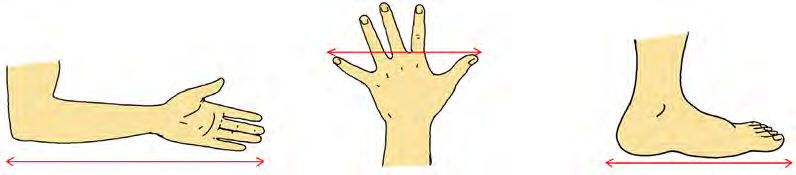
In our country grain, pulses, ghee and oil are measured with the mana and the pathi, which are traditional measuring vessels of fixed size. Field areas are still often given in muri, hal or ropani, units based on how much grain the land yields or how much land can be worked.
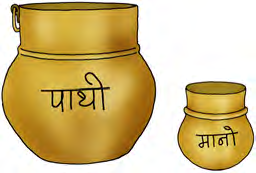
Local unit: a unit used for measuring in a particular locality, which is not accepted all over the world, is called a local unit. The hand, the span, the mana, the pathi, the muri and the ropani are local units.
Measure the length of one desk in your classroom with your own span and write it down, then let your friends measure the same desk with theirs. The answers will not agree, because the span differs from person to person. Since local units are not standard, measurements taken in different places do not match one another. This causes problems in trade both inside the country and between countries.
SI Units and the System of Measurement
People felt the need to make measurement reliable and acceptable everywhere in the world. So in 1960 an international meeting of scientists held in France fixed the standard units of measurement. These units, accepted all over the world, are called SI units. The system of measurement developed at that meeting of scientists in 1960 is the SI system.
SI unit: the units of measurement that belong to the SI system and are accepted all over the world are called SI units.
| Physical quantity | Unit | Symbol of the unit |
| Length | metre | m |
| Mass | kilogram | kg |
| Time | second | s |
| Temperature | kelvin | K |
| Electric current | ampere | A |
| Area | square metre | m² |
| Volume | cubic metre | m³ |
| Force | newton | N |
| Energy | joule | J |
| Power | watt | W |
| Velocity or speed | metre per second | m/s |
The difference between local units and SI units is shown in the conceptual grid below.
| Basis of difference | Local unit | SI unit |
| Reliability | Changes from place to place, less reliable | Accepted worldwide, more reliable |
| Accuracy | Cannot give an exact measurement | Can give an exact measurement |
| Uniformity | Measurements are not uniform | Measurements are uniform |
| Use in scientific learning | Not suitable for use | Suitable for use |
Take a one litre vessel and a pathi. Measure out one pathi of water and pour it into the litre vessel, and you find how many litres one pathi holds. In the same way, draw a line one inch long in your exercise book and measure it in centimetres, and you find how many centimetres one inch is. Local units used traditionally are expressed in SI units in this way.
Not every local unit can be converted into an SI unit exactly. You cannot say for certain how many centimetres one hand length is, because the length of a hand can differ from person to person.
Multiple and Submultiple Units
Suppose you have to measure the distance from the earth to the sun, the length of a field and the length of a pen. The physical quantity in all three is the same, length, but the amounts differ enormously. Giving the length of the field in metres is sensible, but the distance from the earth to the sun needs a unit bigger than the metre, and the length of a pen needs a unit smaller than the metre.
So a large amount of a quantity is expressed in a big unit and a small amount of the same quantity in a small unit. Measuring instruments and units may be large or small, but they can always be converted into one another.
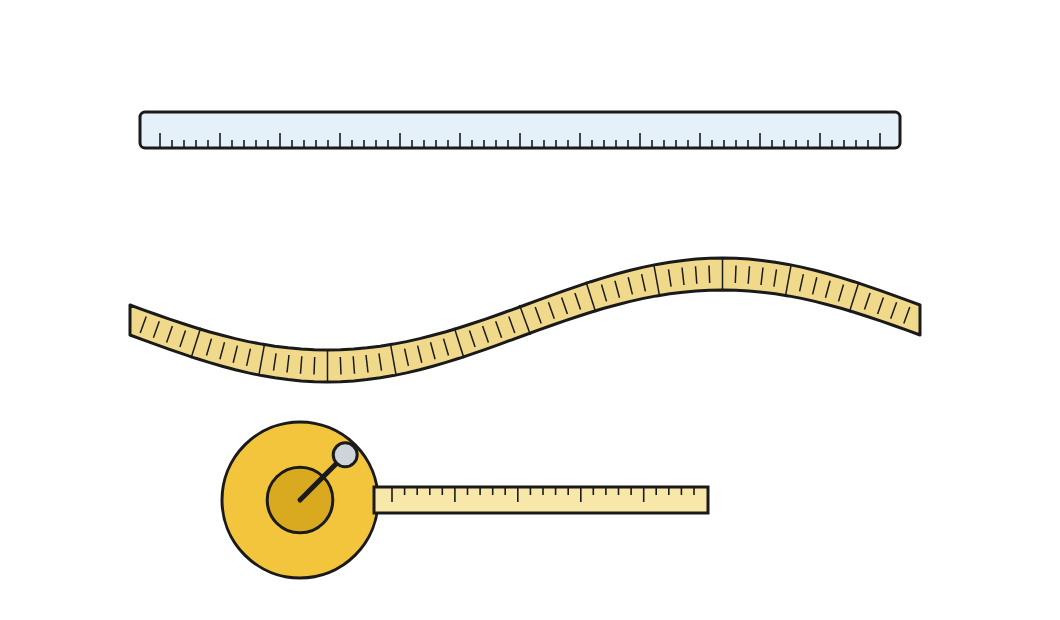
An instrument is used according to the way it is built. A short ruler is used for short lengths and a long tape for long ones. A long tape is made so that it can be rolled up and carried. The short, stiff scale from a geometry box is used for drawing straight lines. In a cloth shop a stiff metal scale makes measuring cloth easy.
Unit of Length
Length: the distance between any two points is called length. A person's height, for example, is the distance from the top of the head to the sole of the foot.
The SI unit of length is the metre. There are units both smaller and larger than the metre, and they are related as shown below.
| Unit | Relation |
| Millimetre (mm) | 10 mm = 1 centimetre (cm) |
| Decimetre (dm) | 10 cm = 1 decimetre (dm) |
| Metre (m) | 100 cm = 1 metre (m) |
| Kilometre (km) | 1000 m = 1 kilometre (km) |
Example 1: How many centimetres are there in 2 m 50 cm?
Step 1: Since \( 1\,\text{m} = 100\,\text{cm} \), change the metres into centimetres and add. The mathematical statement is:
\[ 2\,\text{m}\ 50\,\text{cm} = (2 \times 100 + 50)\,\text{cm} \]
Step 2: Doing the multiplication and the addition inside the bracket:
\[ = (200 + 50)\,\text{cm} = 250\,\text{cm} \]
Example 2: Convert 506 cm into metres.
Step 1: Since \( 100\,\text{cm} = 1\,\text{m} \), divide by 100. The mathematical statement is:
\[ 506\,\text{cm} = \frac{506}{100}\,\text{m} \]
Step 2: Carrying out the division:
\[ = 5.06\,\text{m} \]
Unit of Mass
Take a glass and a bucket. Fill both with water and lift them one after the other. The bucket is harder to lift. The mass of a glass of water is less than the mass of a bucket of water. A substance with more mass is heavy and a substance with less mass is light. That is exactly why the glass of water is easier to lift than the bucket.
Mass: the amount of matter contained in an object is called the mass of that object.
Every substance has mass. Soil, stone, wood, paper, water and air are all substances. A beam balance is used to measure mass.
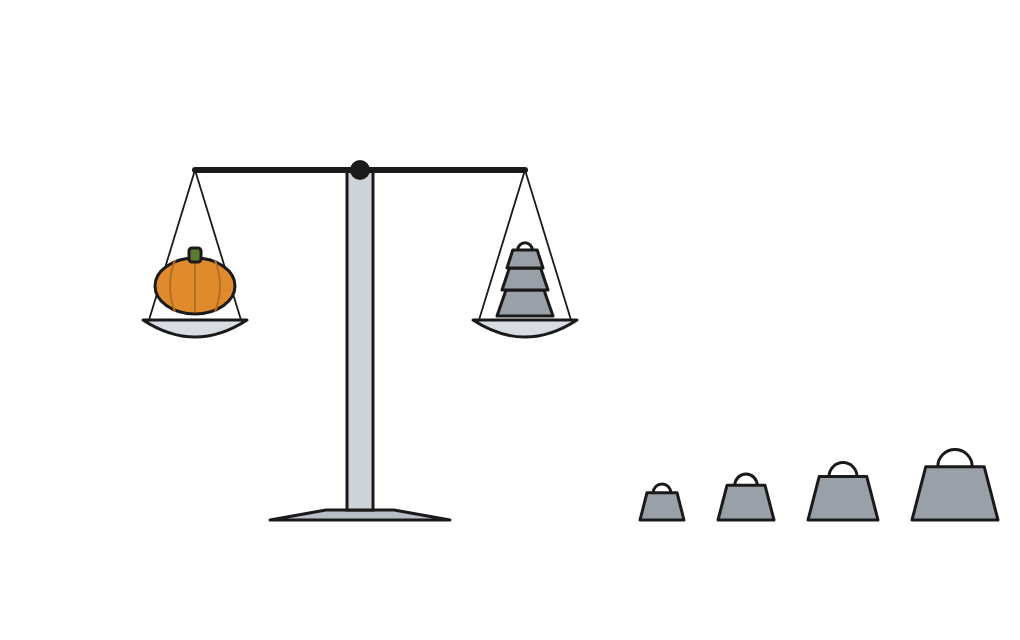
Take a beam balance and a set of weights of different masses. Put an object on one pan. Add or remove weights on the other pan until the balance is level. When the balance is level, the mass of the weights is the mass of the object.
The SI unit of mass is the kilogram. There are units both smaller and larger than the kilogram.
| Unit | Relation |
| Milligram (mg) | 1000 mg = 1 gram (g) |
| Gram (g) | 1000 g = 1 kilogram (kg) |
| Quintal | 100 kg = 1 quintal |
| Tonne | 1000 kg = 1 tonne |
Example 1: How many grams are there in 5 kg 200 g?
Step 1: Since \( 1\,\text{kg} = 1000\,\text{g} \), change the kilograms into grams and add. The mathematical statement is:
\[ 5\,\text{kg}\ 200\,\text{g} = (5 \times 1000 + 200)\,\text{g} \]
Step 2: Doing the multiplication and the addition:
\[ = 5200\,\text{g} \]
Example 2: How many kilograms are there in 1550 g?
Step 1: Since \( 1000\,\text{g} = 1\,\text{kg} \), divide by 1000. The mathematical statement is:
\[ 1550\,\text{g} = \frac{1550}{1000}\,\text{kg} \]
Step 2: Carrying out the division:
\[ = 1.55\,\text{kg} \]
Unit of Time
How long does it take you to get from home to school? Leaving home is one event and reaching school is another event. The interval between those two events is the time taken to reach school.
Time: the interval between any two events is called time.
Different kinds of clocks are used to measure time, such as an ordinary clock, an automatic watch, a digital watch, a table clock and a wall clock. The SI unit of time is the second. The minute, hour, day, week, month, year, decade and century are all units larger than the second.
| Unit | Relation |
| Minute | 60 seconds = 1 minute |
| Hour | 60 minutes = 1 hour |
| Day | 24 hours = 1 day |
| Week | 7 days = 1 week |
| Year | 12 months = 1 year |
| Year (in days) | 365 days = 1 year, and 366 days in a leap year |
Example: How many seconds (s) are there in 1 day?
Step 1: There are 24 hours in a day and 60 minutes in an hour. Writing the day in minutes:
\[ 24 \times 60 = 1440 \]
Step 2: There are 60 seconds in a minute. Writing the day in seconds:
\[ 1440 \times 60 = 86400 \]
Step 3: Writing the answer with its unit, 1 day is equal to \( 86{,}400\,\text{s} \).
Unit of Temperature
Ice is cold, while heated water is hot. The coldness of ice and the hotness of heated water tell us their temperatures. The SI unit of temperature is the kelvin (K). In everyday life temperature is also measured in degree Celsius (°C) and degree Fahrenheit (°F).
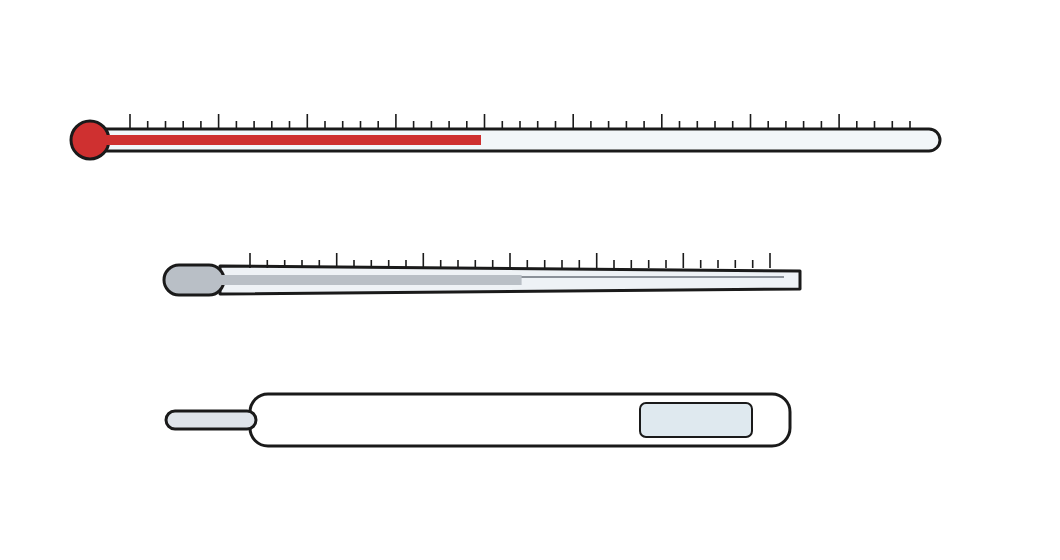
A thermometer is used to measure temperature, and there are several kinds. An ordinary thermometer is used to measure temperature in a laboratory. A clinical thermometer is used to measure the temperature of a person's body. At sea level, melting ice made of pure water is at 0 °C and boiling water is at 100 °C. The temperature of anything else is measured by comparing it with these two temperatures.
A thermometer is made of thin glass. Do not shake it against anything and do not put it into boiling water. If one breaks, do not touch the liquid inside it, and tell your teacher at once.
Unit of Area
Put a coin on your exercise book and draw a line all the way round it with a pencil. Now lift the coin and you can see how much space it took up. The space the coin covered on the page is called its area. In the same way, the space your foot takes up when you stand on the ground is called the area of your foot.
Area: the space covered by the surface of an object is called its area. The SI unit of area is the square metre (m²).
Some of the solid objects around us have a definite geometrical shape. These are called regular objects. Books and exercise books are rectangular objects. For the flat surface of such a regular object, the area can be found using a formula.
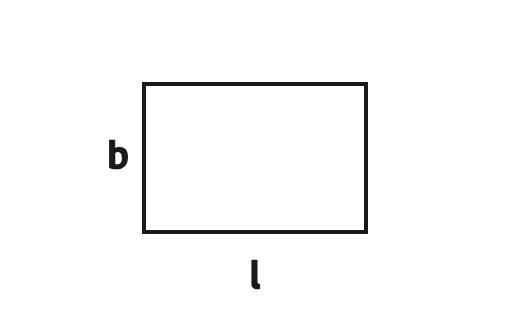
\[ A = l \times b \]
Here \( A \) is the area, \( l \) is the length and \( b \) is the breadth.
Example 1: A rectangular room is 5 m long and 3 m wide. What is the area of the room? Here the length of the room is \( l = 5\,\text{m} \) and the breadth is \( b = 3\,\text{m} \).
Step 1: Writing the formula:
\[ A = l \times b \]
Step 2: Putting the values into the formula:
\[ A = 5\,\text{m} \times 3\,\text{m} \]
Step 3: Multiplying:
\[ A = 15\,\text{m}^2 \]
Example 2: How many square centimetres are equal to 1 m²?
Step 1: Writing the square metre as a length multiplied by a breadth:
\[ 1\,\text{m}^2 = 1\,\text{m} \times 1\,\text{m} \]
Step 2: Changing each metre into centimetres:
\[ = 100\,\text{cm} \times 100\,\text{cm} \]
Step 3: Multiplying:
\[ = 10{,}000\,\text{cm}^2 \]
Writing 1 m² = 100 cm² just because 1 m = 100 cm is wrong. In area both the length and the breadth change, so 100 has to be multiplied twice, which gives 1 m² = 10,000 cm².
In the same way \( 1\,\text{km}^2 = 1000\,\text{m} \times 1000\,\text{m} = 10{,}00{,}000\,\text{m}^2 \). To find the area of a piece of land, however, it is divided into small triangles and the areas of those triangles are added together.
Unit of Volume
In daily life we need liquids such as milk, kerosene, petrol and diesel. Such liquids used to be measured with the mana and the pathi, but nowadays the litre is used, because the litre is a measure accepted all over the world.
Volume: the space occupied by an object is called the volume of that object. In the SI system, volume is measured in cubic metres (m³).
When a liquid is put into a vessel it takes up space. Every substance has volume. The volume of a solid or a liquid is fixed, while the volume of a gas is not fixed. The volume of a liquid is measured in litres (l).
| Unit | Relation |
| Cubic metre (m³) | 1 m³ = 1000 l |
| Millilitre (ml) | 1 l = 1000 millilitres (ml) |
| Cubic centimetre (cm³) | 1 l = 1000 cm³ |
| Millilitre and cubic centimetre | 1 ml = 1 cm³ |
The cubic centimetre, cm³, is also written in the short form cc.
Example: How many cubic centimetres are equal to 1 m³?
Step 1: Writing the cubic metre as three lengths multiplied together:
\[ 1\,\text{m}^3 = 1\,\text{m} \times 1\,\text{m} \times 1\,\text{m} \]
Step 2: Changing each metre into centimetres:
\[ = 100\,\text{cm} \times 100\,\text{cm} \times 100\,\text{cm} \]
Step 3: Multiplying:
\[ = 1000000\,\text{cm}^3 \]
In a science laboratory the volume of a liquid is measured with a measuring cylinder. Measuring cylinders of 10 ml, 25 ml, 50 ml, 100 ml, 250 ml, 500 ml and 1000 ml capacity are available.
The full lesson is waiting for you
The notes are free to read in full. A free account opens the rest of the practice, and tracks your progress and confidence score for every subject. Presentations and videos need approval from Learn Yeti.