What distance means
How far is one wall of the classroom from the other? How long is your desk? How far is the school office from your classroom? All of these questions are answered by one idea, and that idea is distance. Choose any two points, measure the length between them, and that measure is the distance between them. A distance is always stated with a unit. A bare number says nothing on its own. If a friend tells you the desk is 90 long, the statement is incomplete, because nobody can tell whether that means 90 millimeters or 90 centimeters.
Distance: the length between any two points is called the distance between those points.
Different units are used to measure distance, and the unit you choose depends on how big the distance is. Short distances are measured in millimeters (mm), centimeters (cm), feet (ft) and meters (m). Long distances are measured in kilometers (km) and miles. The thickness of a pencil lead suits mm, the width of an exercise book suits cm, the height of a room suits m, and the distance between two towns suits km. Meter, centimeter and millimeter are joined to one another by multiples of ten, which makes them easy to remember.
| Measure in the smaller unit | Equal measure in the bigger unit |
| 10 millimeter (mm) | 1 centimeter (cm) |
| 100 centimeter (cm) | 1 meter (m) |
| 1,000 meter (m) | 1 kilometer (km) |
Relation between inch and centimeter
A school ruler carries marks along both of its edges. One edge is marked in centimeters and millimeters, and the other edge is marked in inches (in). On a ruler of the same length, the centimeter edge fits in more than 15 marks while the inch edge fits in only 6. That alone tells you something useful: an inch is a bigger unit than a centimeter.

When you line up the two edges of the ruler, one inch is clearly a little more than two centimeters. Careful measurement gives this exact relation:
\[ 1 \text{ in} = 2.54 \text{ cm} \]
Inch (in): a unit of length bigger than a centimeter, where 1 inch equals 2.54 centimeters.
Once this relation is known, any measure given in inches can be taken into centimeters. For example, a pencil that is 5 inches long can be stated in centimeters like this:
\[ 5 \times 2.54 = 12.7 \text{ cm} \]
Relation among inch, foot and centimeter
Take a measuring tape and measure the distance from one wall of your classroom to the other in all four units: foot (ft), centimeter (cm), meter (m) and inch (in). Even though it is one and the same distance, each unit gives a different number. A smaller unit gives a bigger number and a bigger unit gives a smaller number. The relations among these four units are given below, and every calculation in this topic uses them.
| One unit | Equal value |
| 1 inch (in) | 2.54 centimeter (cm) |
| 1 foot (ft) | 30.48 centimeter (cm) |
| 1 meter (m) | 39.37 inch (in) |
| 1 meter (m) | 3.28 foot (ft) |
| 1 foot (ft) | 12 inch (in) |
Foot (ft): a unit of length bigger than an inch, where 1 foot equals 12 inches or 30.48 centimeters.
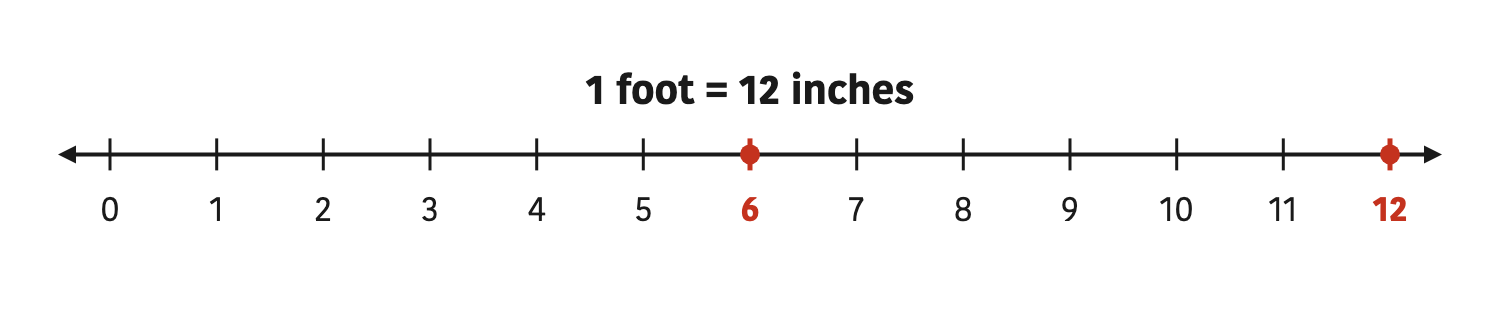
Of these five relations, 1 ft = 12 in is the one you will use most often, because heights and lengths are usually stated as a mixture of feet and inches, such as 4 ft 6 in. The other four relations join the metric units to inches and feet.
When to multiply and when to divide
This is the point where students get confused most often. The way to think about it is simple. When one and the same distance is measured with a smaller unit, that unit fits in many times, so the number goes up. When it is measured with a bigger unit, it fits in only a few times, so the number goes down. A stick 1 meter long becomes 100 in centimeters, but only 3.28 in feet.
To change a bigger unit into a smaller unit you multiply, and to change a smaller unit into a bigger unit you divide.
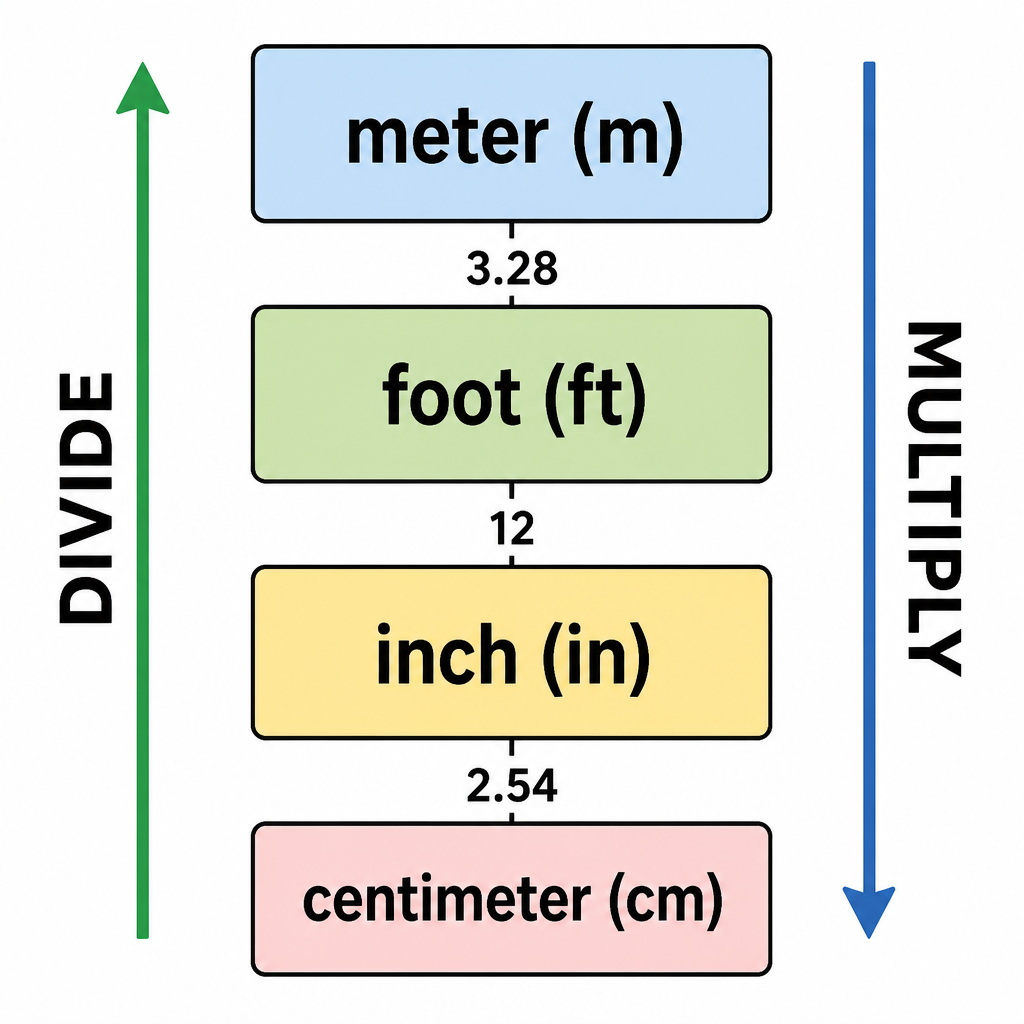
After you get an answer, stop and think once. If the new unit is smaller, the number must be bigger than before. If changing 5 m to cm gives you 0.05, then you have divided where you should have multiplied.
Writing a mixed foot and inch measure in feet
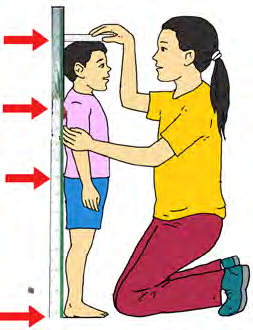
A measuring tape held against the wall gives a friend's height as 4 ft 6 in. A measure like this mixes feet and inches together. Before any calculation is done, it has to be written in one single unit, that is in feet with a decimal.
Step 1: Since 1 foot holds 12 inches, 6 inches is written as a fraction of a foot:
\[ 4 \text{ ft } 6 \text{ in} = 4 + \frac{6}{12} \text{ ft} \]
Step 2: Changing the fraction into a decimal:
\[ 4 + 0.5 = 4.5 \text{ ft} \]
So the friend's height is 4.5 ft. Now this same height is changed into three other units.
(a) Changing to centimeters. A foot is the bigger unit and a centimeter is the smaller one, so multiply by 30.48:
\[ 4.5 \times 30.48 = 137.16 \text{ cm} \]
(b) Changing to meters. A meter is bigger than a foot, so divide by 3.28:
\[ 4.5 \div 3.28 = 1.37 \text{ m} \]
(c) Changing to inches. An inch is smaller than a foot, so multiply by 12:
\[ 4.5 \times 12 = 54 \text{ in} \]
Writing 4 ft 6 in as 4.6 ft is a very common slip. A foot holds 12 inches, not 10, so 6 inches is half a foot and the measure becomes 4.5 ft.
Changing a measure in meters to cm, in and ft
A rope 5 m long is to be written in centimeters, inches and feet. All three new units are smaller than a meter, so all three steps are multiplications.
Step 1: Changing to centimeters, since 1 m = 100 cm:
\[ 5 \times 100 = 500 \text{ cm} \]
Step 2: Changing to inches, since 1 m = 39.37 in:
\[ 5 \times 39.37 = 196.85 \text{ in} \]
Step 3: Changing to feet, since 1 m = 3.28 ft:
\[ 5 \times 3.28 = 16.4 \text{ ft} \]
So a rope 5 m long is 500 cm, 196.85 in and 16.4 ft. All three answers are different names for one and the same length.
Changing a measure in inches to cm, ft and m
Sunita's height is 58 in. Let us find what this same height is in centimeters, feet and meters.
Step 1: Changing to centimeters. A centimeter is smaller than an inch, so multiply by 2.54:
\[ 58 \times 2.54 = 147.32 \text{ cm} \]
Step 2: Changing to feet. A foot is bigger than an inch, so divide by 12:
\[ \frac{58}{12} = 4.83 \text{ ft} \]
Step 3: Changing to meters. A meter is bigger than an inch, so divide by 39.37:
\[ \frac{58}{39.37} = 1.47 \text{ m} \]
So Sunita's height is 147.32 cm, 4.83 ft and 1.47 m.
Changing a measure in centimeters to in, ft and m
The floor of a classroom is 480 cm long. Here the centimeter is the smallest unit of the four, so all three steps are divisions.
Step 1: Changing to inches, since 1 in = 2.54 cm:
\[ \frac{480}{2.54} = 188.98 \text{ in} \]
Step 2: Changing to feet, since 1 ft = 30.48 cm:
\[ \frac{480}{30.48} = 15.75 \text{ ft} \]
Step 3: Changing to meters, since 1 m = 100 cm:
\[ \frac{480}{100} = 4.8 \text{ m} \]
So the length of the classroom is 188.98 in, 15.75 ft and 4.8 m.
Comparing a length and a breadth
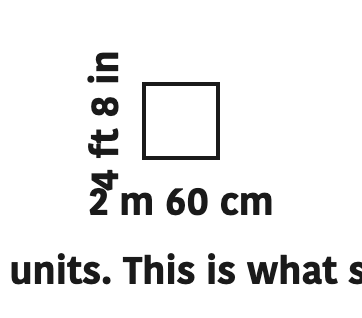
A classroom blackboard is 2 m 60 cm long and 4 ft 8 in wide. We have to find by how many feet the length is greater than the breadth. Two measures cannot be subtracted until they are in the same unit, and since the answer is wanted in feet, both are brought into feet.
Step 1: Writing the length in meters, since 60 cm is 60/100 of a meter:
\[ 2 + \frac{60}{100} = 2.6 \text{ m} \]
Step 2: Changing the length into feet, since 1 m = 3.28 ft:
\[ 2.6 \times 3.28 = 8.53 \text{ ft} \]
Step 3: Writing the breadth in feet, since 8 inches is 8/12 of a foot:
\[ 4 + \frac{8}{12} = 4.67 \text{ ft} \]
Step 4: Both are now in feet, so subtracting the breadth from the length:
\[ 8.53 - 4.67 = 3.86 \text{ ft} \]
So the length of the blackboard is greater than its breadth by 3.86 ft. The same method works when two walls are joined end to end, or when the remaining part of a road is worked out. Bring the measures into one unit first, and only then add or subtract.
The full lesson is waiting for you
Create a free account to unlock activities, practice tests, presentations and videos - and to track your progress and confidence score for every subject.
The length between any two points is called distance, and it is always stated with a unit.
11 more points to remember - sign in to see the rest.
Question 1 of 13