Adding and Subtracting a Decimal and a Fraction
The number 0.34 and the fraction 23/100 look different, yet they stand for the same amount. A decimal number and a fraction are two ways of writing one quantity. When you try to add or subtract them as they are, the digits do not line up in the same places, so the work goes wrong. The first move is always to bring both numbers into one form.
To add or subtract a decimal and a fraction, change both into one form: either both into decimal numbers, or both into fractions.
Now find the sum and the difference of 0.34 and 23/100.
Step 1: Changing the fraction into a decimal number:
\[ \frac{23}{100} = 0.23 \]
Step 2: Both numbers are now decimals, so they can be added:
\[ 0.34 + 0.23 = 0.57 \]
Step 3: Subtracting the smaller number from the larger one gives the difference:
\[ 0.34 - 0.23 = 0.11 \]
There is a second route. Written as a fraction, \( 0.34 = \frac{34}{100} \), and then \( \frac{34}{100} + \frac{23}{100} = \frac{57}{100} \), which is 0.57 again. You may pick either route, because both give the same answer.
A fraction whose denominator is 10, 100 or 1000 is easy to write as a decimal. Count the zeros in the denominator, then count that many digits from the right of the numerator and put the decimal point there.
| Fraction | Decimal number |
| \( \frac{3}{10} \) | 0.3 |
| \( \frac{34}{100} \) | 0.34 |
| \( \frac{713}{1000} \) | 0.713 |
| \( \frac{191}{100} \) | 1.91 |
| \( \frac{3471}{100} \) | 34.71 |
Decimal place: the position of each digit that comes after the decimal point. In 7.563, the digit 5 is in the first place, 6 is in the second place and 3 is in the third place.
Multiplying a Decimal Number by a Whole Number
Multiplication is repeated addition. So \( 0.25 \times 3 \) means 0.25 added three times. On a grid cut into a hundred equal squares, shading 25 squares shades 0.25 of it. Put the shaded parts of three such grids together and 75 squares are shaded, which is 0.75 of one grid.
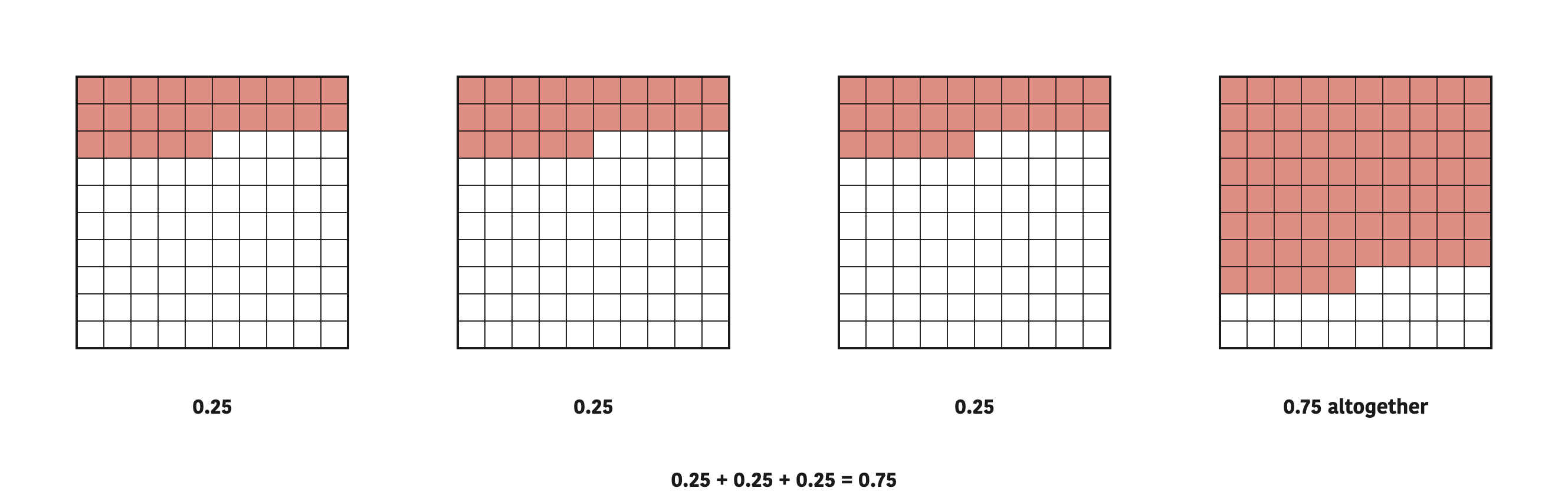
\[ 0.25 + 0.25 + 0.25 = 0.75 \]
So \( 0.25 \times 3 = 0.75 \). Notice something here. The decimal number 0.25 has two digits after the point, and the product 0.75 also has two digits after the point. That match is what the short method for multiplying rests on.
To multiply a decimal number by a whole number, first multiply as though the decimal point were not there. Then count the digits after the point in the decimal number given, count that many digits from the right of the product, and put the decimal point there.
Now work out \( 2.45 \times 5 \).
Step 1: Multiplying as whole numbers, with the decimal point ignored:
\[ 245 \times 5 = 1225 \]
Step 2: Since 2.45 has two digits after the point, two digits are counted from the right of the product and the point is placed there:
\[ 2.45 \times 5 = 12.25 \]
This same skill is used straight away in measuring work. A square handkerchief has a side of 0.62 metres, so find its perimeter.
Step 1: Putting the side into the formula for the perimeter of a square:
\[ P = 4l = 4 \times 0.62 \]
Step 2: Multiplying with the decimal point ignored:
\[ 62 \times 4 = 248 \]
Step 3: Since 0.62 has two digits after the point, the product also gets two:
\[ P = 2.48 \]
So the perimeter of the handkerchief is 2.48 metres. Never leave the unit out of an answer.
Multiplying Two Decimal Numbers
What if both numbers are decimals? Writing them as fractions shows the reason clearly. Written as fractions, \( 0.25 \times 0.2 \) becomes:
\[ \frac{25}{100} \times \frac{2}{10} = \frac{50}{1000} \]
The denominator has three zeros, so the numerator 50 is written as 0.050, which is 0.05.
\[ 0.25 \times 0.2 = 0.05 \]
That gives the rule for multiplying two decimal numbers.
- (a) Multiply as though they were whole numbers, ignoring both decimal points. For example, \( 25 \times 2 = 50 \).
- (b) Count the digits after the point in both decimal numbers together, count that many digits from the right of the product, and put the point in front of them. Here the two numbers have four such digits in all, so the product is 0.0500, which is 0.05.
Now work out \( 0.6 \times 2.47 \).
Step 1: Multiplying as whole numbers with the points removed:
\[ 6 \times 247 = 1482 \]
Step 2: There is one digit after the point in 0.6 and two in 2.47, which makes three in all. So three digits are counted from the right of the product:
\[ 0.6 \times 2.47 = 1.482 \]
A rectangular path through the middle of a garden is 37.7 metres long and 2.8 metres wide. What is the area of the path?
Step 1: Putting the measurements into the formula for the area of a rectangle:
\[ A = l \times b = 37.7 \times 2.8 \]
Step 2: Multiplying with the decimal points ignored:
\[ 377 \times 28 = 10556 \]
Step 3: Each number has one digit after the point, making two in all, so:
\[ A = 105.56 \]
So the area of the path is \( 105.56 \) square metres. The unit of an area is always a square unit.
When placing the point in a product, do not count the digits of only one of the numbers. The digits after the point in both numbers are added together first. Also, a zero counts as a digit while you count from the right, which is why 50 becomes 0.0500 before it is written as 0.05.
Multiplying by 10, 100 and 1000
Multiplying by 10 or by a power of 10 needs no long working. Count the zeros in the multiplier and move the decimal point that many places to the right. If the digits run out while you move, zeros are added at the end.
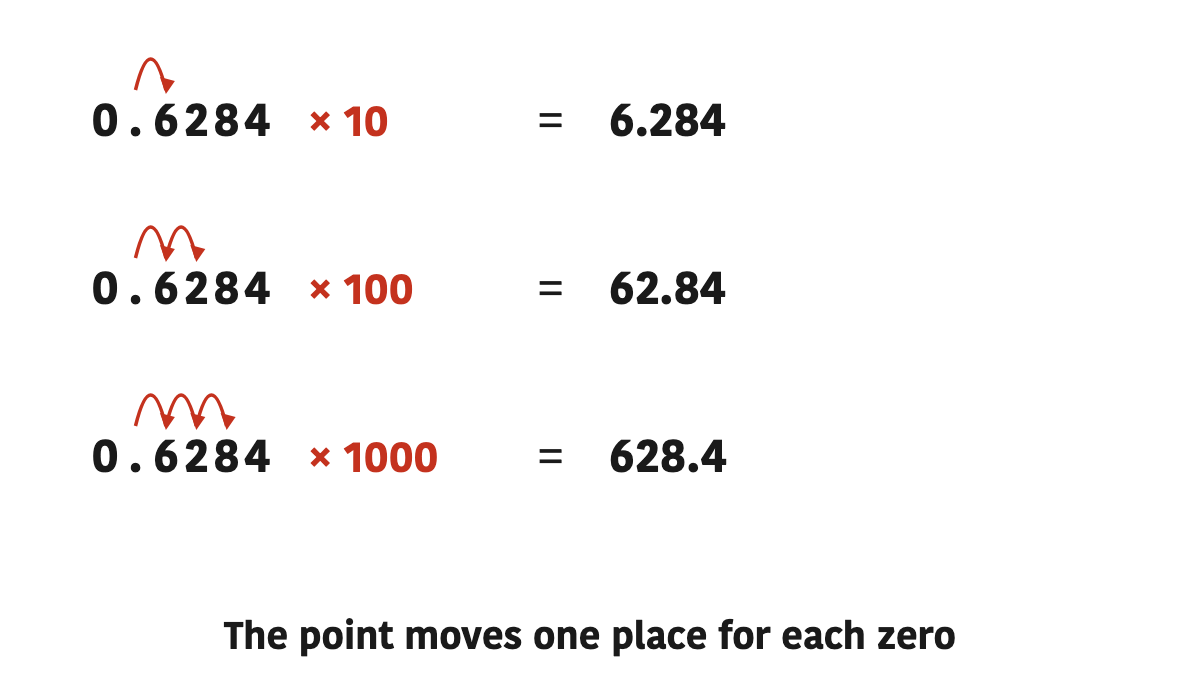
| Multiplication | Product | Decimal point |
| \( 10 \times 0.6284 \) | 6.284 | 1 place right |
| \( 100 \times 0.6284 \) | 62.84 | 2 places right |
| \( 1000 \times 0.6284 \) | 628.4 | 3 places right |
| \( 10000 \times 0.6284 \) | 6284 | 4 places right |
| \( 100000 \times 0.6284 \) | 62840 | 5 places right |
Dividing Decimal Numbers
Twelve refrigerators weigh 1229.4 kilograms together, and each of them weighs the same. What does one weigh? A total is being shared into equal parts, so this is a division. The working is the same as for whole numbers, with one difference: when you reach the decimal point in the dividend, the point goes into the quotient too.
Step 1: 12 goes into 12 exactly once:
\[ 12 \times 1 = 12 \]
Step 2: The next digit 2 is too small for 12, so a 0 goes in the quotient and 9 is brought down to make 29. Since \( 12 \times 2 = 24 \):
\[ 29 - 24 = 5 \]
Step 3: The next digit to come down is the one after the point, so the decimal point is written in the quotient and 4 is brought down to make 54. Since \( 12 \times 4 = 48 \):
\[ 54 - 48 = 6 \]
Step 4: A zero is added after the last decimal digit and brought down to make 60. Since \( 12 \times 5 = 60 \):
\[ 60 - 60 = 0 \]
Step 5: The quotient digits are 1, 0, 2 and then 4, 5 after the point:
\[ 1229.4 \div 12 = 102.45 \]
So one refrigerator weighs 102.45 kg. To check whether a division is right, multiply the divisor by the quotient.
\[ 12 \times 102.45 = 1229.4 \]
Dividend, divisor and quotient: the number being divided is the dividend, the number you divide by is the divisor, and the answer is the quotient. The check is: divisor multiplied by quotient equals the dividend.
Now take \( 17.40 \div 4 \). Dividing 17 by 4 gives 4 with 1 left over. As soon as the 4 after the point is brought down, the decimal point is written in the quotient. Then 14 divided by 4 gives 3 with 2 left over, and 20 divided by 4 gives exactly 5.
\[ 17.40 \div 4 = 4.35 \]
The same division can be done another way. Multiplying the dividend and the divisor by the same number does not change the quotient, so both can be multiplied by 100 to clear the decimal point.
Step 1: Multiplying both the dividend and the divisor by 100:
\[ 17.40 \div 4 = 1740 \div 400 \]
Step 2: Dividing whole numbers now:
\[ 1740 \div 400 = 4.35 \]
Sometimes the dividend has no whole number part at all. Look at \( 0.5850 \div 18 \).
Step 1: There is no digit before the point, so the quotient starts with 0 and a decimal point. Since 18 does not go into 5, a 0 is put in the first decimal place and 58 is taken. Since \( 18 \times 3 = 54 \):
\[ 58 - 54 = 4 \]
Step 2: Bringing down 5 makes 45. Since \( 18 \times 2 = 36 \):
\[ 45 - 36 = 9 \]
Step 3: Bringing down 0 makes 90. Since \( 18 \times 5 = 90 \):
\[ 90 - 90 = 0 \]
Step 4: The quotient digits after the point are 0, 3, 2 and 5, so:
\[ 0.5850 \div 18 = 0.0325 \]
Checking it, \( 18 \times 0.0325 = 0.585 \), so the answer is right.
Dividing by 10, 100 and 1000
Division is the reverse of multiplication, so here the decimal point moves to the left. Count the zeros in the divisor and move the point that many places to the left. If the digits run out on the left, zeros are put in as you move.
- \( 232.59 \div 10 = 23.259 \), the point moved 1 place left.
- \( 232.59 \div 100 = 2.3259 \), the point moved 2 places left.
- \( 232.59 \div 1000 = 0.23259 \), the point moved 3 places left.
- \( 232.59 \div 10000 = 0.023259 \), the point moved 4 places left.
Rounding Off Decimal Numbers
When you measure a pencil with a ruler, the length hardly ever lands exactly on a whole centimetre. The two pencils below measure 5.8 cm and 7.3 cm. In speech, though, we usually call them about 6 cm and about 7 cm.

Why is 5.8 called 6? Because 5.8 sits between 5 and 6 on the number line, and it lies nearer to 6 than to 5. In the same way 7.3 sits between 7 and 8, and it lies nearer to 7 than to 8. Giving a result at the nearest place in this way is called rounding off.

\[ 5.8 \approx 6 \]
\[ 7.3 \approx 7 \]
Rounding off: giving a result at the nearest place instead of exactly. For example, \( 23.67 \approx 23.70 \). The sign \( \approx \) is used to show that the two are close, not equal.
How to Round Off, Step by Step
Before rounding off you must know which place you are rounding at. Look at the digit sitting in that place, and one of the two rules below applies.
- (a) If the digit in that place is smaller than 5, turn it into 0. For example, rounding 3.573 at the third decimal place gives \( 3.573 \approx 3.570 \).
- (b) If the digit in that place is 5 or bigger than 5, turn it into 0 and add 1 to the digit in the place just before it, that is the place on its left. For example, rounding 92.637 at the third decimal place gives \( 92.637 \approx 92.640 \).
Now round 7.563 at each of the three places.
Step 1: The third decimal place holds 3, and \( 3 < 5 \), so the 3 becomes 0:
\[ 7.563 \approx 7.560 \]
Step 2: The second decimal place holds 6, and \( 6 > 5 \), so the 6 becomes 0 and 1 is added to the 5 on its left:
\[ 7.563 \approx 7.60 \]
Step 3: The first decimal place holds 5, and \( 5 = 5 \), so the 5 becomes 0 and 1 is added to the 7 on its left:
\[ 7.563 \approx 8.0 \]
Doing the same three times with 67.328 gives the results below. Each time you look at the original number 67.328, not at the answer from the previous rounding.
| Place | Digit there | Compared with 5 | Rounded |
| Third | 8 | \( 8 > 5 \) | 67.330 |
| Second | 2 | \( 2 < 5 \) | 67.30 |
| First | 3 | \( 3 < 5 \) | 67.0 |
Do not treat 5 as small. Even when the digit in the place is exactly 5, it becomes 0 and 1 is added to the digit on its left. Also, rounding off does not cut the number of decimal places, so write 3.570 up to the third place rather than shortening it to 3.57.
The full lesson is waiting for you
Create a free account to unlock activities, practice tests, presentations and videos - and to track your progress and confidence score for every subject.
To add or subtract a decimal and a fraction, bring both into one form first.
11 more points to remember - sign in to see the rest.
Question 1 of 15