What a Fraction Shows
Rama cut one roti into four equal parts and ate three of them. The amount she ate is written as \( \frac{3}{4} \). The number below tells how many equal parts the whole was cut into, and the number above tells how many of those parts were taken. A number written this way, to name a part of a whole, is a fraction.
Fraction: a number that names one or more equal parts of a whole or of a group. It is written as \( \frac{a}{b} \), where \( b \) is not zero.
Numerator and denominator: the top number of a fraction is the numerator and it counts the parts that were taken. The bottom number is the denominator and it tells how many equal parts the whole was divided into.
Many everyday amounts can be written the same way. If Praveen reads seven pages of a story that is ten pages long, the part he has read is \( \frac{7}{10} \). When Hari's father eats one quarter of a roti, the roti has been cut into four equal parts and one of them has been eaten, so the amount is \( \frac{1}{4} \).
A fraction is made only from equal parts. If a roti is broken into four pieces of different sizes, one piece is not \( \frac{1}{4} \). Check that every part is the same size before you write the denominator.
Equivalent Fractions
Take two circles of the same size. Fold the first into two equal parts and colour one of them, which shows \( \frac{1}{2} \). Fold the second into four equal parts and colour two of them, which shows \( \frac{2}{4} \). Lay one over the other and the coloured region is exactly the same. The numbers look different, but the amount is the same.
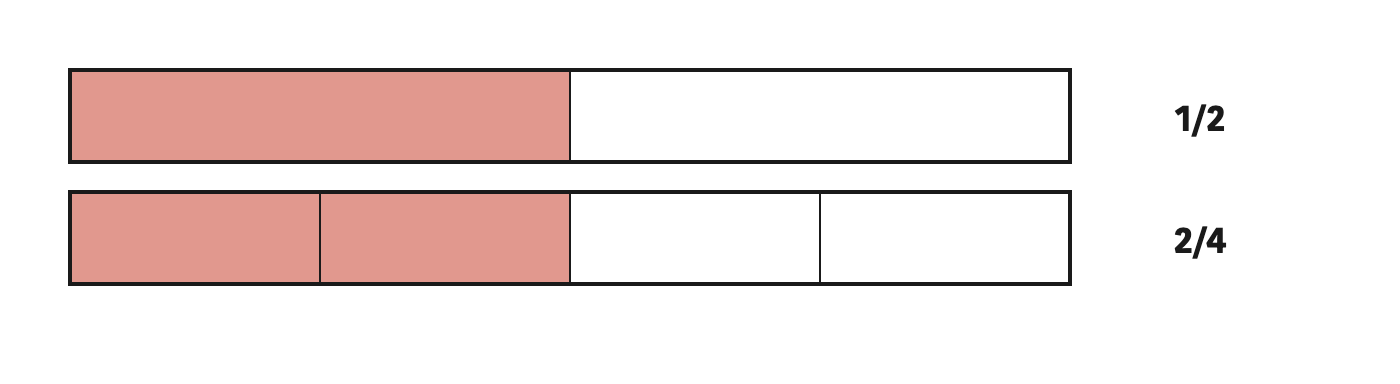
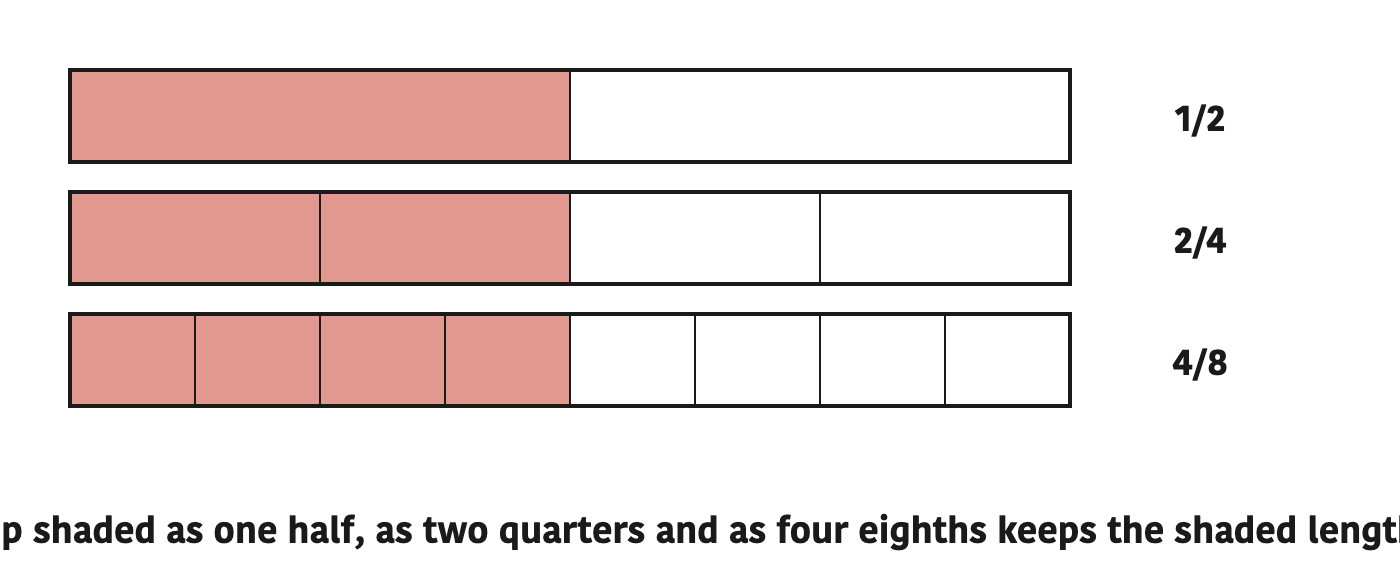
Fold one rectangular strip into two equal parts, then into four, then into eight, colouring half of it each time. The shading is named \( \frac{1}{2} \), then \( \frac{2}{4} \), then \( \frac{4}{8} \), yet the coloured length never changes. All three names stand for the same amount.
\[ \frac{1}{2} = \frac{2}{4} = \frac{4}{8} \]
Equivalent fractions: fractions that have different numerators and denominators but stand for exactly the same amount.
Equivalent fractions can be made without folding any paper. Multiplying the numerator and the denominator of a fraction by the same number does not change its value. Here is how the equivalent fractions of \( \frac{1}{2} \) are found.
Step 1: Multiply both the numerator and the denominator by 2:
\[ \frac{1}{2} = \frac{1 \times 2}{2 \times 2} = \frac{2}{4} \]
Step 2: Multiply both the numerator and the denominator by 3:
\[ \frac{1}{2} = \frac{1 \times 3}{2 \times 3} = \frac{3}{6} \]
Step 3: Multiply both the numerator and the denominator by 4:
\[ \frac{1}{2} = \frac{1 \times 4}{2 \times 4} = \frac{4}{8} \]
Step 4: Multiply both the numerator and the denominator by 5:
\[ \frac{1}{2} = \frac{1 \times 5}{2 \times 5} = \frac{5}{10} \]
So the equivalent fractions of \( \frac{1}{2} \) are \( \frac{2}{4} \), \( \frac{3}{6} \), \( \frac{4}{8} \) and \( \frac{5}{10} \). As many equivalent fractions as you like can be made in this way.
To build an equivalent fraction, multiply the numerator and the denominator of the fraction by one and the same number.
Applying the same rule to \( \frac{3}{4} \) gives the equivalent fractions shown below.
| Multiply by | Working | Equivalent fraction |
| 2 | \( \frac{3 \times 2}{4 \times 2} \) | \( \frac{6}{8} \) |
| 3 | \( \frac{3 \times 3}{4 \times 3} \) | \( \frac{9}{12} \) |
| 4 | \( \frac{3 \times 4}{4 \times 4} \) | \( \frac{12}{16} \) |
| 5 | \( \frac{3 \times 5}{4 \times 5} \) | \( \frac{15}{20} \) |
Sometimes the denominator you need is fixed in advance. Here is how to find the equivalent fraction of \( \frac{3}{4} \) whose denominator is 12.
Step 1: Find what the denominator 4 must be multiplied by to give 12:
\[ 4 \times 3 = 12 \]
Step 2: Multiply the numerator by that same 3 so that the value does not change:
\[ \frac{3}{4} = \frac{3 \times 3}{4 \times 3} = \frac{9}{12} \]
Comparing Unlike Fractions
A long strip cut into seven equal parts with five of them coloured shows \( \frac{5}{7} \) coloured and \( \frac{2}{7} \) left plain. The coloured part holds five pieces of size \( \frac{1}{7} \) while the plain part holds only two such pieces. The pieces are the same size, so five of them beat two of them.
\[ \frac{5}{7} > \frac{2}{7} \]
Like fractions are fractions with the same denominator, such as \( \frac{3}{8} \) and \( \frac{5}{8} \). Unlike fractions have different denominators, such as \( \frac{2}{3} \) and \( \frac{3}{4} \).
When two fractions have the same denominator, compare only the numerators. The fraction with the bigger numerator is the bigger fraction.
With fractions like \( \frac{3}{8} \) and \( \frac{8}{16} \) the pieces themselves are of different size, so the numerators cannot be compared straight away. In such a case both fractions must first be rewritten with the same denominator.
Converting Unlike Fractions into Like Fractions
Giving two fractions the same denominator means cutting both of them into pieces of one size. Sometimes one denominator is already a multiple of the other, which makes the work short. Here is how \( \frac{3}{5} \) and \( \frac{5}{10} \) are given the same denominator.
Step 1: To match the first denominator 5 with the second denominator 10, multiply the numerator and the denominator by 2:
\[ \frac{3}{5} = \frac{3 \times 2}{5 \times 2} = \frac{6}{10} \]
Step 2: Both fractions now have denominator 10, so the like fractions are:
\[ \frac{6}{10} \ \text{,} \ \frac{5}{10} \]
When neither denominator divides the other, list the multiples of both denominators and pick the lowest common multiple. Below, \( \frac{2}{3} \) and \( \frac{3}{4} \) are given the same denominator.
Step 1: List the multiples of 3:
\[ 3, \ 6, \ 9, \ 12, \ 15, \ \ldots \]
Step 2: List the multiples of 4:
\[ 4, \ 8, \ 12, \ 16, \ 20, \ \ldots \]
Step 3: The first common multiple of both lists is 12, so 12 becomes the denominator. Multiplying the numerator and denominator of \( \frac{2}{3} \) by 4:
\[ \frac{2}{3} = \frac{2 \times 4}{3 \times 4} = \frac{8}{12} \]
Step 4: Multiplying the numerator and denominator of \( \frac{3}{4} \) by 3:
\[ \frac{3}{4} = \frac{3 \times 3}{4 \times 3} = \frac{9}{12} \]
Before unlike fractions can be compared, they must first be turned into like fractions.
The same steps now settle which is bigger, \( \frac{2}{3} \) or \( \frac{5}{6} \). The multiples of 3 are 3, 6, 9, 12 and the multiples of 6 are 6, 12, 18, so the lowest common multiple is 6.
Step 1: To make the denominator of \( \frac{2}{3} \) equal to 6, multiply the numerator and the denominator by 2:
\[ \frac{2}{3} = \frac{2 \times 2}{3 \times 2} = \frac{4}{6} \]
Step 2: The denominator of \( \frac{5}{6} \) is already 6, so it stays as it is. The denominators now match, so compare the numerators:
\[ \frac{5}{6} > \frac{4}{6} \]
Step 3: Since \( \frac{4}{6} \) is the same as \( \frac{2}{3} \), the conclusion is:
\[ \frac{5}{6} > \frac{2}{3} \]
Adding and Subtracting Unlike Fractions
Fraction strips show what \( \frac{1}{2} \) and \( \frac{2}{5} \) come to when they are put together. Cut three strips of the same length, dividing the first into two equal parts, the second into five and the third into ten. Take one part from the first strip and two parts from the second, lay them along the third strip, and together they cover exactly nine of its ten parts.
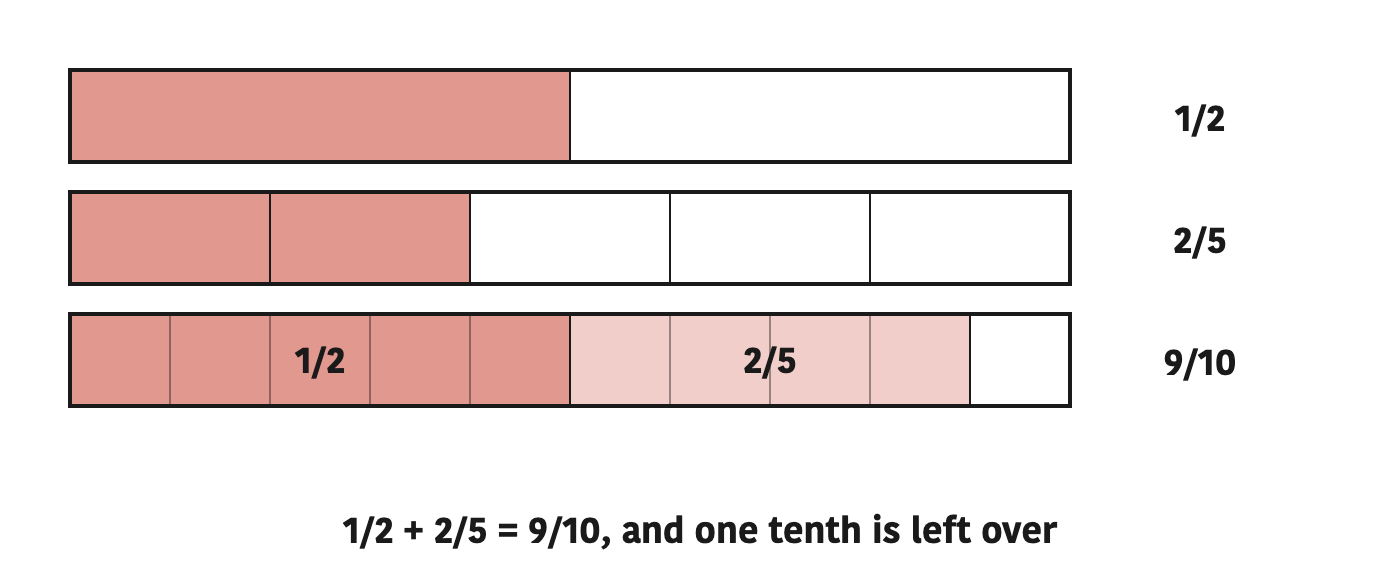
\[ \frac{1}{2} + \frac{2}{5} = \frac{9}{10} \]
Cutting strips is not possible every time. In the written method, the lowest common multiple of the two denominators becomes the common denominator, and then the numerators are added or subtracted. Here is \( \frac{9}{10} + \frac{1}{6} \) worked out.
Step 1: The multiples of 10 are:
\[ 10, \ 20, \ 30, \ 40, \ 50, \ 60, \ \ldots \]
Step 2: The multiples of 6 are:
\[ 6, \ 12, \ 18, \ 24, \ 30, \ \ldots \]
Step 3: The lowest common multiple is 30, so both fractions are rewritten with denominator 30:
\[ \frac{9}{10} = \frac{9 \times 3}{10 \times 3} = \frac{27}{30} \]
\[ \frac{1}{6} = \frac{1 \times 5}{6 \times 5} = \frac{5}{30} \]
Step 4: The denominators now match, so add the numerators:
\[ \frac{27}{30} + \frac{5}{30} = \frac{27 + 5}{30} = \frac{32}{30} \]
Step 5: Dividing the numerator and the denominator by 2 puts the answer in its lowest terms:
\[ \frac{32}{30} = \frac{16}{15} \]
Subtraction follows exactly the same road, with the numerators taken away instead of added at the last step. Work out \( \frac{11}{24} - \frac{3}{8} \). The multiples of 24 are 24, 48 and the multiples of 8 are 8, 16, 24, 32, so the lowest common multiple is 24.
Step 1: The denominator of \( \frac{11}{24} \) is already 24, so only \( \frac{3}{8} \) changes. Multiply its numerator and denominator by 3:
\[ \frac{3}{8} = \frac{3 \times 3}{8 \times 3} = \frac{9}{24} \]
Step 2: Subtract the numerators of the like fractions:
\[ \frac{11}{24} - \frac{9}{24} = \frac{11 - 9}{24} = \frac{2}{24} \]
Step 3: Divide the numerator and the denominator by 2 to reach the lowest terms:
\[ \frac{2}{24} = \frac{1}{12} \]
Adding numerator to numerator and denominator to denominator is wrong. The answer to \( \frac{2}{3} + \frac{1}{4} \) is not \( \frac{3}{7} \). Never add or subtract until the denominators are equal.
When a sum contains mixed numbers, change them into improper fractions first. Multiply the whole number by the denominator and add the numerator, so \( 3\frac{1}{5} = \frac{3 \times 5 + 1}{5} = \frac{16}{5} \). After that, the denominators are matched in the usual way.
Multiplying Fractions
If 1 litre of paint covers \( \frac{3}{5} \) m², then asking how much 4 litres will cover means taking \( \frac{3}{5} \) four times. That repeated taking is written as a multiplication.
Step 1: The mathematical statement is:
\[ \frac{3}{5} \times 4 \]
Step 2: Each \( \frac{3}{5} \) is three pieces of size \( \frac{1}{5} \), so four of them make \( 4 \times 3 = 12 \) such pieces. Multiplying only the numerator by 4:
\[ \frac{3 \times 4}{5} = \frac{12}{5} \]
So 4 litres of paint cover \( \frac{12}{5} \) m².
To multiply a fraction by a whole number, multiply only the numerator of the fraction by that whole number and keep the denominator as it is.
The same rule settles \( 56 \times \frac{7}{8} \) quickly. The numerator becomes \( 56 \times 7 = 392 \), and dividing that by the denominator 8 gives \( \frac{392}{8} = 49 \).
Shashikala has 6 oranges and gives Bishnu \( \frac{1}{3} \) of them. Finding how many she gives is again a multiplication, because a fraction of a number means that number multiplied by the fraction.
Step 1: The mathematical statement is:
\[ 6 \times \frac{1}{3} \]
Step 2: Multiplying the numerator by 6:
\[ \frac{6 \times 1}{3} = \frac{6}{3} = 2 \]
Do not turn the word of into a division sign. One third of 6 means \( 6 \times \frac{1}{3} \) and not \( 6 \div \frac{1}{3} \).
Now suppose 1 litre of paint covers \( \frac{3}{4} \) m² and you want to know what \( \frac{1}{2} \) litre covers. This time a fraction has to be multiplied by a fraction. Cutting the \( \frac{3}{4} \) part into two equal halves and keeping one of them leaves three parts out of eight.
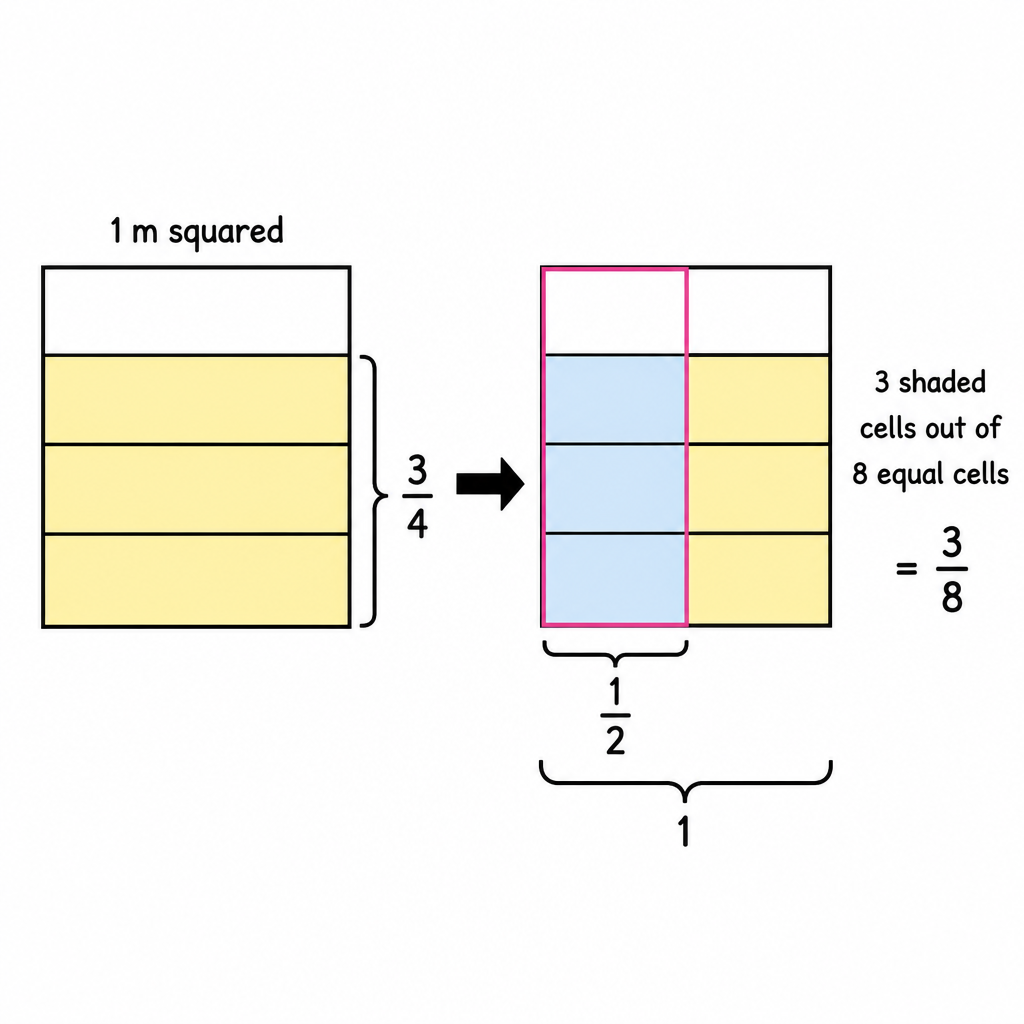
Step 1: The mathematical statement is:
\[ \frac{3}{4} \times \frac{1}{2} \]
Step 2: Multiplying numerator by numerator and denominator by denominator:
\[ \frac{3 \times 1}{4 \times 2} = \frac{3}{8} \]
To multiply one fraction by another, multiply the two numerators to get the new numerator and multiply the two denominators to get the new denominator.
For example, in \( \frac{3}{5} \times \frac{5}{6} \) the numerators give \( 3 \times 5 = 15 \) and the denominators give \( 5 \times 6 = 30 \), so the answer is \( \frac{15}{30} \), which in lowest terms is \( \frac{1}{2} \).
When the amounts carry units, the answer carries them too. Three quarters of \( \frac{1}{2} \) kg is \( \frac{1 \times 3}{2 \times 4} = \frac{3}{8} \) kg, and since \( 1 \ \text{kg} = 1000 \ \text{gm} \), that equals \( \frac{3}{8} \times 1000 = 375 \ \text{gm} \).
Dividing Fractions
Two sacks of fertiliser are enough for \( \frac{4}{5} \) of a farmer's field, and the question is how much one sack covers. That means sharing \( \frac{4}{5} \) into two equal parts. To divide a fraction by a whole number, the division sign is changed into a multiplication sign and the divisor is replaced by its reciprocal.
Reciprocal: the number formed by exchanging the numerator and the denominator. The reciprocal of \( \frac{3}{8} \) is \( \frac{8}{3} \), and since the whole number 2 is read as \( \frac{2}{1} \), its reciprocal is \( \frac{1}{2} \).
Step 1: The mathematical statement is:
\[ \frac{4}{5} \div 2 \]
Step 2: Change the division sign to a multiplication sign and use the reciprocal of the divisor 2:
\[ \frac{4}{5} \times \frac{1}{2} \]
Step 3: Multiplying numerator by numerator and denominator by denominator:
\[ \frac{4 \times 1}{5 \times 2} = \frac{4}{10} \]
Step 4: Dividing the numerator and the denominator by 2 gives the lowest terms:
\[ \frac{4}{10} = \frac{2}{5} \]
To divide a fraction by a whole number, change the division sign into a multiplication sign and turn the divisor upside down.
If \( \frac{1}{3} \) litre of paint covers \( \frac{3}{5} \) of a door, working out what 1 litre covers means dividing a fraction by another fraction. The rule stays the same.
Step 1: The mathematical statement is:
\[ \frac{3}{5} \div \frac{1}{3} \]
Step 2: The reciprocal of the divisor \( \frac{1}{3} \) is \( \frac{3}{1} \), so the division becomes a multiplication:
\[ \frac{3}{5} \times \frac{3}{1} \]
Step 3: Multiplying the numerators and the denominators separately:
\[ \frac{3 \times 3}{5 \times 1} = \frac{9}{5} \]
To divide one fraction by another, change the division sign into a multiplication sign and turn the dividing fraction upside down.
Only the divisor is turned upside down, never both fractions. In \( \frac{3}{5} \div \frac{1}{3} \) the first fraction \( \frac{3}{5} \) stays exactly as it is.
Mixed numbers are changed into improper fractions first. In \( 3\frac{5}{9} \div 2\frac{2}{3} \), the numbers become \( \frac{32}{9} \) and \( \frac{8}{3} \). Turning the divisor over gives \( \frac{32}{9} \times \frac{3}{8} = \frac{96}{72} = \frac{4}{3} \), which as a mixed number is \( 1\frac{1}{3} \).
Fractions in Everyday Problems
With a problem given in words, the first habit is to write it as a mathematical statement. A question asking how much is left calls for subtraction, one asking for the total calls for addition, one asking for a part of an amount calls for multiplication, and one asking how many equal pieces fit calls for division.
Vinita had \( \frac{3}{4} \) of an apple and gave Hari \( \frac{1}{5} \) of an apple. Find how much she has left.
Step 1: The mathematical statement is:
\[ \frac{3}{4} - \frac{1}{5} \]
Step 2: The lowest common multiple of 4 and 5 is 20, so both fractions are rewritten with denominator 20:
\[ \frac{3}{4} = \frac{15}{20} \]
\[ \frac{1}{5} = \frac{4}{20} \]
Step 3: Subtracting the numerators:
\[ \frac{15}{20} - \frac{4}{20} = \frac{11}{20} \]
In another problem, pieces of length \( \frac{5}{6} \) metre are cut from a rope 25 metres long, and the question is how many pieces are made. Here you are asking how many times \( \frac{5}{6} \) fits inside 25, so this is a division.
Step 1: The mathematical statement is:
\[ 25 \div \frac{5}{6} \]
Step 2: Using the reciprocal of the divisor turns it into a multiplication:
\[ 25 \times \frac{6}{5} = \frac{150}{5} = 30 \]
So 30 pieces are made. Since the answer counts pieces, a whole number is what you should expect, and that acts as a check on the working.
Addition and subtraction: make the denominators equal first, then add or subtract only the numerators.
Multiplication: multiply numerator by numerator and denominator by denominator, with no need to match denominators.
Division: change the division sign to multiplication and turn the divisor upside down.
Comparison: make the denominators equal and then look at the numerators.
The full lesson is waiting for you
Create a free account to unlock activities, practice tests, presentations and videos - and to track your progress and confidence score for every subject.
In a fraction the denominator tells how many equal parts the whole was divided into and the numerator tells how many of those parts were taken.
11 more points to remember - sign in to see the rest.
Question 1 of 13