Adding, subtracting and multiplying whole numbers
The numbers we count with, starting from 0 and going on without ending, form the set of whole numbers. We write this set with the letter W. If you take any two numbers from this set and add, multiply or subtract them, something interesting shows up.
Whole numbers: the counting numbers starting at zero and increasing by one each time, that is \( W = \{0, 1, 2, 3, \ldots\} \).
Take 2 and 3 from the set W. Adding them gives \( 2 + 3 = 5 \) and multiplying them gives \( 2 \times 3 = 6 \). Both 5 and 6 are whole numbers again. Whichever two whole numbers you pick, their sum and their product are always whole numbers. Now try subtraction. In \( 3 - 2 = 1 \) the answer is still a whole number, but what is the answer to \( 2 - 3 \)? This is exactly where we need numbers we have not met yet.
When subtraction goes below zero
A number line shows very clearly where the answer lands when a bigger number is subtracted from a smaller one. Subtracting means moving to the left on the number line. Let us work out \( 2 - 3 \) step by step.
Step 1: The mathematical statement is:
\[ 2 - 3 \]
Step 2: Stand at 2 on the number line and move 3 units to the left, one unit for each 1 being subtracted. The first step lands on:
\[ 1 \]
Step 3: The second step lands on:
\[ 0 \]
Step 4: The third step lands one unit to the left of 0. The number at that place is written as -1. So:
\[ 2 - 3 = -1 \]
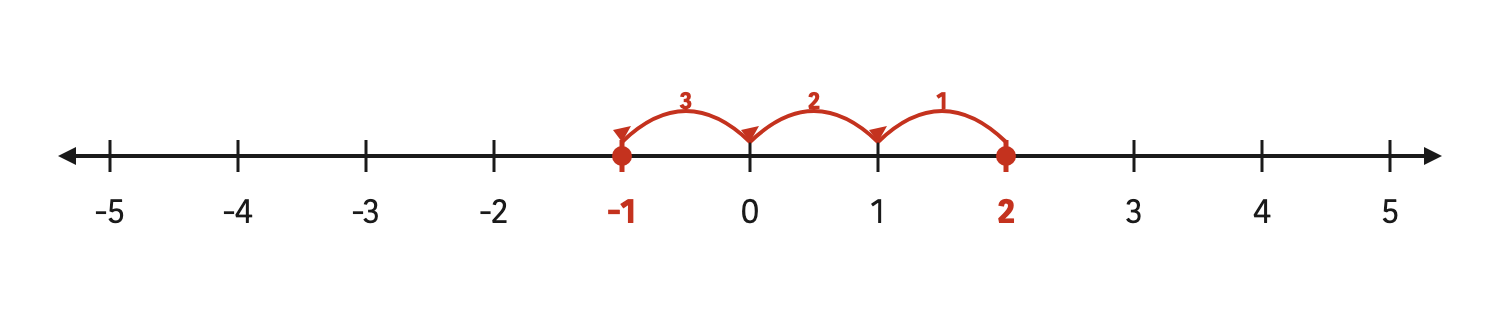
Other subtractions work the same way. Taking 6 away from 4 carries the count two units to the left of 0, so \( 4 - 6 = -2 \). In the same way, taking 6 away from 3 carries it three units to the left of 0, so \( 3 - 6 = -3 \).
Negative numbers and the set of integers
The numbers -1, -2 and -3 that turned up above are not whole numbers, because they are not in the set W. Numbers smaller than zero like these are called negative numbers. They are written with a minus sign in front.
Negative number: a number smaller than zero, written with a minus sign in front of it, such as -1, -2 and -3.
Now put the negative numbers, zero and the positive numbers together in one set. The set formed in this way is called the set of integers, and we write it as Z.
\[ Z = \{\ldots, -3, -2, -1, 0, 1, 2, 3, \ldots\} \]
Integers: the set of numbers made up of the negative numbers, zero and the positive numbers taken together.
The set of positive numbers, zero, and the set of negative numbers together form the set of integers. Zero itself is neither negative nor positive.
An integer has no decimal part and no fraction part. So numbers like 1.5, 0.66, \( \frac{1}{2} \) and \( \frac{2}{3} \) are not integers, while -75, 0, 40 and 100 are integers.
Integers on the number line
Integers can be shown on a number line by marking them at equal distances. Zero is written in the middle, 1, 2, 3 go to its right, and -1, -2, -3 go to its left.
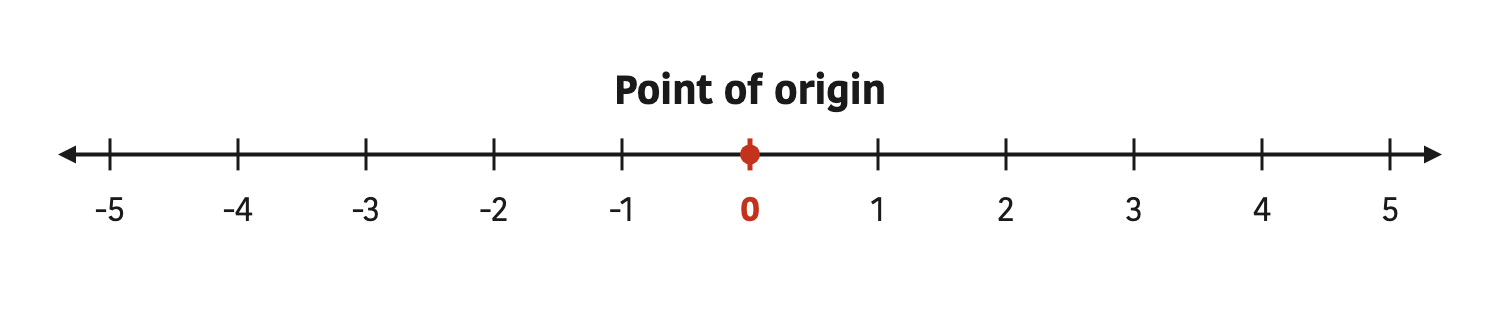
The place where 0 is written on the number line is called the point of origin. Going to the right from the point of origin, the value of the numbers keeps increasing, and going to the left it keeps decreasing. The numbers to the right are positive and the numbers to the left are negative.
Point of origin: the place on the number line where 0 is written, and from which we measure to the right and to the left.
The set of positive integers is written as \( Z^{+} = \{+1, +2, +3, \ldots\} \). In the same way, \( Z^{-} = \{-1, -2, -3, -4, \ldots\} \) is called the set of negative integers.
Positive integers: the integers lying to the right of the point of origin, such as +1, +2 and +3.
Zero: the integer that sits at the point of origin itself, and is neither positive nor negative.
Negative integers: the integers lying to the left of the point of origin, such as -1, -2 and -3.
Writing that zero is a positive number is wrong. Zero is neither positive nor negative. It is the integer that sits right at the point of origin.
Which integer is greater?
The number line itself tells us which of two integers is greater. The number lying further to the right is always the greater one, and the number lying further to the left is always the smaller one. Because of this, every negative integer is smaller than zero and every positive integer is greater than zero. Let us compare -12 and -5.
Step 1: The two integers to be compared are:
\[ -12, \quad -5 \]
Step 2: Find where each one sits. The number -12 is 12 units to the left of the point of origin, while -5 is only 5 units to the left, so -12 lies further left.
Step 3: Since the number lying further left is the smaller one:
\[ -12 < -5 \]
Now compare -21 and -23. The number -23 is 23 units to the left of the point of origin, while -21 is only 21 units to the left, so -21 lies to the right of -23. The number on the right is greater, so \( -21 > -23 \).
| Comparison | Answer | Reason |
| -2 and 0 | \( -2 < 0 \) | A negative number lies to the left of zero |
| -8 and 8 | \( -8 < 8 \) | -8 is on the left and 8 is on the right |
| -33 and 0 | \( -33 < 0 \) | Every negative integer is smaller than zero |
Do not call a negative number greater just because its digit looks bigger. In -6 and -5 the digit 6 is bigger, but -6 lies further left on the number line, so \( -6 < -5 \).
Putting integers in order
When several integers have to be arranged from smallest to greatest, imagine reading the number line from left to right. Let us arrange 5, 8, -3, -4, 0, 9.
Step 1: The negative integers lie furthest to the left, so take them first. Since -4 is further to the left of the point of origin than -3, it comes first:
\[ -4, \; -3 \]
Step 2: After the negative integers comes zero, which sits at the point of origin:
\[ -4, \; -3, \; 0 \]
Step 3: Finally, place the positive integers in order from smallest to greatest to complete the answer:
\[ -4, \; -3, \; 0, \; 5, \; 8, \; 9 \]
Integers that lie between two integers
To find which integers lie between two given integers, read the marks that fall between their two places on the number line. Let us find the integers lying between -8 and -15.
Step 1: Locate both numbers. Since -15 lies further left and -8 lies further right, the counting must start from -15:
\[ -15 < -8 \]
Step 2: Start one unit to the right of -15 and pick up every integer until just before -8 is reached:
\[ -14, \; -13, \; -12, \; -11, \; -10, \; -9 \]
Step 3: The two given numbers are not counted as lying in between, so the answer holds 6 integers. In the same way, the integers between -2 and 3 are:
\[ -1, \; 0, \; 1, \; 2 \]
Integers in daily life
Integers are not something that lives only in an exercise book. Wherever a measurement has to be made in two opposite directions from one fixed place, integers are needed. That fixed place acts as the point of origin.
- When the temperature in winter falls 4 degrees below zero, it is written as -4 degrees.
- A place 300 metres above sea level is shown as +300 metres, while a pit below sea level is shown by a negative number.
- A shop that makes a profit of 500 rupees records +500, and one that suffers a loss of 500 rupees records -500.
- Taking the ground floor of a building as 0, the floors above it are 1, 2, 3 and the parking floors below it are -1 and -2.
- On a straight road, if distance towards the east is taken as positive, then distance towards the west is negative.
Now take a real problem. Place A is 5 kilometres east of a temple and place B is 3 kilometres west of the same temple. Show this on a number line and find the distance between A and B.
Step 1: Take the temple as the point of origin, with east to the right and west to the left. So the position of A is:
\[ A = +5 \]
Step 2: B lies west of the temple, which is to the left. So the position of B is:
\[ B = -3 \]
Step 3: Going from A to B means walking 5 kilometres up to the temple and then 3 kilometres beyond it to B. So the whole distance is:
\[ 5\ \text{km} + 3\ \text{km} = 8\ \text{km} \]
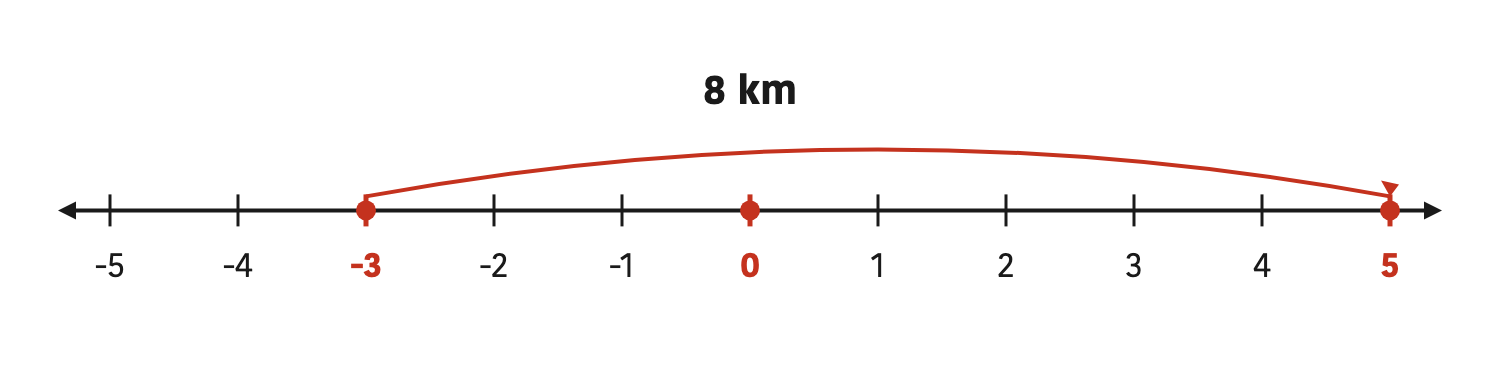
A distance is always positive. Negative numbers may be used to show a position, but the distance between two positions is never negative.
The full lesson is waiting for you
Create a free account to unlock activities, practice tests, presentations and videos - and to track your progress and confidence score for every subject.
The set of whole numbers is \( W = \{0, 1, 2, 3, \ldots\} \).
11 more points to remember - sign in to see the rest.
Question 1 of 13