The numbers we count with
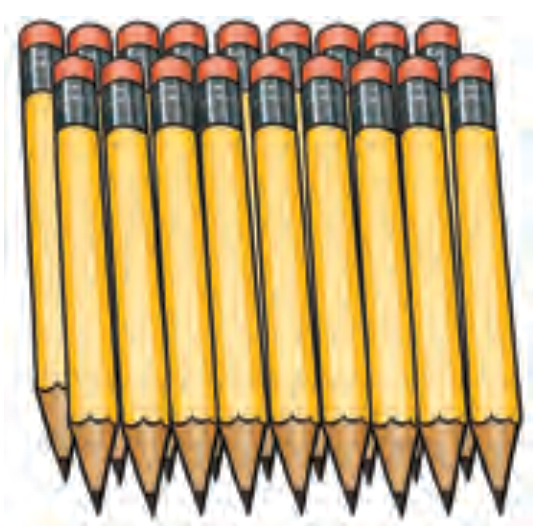
The pencils in your hand can be counted one, two, three, and so on. The grains of rice in a sack can be counted too, though counting every grain would take a very long time. The numbers used for counting things are called natural numbers. They begin at 1 and go on for ever.

The collection of counting numbers is called the set of natural numbers. It is written as N.
\[ N = \{1, 2, 3, 4, \ldots\} \]
Zero and the whole numbers
Adding or multiplying two natural numbers always gives another natural number. For example \( 8 + 6 = 14 \) and \( 8 \times 6 = 48 \) are both natural numbers. Subtraction is different. \( 8 - 6 = 2 \) is a natural number, but \( 8 - 8 = 0 \) gives zero, which is not. Zero is the number we use to say that there is nothing at all.
The natural numbers together with zero form the set of whole numbers. It is written as W. The first and smallest whole number is zero, 0.
\[ W = \{0, 1, 2, 3, 4, \ldots\} \]
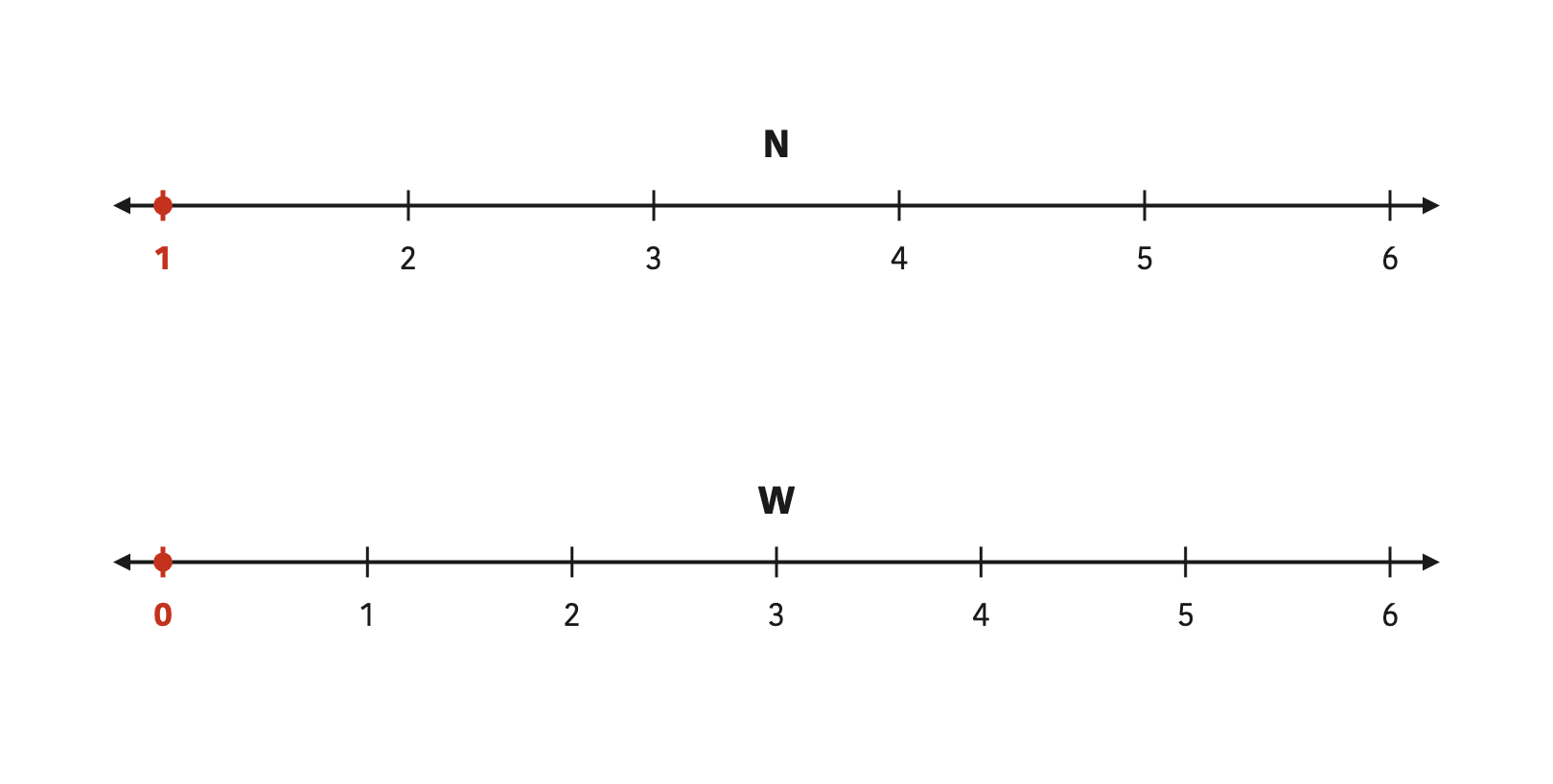
Zero is a whole number but it is not a natural number. The smallest natural number is 1 and the smallest whole number is 0.
Making the smallest and the largest number
Just ten digits, 0, 1, 2, 3, 4, 5, 6, 7, 8 and 9, are enough to write any number, however large. The value a digit carries depends on the place it stands in, so by moving the same digits into different places we can build a larger number or a smaller one.
| Number of digits | Smallest number | Largest number |
| One digit | 1 | 9 |
| Two digits | 10 | 99 |
| Three digits | 100 | 999 |
| Four digits | 1000 | 9999 |
| Five digits | 10000 | 99999 |
| Six digits | 100000 | 999999 |
Take the three digits 3, 5 and 8 and write every three digit number they can make. Put each digit in the hundreds place in turn, then swap the other two.
- With 3 in the hundreds place: 358, 385
- With 5 in the hundreds place: 538, 583
- With 8 in the hundreds place: 835, 853
Now find the difference between the largest and the smallest three digit number that 6, 0 and 3 can make.
Step 1: Putting the biggest digit first gives the largest number:
\[ 630 \]
Step 2: The smallest digit should come first, but 0 in the hundreds place would leave only a two digit number. So 3 goes in the hundreds place and the smallest number is:
\[ 306 \]
Step 3: Subtracting the smaller from the larger:
\[ 630 - 306 = 324 \]
When you build the smallest number, zero cannot go in the highest place. 036 is not a three digit number, it is only 36.
Simplification and the order of operations
A word problem becomes much easier once it is written as a single mathematical statement. Krishna shares 24 pencils equally among 8 friends. Ram's mother then gives him 5 more, and Ram gives 3 of his to his sister. How many pencils does Ram have left?

In a simplification, division and multiplication are done first, then addition and subtraction are worked from left to right.
Step 1: The mathematical statement is:
\[ 24 \div 8 + 5 - 3 \]
Step 2: Division is done first. Since \( 24 \div 8 = 3 \), this becomes:
\[ 3 + 5 - 3 \]
Step 3: Working from the left, adding the first two numbers:
\[ 8 - 3 \]
Step 4: Finally subtracting:
\[ 8 - 3 = 5 \]
So Ram is left with 5 pencils.
Simplification with brackets
Sometimes one operation has to be carried out before the others. Sajan keeps 4 of his 12 chocolates and shares the rest equally between 2 friends. Here 4 must be taken away from 12 first, and only then is the answer divided by 2. Brackets are what show that order, and \( (12 - 4) \div 2 = 4 \).
When a simplification has the four operations ( +, −, ×, ÷ ) together with brackets, the work inside the brackets is done first and the remaining operations follow. The brackets are cleared in this order: the small bracket ( ), then the middle bracket { }, then the big bracket [ ].
Now simplify \( [\,6 \times \{30 - 4 \times (9 - 6)\}\,] + 12 \).
Step 1: Doing the subtraction inside the small bracket ( ):
\[ [\,6 \times \{30 - 4 \times 3\}\,] + 12 \]
Step 2: Inside the middle bracket { } the multiplication comes first. Since \( 4 \times 3 = 12 \):
\[ [\,6 \times \{30 - 12\}\,] + 12 \]
Step 3: Completing the subtraction inside the middle bracket:
\[ [\,6 \times 18\,] + 12 \]
Step 4: Doing the multiplication inside the big bracket [ ]:
\[ 108 + 12 \]
Step 5: Finally adding:
\[ 108 + 12 = 120 \]
Always clear the innermost bracket first. Doing the multiplication in the big bracket before the small one gives the wrong answer.
Divisibility tests
Dividing 365 by 3 gives a quotient of 121 and leaves a remainder of 2, so 365 is not exactly divisible by 3. Doing a full division every time is slow work. Checking whether one number divides another exactly, without carrying out the division, is called a divisibility test.
| Divisor | Test | Example |
| 2 | The number must be even | 1644 is even, so 2 divides it |
| 3 | The sum of the digits must be divisible by 3 | In 7542, 7+5+4+2 = 18 |
| 5 | The units digit must be 0 or 5 | 1250 has 0 in the units place |
| 7 | Twice the units digit taken from the rest must be divisible by 7 | For 364, 36 − 8 = 28 |
| 11 | Taking the units digit from the rest repeatedly must give a multiple of 11 | For 517, 51 − 7 = 44 |
Now test whether 364 is exactly divisible by 7.
Step 1: Twice the units digit, which is 4:
\[ 4 \times 2 = 8 \]
Step 2: Removing the units digit leaves 36, and subtracting that double from it:
\[ 36 - 8 = 28 \]
Step 3: 28 is divisible by 7, because \( 28 \div 7 = 4 \). So 364 is divisible by 7 as well.
Factors and multiples
Six paper squares of 1 cm by 1 cm can be arranged into a rectangle in four different ways. Those four arrangements show that 6 is exactly divisible by 1, 2, 3 and 6.
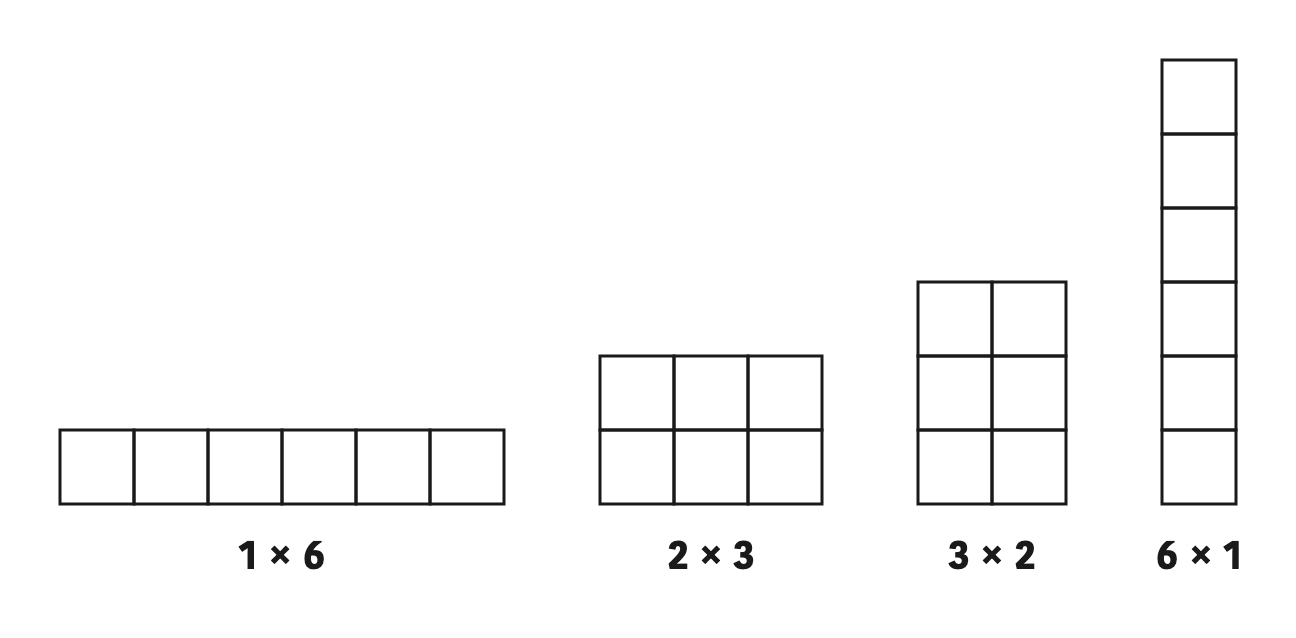
The numbers that divide a given number exactly are called its factors. Every number has at least two factors, 1 and the number itself.
To find the factors of 20, list the pairs whose product is 20: \( 1 \times 20 \), \( 2 \times 10 \) and \( 4 \times 5 \). The set of factors of 20 is then written as follows.
\[ F_{20} = \{1, 2, 4, 5, 10, 20\} \]
When a number is multiplied by the natural numbers one after another, the products obtained are called the multiples of that number.
Multiplying 7 by 1, 2, 3 and so on gives the set of the first ten multiples of 7.
\[ M_{7} = \{7, 14, 21, 28, 35, 42, 49, 56, 63, 70\} \]
A factor is never larger than the number and there are only a limited number of them. A multiple is never smaller than the number and the list of them never ends.
Prime and composite numbers, and prime factorization
Counting the factors of the numbers from 1 to 10 shows that 1 has only one factor. The numbers 2, 3, 5 and 7 have exactly two factors each. The numbers 4, 6, 8, 9 and 10 have more than two.
A number whose only factors are 1 and the number itself, that is exactly two factors, is called a prime number. For example 2, 3, 5, 7, and so on.
A number that has more than two factors is called a composite number. For example 4, 6, 8, 9, 10, and so on.
The number 1 is neither prime nor composite, because it has only one factor. The smallest prime number is 2, and it is the only even prime number.
Writing a composite number as a product of prime numbers only is called the prime factorization of that number. For example \( 24 = 2 \times 2 \times 2 \times 3 \).
Method 1 is the division method. Here the number is divided again and again by small prime numbers. Take the prime factorization of 180.
Step 1: 180 is even, so it is divisible by 2:
\[ 180 \div 2 = 90 \]
Step 2: 90 is even as well, so dividing by 2 again:
\[ 90 \div 2 = 45 \]
Step 3: 45 is odd. Its digits add to \( 4 + 5 = 9 \), which is divisible by 3, so dividing by 3:
\[ 45 \div 3 = 15 \]
Step 4: Dividing 15 by 3 again:
\[ 15 \div 3 = 5 \]
Step 5: The 5 that is left is a prime number, so the dividing stops here. Therefore:
\[ 180 = 2 \times 2 \times 3 \times 3 \times 5 \]
Method 2 is the tree method of factors. The number is split into two factors, and the splitting carries on until no composite number is left. Splitting 120 in a tree leaves only prime numbers in the bottom row.
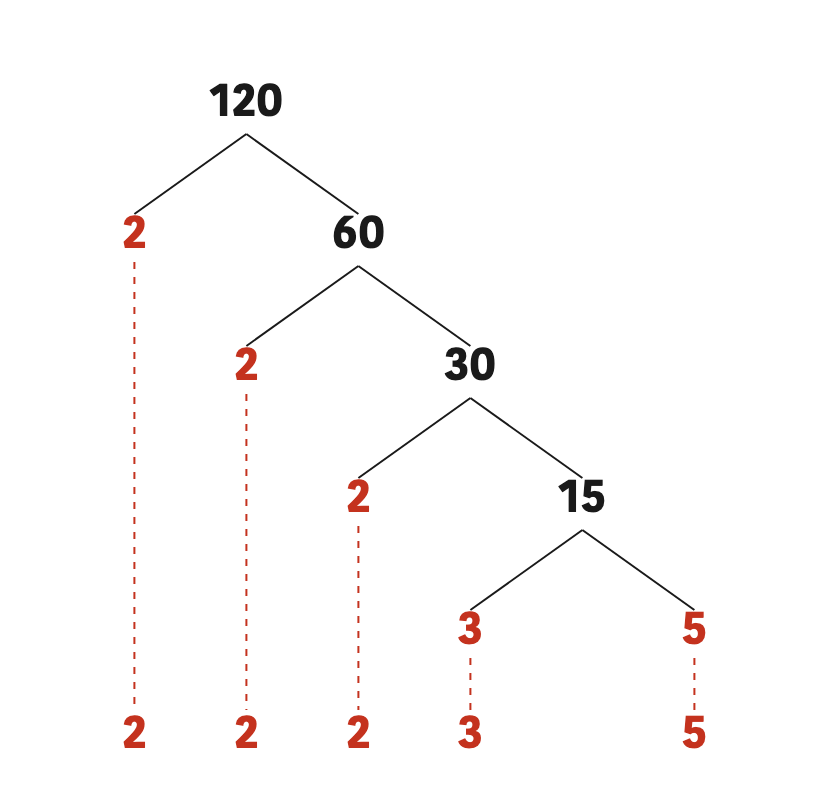
\[ 120 = 2 \times 2 \times 2 \times 3 \times 5 \]
Square numbers and square roots
When dots are arranged so that every row and every column holds the same number of them, they form a square shape. The numbers 1, 4, 9, 16, 25, 36 and 49 can all be arranged in this way.
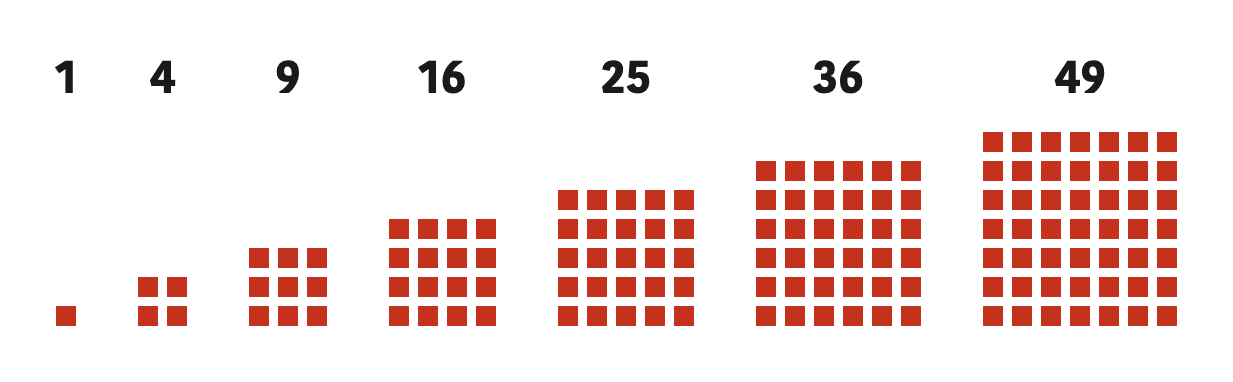
When a number is multiplied by itself, the product obtained is the square number of that number.
If a number can be written as the product of two equal factors, one of those factors is called the square root of the number.
\( 1 \times 1 = 1 \)
\( 2 \times 2 = 4 \)
\( 3 \times 3 = 9 \)
\( 4 \times 4 = 16 \)
\( 5 \times 5 = 25 \)
\( 6 \times 6 = 36 \)
\( 7 \times 7 = 49 \)
\( 8 \times 8 = 64 \)
\( 9 \times 9 = 81 \)
\( 10 \times 10 = 100 \)
Ask how many students stand in each row when 81 students are arranged in a square with equal numbers in every row and column. Since \( 81 = 9 \times 9 \), there must be 9 students in each row.
Highest common factor
The largest factor shared by the given numbers is called their highest common factor. It is written in short as H.C.F.
Method 1 is by making the set of factors. Find the H.C.F. of 18 and 24.
Step 1: Writing the set of factors of each number:
\[ F_{18} = \{1, 2, 3, 6, 9, 18\} \]
\[ F_{24} = \{1, 2, 3, 4, 6, 8, 12, 24\} \]
Step 2: Picking out the factors that appear in both sets:
\[ \{1, 2, 3, 6\} \]
Step 3: Taking the largest of those common factors, the H.C.F. of 18 and 24 is 6.
Method 2 is the prime factorization method. Each number is broken into prime factors and the product of the shared prime factors is the H.C.F. Find the H.C.F. of 36 and 48.
Step 1: Writing the prime factorization of each number:
\[ 36 = 2 \times 2 \times 3 \times 3 \]
\[ 48 = 2 \times 2 \times 2 \times 2 \times 3 \]
Step 2: Multiplying the prime factors that both numbers share:
\[ 2 \times 2 \times 3 = 12 \]
So the H.C.F. of 36 and 48 is 12. When three numbers are given, only the prime factors that appear in all three may be taken.
Lowest common multiple
Two buses set off from the same bus park. The first has a station every 5 km and the second has a station every 10 km. As the first bus travels it marks out the multiples of 5, and as the second travels it marks out the multiples of 10.
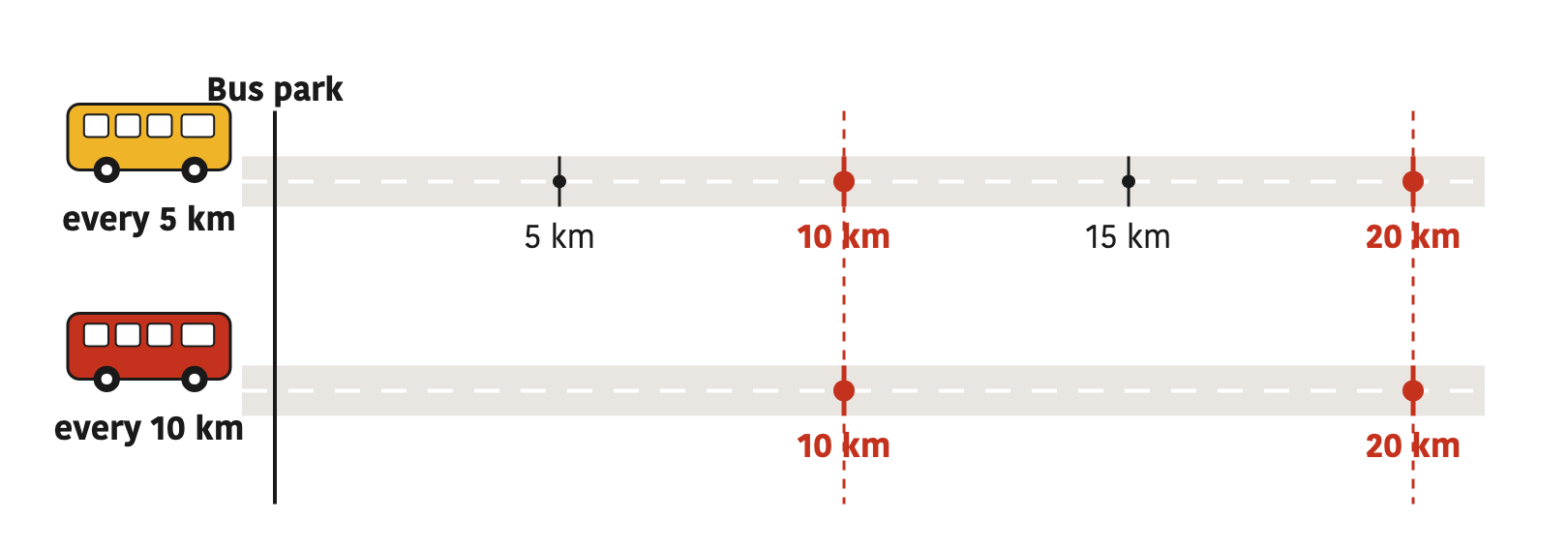
The smallest number that the given numbers all divide exactly is called their lowest common multiple. It is written in short as L.C.M.
Method 1 is by making the set of multiples, which is easy when the numbers are small. For 8 and 12 the multiples are \( M_{8} = \{8, 16, 24, 32, 40, 48, \ldots\} \) and \( M_{12} = \{12, 24, 36, 48, \ldots\} \). The common multiples are 24, 48 and so on, and the smallest of them is 24, so the L.C.M. of 8 and 12 is 24.
Method 2 is the prime factorization method. The shared prime factors are multiplied by the prime factors that are left over. Find the L.C.M. of 20 and 30.
Step 1: Writing the prime factorization of each number:
\[ 20 = 2 \times 2 \times 5 \]
\[ 30 = 2 \times 3 \times 5 \]
Step 2: Multiplying the prime factors that both numbers share:
\[ 2 \times 5 = 10 \]
Step 3: Multiplying the prime factors that are left over:
\[ 2 \times 3 = 6 \]
Step 4: The L.C.M. is the shared product multiplied by the leftover product:
\[ 10 \times 6 = 60 \]
How the H.C.F. and the L.C.M. are linked
Drawing the factors of 22 and 33 in a picture separates the shared factor from the leftover ones. Here \( 22 = 2 \times 11 \) and \( 33 = 3 \times 11 \).
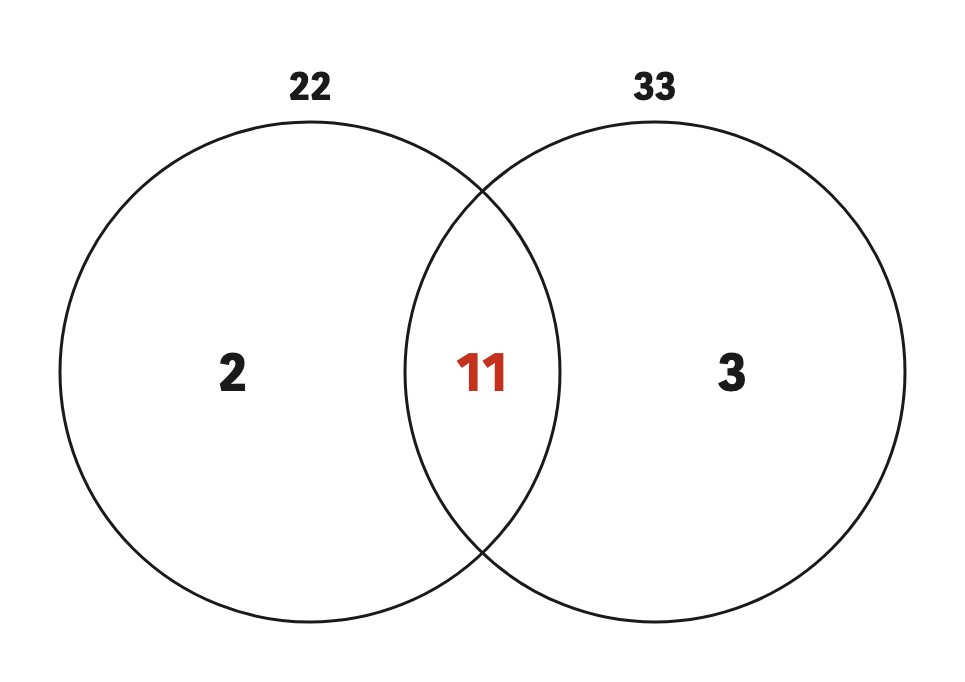
The shared factor 11 is the H.C.F. The product of the shared and leftover factors, \( 11 \times 2 \times 3 = 66 \), is the L.C.M. The product of the two numbers, \( 22 \times 33 = 726 \), turns out to equal the product of the L.C.M. and the H.C.F., \( 66 \times 11 = 726 \).
\( \text{L.C.M.} \times \text{H.C.F.} = \text{first number} \times \text{second number} \)
This relation lets you find one when you know the other. If the H.C.F. of 24 and 40 is 8, then the L.C.M. \( = (24 \times 40) \div 8 = 120 \).
The full lesson is waiting for you
The notes are free to read in full. A free account opens the rest of the practice, and tracks your progress and confidence score for every subject. Presentations and videos need approval from Learn Yeti.