Naming a square on a grid
Picture a large grid drawn on squared paper. Along the bottom row the letters A to I are written, and up the left side the numbers 1 to 9 are written. Now suppose you want to tell a friend about one particular box without pointing at it. You say the letter from the bottom first, then the number from the side. If you say C, 6 your friend goes along to the column marked C, then up to the row marked 6, and lands on exactly the box you meant.
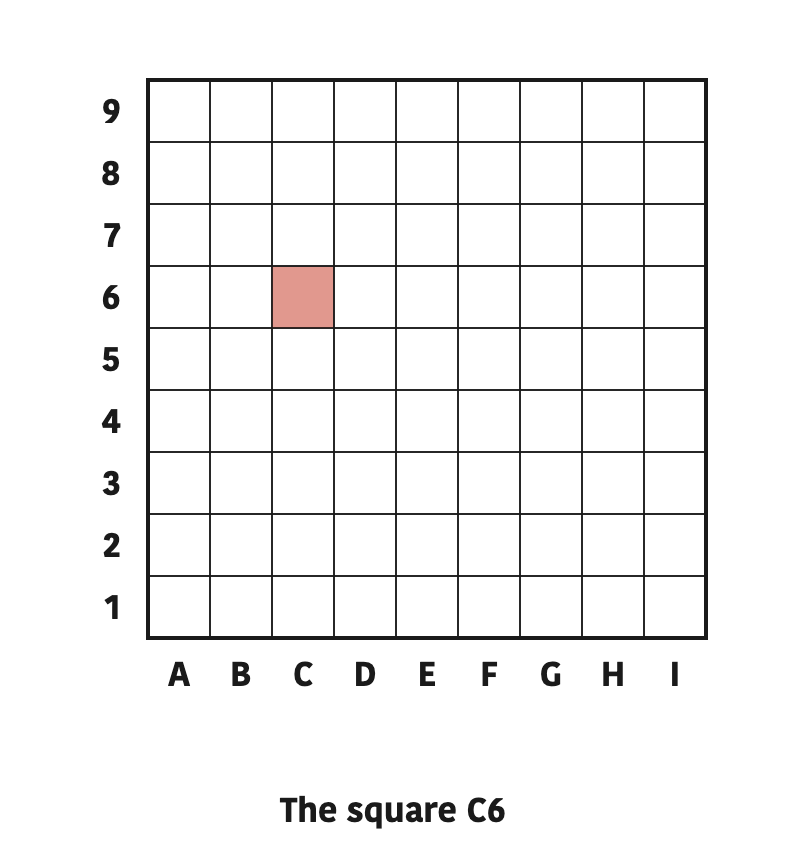
C is the third letter, so C, 6 means three units across and six units up from the starting corner. That can be written in short as \( (3, 6) \). The important idea is here already: two numbers fix one box, and their order never changes. The first number gives the sideways distance and the second gives the upward distance. When this idea is stretched so that it also works to the left and downwards, it becomes coordinate geometry.
The sideways distance is always written first and the upward distance always second.
The two axes and the origin
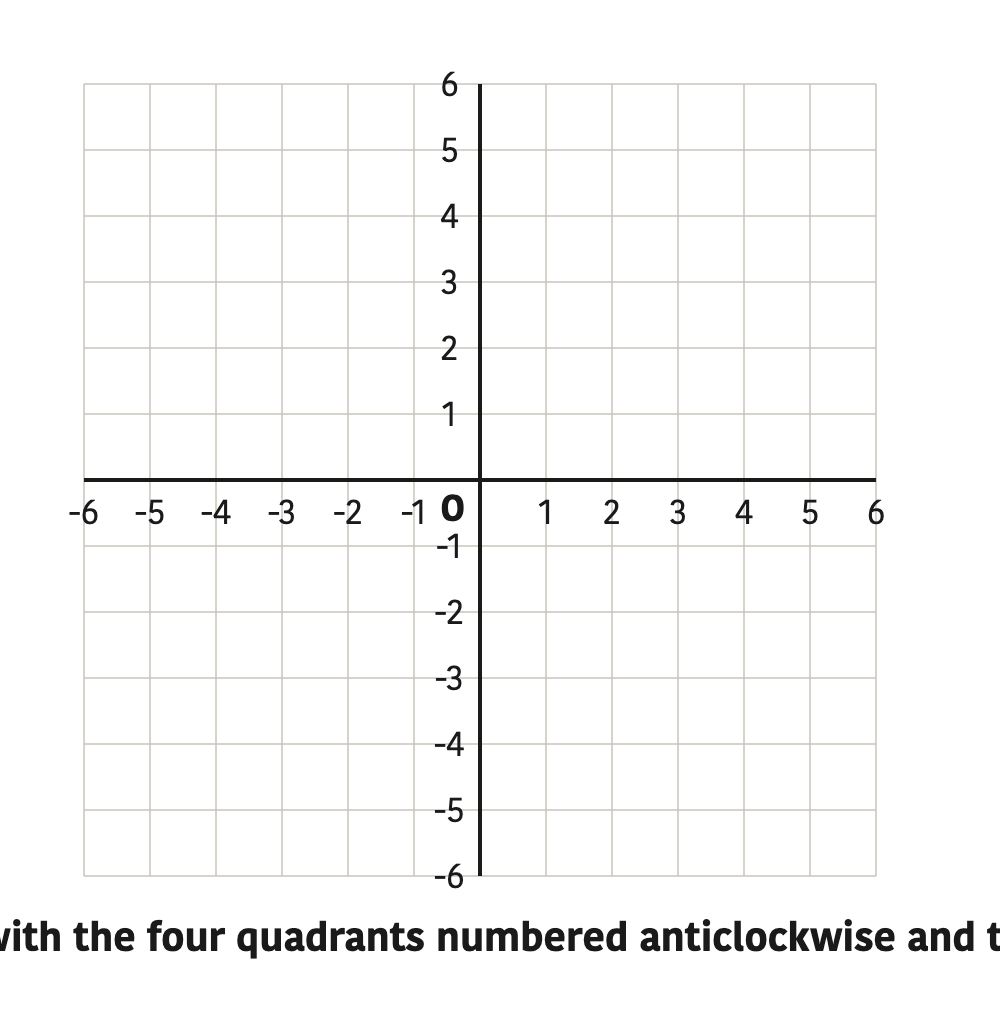
On a graph board two straight lines XX' and YY' are drawn so that they cross each other at one point O and make a right angle there. The point O where they cross is called the origin, and every count of distance starts from it. The two crossing lines are called the axes. The flat line XX' is the X-axis and the upright line YY' is the Y-axis.
Origin: the point where the X-axis and the Y-axis cross each other, and from which every distance to the right, left, up or down is measured.
Axes: the two straight lines that cross at right angles at the origin, namely the X-axis and the Y-axis.
Each axis has two halves and each half has its own name. The part OX running to the right of O is the positive X-axis, and the part OX' running to the left is the negative X-axis. In the same way the part OY going up from O is the positive Y-axis and the part OY' going down is the negative Y-axis. This naming is what later decides whether a number is written with a plus sign or a minus sign.
The four quadrants
The two axes cut the flat sheet into four equal parts, and each part is called a quadrant. The part at the top right, XOY, is the first quadrant. Moving round in the direction opposite to the hands of a clock, the part at the top left, YOX', is the second quadrant, the part at the bottom left, X'OY', is the third quadrant, and the part at the bottom right, Y'OX, is the fourth quadrant.
Quadrant: one of the four parts into which the X-axis and the Y-axis divide the flat surface.
Coordinates of a point
Now take any point A on the graph and count how far you must go from the origin O to reach it: so many units to the right, then so many units up. Suppose five units to the right and six units up bring you to A. This is written as \( (5, 6) \), and \( (5, 6) \) is called the coordinates of A. The first number, 5, is the x-coordinate and the second number, 6, is the y-coordinate.
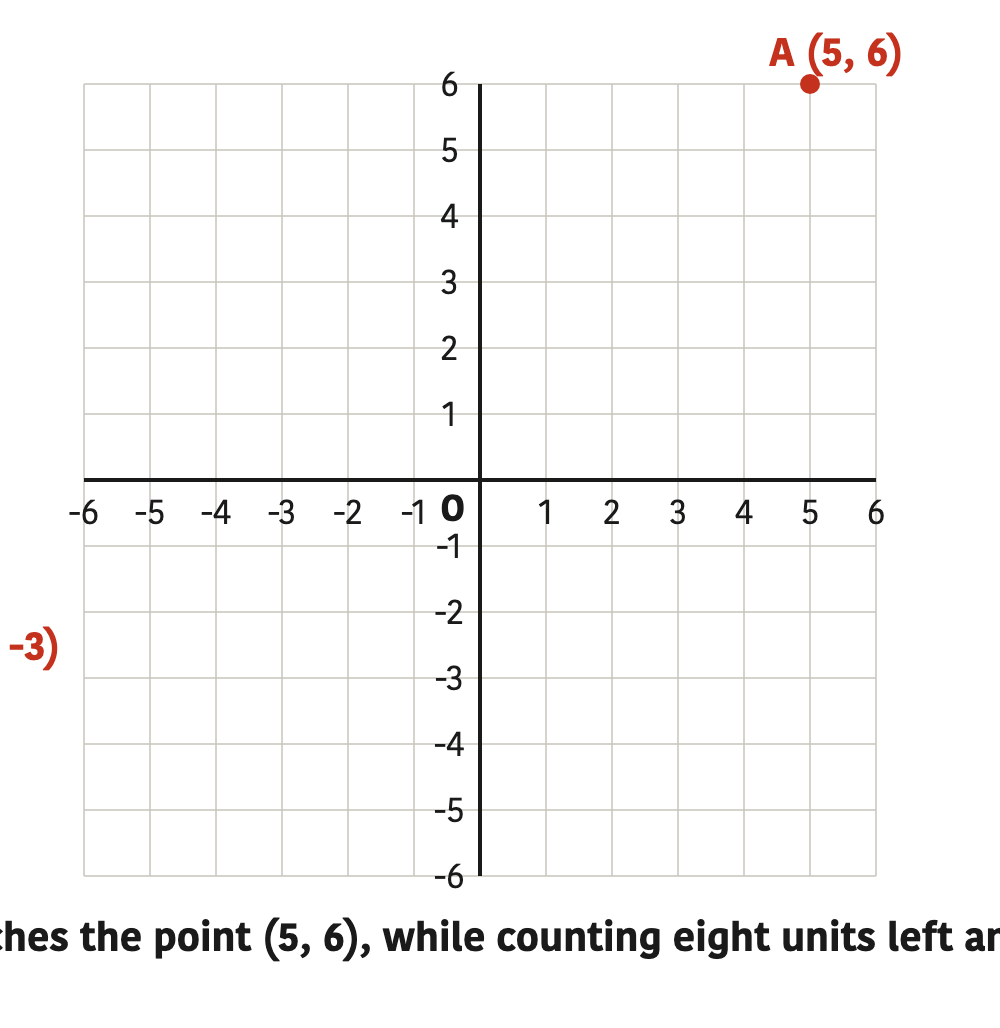
To reach another point D you must go eight units to the left of the origin and three units down. Going left is going in the negative direction, and going down is also going in the negative direction. So these two distances are written as \( -8 \) and \( -3 \), which makes the coordinates of D equal to \( (-8, -3) \).
Coordinates: the pair of numbers \( (x, y) \) that gives, in order, the sideways distance and then the upward distance needed to reach a point from the origin.
The points \( (5, 6) \) and \( (6, 5) \) are not the same. The first number is always the sideways distance. Swapping the order lands you on a completely different point.
The signs in each quadrant
Moving to the right of the origin makes the x-coordinate positive, and moving to the left makes it negative. In the same way, moving up makes the y-coordinate positive and moving down makes it negative. Putting these two rules together gives a table showing which pair of signs belongs to which quadrant.
| Quadrant | Direction from the origin | Signs | Example point |
| First | Right, up | (+, +) | \( (5, 6) \) |
| Second | Left, up | (-, +) | \( (-3, 11) \) |
| Third | Left, down | (-, -) | \( (-9, -4) \) |
| Fourth | Right, down | (+, -) | \( (8, -4) \) |
Reading coordinates from a graph
On the graph below four animals are sitting on crossing points of the grid. For each one, count how many units you walk right or left from the origin, and how many units up or down, and then write the position down.
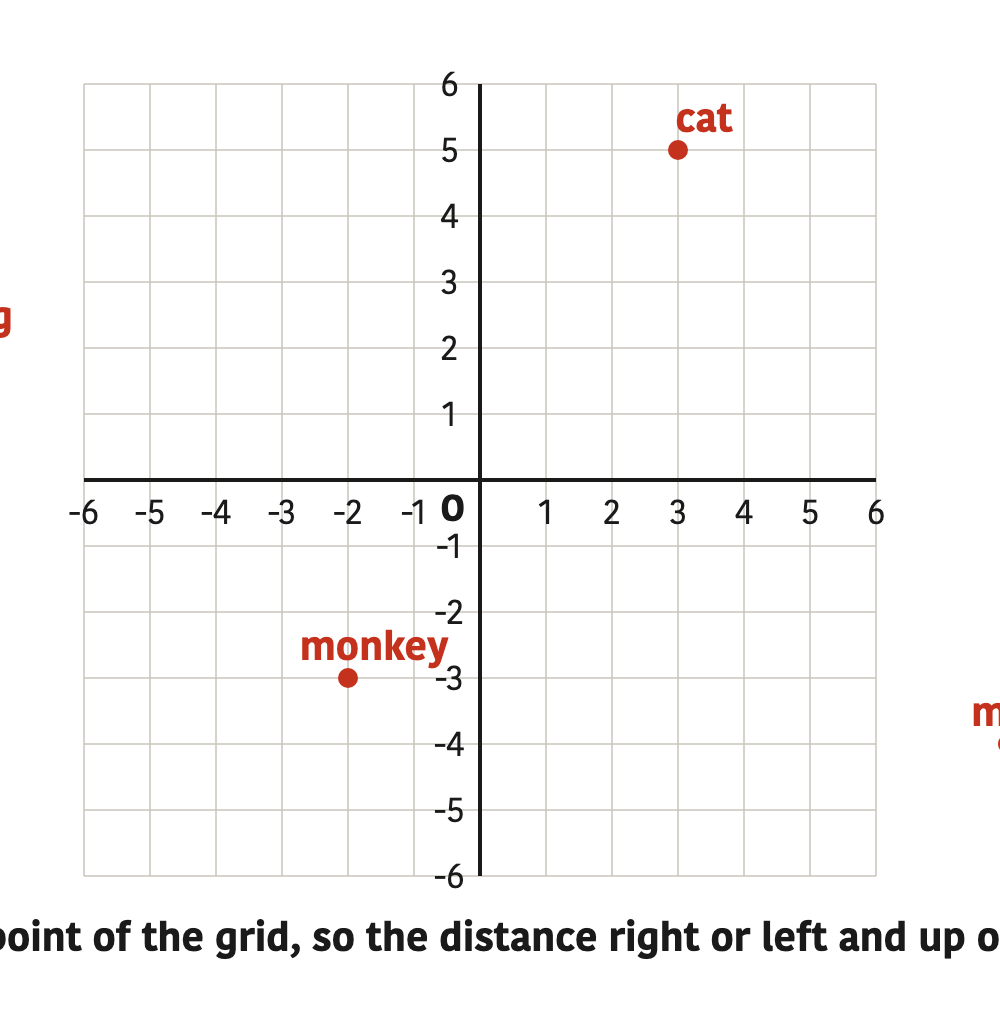
Step 1: To reach the cat you go three units right and five units up from the origin. Both directions are positive, so its position is:
\[ (3, 5) \]
Step 2: To reach the dog you go eight units left and two units up. Because it is to the left, the first number takes a minus sign:
\[ (-8, 2) \]
Step 3: To reach the monkey you go two units left and three units down. Left and down are both negative directions, so:
\[ (-2, -3) \]
Step 4: To reach the mouse you go eight units right and four units down. Right is positive and down is negative, so:
\[ (8, -4) \]
Points that lie on an axis
Not every point falls inside one of the quadrants. A point can sit exactly on an axis instead. Look at the six points on the graph below and work out both their coordinates and where they lie.
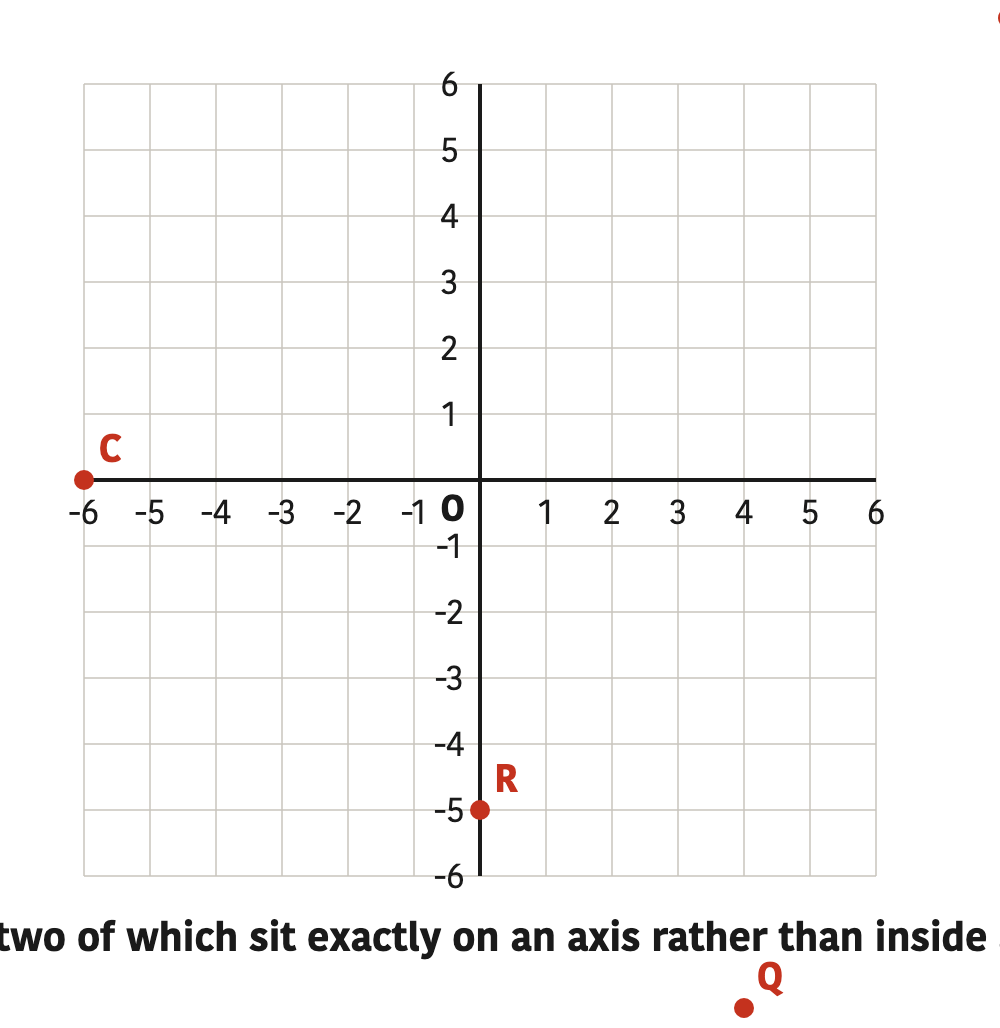
To reach A you go eight units right and seven units up, so A lies in the first quadrant and its coordinates are \( (8, 7) \). To reach B you go three units left and eleven units up, so B lies in the second quadrant and its coordinates are \( (-3, 11) \).
To reach C you only go six units to the left. There is no need to go up or down at all, so the y-coordinate is 0 and the point sits on the negative X-axis. Its coordinates are \( (-6, 0) \). In the same way, to reach R you only go five units down from the origin without moving right or left. So R sits on the negative Y-axis and its coordinates are \( (0, -5) \).
Of the two points left, P needs nine units left and eight... nine units left and four units down, so it lies in the third quadrant with coordinates \( (-9, -4) \). Q needs four units right and eight units down, so it lies in the fourth quadrant with coordinates \( (4, -8) \).
Any point on the X-axis has y-coordinate 0, any point on the Y-axis has x-coordinate 0, and the origin itself has coordinates \( (0, 0) \).
Plotting a point when the coordinates are given
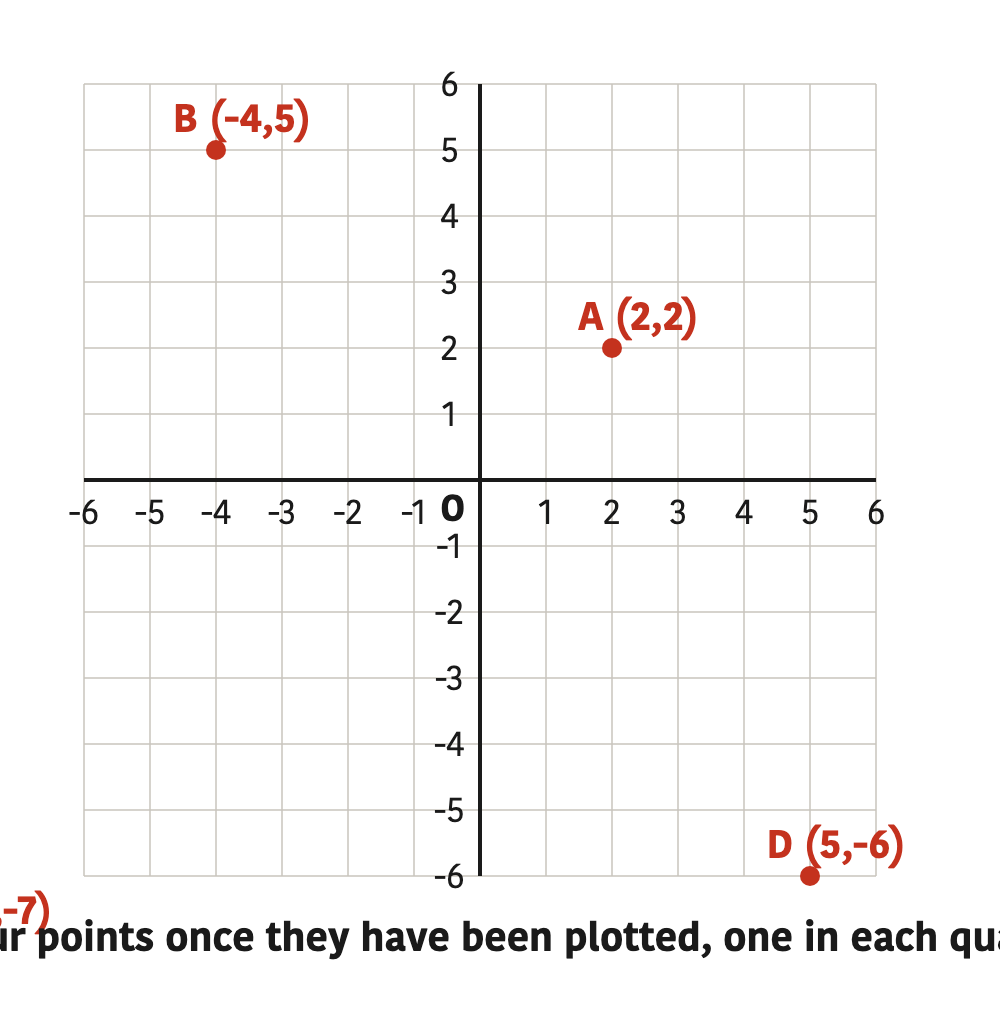
Now do the opposite job. When the coordinates are given, the point has to be marked on the graph. The method is this:
- Start at the origin O.
- Look at the first number. If it is positive, move that many units to the right; if it is negative, move that many units to the left.
- From there look at the second number. If it is positive, move that many units up; if it is negative, move that many units down.
- Put a small dot where you arrive and write the name of the point beside it.
Following this method for A(2, 2), B(-4, 5), C(-8, -7) and D(5, -6) puts A in the first quadrant, B in the second, C in the third and D in the fourth.
Making shapes and finding their area
When several points are plotted and then joined one after another, a shape is formed. Once the shape is recognised, its area can be found either by counting the unit squares inside it or by using the area rule for that shape. Take the four points \( (4, 4) \), \( (-4, 4) \), \( (-4, -4) \) and \( (4, -4) \) first.
Step 1: Plot all four points and join them in an order that travels round the shape. A closed figure is formed.
Step 2: The two upper corners are \( (4, 4) \) and \( (-4, 4) \). They are at the same height, so the length of the top side is:
\[ 4 - (-4) = 8 \]
Step 3: Measured the same way, all four sides come out as 8 units, so the shape is a square. The area of a square is one side multiplied by itself:
\[ A = 8 \times 8 = 64 \]
Step 4: So this square covers an area of 64 square units.
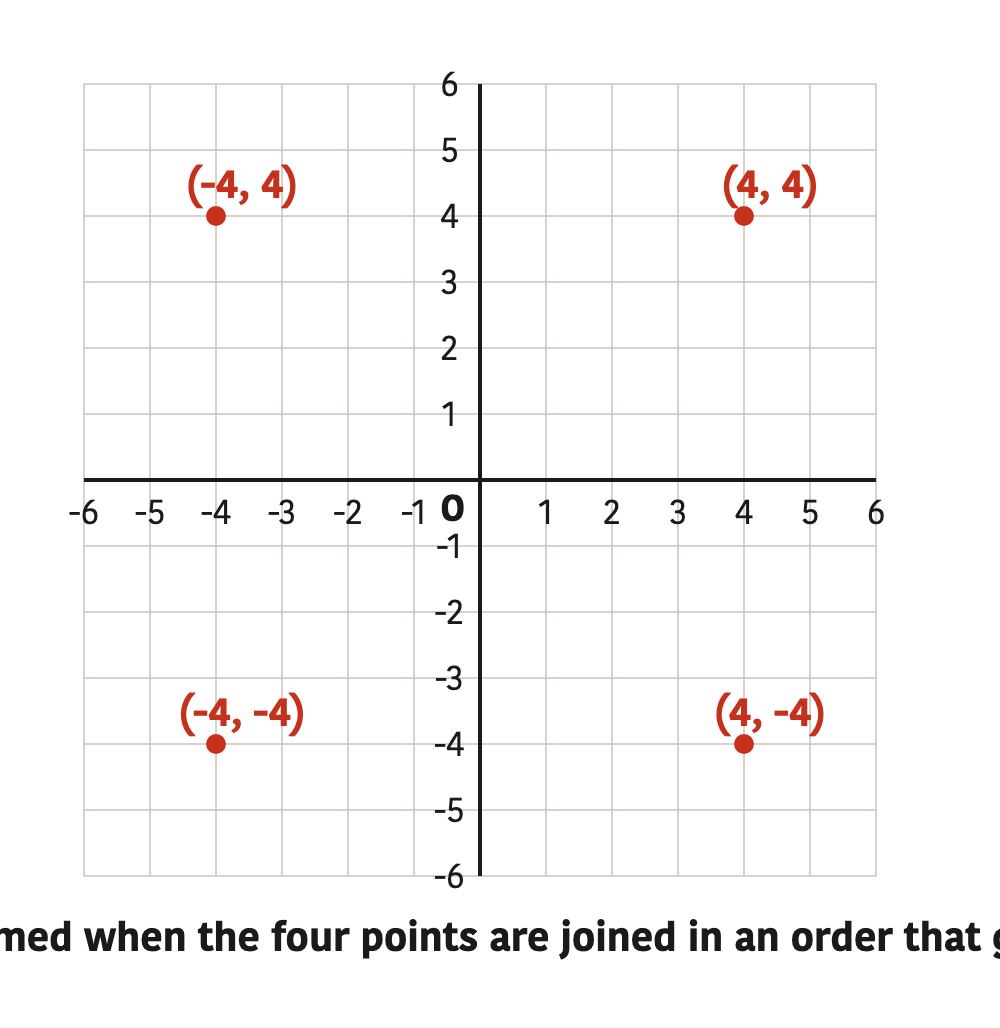
Joining the points in the order they happen to be listed sometimes makes the lines cross each other and spoils the shape. Always join neighbouring corners so that the line travels round the outside of the figure.
For a second example take \( (0, 6) \), \( (-6, 0) \) and \( (6, 0) \). Three points give a triangle.
Step 1: The points \( (-6, 0) \) and \( (6, 0) \) both lie on the X-axis, so the line joining them is the base. Its length is:
\[ b = 6 - (-6) = 12 \]
Step 2: The third point \( (0, 6) \) is six units above the X-axis, so the height is \( h = 6 \). Using the area rule for a triangle:
\[ A = \frac{1}{2} \times 12 \times 6 \]
Step 3: Working out the multiplication:
\[ A = 36 \]
Step 4: So this triangle covers an area of 36 square units. In this way a shape can be recognised and its area found even when nothing but the coordinates of its corners is given.
The full lesson is waiting for you
Create a free account to unlock activities, practice tests, presentations and videos - and to track your progress and confidence score for every subject.
The point O where the two straight lines XX' and YY' cross at right angles is called the origin.
11 more points to remember - sign in to see the rest.
Question 1 of 13