Writing everyday sentences with maths signs
Many of the sentences we say every day have a number hidden inside them. Sometimes we know that number and sometimes we do not. A number we do not yet know is written as a letter such as \( x \), \( y \) or \( z \). Once the letter is chosen, the sentence can be written in a very short way using the signs for equal to, less than and greater than.
| Sentence | Mathematical form |
| Ram has less than 20 rupees. | \( x < 20 \) |
| Shailesh is at most 12 years old. | \( x \leq 12 \) |
| I walk at least 3 km every morning. | \( x \geq 3 \) |
The words "at most" ask for the sign \( \leq \) and the words "at least" ask for the sign \( \geq \). Once you can spot these two phrases, half the work is done.
Mathematical statements
A sentence built with the four basic operations of mathematics, that is addition, subtraction, multiplication and division, is called a mathematical statement. It is made of numbers, letters and signs, and it always claims something.
Mathematical statement: a sentence built from numbers, letters and signs using addition, subtraction, multiplication or division, which claims something.
Here are some mathematical statements of the kind a teacher writes on the class board. Read each one carefully.
- (a) 2 is an even prime number.
- (b) \( 3 + 5 = 8 \)
- (c) There is one odd number between 4 and 6.
- (d) The product of 3 and 5 is 8.
- (e) The difference of 9 and 7 is 3.
- (f) \( x \) is a factor of 18.
- (g) \( x \neq 5 \)
- (h) \( y < 7 \)

True, false and open statements
Some of those statements can be settled at once. Nobody has to guess whether they are true or false. For instance 2 is the only even number that is prime, so
- (a) is true. But the product of 3 and 5 is 15 and not 8, so
- (d) is false. In the same way the difference of 9 and 7 is 2, so
- (e) is false as well.
Now look at (f), (g) and (h). Each of them carries a letter whose value is not known, and until that value is fixed the statement cannot be called true or false. Statement (f) is true only when \( x \) is 1, 2, 3, 6, 9 or 18, and it is false for every other value. A statement like this is called an open statement.
Open statement: a mathematical statement whose truth cannot be decided, because it holds for some values of the letter and fails for others.
| Mathematical statement | Kind |
| 2 is an even prime number. | True |
| \( 3 + 5 = 8 \) | True |
| There is one odd number between 4 and 6. | True |
| The product of 3 and 5 is 8. | False |
| The difference of 9 and 7 is 3. | False |
| \( x \) is a factor of 18. | Open |
| \( x \neq 5 \) | Open |
| \( y < 7 \) | Open |
A false statement is still a statement, not a broken one. Writing \( 3 \times 5 = 8 \) gives a false statement and not an open one, because there is no letter in it and it can be settled straight away.
Equations and their solutions
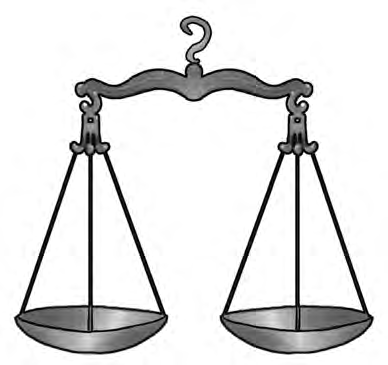
When the two pans of a balance stay at the same level, the amounts on them are equal. That is exactly what the sign \( = \) says. On a seesaw it is the other way round. A heavy man on one end and a light boy on the other make the plank tip, which shows the two sides are not equal. Amounts that are not equal are joined by the sign \( \neq \).
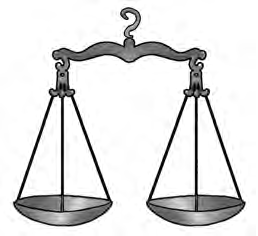
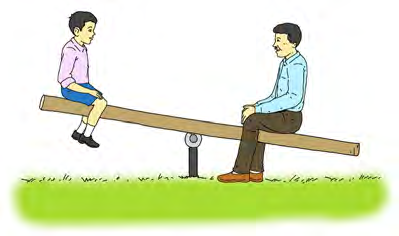
An open statement made by joining two algebraic expressions with the equal sign \( = \) is called an equation. An equation carries both letters and fixed numbers, and our job is to find the value of the letter that makes the statement true.
Equation: an open mathematical statement in which two expressions are joined by the equal sign \( = \).
Solution of an equation: the value of the letter which turns the equation into a true statement. In \( x + 2 = 5 \) the statement becomes true when \( x = 3 \), so the solution is \( x = 3 \).
For a small equation the value can be found simply by trying. Take \( x + 5 = 12 \).
Step 1: The equation given to us is:
\[ x + 5 = 12 \]
Step 2: Putting 7 in place of \( x \) gives:
\[ 7 + 5 = 12 \]
Step 3: Both sides are equal, so the statement is true and the solution is:
\[ x = 7 \]
In the same way, putting \( x = 6 \) into \( 3x = 18 \) gives \( 3 \times 6 = 18 \), so the solution of that equation is \( x = 6 \).
What a balance shows: the equal axioms
For bigger equations, guessing is slow. What we need instead is one rule, and a balance gives it to us. While the beam is level we may add the same amount to both pans, or take the same amount off both pans, and it stays level.
Now put a block marked \( x \) and 2 marbles in the left pan, and 7 marbles in the right pan. The beam stays level, and what it shows is the open statement \( x + 2 = 7 \). Take two marbles off each pan and the beam is still level, with only the block on the left and 5 marbles on the right. So \( x = 5 \).
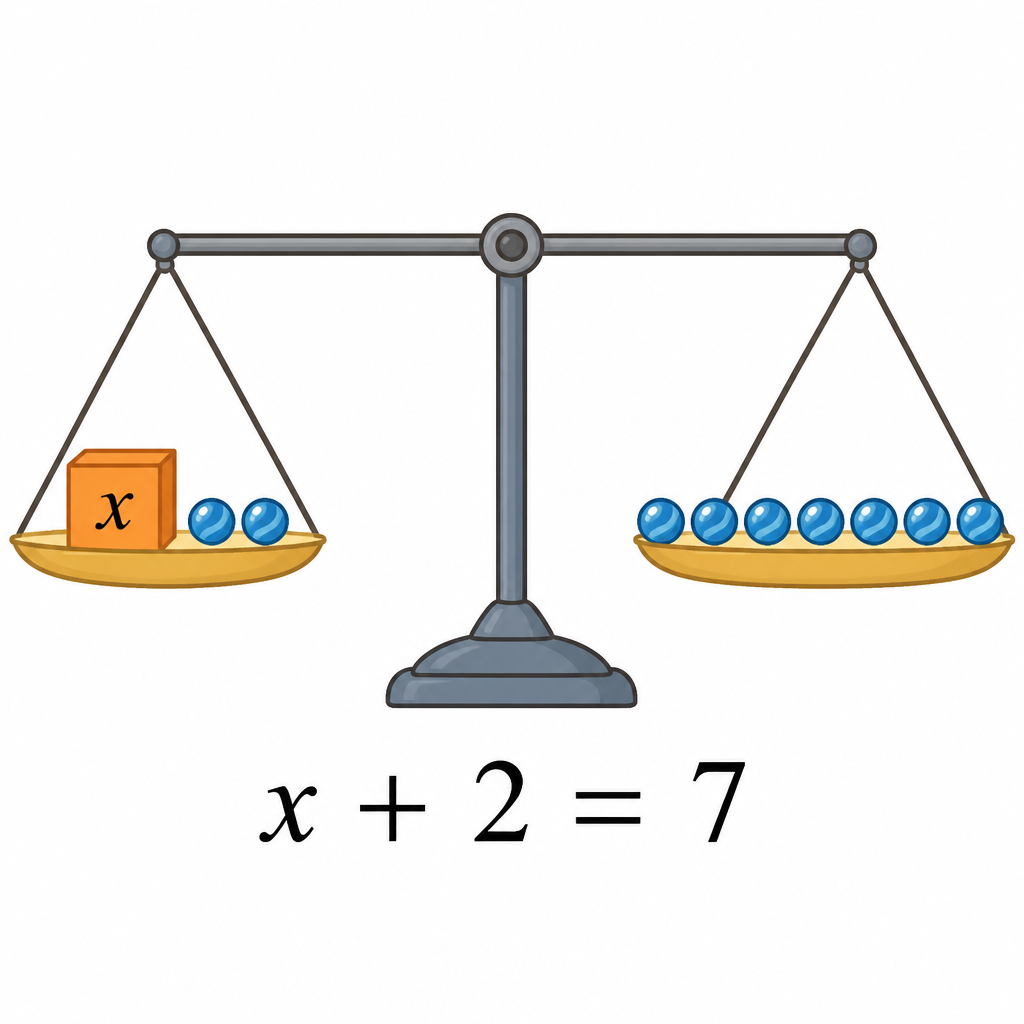
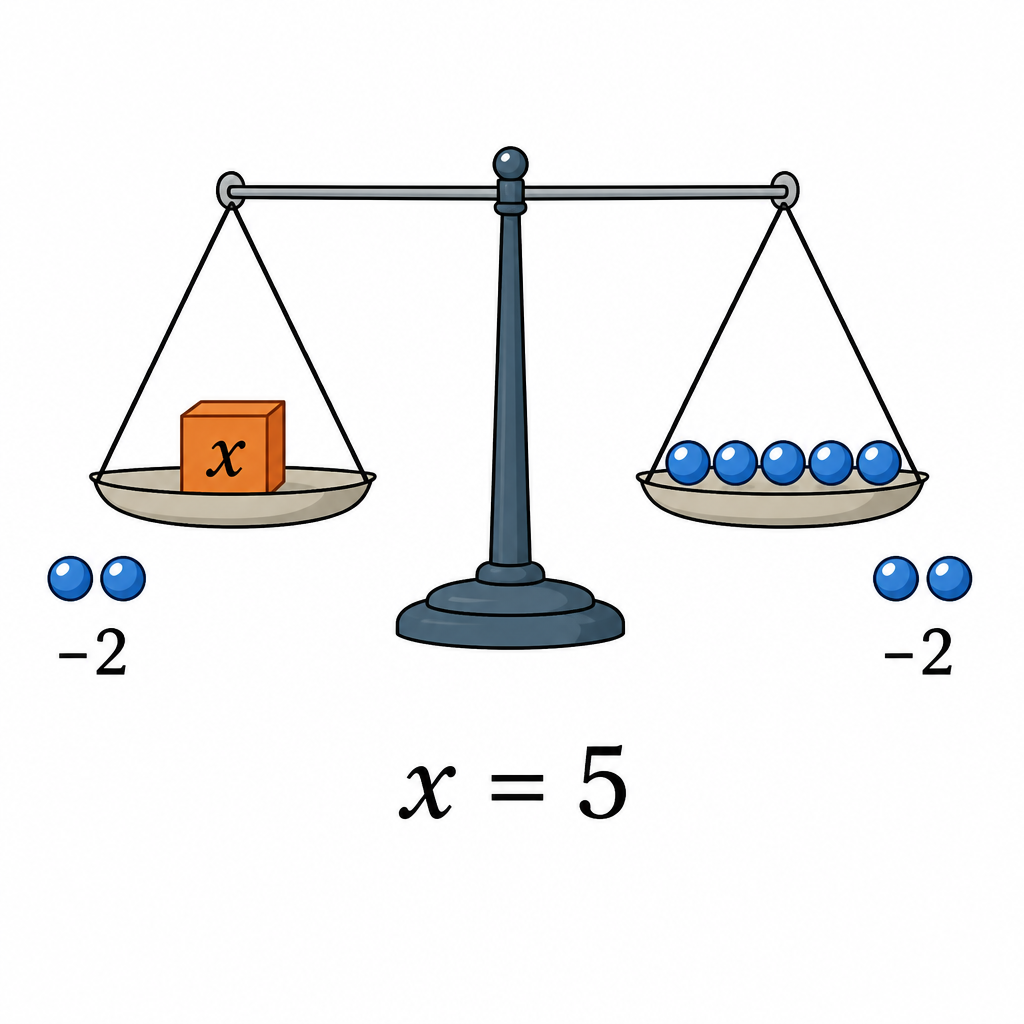
What the balance shows is written in mathematics as four equal axioms.
Axiom of addition: if equal amounts are added to equal amounts, the results stay equal.
Axiom of subtraction: if equal amounts are taken from equal amounts, the results stay equal.
Axiom of multiplication: if equal amounts are multiplied by equal amounts, the results stay equal.
Axiom of division: if equal amounts are divided by equal amounts, the results stay equal.
Solving equations with the equal axioms
Solving an equation means leaving the letter alone on one side. Whatever operation is holding on to the letter, we undo it by doing the opposite operation on both sides. Start with \( x - 3 = 5 \), where 3 has been taken away from \( x \).
Step 1: The equation given to us is:
\[ x - 3 = 5 \]
Step 2: By the axiom of addition, 3 is added to both sides:
\[ x - 3 + 3 = 5 + 3 \]
Step 3: On the left the \( -3 \) and \( +3 \) cancel and leave \( x \) alone, so the solution is:
\[ x = 8 \]
In \( x + 2 = 9 \) the number 2 has been added to \( x \), so this time the axiom of subtraction is the one we need.
Step 1: The equation given to us is:
\[ x + 2 = 9 \]
Step 2: Subtracting 2 from both sides gives:
\[ x + 2 - 2 = 9 - 2 \]
Step 3: Doing the subtraction on the right gives the solution:
\[ x = 7 \]
When the letter has been divided, the axiom of multiplication brings it back. Take \( \dfrac{x}{3} = 3 \).
Step 1: The equation given to us is:
\[ \frac{x}{3} = 3 \]
Step 2: Multiplying both sides by 3 gives:
\[ \frac{x}{3} \times 3 = 3 \times 3 \]
Step 3: The 3 on the left cancels, so the solution is:
\[ x = 9 \]
When the letter has been multiplied by a number, the axiom of division undoes it. Take \( 7x = 49 \).
Step 1: The equation given to us is:
\[ 7x = 49 \]
Step 2: Dividing both sides by 7 gives:
\[ \frac{7x}{7} = \frac{49}{7} \]
Step 3: Simplifying both sides gives the solution:
\[ x = 7 \]
Whatever is done to one side must be done to the other side in exactly the same way. Taking a number off one side only is like emptying just one pan of the balance, and the answer that follows is wrong.
Two-step equations and word problems
Some equations hold the letter with two operations at once. In such a case the addition or subtraction is cleared first, and the multiplication or division after it. Take \( 5x + 3 = 18 \).
Step 1: The equation given to us is:
\[ 5x + 3 = 18 \]
Step 2: By the axiom of subtraction, 3 is taken from both sides:
\[ 5x + 3 - 3 = 18 - 3 \]
Step 3: Simplifying both sides gives:
\[ 5x = 15 \]
Step 4: By the axiom of division, both sides are divided by 5:
\[ \frac{5x}{5} = \frac{15}{5} \]
Step 5: Simplifying gives the solution:
\[ x = 3 \]
Now take a problem given in words. Three times a number, with 4 added to it, comes to 22. What is that number?
Step 1: Calling the number \( x \), the question turns into the equation:
\[ 3x + 4 = 22 \]
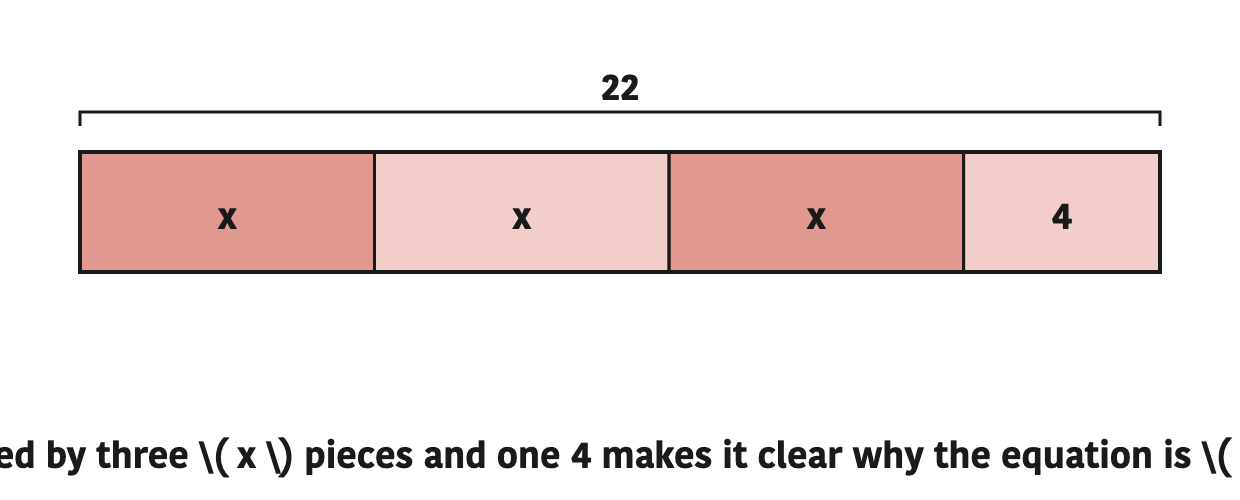
Step 2: Taking 4 from both sides gives:
\[ 3x = 18 \]
Step 3: Dividing both sides by 3 gives:
\[ \frac{3x}{3} = \frac{18}{3} \]
Step 4: Simplifying gives the number we were looking for:
\[ x = 6 \]
To check the answer, put \( x = 6 \) back into the equation. Since \( 3 \times 6 + 4 = 18 + 4 = 22 \), the answer is right.
The trichotomy laws
Pick any number, say 6. Compare it with the five numbers before it, 1, 2, 3, 4, 5, and the five after it, 7, 8, 9, 10, 11. The number 6 is greater than some of them, smaller than others, and equal to itself.
Between two numbers there is no fourth possibility beyond these three.

Trichotomy laws: for any two numbers \( a \) and \( b \) exactly one of the three relations holds, that is (a) \( a > b \), (b) \( a = b \), (c) \( a < b \). The first and the third are inequalities and the second is the relation of equality.
When either side still has some arithmetic left in it, finish the arithmetic first and only then put in the sign. Here are some comparisons with the right sign filled in.
- (a) \( 3 > 2 \)
- (b) \( 5 < 7 \)
- (c) \( -6 < 2 \)
- (d) \( 3 + 4 = 7 \)
- (e) \( 11 < 15 - 2 \)
- (f) \( -5 > -7 \)
- (g) \( -6 < 2 - 5 \)
With negative numbers a bigger looking digit does not mean a bigger number. Seeing the 7 in \( -7 \) does not make it the larger one. In fact \( -5 > -7 \), because \( -7 \) sits further to the left on the number line.
Writing statements as inequalities
When a comparison is given in words, the care needed is over which quantity comes first. "x is smaller than 5" makes \( x \) the smaller one and 5 the greater, so it is written \( x < 5 \). "\( x - 3 \) is greater than 4" makes \( x - 3 \) the greater one, so it is written \( 4 < x - 3 \).
Inequality: a mathematical statement in which two quantities are joined by one of the signs \( < \), \( > \), \( \leq \), \( \geq \) or \( \neq \).
\( = \) is equal to
\( \neq \) is not equal to
\( < \) is less than
\( > \) is greater than
\( \leq \) is less than or equal to
\( \geq \) is greater than or equal to
An equation is usually made true by a single value of the letter, while an inequality is made true by many values. Only \( x = 5 \) works in \( x + 2 = 7 \), but in \( x < 5 \) the values 4, 3, 2 and 1 all work.
The full lesson is waiting for you
Create a free account to unlock activities, practice tests, presentations and videos - and to track your progress and confidence score for every subject.
A sentence built with addition, subtraction, multiplication or division is a mathematical statement.
11 more points to remember - sign in to see the rest.
Question 1 of 14