Quantities that change and quantities that stay fixed
To enter a park, every visitor pays an entry fee of Rs. 100. Whoever goes in, and whenever they go in, that amount stays Rs. 100. It does not change. Inside the same park there are boats, and one round costs Rs. 20. Two rounds cost Rs. 40 and three rounds cost Rs. 60. Here the amount to be paid grows as the number of rounds grows. The amount is always 20 times the number of rounds.
The number of rounds can be anything, so it is convenient to write it with a letter. If the number of rounds is written as \( x \), then the boat charge is \( 20 \times x \), that is Rs. \( 20x \). In the same way, if one round on a horse costs Rs. 50, then \( y \) rounds cost Rs. \( 50y \).
Constant: a quantity that has only one value is called a constant. The entry fee Rs. 100, and numbers like 7 and 20, are constants.
Variable: a quantity that can take two or more values is called a variable. The letter \( x \) standing for the number of rounds, or \( y \) standing for a number of students, is a variable.
Terms and algebraic expressions
Separate pieces such as Rs. 100, \( 20x \) and \( 50y \) are called algebraic terms. When such terms are joined by the signs of addition, subtraction, multiplication or division, the mathematical statement formed is an algebraic expression. If somebody pays the entry fee and takes \( x \) boat rounds, the total paid is \( 100 + 20x \).
A mathematical relation formed by joining variables and constants with the four basic operations of addition, subtraction, multiplication and division is called an algebraic expression.
The number of terms in an expression gives it its name. Some everyday statements can be written as algebraic expressions. If Rupa had \( x \) marbles and Rupak gave her 3 more, Rupa now has \( x + 3 \) marbles. If Dipesh gives 7 of his \( y \) pencils to his brother, he is left with \( y - 7 \) pencils. If Surakshya shares her \( x \) chocolates equally between two brothers, each one gets \( \frac{x}{2} \) chocolates.
- An expression having only one term is called a monomial, for example \( \frac{x}{2} \), \( 20x \) and \( 6ab \).
- An expression having two terms is called a binomial, for example \( x + 3 \), \( y - 7 \) and \( 100 + 20x \).
Like terms and unlike terms
Whether two terms can be added or subtracted is decided by looking at their variables. The number in a term is its coefficient, and the letter part is its algebraic factor. The factors of \( 3xy \) are 3, \( x \) and \( y \), while the factors of \( 2xy \) are 2, \( x \) and \( y \). Both terms have the same algebraic factors \( x \) and \( y \), so they are like terms.
Like terms: terms that have the same variables raised to the same indices are called like terms. In other words, terms whose algebraic factors are the same are like terms.
Unlike terms: terms that have different variables, or the same variable with different indices, are called unlike terms.
| Pair of terms | Like or unlike | Reason |
| \( 2x \) and \( 5x \) | Like | both have the variable \( x \) |
| \( 4a \) and \( 7a \) | Like | both have the variable \( a \) |
| \( 3x \) and \( 4y \) | Unlike | one has \( x \) and the other has \( y \) |
| \( 3a^2 \) and \( 7a^2 \) | Like | both have the variable part \( a^2 \) |
| \( 7x^3 \) and \( 9x^2 \) | Unlike | the indices are different |
| \( 3a^2b \) and \( 3b^2a \) | Unlike | one has \( a^2b \) and the other has \( b^2a \) |
| \( 4x^2y \) and \( 7x^2yz \) | Unlike | the second one also carries \( z \) |
Unlike terms cannot be joined into one term. Writing \( 3x + 4y \) as \( 7xy \) is wrong, because the answer stays \( 3x + 4y \). In the same way \( 2a + 4a^2 \) is not \( 6a^2 \).
Adding and subtracting algebraic expressions
When adding or subtracting, only like terms are combined and unlike terms are written as they are. The sum of \( 12x^2y \), \( 5x^2yz \) and \( 15x^2y \) is found step by step below.
Step 1: The mathematical statement is:
\[ 12x^2y + 5x^2yz + 15x^2y \]
Step 2: The like terms \( 12x^2y \) and \( 15x^2y \) are brought together:
\[ 12x^2y + 15x^2y + 5x^2yz \]
Step 3: Adding the coefficients, since \( 12 + 15 = 27 \), this becomes:
\[ 27x^2y + 5x^2yz \]
Step 4: The two terms that are left are unlike, so they cannot be joined any further. The sum is \( 27x^2y + 5x^2yz \).
When one bracket is subtracted from another, the sign of every term inside it changes. Subtracting \( (2a + b - 3c) \) from \( (4a - 3b + 5c) \) is done like this.
Step 1: The mathematical statement is:
\[ (4a - 3b + 5c) - (2a + b - 3c) \]
Step 2: The bracket is removed, and the sign of each term inside the second bracket changes:
\[ 4a - 3b + 5c - 2a - b + 3c \]
Step 3: The like terms are grouped together:
\[ (4a - 2a) + (-3b - b) + (5c + 3c) \]
Step 4: Simplifying each group:
\[ 2a - 4b + 8c \]
When a bracket is subtracted, the sign of every term inside changes, not only the first one. Writing \( -(2a + b - 3c) \) as \( -2a + b - 3c \) is the mistake students make most often.
Multiplying monomials
Take a rectangle of length \( 3a \) cm and breadth \( 2b \) cm. Cutting the length into three pieces of \( a \) cm and the breadth into two pieces of \( b \) cm divides the rectangle into six small rectangles, each of area \( ab \) cm².
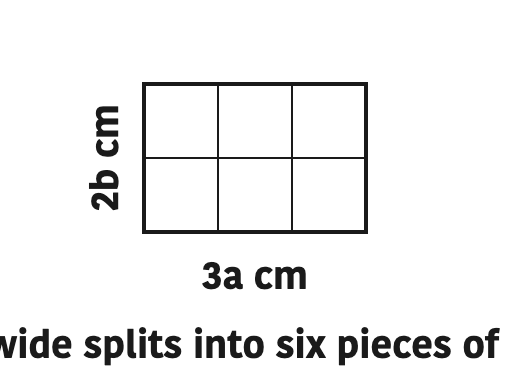
Adding the six small areas gives the area of rectangle ABCD as \( (ab + ab + ab + ab + ab + ab) \) cm², that is \( 6ab \) cm². Again, since area (A) = length (l) × breadth (b), the same area is \( 3a \times 2b \). So \( 3a \times 2b = 6ab \). Here the coefficients 3 and 2 were multiplied to give 6, and the variables \( a \) and \( b \) were multiplied to give \( ab \).
When monomials are multiplied, the product of the coefficients is written in front of the product of the variables. If the product of the coefficients is 1, that 1 is not written, for example \( 1 \times b = b \) and \( a \times b = ab \).
Now multiply \( 3y \times 4y \times 5y \). First the numbers are put together and the letters are put together:
\[ 3 \times 4 \times 5 \times y \times y \times y = 60y^3 \]
The method stays the same when a coefficient is a fraction. Look at \( \frac{2}{3}a \times 6b \times \frac{c}{4} \) step by step.
Step 1: The numbers and the letters are separated:
\[ \frac{2}{3} \times 6 \times \frac{1}{4} \times a \times b \times c \]
Step 2: Multiplying the numbers gives:
\[ \frac{12}{12} \times abc \]
Step 3: Since \( \frac{12}{12} = 1 \) and a coefficient of 1 is not written:
\[ abc \]
Multiplying a binomial by a monomial
Take a rectangle ABCD of length \( (a + b) \) cm and breadth \( d \) cm. Cutting the length into \( a \) cm and \( b \) cm splits the rectangle into two parts.
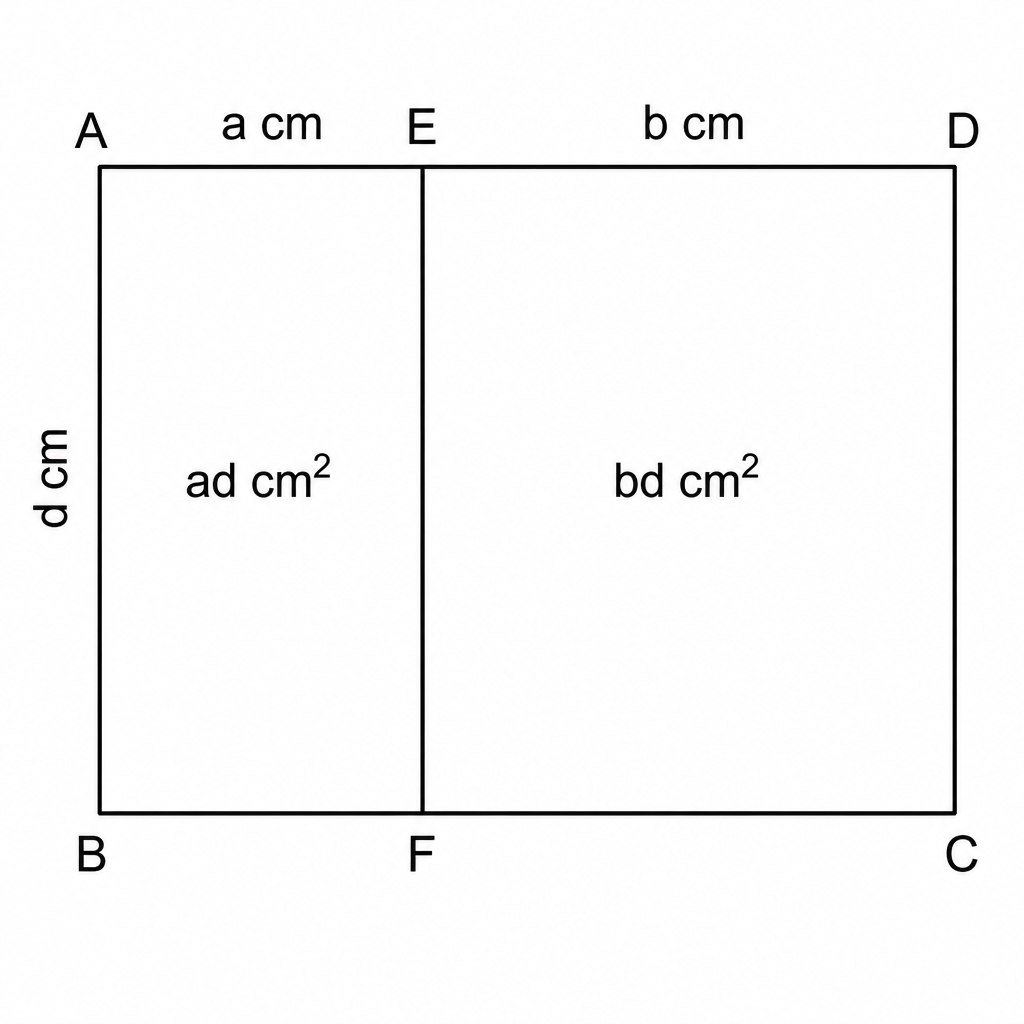
The area of rectangle ABCD is the area of ABFE plus the area of EFCD, that is \( ad \) cm² + \( bd \) cm² = \( (ad + bd) \) cm². Again, since area = length × breadth, the same area is \( (a +
- b) \times d \). So \( (a +
- b) \times d = ad + bd \).
When a binomial is multiplied by a monomial, the monomial multiplies each term of the binomial, and the two products are added together.
Use this rule to multiply \( 8a \times (2a + 9ac) \).
Step 1: \( 8a \) multiplies each term inside the bracket:
\[ 8a \times 2a + 8a \times 9ac \]
Step 2: Working out the first product:
\[ 8a \times 2a = 16a^2 \]
Step 3: Working out the second product:
\[ 8a \times 9ac = 72a^2c \]
Step 4: Adding the two products together:
\[ 16a^2 + 72a^2c \]
Finding the value of an expression
Once the values of the variables are given, an expression has one number as its value. Each letter is replaced by its value, then the powers are worked out, then the multiplications, and the additions and subtractions come last. Find the value of \( x^3 - 2x^2y + y^2 \) when \( x = 2 \) and \( y = 3 \).
Step 1: Putting the values in place of the letters:
\[ 2^3 - 2 \times 2^2 \times 3 + 3^2 \]
Step 2: Working out the powers:
\[ 8 - 2 \times 4 \times 3 + 9 \]
Step 3: Multiplying, since \( 2 \times 4 \times 3 = 24 \), this becomes:
\[ 8 - 24 + 9 \]
Step 4: Adding the two positive numbers:
\[ 17 - 24 \]
Step 5: Subtracting gives the value:
\[ -7 \]
Dividing a monomial by a monomial
Finding the breadth of a rectangular field whose area is \( 4xy \) cm² and whose length is \( 2x \) cm needs division. Since area (A) = length (l) × breadth (b), the breadth is \( b = \frac{A}{l} = \frac{4xy}{2x} = 2y \) cm.
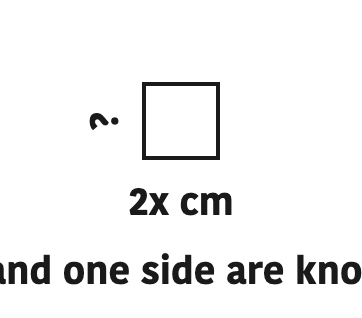
The safe way to divide is to write the numerator and the denominator as factors and cancel the common factors. Here is \( 18a^2b \div 3ab \).
Step 1: The division is written as a fraction:
\[ \frac{18a^2b}{3ab} \]
Step 2: The numerator and the denominator are written as factors:
\[ \frac{2 \times 3 \times 3 \times a \times a \times b}{3 \times a \times b} \]
Step 3: Cancelling the common factors 3, \( a \) and \( b \) leaves:
\[ 2 \times 3 \times a = 6a \]
Dividing a binomial by a monomial
Finding the length of a rectangular field whose area is \( (6x^2 + 9x) \) cm² and whose breadth is \( 3x \) cm means dividing a two term expression by a single term.
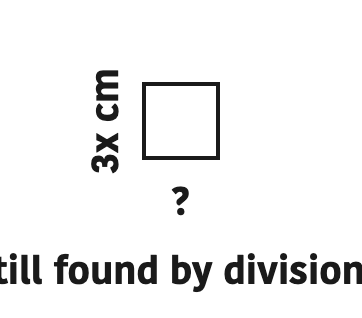
When a binomial is divided by a monomial, the denominator must divide each of the two terms of the numerator separately.
Now work out \( (21x^3y^2 - 56x^2y^3) \div 7x^2y^2 \).
Step 1: The division is written as a fraction:
\[ \frac{21x^3y^2 - 56x^2y^3}{7x^2y^2} \]
Step 2: The denominator divides each of the two terms separately:
\[ \frac{21x^3y^2}{7x^2y^2} - \frac{56x^2y^3}{7x^2y^2} \]
Step 3: Cancelling the common factors in the first fraction:
\[ \frac{21x^3y^2}{7x^2y^2} = 3x \]
Step 4: Cancelling the common factors in the second fraction:
\[ \frac{56x^2y^3}{7x^2y^2} = 8y \]
Step 5: Writing the two quotients with the sign they had:
\[ 3x - 8y \]
The length of the field above comes out the same way. Since \( \frac{6x^2}{3x} = 2x \) and \( \frac{9x}{3x} = 3 \), the length is \( (2x + 3) \) cm. To check a quotient, multiply it back by the divisor, because \( 3x \times (2x + 3) \) returns \( 6x^2 + 9x \).
The full lesson is waiting for you
Create a free account to unlock activities, practice tests, presentations and videos - and to track your progress and confidence score for every subject.
A quantity with only one value is a constant; a quantity that can take two or more values is a variable.
11 more points to remember - sign in to see the rest.
Question 1 of 13