When a collection becomes a set
All around us, things are kept together in groups. Anything put together in this way is called a collection. In mathematics, however, not every collection is called a set. One question settles it: can you say with certainty which things belong to the collection and which do not? If you can, the collection is a set.
Look at the two pictures below. The first shows six animals: a goat, a deer, an ox, a cat, an elephant and a lion. The second shows a bus carrying passengers. If both are put together into one collection, there is no clear name for that collection, because a bus is not an animal.
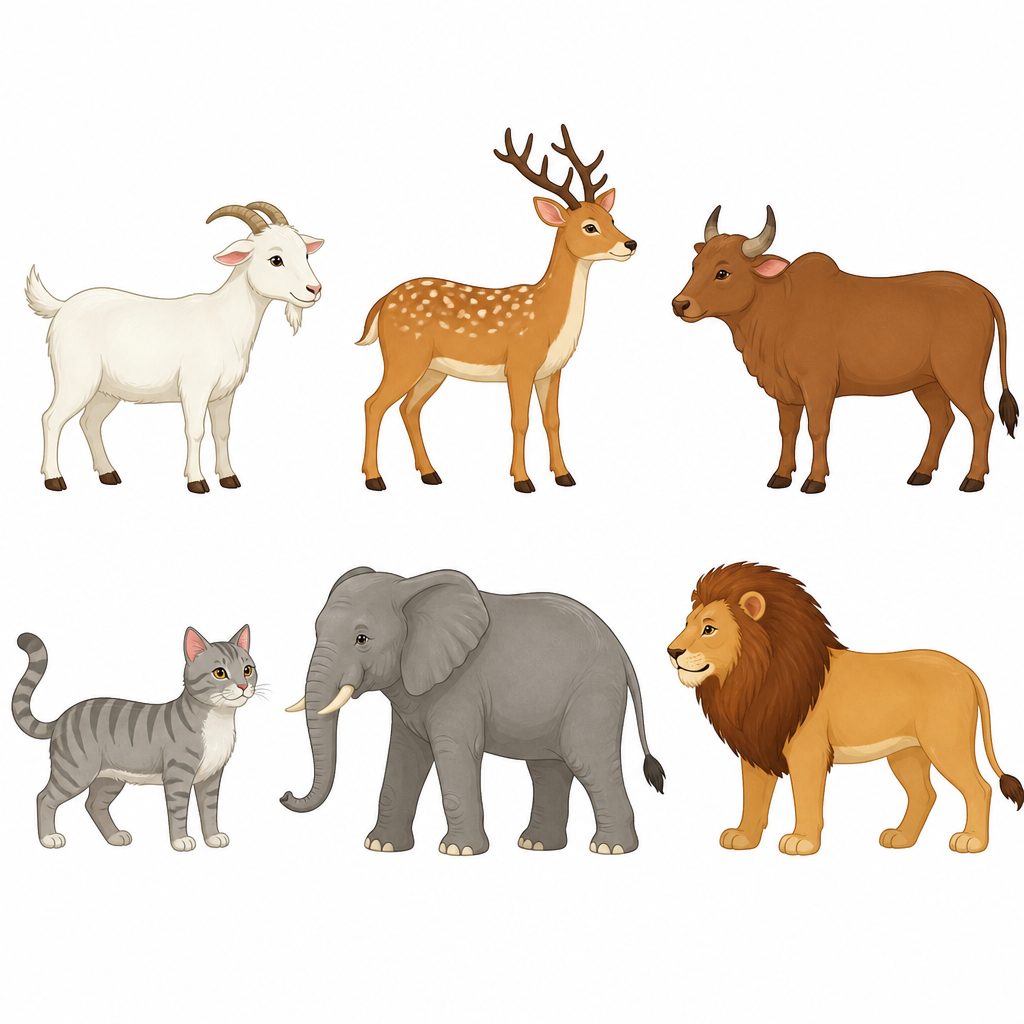

Take the bus out, and the property shared by the rest becomes clear. They are all animals. Now the collection can be called the set of animals. Looking for the shared property is therefore the first job in forming a set.
Set: a collection of things that can be well defined is called a set. For a set, it can be said with certainty whether a particular thing belongs to it or does not.
Naming a set and its members with letters
To write a set neatly, the capital letters of the English alphabet A, B, C, ... are used. The things inside a set are called its members, and small letters a, b, c, ... are used for them. The members are written inside curly brackets { }, separated by commas.
Taking A to stand for the set of animals above, it is written like this:
\[ A = \{\text{elephant, lion, goat, deer, cat, ox}\} \]
Here the elephant is one member of set A and the lion is another member. The set has six members in all.


Always write the name of a set with a capital letter, and separate its members with commas inside curly brackets { }.
Many sets from one collection
A single collection may hold quite different things, yet by looking for shared properties it can be split into more than one set. Suppose one big picture holds a lychee, an aeroplane, bananas, an apple, a motorcycle, an orange, a bicycle, a mango, a car, a tractor and a bus. The three pictures below show three of the things in that collection.



Looking at shared properties, two sets can be formed from this collection:
- The set of fruits: lychee, banana, apple, orange, mango
- The set of vehicles: aeroplane, motorcycle, bicycle, car, tractor, bus
Both of these are well defined, because it can be said with certainty which thing goes into which set.
Taking out the thing that does not belong
Sometimes almost everything in a collection shares one property and just one thing does not fit. Marking that one with a cross (×) and taking it out leaves a collection that is properly defined, and so a set.
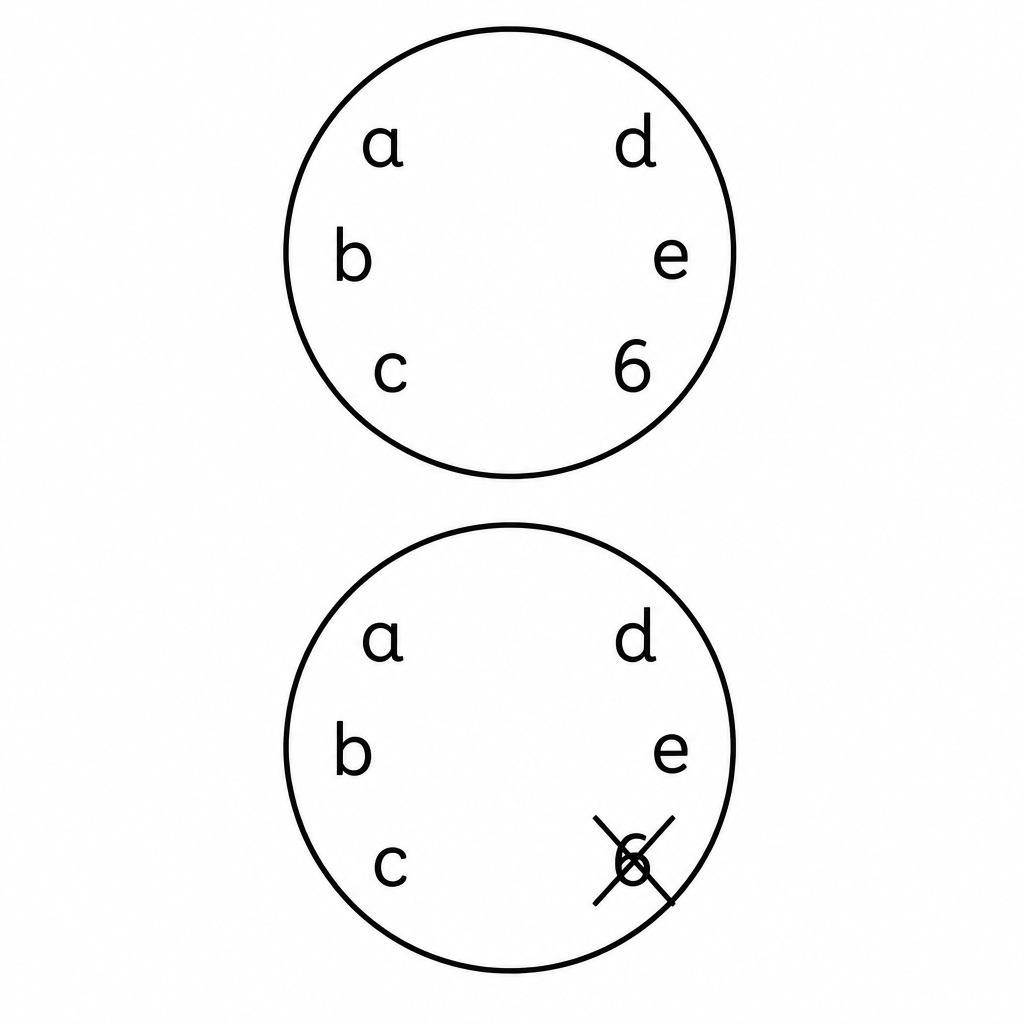
Step 1: The things inside the circle are:
\[ a, b, c, d, e, 6 \]
Step 2: Here a, b, c, d and e are the first five letters of the English alphabet, while 6 is a natural number. So the one that does not fit is:
\[ 6 \]
Step 3: After removing 6, taking L for the set of members left:
\[ L = \{a, b, c, d, e\} \]
Step 4: In words, L is the set of the first five letters of the English alphabet.
Each of the three collections below also has exactly one thing that does not fit. Think what property the rest share, then take the odd one out.
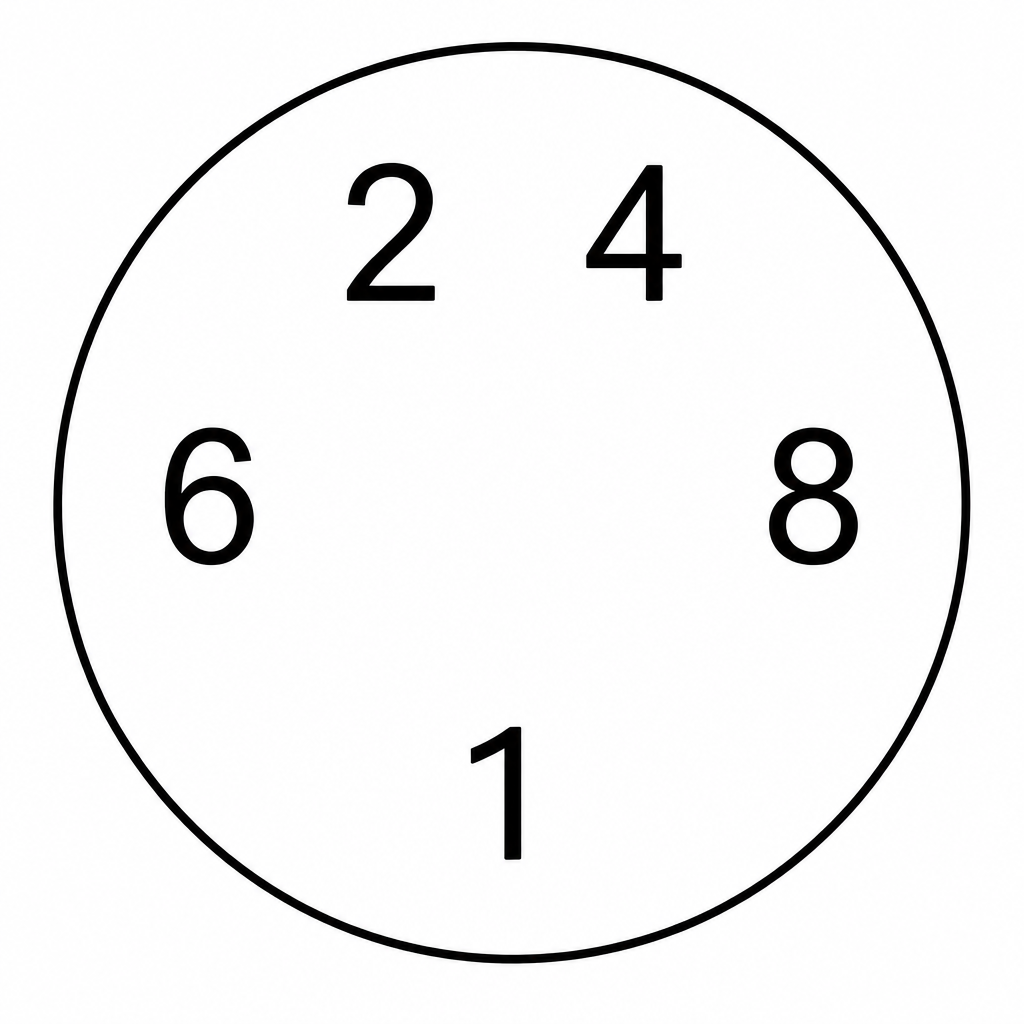


Removing 1 from the first leaves the set of even numbers less than 10. Removing the orange from the second leaves the set of vegetables, and removing the laptop from the third leaves the set of vehicles.
Well defined and not well defined collections
To test whether a collection is a set, always ask the same question: would everybody give the same answer about what belongs to it?
If the answer changes from person to person, the collection is not well defined.
- (a) In the collection of odd natural numbers less than 20, exactly which members belong can be said with certainty, so it is a well defined collection.
- (b) In choosing two beautiful cities of Nepal there is no fixed basis for the choice, so it is not a well defined collection.
- (c) For the collection of tall students of class 6, there is no fixed height above which a student counts as tall, so it is not a well defined collection.
- (d) The days of the week beginning with the letter S are Sunday and Saturday, and that can be said with certainty, so it is a well defined set.
Words like good, tall, tasty and brave do not give a basis for choosing, because their meaning changes from person to person. A collection described with such a word must not be called a set.
Methods of describing a set
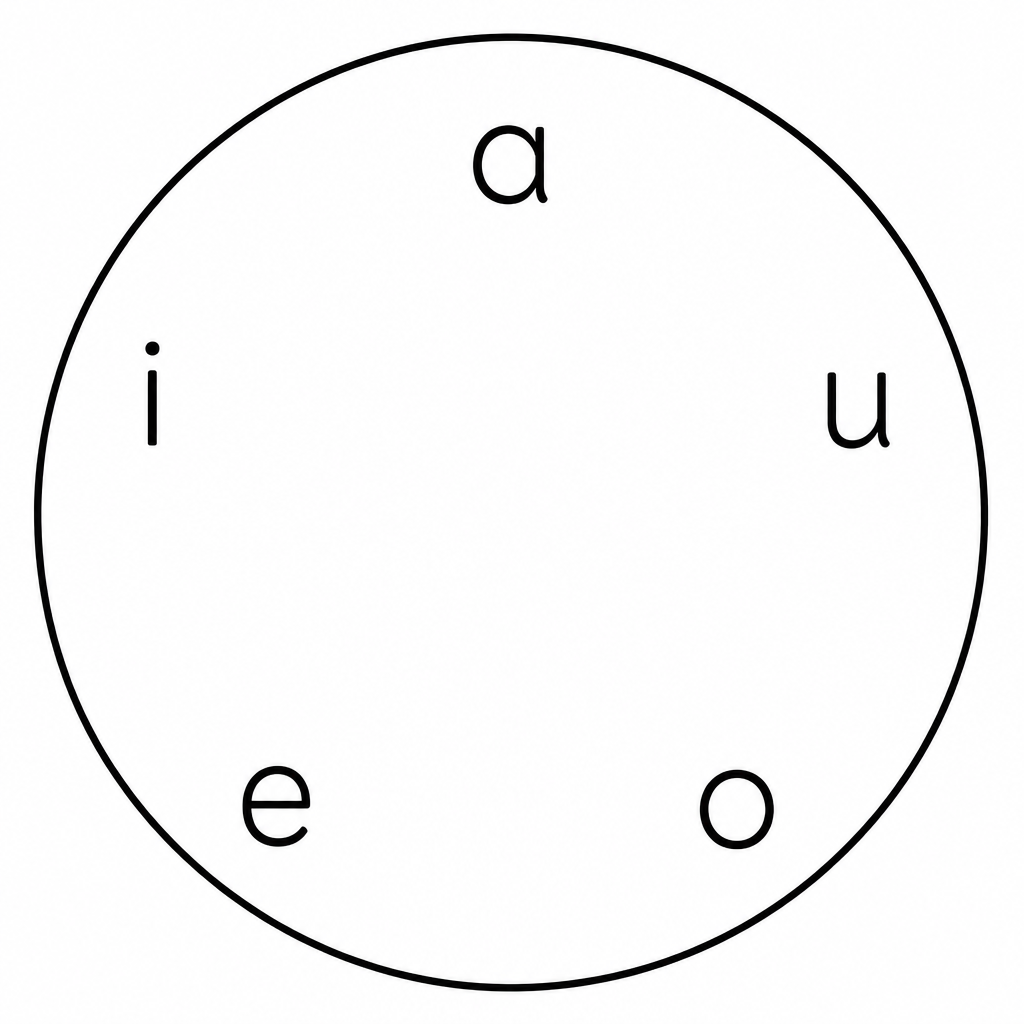
Inside the circle are a, e, i, o and u. These are the vowels of the English alphabet. Taking V for this set, it is written like this:
\[ V = \{a, e, i, o, u\} \]
The same set can be written in three ways. All three describe the same set; only the way of writing it changes.
Listing method: writing the members of a set inside curly brackets, separated by commas, is called the listing method. For example, \( V = \{a, e, i, o, u\} \)
Describing method: expressing the property shared by the members in words or in a sentence is called the describing method. For example, \[ V = \{\text{the set of vowels of the English alphabet}\} \]
Set builder method: here a variable is used, and that variable is described by the property shared by the members. For example, \( V = \{x : x \text{ is a vowel of the English alphabet}\} \)
| Method | How it is written | Example |
| Listing method | A list of the members | \( P = \{2, 3, 5, 7\} \) |
| Describing method | The shared property in words | \[ P = \{\text{the set of prime numbers less than } 10\} \] |
| Set builder method | The variable x described | \( P = \{x : x \text{ is a prime number less than } 10\} \) |
Using the listing method
When writing a set in the listing method, follow these steps in order.
- Step 1: Decide which letter will stand for the set.
- Step 2: Identify every member of the set.
- Step 3: Write the members inside curly brackets { }, separated by commas.
- Step 4: Write them so that no member is left out and none is repeated.
Now write the factors of 16 as a set in the listing method.
Step 1: The set is named F.
Step 2: Looking for the numbers that divide 16 exactly, the pairs come out like this:
\[ 16 = 1 \times 16 = 2 \times 8 = 4 \times 4 \]
Step 3: Arranging the factors found from those pairs from smallest to largest:
\[ F = \{1, 2, 4, 8, 16\} \]
Step 4: Although 4 appears twice in the pairs, it is written only once. The set F has five members.
Never write the same member twice. Writing \( \{1, 2, 4, 4, 8, 16\} \) is wrong.
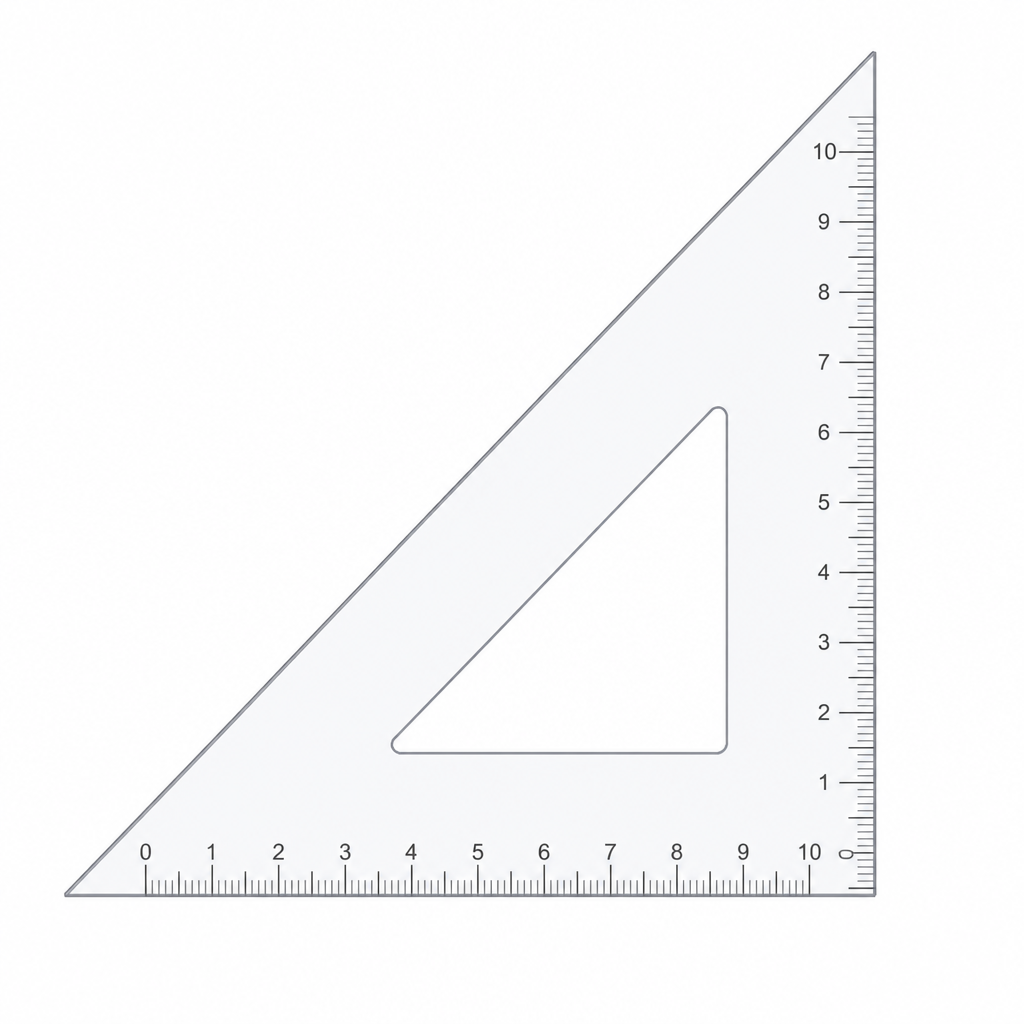
Things, not only numbers, are listed in the same way. Taking G for the instruments kept in a geometry box, \[ G = \{\text{compass, divider, set square, protractor, ruler, pencil}\} \].

Using the describing method
In the describing method the members are not listed. Instead the property they share is written in words. The steps are given below.
- Step 1: Decide which letter will stand for the set.
- Step 2: Identify the property shared by all the members.
- Step 3: Write that property as a sentence inside the brackets.
Step 1: Taking A for the given set:
\[ A = \{0, 2, 4, 6, 8, 10\} \]
Step 2: Every one of these numbers is exactly divisible by 2 and none is greater than 10. So the shared property is being an even whole number up to 10.
Step 3: Written in the describing method:
\[ A = \{\text{the set of even whole numbers up to } 10\} \]
The same method works for sets of objects. The picture below shows a square, a circle, a triangle and a rectangle. Every one of them is a shape drawn on a flat surface.
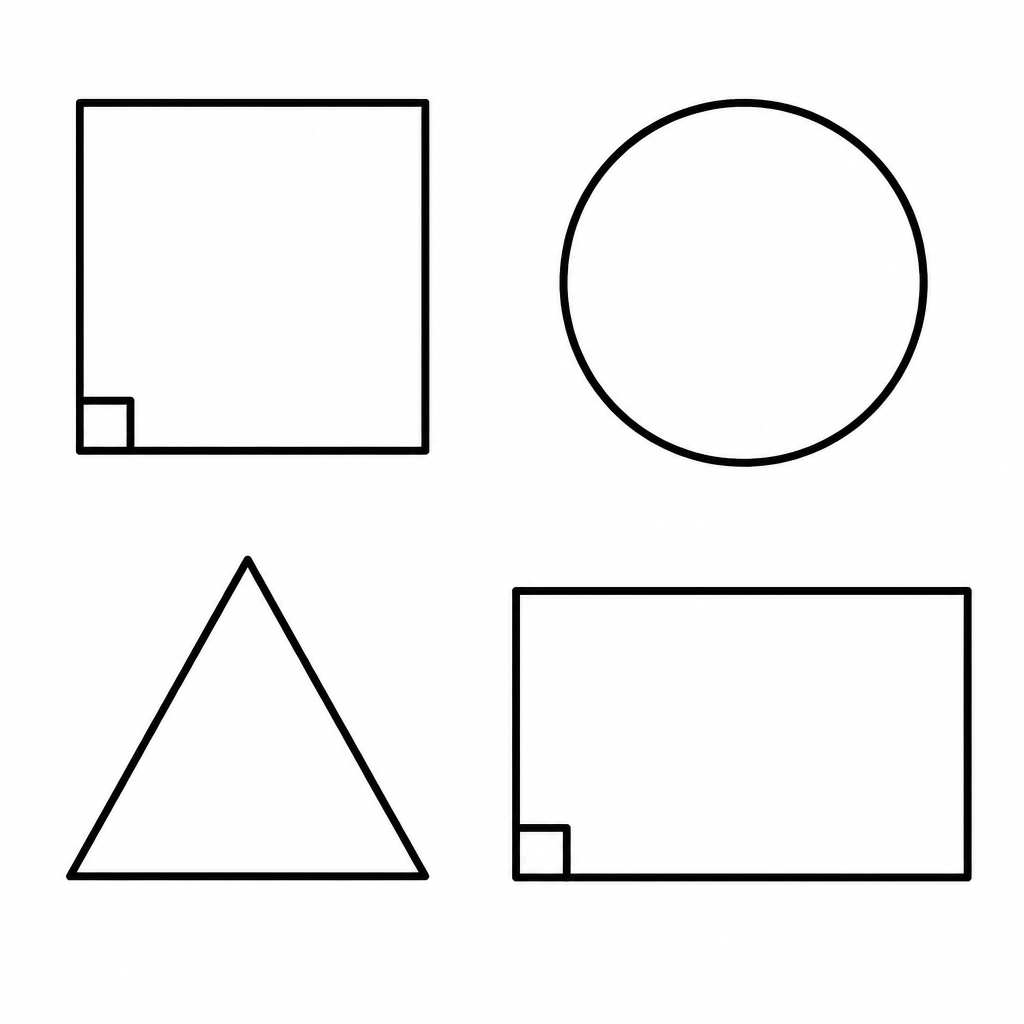
Taking S for this set, the listing method gives \( S = \{\text{square, circle, triangle, rectangle}\} \) and the describing method gives \( S = \{\text{the set of plane shapes}\} \).
Using the set builder method
In the set builder method a variable such as x is used. The variable x stands in place of the members, and after it the property of x is written. The ':' sign written between them is read as 'such that'.
Step 1: The given set is:
\[ A = \{1, 2, 3, 4, 5\} \]
Step 2: All of these are natural numbers less than 6, so that is the property of x as well.
Step 3: In the set builder method this is \( A = \{x : x \text{ is a natural number less than } 6\} \). It is read as: A is the set of all x such that x is a natural number less than 6.
Membership of a set

The circle in the picture holds several flowers. It is a collection of rose, marigold, sunflower and lotus. Every flower inside the circle is a member of this set. Taking F for the set, \( F = \{\text{rose, marigold, sunflower, lotus}\} \). The set has four members.
The marigold belongs to set F, so we write marigold \( \in F \). The globe amaranth flower is not in F, so we write globe amaranth \( \notin F \).
The symbol \( \in \) shows that something is a member of a set, that is, it belongs to the set. The symbol '∈' is read as 'belongs to'.
The symbol \( \notin \) shows that something is not a member of a set, that is, it does not belong to the set. The symbol '∉' is read as 'does not belong to'.
Choosing between ∈ and ∉
To put the right symbol in the blank, first look at the members of the set, then check whether the given thing is there or not.
Step 1: The number 6 can be seen in the set \( \{1, 2, 3, 4, 5, 6, 7, 8, 9, 10\} \). So:
\[ 6 \in \{1, 2, 3, 4, 5, 6, 7, 8, 9, 10\} \]
Step 2: Therefore 6 is a member of that set.
Step 3: The number 5 is not there in the set \( \{2, 4, 6, 8, 9\} \). So:
\[ 5 \notin \{2, 4, 6, 8, 9\} \]
Step 4: Therefore 5 is not a member of that set.
When a set is given in the describing method, write it out in the listing method first. Choosing between \( \in \) and \( \notin \) then becomes easy.
The full lesson is waiting for you
Create a free account to unlock activities, practice tests, presentations and videos - and to track your progress and confidence score for every subject.
A collection of things that can be well defined is called a set.
11 more points to remember - sign in to see the rest.
Question 1 of 12