Comparing Things Around Us
Every day we compare things without even noticing. We say one bag is heavier than another, one road is longer than another, or one friend is the tallest in the class. Comparing means looking at two or more things and saying how they are different or how one stands out. English has special forms of describing words for exactly this job, and this unit teaches you how to use them.
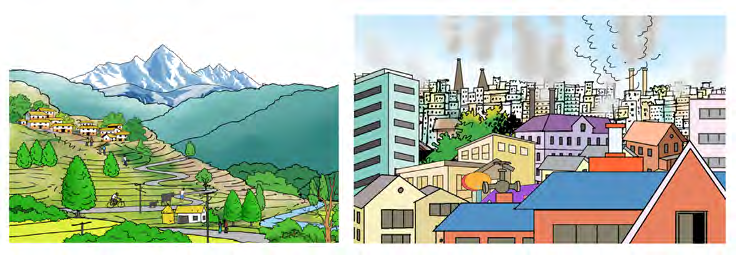
Look at a village and a city side by side. The village air is fresher. The city has taller buildings and more people. When you put the two pictures next to each other, comparing words come out of your mouth naturally: cleaner, busier, noisier, more crowded.
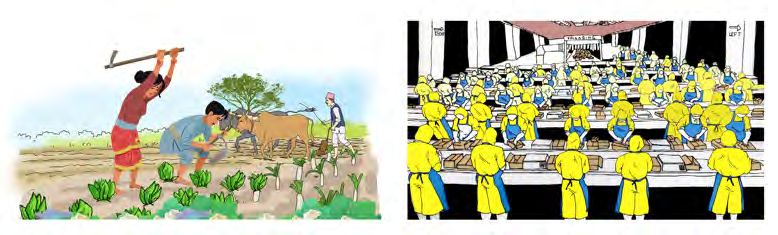
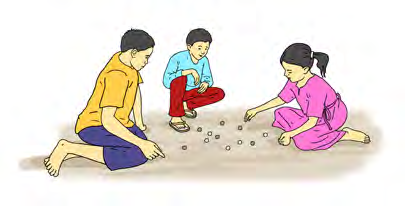
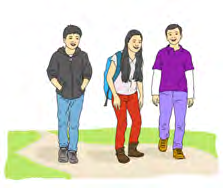
Farm work happens in the open field with a few people, while factory work happens indoors with many workers doing the same task. Small children play games like marbles on the ground, while teenagers would rather walk and talk. In each pair, one side is bigger, older, busier or quieter than the other. Saying which side, and by how much, is what this unit is about.
A Song About Comparing
This little song plays with comparing words. Notice how it moves from big to bigger to biggest, and how it uses best and easiest. Sing it aloud and listen for those words.
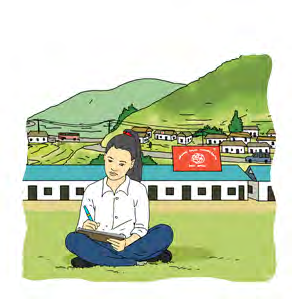
Can I compare moon to the earthOr can compare death to the birthI know what means big, bigger, biggestBut still confused earth or moon, the bestEarning is good but learning is the bestEveryone says discipline defeats all the restHere in school I find everything tough and tallWhat is the way of living life easiest of all?
After singing, talk with a friend. Which of your school subjects is easier for you, and which is more difficult? Give a reason. You are already using the language this unit teaches.
Reading: Rara Lake
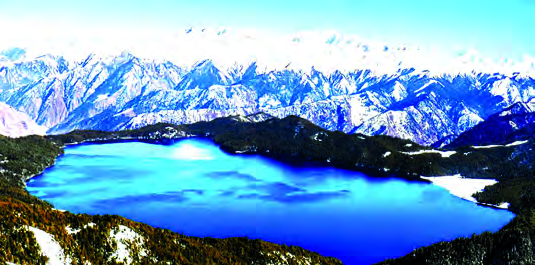
Rara Lake is the biggest lake in Nepal. It lies in Mugu district of Karnali Province. Its water surface covers 10.8 square kilometres, and the lake is 167 metres deep. It sits at an altitude of 2990 metres, surrounded by beautiful hills, and it is an important tourist site of Rara National Park.
Visitors find many amazing features at Rara. The first is its colour. Rara is a colourful lake: it shows three different colours in a single day, and nobody yet knows the reason. The background of the lake also keeps changing from time to time, which is another mystery about Rara.
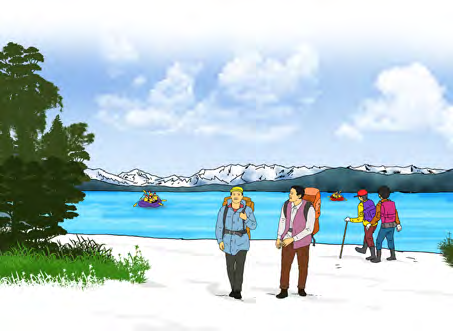
The next amazing feature is the mirror effect. The water is crystal clear. People boating on the lake do not even feel that they are on water. They see the hills and green forests in front of them, and exactly the same picture inside the water, together with their own images.
Rara is full of magnificent beauty and is one of the best destinations for trekkers. Visitors can go hiking on the hills around the lake. The flora and fauna, meaning the plants and animals, are another attraction. More than 214 species of birds, 20 species of mammals and 500 types of flowers are found there. The park is home to many endangered wild animals such as the red panda, musk deer, Himalayan black bear, leopard and wild boar.
Since Rara is free from dirt and contamination, and is less crowded, it is less polluted. Nature lovers can find solitude on the lap of the Himalayas there. To reach this splendid lake, you can go by air, taking a flight from Nepalgunj to Talcha airport of Mugu, or you can travel along the Karnali Highway by bus or jeep.
Words from the Passage
These words carry the passage, so learn each one with its meaning.
- altitude: height above sea level
- mystery: something difficult to understand
- crystal clear: completely clear, like glass
- magnificent: grand in appearance
- endangered: going to die out
- solitude: silence, being quietly alone
- route: the way you travel to reach a place
Three Forms of an Adjective
An adjective is a word that gives more information about a noun or pronoun, and it can go in different positions in a sentence. In 'They have a beautiful house', the adjective beautiful comes before the noun. In 'Their house is beautiful', it comes after a link verb like be, look or feel.
An adjective has three forms. Think of three books: a thin one of 50 pages, a thinner one of 30 pages, and the thinnest one of 10 pages. Or three cars: a fast one at 50 km per hour, a faster one at 70 km per hour, and the fastest one at 100 km per hour. Or three bags: a heavy one of 5 kg, a heavier one of 15 kg, and the heaviest one of 30 kg. The plain form describes one thing, the second form compares two, and the third form picks out one from the whole group.
A comparative adjective shows change or compares one thing with another. It usually ends in -er or uses more, and it takes than: 'She is two years older than me.'
A superlative adjective describes an object at the upper or lower limit of a quality, such as the tallest, the smallest, the fastest or the highest. It usually ends in -est or uses most, and it normally takes the: 'It was the happiest day of my life.'
| Adjective | Comparative | Superlative |
| good | better | best |
| scary | scarier | scariest |
| hot | hotter | hottest |
| bad | worse | worst |
| dangerous | more dangerous | most dangerous |
| interesting | more interesting | most interesting |
| embarrassing | more embarrassing | most embarrassing |
| old | older | oldest |
| young | younger | youngest |
| important | more important | most important |
| disgusting | more disgusting | most disgusting |
Sentences That Compare
A comparative sentence puts two things side by side and joins them with than. Read these two and watch the -er word do its work.
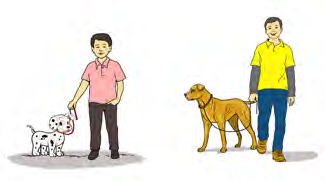
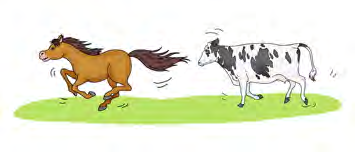
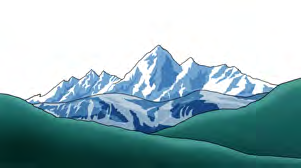
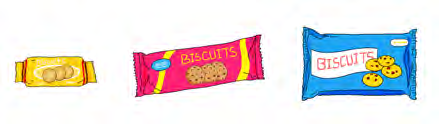
A superlative sentence compares one thing with its whole group, three or more things, and uses the before the -est word. Mt. Everest is not just taller than one mountain. It stands above every mountain on Earth, so we say it is the tallest. In the same way, when three biscuit packets cost Rs. 20, Rs. 10 and Rs. 30, all three are cheap, but the one at Rs. 10 is the cheapest of all.
Never use more together with an -er form, or most together with an -est form. 'More taller' and 'most tallest' are wrong. Choose one: taller, or more beautiful, never both at once. And a comparative needs than, not then: 'faster than the cow', never 'faster then the cow'.
How Comparatives and Superlatives Are Formed
We usually add -er and -est to one syllable words to make comparatives and superlatives. But spelling changes a little depending on how the word ends, and long words take a different road altogether. Here are the rules with an example for each.
| Rule | Example |
| Most one syllable words: add -er and -est | old, older, oldest |
| The word ends in -e: add only -r and -st | large, larger, largest |
| The word ends in a vowel and a consonant: double the consonant | big, bigger, biggest |
| The word ends in a consonant and -y: change -y to -i, then add -er or -est | happy, happier, happiest |
| Most two syllable words, and all words of three or more syllables: use more and most | interesting, more interesting, most interesting |
| Irregular words change completely | good, better, best; bad, worse, worst; far, farther or further, farthest or furthest |
A quick check before you write: count the syllables. Short word? Reach for -er and -est. Long word like dangerous or important? Reach for more and most. Then look at the last letters for a spelling change, and finally ask if the word is one of the irregular three: good, bad, far.
Reading a Food Menu
A menu is a table of food items and their prices. When two restaurants print their menus, you can compare them item by item and decide where your money goes further. Study these two menus from Lamjung. Prices are in rupees, and where two prices are given they are for the vegetable and chicken versions.
| Items | Besisahar Chamena Griha (Rs.) | Deurali Restaurant (Rs.) |
| Black Tea | 10 | 15 |
| Milk Tea | 20 | 25 |
| Cold Drinks | 45 | 45 |
| French Fries | 85 | 80 |
| Momo (Veg/Chicken) | 80/120 | 75/115 |
| Chow Mein (Veg/Chicken) | 80/120 | 85/125 |
| Thakali Khana (Veg/Chicken) | 120/150 | 130/180 |
Now compare. Tea is cheaper at Besisahar Chamena Griha. Momo and French fries are cheaper at Deurali Restaurant. Cold drinks cost the same at both places. Veg chow mein differs by Rs. 5 between the two. For Thakali Khana, Besisahar Chamena Griha is the cheaper choice, because Rs. 120 and Rs. 150 are lower than Rs. 130 and Rs. 180. Comparing a menu is comparative adjectives doing real work: cheaper, dearer, the cheapest of all.
Listening: A Phone Call to a Restaurant
People often phone a hotel or a restaurant to order food. In such a call, the caller gives their name and place, says what they want and how many plates, and asks how long delivery will take and what the total amount is. When you listen to a recording of such a call, listen for exactly these details: the place names, the number of plates, the minutes, and the money. Small words carry the answers, so listen twice if you can. Then talk with your friends: have you ever eaten at a hotel or a restaurant, and what do you like to eat there?
Writing with Adjectives
A good description walks through a picture and compares the things in it. Use adjectives like tall, short, long, big, small, high, low, thick and thin, in their correct forms. Here is a model built on the scene below.
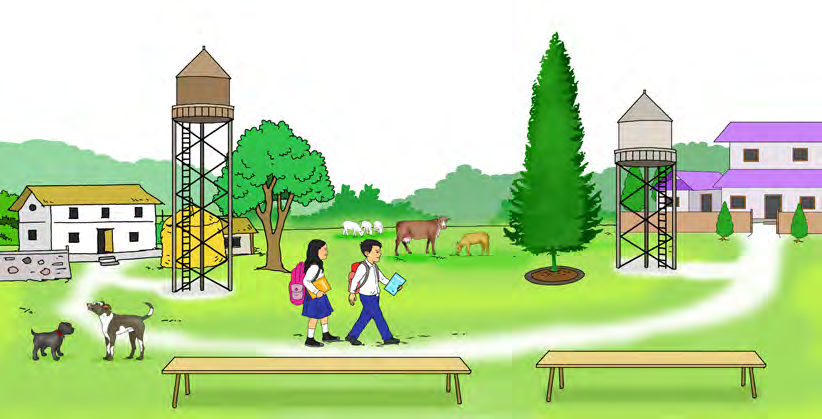
This is a beautiful village. There are houses, towers, trees, flowers and many other things in the village. The pine tree is taller than the mango tree. The left water tower is higher than the right one. The girl is shorter than the boy, but her bag looks bigger than his. Of the two dogs, the spotted one is the larger. The cow is bigger than the calf grazing beside it. The trunk of the mango tree is thicker than the small plants near the gate. The bench near the children is longer than the one near the house. The purple house is the biggest building in the whole village.
Now try the same skill on your own world. Write a description of how your classroom is different from other classrooms in your school. Use comparative adjectives: our room is brighter, our benches are longer, our notice board is more colourful.
Project Work: A Brochure for Rara Lake
A brochure or leaflet is a small folded paper that advertises a place. Prepare one for Rara Lake. Give it a bold title, add a drawing or photo of the lake, and then sell the place with its real facts: the biggest lake in Nepal, three colours in one day, a mirror of the Himalayas, home of the red panda and musk deer, and two easy routes to reach it. Superlative adjectives are the language of advertising, so use them: the biggest, the clearest, the most peaceful. End the brochure by telling the reader how to get there, by air through Talcha airport or by road along the Karnali Highway.
The full lesson is waiting for you
Create a free account to unlock activities, practice tests, presentations and videos - and to track your progress and confidence score for every subject.
An adjective describes a noun or pronoun. It can come before the noun or after a link verb like be, look or feel.
11 more points to remember - sign in to see the rest.
Question 1 of 14