What a Surd Is
Some numbers come out neatly when you take their root. The square root of 9 is 3 and the cube root of 8 is 2. Many numbers do not behave like that. Find the square root of 2 on a calculator and you get 1.4142135..., and the digits never stop and never settle into a repeating pattern. Such a number is irrational: it cannot be written as a fraction of two whole numbers. When the root of a number under the root sign cannot be found as a rational number, that root is called a surd.
Surd: a root of a rational number whose value cannot be found as a rational number. Its value is irrational. Examples: \( \sqrt{2} \), \( \sqrt{3} \), \( \sqrt[3]{5} \).
The values of \( \sqrt{2} \), \( \sqrt{3} \), \( \sqrt{5} \), \( \sqrt{7} \), \( \sqrt{12} \), \( \sqrt{45} \), \( \sqrt[3]{2} \) and \( \sqrt[3]{5} \) are all irrational, so every one of them is a surd. A root sign alone does not make a surd. Since \( \sqrt{16} = 4 \) and \( \sqrt[3]{27} = 3 \), these two are rational numbers and are not surds.
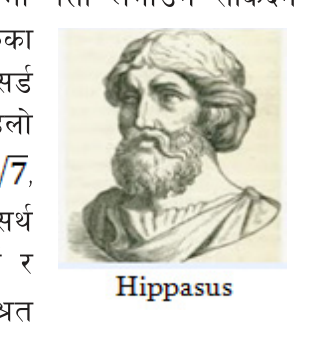
The idea is very old. The Greek mathematician Hippasus, who lived around 500 BC, is regarded as the founder of the concept of surds. The word 'surd' was first used formally much later, by Robert Recorde in 1551.
Pure Surds and Mixed Surds
Surds are of two kinds. To tell them apart, look at whether a rational number stands outside the root sign.
Pure surd: a surd with the whole number inside the root sign and no rational factor outside it, such as \( \sqrt{2} \), \( \sqrt{7} \) or \( \sqrt[3]{5} \).
Mixed surd: a surd multiplied by a rational number written outside the root sign, such as \( 2\sqrt{3} \) or \( 3\sqrt{5} \).
A surd like \( \sqrt{12} \) can be written as a mixed surd. Break 12 into prime factors and look for a pair of equal factors. Under a square root, a pair comes out as a single factor:
\[ \sqrt{12} = \sqrt{2 \times 2 \times 3} = 2\sqrt{3} \]
In the same way, 45 contains a pair of 3s:
\[ \sqrt{45} = \sqrt{3 \times 3 \times 5} = 3\sqrt{5} \]
| Surd | Kind | Reason |
| \( \sqrt{7} \) | Pure | Nothing stands outside the root sign |
| \( \sqrt[3]{2} \) | Pure | Nothing stands outside the cube root |
| \( 2\sqrt{3} \) | Mixed | The rational number 2 multiplies the surd |
| \( 3\sqrt{5} \) | Mixed | The rational number 3 multiplies the surd |
Where Surds Are Used
Surds can be added, subtracted, multiplied and divided, just like other numbers. They are used in engineering, physics, computer science, commerce, geometry and trigonometry. Their great strength is exactness. The diagonal of a square whose side is 1 m is exactly \( \sqrt{2} \) m long. Any decimal you write for it, such as 1.41 m or 1.4142 m, is only close. Keeping the value as a surd lets us record a number that cannot be shown exactly as a decimal, and it reduces the rounding error that builds up when rounded decimals are used again and again in a long calculation.
Equations Involving Surds
Look at these three equations:
\[ \sqrt{x} - 2 = 3 \]
\[ \sqrt{2x - 1} = 3 \]
\[ \sqrt{3x + 10} - x = 0 \]
In each of them the unknown \( x \) sits inside a root sign. Which values of \( x \) make them true, and is there a fixed way to find those values? There is, and it rests on one fact: squaring a square root undoes it, and cubing a cube root undoes it.
\[ (\sqrt{a})^2 = a \]
\[ (\sqrt[3]{a})^3 = a \]
Equation involving surds: an equation in which the variable appears under a root sign, such as \( \sqrt{2x - 1} = 3 \). Solving it means finding every value of the variable that makes the equation true.
The plan is always the same. Keep the terms under the root sign apart from the terms that are not, then square or cube both sides so that the root sign disappears. What remains is an ordinary linear or quadratic equation, which you already know how to solve.
Five Steps for Solving a Surd Equation
Step 1: Separate the terms. Keep the term with the root sign alone on one side and move every other term to the other side. For example:
\[ \sqrt{x} - 2 = 3 \;\Rightarrow\; \sqrt{x} = 5 \]
Step 2: Remove the root sign. Square both sides for a square root, or cube both sides for a cube root. For example, when \( \sqrt{2x - 1} = 3 \), squaring gives:
\[ (\sqrt{2x - 1})^2 = 3^2 \]
Step 3: Simplify the new equation and solve it. Continuing the same example:
\[ 2x - 1 = 9 \]
\[ 2x = 9 + 1 = 10 \]
\[ x = 5 \]
Step 4: Check every value in the original equation. Squaring or cubing can give a value that does not satisfy the equation you started with. Solving \( \sqrt{3x + 10} - x = 0 \) produces two values, 5 and \( -2 \). Putting \( x = -2 \) back makes the equation false, while \( x = 5 \) makes it true, so only 5 is kept.
Step 5: If there are two terms under root signs, square or cube twice. The first squaring removes one root sign. Then separate the remaining surd and square again to remove the second.
False root (also called an extraneous root): a value that comes out of the working after squaring or cubing but does not satisfy the original equation. It must be rejected.
Stopping after Step 3. A value found after squaring is only a candidate. It becomes an answer only when it has been put back into the original equation and made both sides equal.
Why False Roots Appear
Squaring throws away information about signs. The equation \( x = 3 \) has exactly one solution. Square both sides and you get \( x^2 = 9 \), which has two solutions, 3 and \( -3 \). The value \( -3 \) was never a solution of the first equation. The squaring created it. Exactly the same thing happens inside a surd equation.
There is a second reason. The square root sign always means the root that is not negative, so \( \sqrt{25} = 5 \) and never \( -5 \). A surd such as \( \sqrt{3x + 10} \) can therefore never equal a negative number. In \( \sqrt{3x + 10} = x \), the value \( x = -2 \) would need a square root to equal \( -2 \), which is impossible. That is how you can see it is a false root.
Squaring both sides can add values that are not solutions, but it never loses a real solution. So solve freely, then check every value in the original equation at the end.
Worked Example 1: Solving and Checking Four Equations
Each part below is solved with the five steps and then checked.
(a) Solve \( \sqrt{2x} = 6 \) and check.
Step 1: The surd is already alone on the left. Squaring both sides removes the square root:
\[ (\sqrt{2x})^2 = 6^2 \]
Step 2: Simplifying both sides:
\[ 2x = 36 \]
Step 3: Dividing both sides by 2:
\[ x = \frac{36}{2} = 18 \]
Check: Putting \( x = 18 \) into the original equation:
\[ \sqrt{2 \times 18} = \sqrt{36} = 6 \]
Both sides are 6, which is true. So \( x = 18 \).
(b) Solve \( \sqrt[3]{2x - 1} = 3 \) and check.
Step 1: This is a cube root, so both sides are cubed:
\[ (\sqrt[3]{2x - 1})^3 = 3^3 \]
Step 2: Simplifying both sides:
\[ 2x - 1 = 27 \]
Step 3: Adding 1 to both sides:
\[ 2x = 28 \]
Step 4: Dividing both sides by 2:
\[ x = \frac{28}{2} = 14 \]
Check: Putting \( x = 14 \) into the original equation:
\[ \sqrt[3]{2 \times 14 - 1} = \sqrt[3]{27} = 3 \]
This is true. So \( x = 14 \).
(c) Solve \( \sqrt{3x + 10} - x = 0 \) and check.
Step 1: Moving \( x \) to the right side leaves the surd alone:
\[ \sqrt{3x + 10} = x \]
Step 2: Squaring both sides:
\[ 3x + 10 = x^2 \]
Step 3: Bringing every term to one side gives a quadratic equation:
\[ x^2 - 3x - 10 = 0 \]
Step 4: Splitting the middle term, since \( -5 \times 2 = -10 \) and \( -5 + 2 = -3 \):
\[ x^2 - 5x + 2x - 10 = 0 \]
Step 5: Taking common factors from each pair:
\[ x(x - 5) + 2(x - 5) = 0 \]
\[ (x + 2)(x - 5) = 0 \]
Step 6: Setting each factor equal to zero gives two candidates:
\[ x = -2 \ \text{or} \ x = 5 \]
Check \( x = -2 \): the left side becomes
\[ \sqrt{3(-2) + 10} - (-2) \]
\[ = \sqrt{4} + 2 = 4 \]
The right side is 0, and \( 4 \neq 0 \). This is false, so \( x = -2 \) is a false root and is rejected.
Check \( x = 5 \): the left side becomes
\[ \sqrt{3(5) + 10} - 5 = \sqrt{25} - 5 = 0 \]
This is true. So \( x = 5 \) is the only solution.
(d) Solve \( \sqrt{x + 1} - \sqrt{x} = 1 \) and check.
Step 1: There are two surds. Keeping \( \sqrt{x + 1} \) alone by moving \( \sqrt{x} \) to the right side:
\[ \sqrt{x + 1} = 1 + \sqrt{x} \]
Step 2: Squaring both sides. The right side is expanded with \( (a + b)^2 = a^2 + 2ab + b^2 \):
\[ x + 1 = 1 + 2\sqrt{x} + x \]
Step 3: Subtracting \( x + 1 \) from both sides:
\[ 0 = 2\sqrt{x} \]
Step 4: Dividing by 2, then squaring:
\[ \sqrt{x} = 0 \]
\[ x = 0 \]
Check: Putting \( x = 0 \) into the original equation:
\[ \sqrt{0 + 1} - \sqrt{0} = 1 - 0 = 1 \]
This is true. So \( x = 0 \). Here the second surd became zero after one squaring. When a surd is still left after the first squaring, separate it and square a second time.
Worked Example 2: An Equation with a Fraction
Solve and check:
\[ \frac{x - 1}{\sqrt{x} - 1} = 3 + \frac{\sqrt{x} + 1}{2} \]
The key is to see that \( x - 1 \) is a difference of two squares, because \( x = (\sqrt{x})^2 \) and \( 1 = 1^2 \).
Step 1: Writing the numerator as a difference of squares and putting the right side over the common denominator 2:
\[ \frac{(\sqrt{x})^2 - 1^2}{\sqrt{x} - 1} = \frac{6 + \sqrt{x} + 1}{2} \]
Step 2: Factorising the numerator with \( a^2 - b^2 = (a + b)(a - b) \), and adding 6 and 1 on the right:
\[ \frac{(\sqrt{x} + 1)(\sqrt{x} - 1)}{\sqrt{x} - 1} = \frac{\sqrt{x} + 7}{2} \]
Step 3: Cancelling the common factor \( \sqrt{x} - 1 \):
\[ \sqrt{x} + 1 = \frac{\sqrt{x} + 7}{2} \]
Step 4: Multiplying both sides by 2:
\[ 2\sqrt{x} + 2 = \sqrt{x} + 7 \]
Step 5: Collecting the surd terms on the left and the numbers on the right:
\[ 2\sqrt{x} - \sqrt{x} = 7 - 2 \]
\[ \sqrt{x} = 5 \]
Step 6: Squaring both sides:
\[ (\sqrt{x})^2 = 5^2 \;\Rightarrow\; x = 25 \]
Check: When \( x = 25 \), \( \sqrt{x} = 5 \). The left side is
\[ \frac{25 - 1}{5 - 1} = \frac{24}{4} = 6 \]
and the right side is
\[ 3 + \frac{5 + 1}{2} = 3 + 3 = 6 \]
Both sides are 6, which is true. So \( x = 25 \).
Cancelling \( \sqrt{x} - 1 \) is allowed only because it is not zero. When \( x = 1 \) the denominator is 0 and the fraction has no meaning, so \( x = 1 \) can never be a solution of this equation.
Worked Example 3: Two Radicals and a Perfect Square
Solve and check:
\[ \sqrt{x^2 - 3x + 5} - \sqrt{x^2 - 4x + 4} = 1 \]
Step 1: Moving the second surd to the right side:
\[ \sqrt{x^2 - 3x + 5} = 1 + \sqrt{x^2 - 4x + 4} \]
Step 2: Recognising \( x^2 - 4x + 4 \) as the perfect square \( (x - 2)^2 \):
\[ \sqrt{x^2 - 3x + 5} = 1 + \sqrt{(x - 2)^2} \]
Step 3: Taking the square root of the perfect square and simplifying:
\[ \sqrt{x^2 - 3x + 5} = 1 + x - 2 \]
\[ \sqrt{x^2 - 3x + 5} = x - 1 \]
Step 4: Only one surd is left now. Squaring both sides, with \( (x - 1)^2 = x^2 - 2x + 1 \):
\[ x^2 - 3x + 5 = x^2 - 2x + 1 \]
Step 5: Subtracting \( x^2 \) from both sides and collecting the terms:
\[ -3x + 2x = 1 - 5 \]
\[ -x = -4 \]
\[ x = 4 \]
Check: Putting \( x = 4 \) into the original equation:
\[ \sqrt{16 - 12 + 5} - \sqrt{16 - 16 + 4} \]
\[ = \sqrt{9} - \sqrt{4} = 3 - 2 = 1 \]
This is true. So \( x = 4 \). The perfect square hidden under the second root saved us from squaring twice. When there is no such shortcut, square once, separate the surd that is left, and square again.
\( \sqrt{(x - 2)^2} \) equals \( x - 2 \) only when \( x - 2 \) is not negative, because a square root is never negative. This is one more reason the check at the end can never be skipped.
The full lesson is waiting for you
The notes are free to read in full. A free account opens the rest of the practice, and tracks your progress and confidence score for every subject. Presentations and videos need approval from Learn Yeti.