Algebraic Fractions and Their Lowest Terms
You already know that \( \frac{6}{8} \) and \( \frac{3}{4} \) are the same number, because 6 and 8 share the factor 2 and it can be cancelled. Fractions with letters in them follow exactly the same rule. We look for a factor that the numerator and the denominator share, and we cancel it.
Algebraic fraction: a fraction whose numerator, denominator or both are algebraic expressions, such as \( \frac{x}{x-y} \) or \( \frac{a+3}{a^2+5a+6} \). Its denominator can never be zero.
Lowest terms: a fraction is in its lowest terms when its numerator and denominator have no common factor other than 1.
To bring a fraction to its lowest terms, factorise the numerator and the denominator completely, then cancel the factors they share. Start with \( \frac{xy}{x^2y} \).
Step 1: Writing the numerator and denominator as products of factors:
\[ \frac{xy}{x^2y} = \frac{x \times y}{x \times x \times y} \]
Step 2: Cancelling the common factors \( x \) and \( y \):
\[ = \frac{1}{x} \]
Now a harder one, \( \frac{a+3}{a^2+5a+6} \). The numerator cannot be factorised any further, so all the work happens in the denominator.
Step 1: Splitting the middle term \( 5a \) into \( 2a + 3a \), because \( 2 \times 3 = 6 \) and \( 2 + 3 = 5 \):
\[ a^2+5a+6 = a^2+2a+3a+6 \]
Step 2: Taking out common factors in pairs:
\[ = a(a+2)+3(a+2) \]
\[ = (a+2)(a+3) \]
Step 3: Putting the factors back under the numerator and cancelling \( (a+3) \):
\[ \frac{a+3}{(a+2)(a+3)} = \frac{1}{a+2} \]
Only a factor can be cancelled, never a term. In \( \frac{x+y}{x} \) the \( x \) on top is a term joined on by a plus sign, not a factor of the whole numerator, so it cannot be cut against the \( x \) below. \( \frac{x+y}{x} \) is not equal to \( y \).
Adding Fractions: Same and Different Denominators
How we add or subtract fractions depends on one question: are the denominators the same? If they are, add the numerators and write the denominator once, as in \( \frac{3}{5} + \frac{1}{5} = \frac{4}{5} \). If they are different, both fractions are first rewritten over the LCM of the denominators.
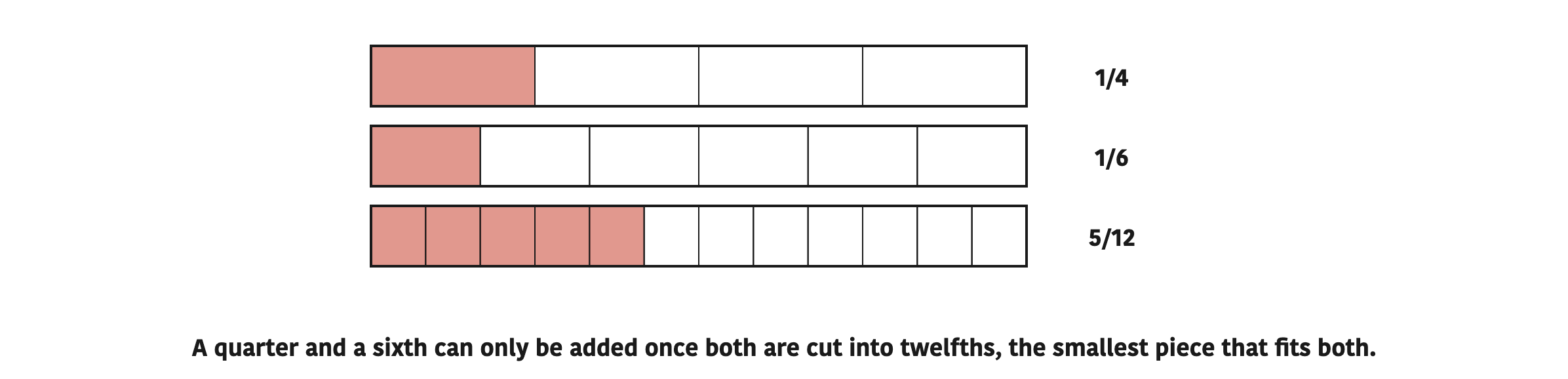
For \( \frac{1}{4} + \frac{1}{6} \), the LCM of 4 and 6 is 12. Then \( \frac{1}{4} = \frac{3}{12} \) and \( \frac{1}{6} = \frac{2}{12} \), so the sum is \( \frac{5}{12} \).
Fractions with letters follow the same rule. With the same denominator, \( \frac{a}{b} + \frac{2a}{b} = \frac{3a}{b} \). In \( \frac{3}{xy} + \frac{2a}{xy^2} \) the denominators differ. The LCM of \( xy \) and \( xy^2 \) is \( xy^2 \), so the first fraction needs one extra factor \( y \) above and below:
\[ \frac{3}{xy} + \frac{2a}{xy^2} = \frac{3y}{xy^2} + \frac{2a}{xy^2} \]
\[ = \frac{3y+2a}{xy^2} \]
Like and Unlike Algebraic Fractions
Simplifying algebraic fractions is the same idea applied to algebraic denominators. The first thing to decide is which kind of pair you have.
Like algebraic fractions: fractions that have the same denominator, such as \( \frac{x}{x-y} \) and \( \frac{y}{x-y} \).
Unlike algebraic fractions: fractions that have different denominators, such as \( \frac{x}{x-y} \) and \( \frac{y}{x+y} \).
For like fractions, add or subtract the numerators only and write the common denominator once.
For example:
\[ \frac{x}{x-y} + \frac{y}{x-y} = \frac{x+y}{x-y} \]
Subtraction works the same way. Sometimes the new numerator turns out to be the denominator itself, and the answer is 1:
\[ \frac{x}{x-y} - \frac{y}{x-y} = \frac{x-y}{x-y} = 1 \]
Making Unlike Denominators Equal
There are two ways to bring unlike fractions to a common denominator. Both give the same answer.
Method 1 is to multiply across. Each fraction is multiplied above and below by the other fraction's denominator. Take \( \frac{x}{x-y} - \frac{y}{x+y} \).
Step 1: Multiplying the first fraction above and below by \( (x+y) \), and the second by \( (x-y) \):
\[ = \frac{x(x+y)}{(x-y)(x+y)} - \frac{y(x-y)}{(x+y)(x-y)} \]
Step 2: Writing both numerators over the one denominator:
\[ = \frac{x(x+y) - y(x-y)}{(x+y)(x-y)} \]
Step 3: Expanding the numerator, where \( xy \) and \( -xy \) cancel:
\[ = \frac{x^2+xy-xy+y^2}{(x+y)(x-y)} \]
Step 4: Using \( (x+y)(x-y) = x^2-y^2 \) in the denominator:
\[ = \frac{x^2+y^2}{x^2-y^2} \]
Method 2 is to factorise the denominators and use their LCM. It is the better method whenever one denominator already contains a factor of another, because multiplying across would make the denominator bigger than it needs to be. Take \( \frac{1}{a-b} - \frac{b}{a^2-b^2} \).
LCM of algebraic expressions: the product of every factor that appears in any of the expressions, each taken the greatest number of times it appears in any one of them.
Step 1: Factorising the second denominator as a difference of two squares:
\[ = \frac{1}{a-b} - \frac{b}{(a-b)(a+b)} \]
Step 2: Finding the LCM. The first denominator is \( (a-b) \) and the second is \( (a-b)(a+b) \), so the LCM is:
\[ (a-b)(a+b) \]
Step 3: Dividing the LCM by each denominator and multiplying that fraction's numerator by the quotient. For the first fraction \( (a-b)(a+b) \div (a-b) = (a+b) \), and for the second the quotient is 1:
\[ = \frac{1 \times (a+b) - b \times 1}{(a-b)(a+b)} \]
Step 4: Simplifying the numerator:
\[ = \frac{a+b-b}{(a-b)(a+b)} = \frac{a}{a^2-b^2} \]
Whichever method you use, the whole process has the same shape:
- Check whether the denominators are the same.
- If they are different, factorise every denominator completely.
- Find the LCM of the denominators.
- Divide the LCM by each denominator and multiply that fraction's numerator by the quotient.
- Combine the numerators over the LCM, taking care with minus signs.
- Simplify the numerator, factorise it if you can, and cancel any factor it shares with the denominator.
Factorisations You Will Use
Nearly every question on algebraic fractions depends on spotting one of these patterns in a denominator or a numerator.
| Expression | Factors | Name |
| \( a^2 - b^2 \) | \( (a+b)(a-b) \) | Difference of two squares |
| \( a^3 + b^3 \) | \( (a+b)(a^2-ab+b^2) \) | Sum of two cubes |
| \( a^3 - b^3 \) | \( (a-b)(a^2+ab+b^2) \) | Difference of two cubes |
| \( a^4+a^2b^2+b^4 \) | \( (a^2+ab+b^2)(a^2-ab+b^2) \) | Fourth power pattern |
| \( x^2 + px + q \) | split the middle term | Quadratic trinomial |
Writing a bracket the other way round changes its sign: \( b-a = -(a-b) \) and \( 9-a^2 = -(a^2-9) \). So \( \frac{b}{b-a} = -\frac{b}{a-b} \). Watch for this whenever two denominators look alike but are written in the opposite order.
Same Denominator, Then Cancel
Simplify \( \frac{x^2}{x+y} - \frac{y^2}{x+y} \). The denominators are the same, so only the numerators are worked on.
Step 1: Subtracting the numerators over the common denominator:
\[ = \frac{x^2 - y^2}{x+y} \]
Step 2: Factorising the numerator as a difference of two squares:
\[ = \frac{(x-y)(x+y)}{x+y} \]
Step 3: Cancelling the common factor \( (x+y) \):
\[ = x - y \]
A simplification is not finished until the numerator has been checked for a factor it shares with the denominator.
Two Denominators Whose Product Is a Difference of Squares
When the denominators are \( x-y \) and \( x+y \), their LCM is their product, and that product is the difference of squares \( x^2-y^2 \). Simplify \( \frac{1}{x-y} - \frac{1}{x+y} \).
Step 1: Writing both fractions over the LCM \( (x-y)(x+y) = x^2-y^2 \):
\[ = \frac{(x+y) - (x-y)}{x^2-y^2} \]
Step 2: Removing the brackets. The minus sign in front of \( (x-y) \) changes both signs inside it:
\[ = \frac{x+y-x+y}{x^2-y^2} \]
Step 3: Collecting like terms:
\[ = \frac{2y}{x^2-y^2} \]
Now simplify \( \frac{x+y}{x-y} + \frac{x-y}{x+y} \). This time each numerator ends up multiplied by itself.
Step 1: Writing both over \( (x-y)(x+y) \):
\[ = \frac{(x+y)^2 + (x-y)^2}{(x-y)(x+y)} \]
Step 2: Expanding the two squares in the numerator separately:
\[ (x+y)^2 = x^2+2xy+y^2 \]
\[ (x-y)^2 = x^2-2xy+y^2 \]
Step 3: Adding the two, where \( 2xy \) and \( -2xy \) cancel, and taking out the common factor 2:
\[ 2x^2+2y^2 = 2(x^2+y^2) \]
Step 4: Putting the numerator back over the denominator:
\[ = \frac{2(x^2+y^2)}{x^2-y^2} \]
Factorising the Numerators First
Simplify \( \frac{a^3+1}{a^2-a+1} + \frac{a^3-1}{a^2+a+1} \). The denominators are different, but before hunting for an LCM, look at the numerators. \( a^3+1 \) is a sum of two cubes and \( a^3-1 \) is a difference of two cubes.
Step 1: Factorising both numerators, using \( 1 = 1^3 \):
\[ a^3+1 = (a+1)(a^2-a+1) \]
\[ a^3-1 = (a-1)(a^2+a+1) \]
Step 2: Each denominator is now a factor of its own numerator, so it cancels:
\[ \frac{a^3+1}{a^2-a+1} = a+1 \]
\[ \frac{a^3-1}{a^2+a+1} = a-1 \]
Step 3: Adding the two results:
\[ (a+1)+(a-1) = 2a \]
If something can be cancelled before any LCM is found, cancel it first. It can turn a long question into two lines.
When One Denominator Contains the Other
Often one denominator is hidden inside another. In \( \frac{1}{2a-3b} - \frac{a+b}{4a^2-9b^2} \), the second denominator factorises.
Step 1: Writing \( 4a^2-9b^2 \) as a difference of two squares:
\[ 4a^2-9b^2 = (2a)^2-(3b)^2 \]
\[ = (2a+3b)(2a-3b) \]
Step 2: The LCM is \( (2a-3b)(2a+3b) \). The first fraction is missing the factor \( (2a+3b) \), so its numerator is multiplied by it:
\[ = \frac{(2a+3b)-(a+b)}{(2a-3b)(2a+3b)} \]
Step 3: Removing the brackets and collecting like terms, since \( 2a - a = a \) and \( 3b - b = 2b \):
\[ = \frac{a+2b}{4a^2-9b^2} \]
The same pattern appears in \( \frac{4x^2+y^2}{4x^2-y^2} - \frac{2x-y}{2x+y} \).
Step 1: Factorising the first denominator, since \( 4x^2-y^2 = (2x)^2-y^2 \):
\[ = \frac{4x^2+y^2}{(2x-y)(2x+y)} - \frac{2x-y}{2x+y} \]
Step 2: The second fraction is missing the factor \( (2x-y) \). Multiplying its numerator by \( (2x-y) \) turns it into \( (2x-y)^2 \):
\[ = \frac{4x^2+y^2-(2x-y)^2}{(2x-y)(2x+y)} \]
Step 3: Working on the numerator alone, with \( (2x-y)^2 = 4x^2-4xy+y^2 \):
\[ 4x^2+y^2-(4x^2-4xy+y^2) \]
\[ = 4x^2+y^2-4x^2+4xy-y^2 \]
\[ = 4xy \]
Step 4: Placing the numerator over the denominator:
\[ = \frac{4xy}{4x^2-y^2} \]
When a bracket is subtracted, every term inside it changes sign. Writing \( -(2x-y)^2 \) as \( -4x^2-4xy+y^2 \) is the usual slip. Expand the square first, keep it inside brackets, and only then remove the brackets. The correct form is \( -4x^2+4xy-y^2 \).
Three Fractions at Once
With three fractions you may take the LCM of all three at once, or combine two of them first and then bring in the third. When two of the denominators pair up neatly, combining those two first is usually easier.
Simplify \( \frac{x}{x-y} + \frac{x}{x+y} + \frac{2xy}{x^2+y^2} \).
Step 1: Adding the first two fractions over \( (x-y)(x+y) = x^2-y^2 \):
\[ \frac{x(x+y)+x(x-y)}{x^2-y^2} \]
Step 2: Expanding, where \( xy \) and \( -xy \) cancel:
\[ = \frac{x^2+xy+x^2-xy}{x^2-y^2} \]
\[ = \frac{2x^2}{x^2-y^2} \]
Step 3: Bringing in the third fraction. \( x^2-y^2 \) and \( x^2+y^2 \) share no factor, so the LCM is their product:
\[ (x^2-y^2)(x^2+y^2) = x^4-y^4 \]
Step 4: Cross multiplying to get the new numerator:
\[ 2x^2(x^2+y^2) + 2xy(x^2-y^2) \]
\[ = 2x^4+2x^2y^2+2x^3y-2xy^3 \]
Step 5: Placing the numerator over \( x^4-y^4 \):
\[ = \frac{2x^4+2x^2y^2+2x^3y-2xy^3}{x^4-y^4} \]
Now simplify \( \frac{1}{2(x-y)} - \frac{1}{2(x+y)} - \frac{y}{x^2-y^2} \). Here it is easier to take the LCM of all three at once.
Step 1: The third denominator is \( x^2-y^2 = (x-y)(x+y) \). The factors present are 2, \( (x-y) \) and \( (x+y) \), so the LCM is:
\[ 2(x-y)(x+y) \]
Step 2: Dividing the LCM by the three denominators gives \( (x+y) \), \( (x-y) \) and 2 in turn. Multiplying each numerator by its own quotient:
\[ = \frac{(x+y)-(x-y)-2y}{2(x-y)(x+y)} \]
Step 3: Removing the brackets:
\[ = \frac{x+y-x+y-2y}{2(x-y)(x+y)} \]
Step 4: Collecting like terms, where every term in the numerator cancels:
\[ = \frac{0}{2(x-y)(x+y)} = 0 \]
An answer of zero is a real answer. It means the three fractions balance each other exactly for every allowed value of \( x \) and \( y \).
Quadratic Denominators
Simplify \( \frac{a-1}{a^2-4a+3} + \frac{a-2}{a^2-8a+12} + \frac{a-5}{a^2-8a+15} \). Each denominator is a quadratic, so each is factorised by splitting the middle term.
Step 1: Factorising \( a^2-4a+3 \). Two numbers with product 3 and sum \( -4 \) are \( -3 \) and \( -1 \):
\[ a^2-3a-a+3 = a(a-3)-1(a-3) \]
\[ = (a-3)(a-1) \]
Step 2: Factorising \( a^2-8a+12 \) with \( -6 \) and \( -2 \):
\[ a^2-6a-2a+12 = (a-6)(a-2) \]
Step 3: Factorising \( a^2-8a+15 \) with \( -5 \) and \( -3 \):
\[ a^2-5a-3a+15 = (a-5)(a-3) \]
Step 4: Each numerator is a factor of its own denominator, so after cancelling the fractions become:
\[ = \frac{1}{a-3} + \frac{1}{a-6} + \frac{1}{a-3} \]
Step 5: Adding the two equal fractions first:
\[ = \frac{2}{a-3} + \frac{1}{a-6} \]
Step 6: Writing over the LCM \( (a-3)(a-6) \):
\[ = \frac{2(a-6)+(a-3)}{(a-3)(a-6)} \]
Step 7: Expanding and collecting, since \( 2a-12+a-3 = 3a-15 \):
\[ = \frac{3a-15}{(a-3)(a-6)} \]
Step 8: Taking the common factor 3 out of the numerator:
\[ = \frac{3(a-5)}{(a-3)(a-6)} \]
Turning a Denominator Round
Simplify \( \frac{pr^2+q}{2r-1} + \frac{pr^2-q}{2r+1} + \frac{4pr^3}{1-4r^2} \). The third denominator is written the other way round: \( 1-4r^2 \) is the negative of \( 4r^2-1 \).
Step 1: Changing the sign of the denominator and the sign in front of the fraction together, which leaves its value unchanged:
\[ \frac{4pr^3}{1-4r^2} = -\frac{4pr^3}{4r^2-1} \]
Step 2: Factorising \( 4r^2-1 = (2r)^2-1^2 \):
\[ 4r^2-1 = (2r-1)(2r+1) \]
Step 3: This is the LCM of all three denominators. The first numerator is multiplied by \( (2r+1) \):
\[ (pr^2+q)(2r+1) \]
\[ = 2pr^3+pr^2+2qr+q \]
Step 4: The second numerator is multiplied by \( (2r-1) \):
\[ (pr^2-q)(2r-1) \]
\[ = 2pr^3-pr^2-2qr+q \]
Step 5: Adding these two and subtracting \( 4pr^3 \). The terms in \( pr^2 \) and \( 2qr \) cancel, and \( 4pr^3 - 4pr^3 = 0 \):
\[ 4pr^3+2q-4pr^3 = 2q \]
Step 6: Placing the numerator over the LCM:
\[ = \frac{2q}{4r^2-1} \]
A Fourth Power Denominator
Simplify \( \frac{a-b}{a^2-ab+b^2} + \frac{a+b}{a^2+ab+b^2} - \frac{2a^3}{a^4-a^2b^2+b^4} \). The first two denominators multiply to give a fourth power expression.
Step 1: Finding the product of the first two denominators:
\[ (a^2-ab+b^2)(a^2+ab+b^2) \]
\[ = a^4+a^2b^2+b^4 \]
Step 2: Cross multiplying for the first two numerators. Each product is a sum or difference of cubes:
\[ (a-b)(a^2+ab+b^2) = a^3-b^3 \]
\[ (a+b)(a^2-ab+b^2) = a^3+b^3 \]
Step 3: Adding them, \( -b^3 \) and \( b^3 \) cancel, so the first two fractions together make:
\[ \frac{2a^3}{a^4+a^2b^2+b^4} \]
Step 4: Finding the LCM before subtracting the third fraction. The two denominators differ in one sign only, so the LCM is their product. Using \( (A+B)(A-B) = A^2-B^2 \) with \( A = a^4+b^4 \) and \( B = a^2b^2 \):
\[ (a^4+b^4)^2 - a^4b^4 \]
\[ = a^8+a^4b^4+b^8 \]
Step 5: The new numerator is \( 2a^3 \) times the difference of the two denominators. The \( a^4 \) and \( b^4 \) terms cancel, and \( -a^2b^2 - a^2b^2 = -2a^2b^2 \):
\[ 2a^3 \times (-2a^2b^2) = -4a^5b^2 \]
Step 6: Placing the numerator over the LCM:
\[ = \frac{-4a^5b^2}{a^8+a^4b^4+b^8} \]
Finding an Unknown by Comparing Numerators
Sometimes the sum is given and a number in one numerator is unknown. Simplify the side with the unknown, then match its numerator to the given numerator term by term. Find \( a \) if \( \frac{a}{2x+1} + \frac{1}{x+2} = \frac{4x+5}{2x^2+5x+2} \).
Step 1: Factorising the right hand denominator, since \( 2x^2+4x+x+2 = 2x(x+2)+1(x+2) \):
\[ 2x^2+5x+2 = (2x+1)(x+2) \]
Step 2: Adding the left side over this LCM:
\[ \frac{a(x+2)+(2x+1)}{(2x+1)(x+2)} \]
Step 3: Arranging the numerator into an \( x \) term and a constant term:
\[ ax+2a+2x+1 = (a+2)x+(2a+1) \]
Step 4: The denominators are equal, so the numerators must be equal for every value of \( x \). Comparing the coefficients of \( x \):
\[ a+2 = 4 \Rightarrow a = 2 \]
Step 5: Checking with the constant terms:
\[ 2a+1 = 2(2)+1 = 5 \]
Both parts agree, so \( a = 2 \). The same method works with two unknowns: the coefficients of \( x \) give one equation, the constant terms give another, and the two are solved together.
Practice: Simplify These
The set below practises every type met above: like denominators, pairs that make a difference of squares, cubes in the numerator, quadratic denominators, reversed denominators and fourth powers. Before starting each one, name its type.
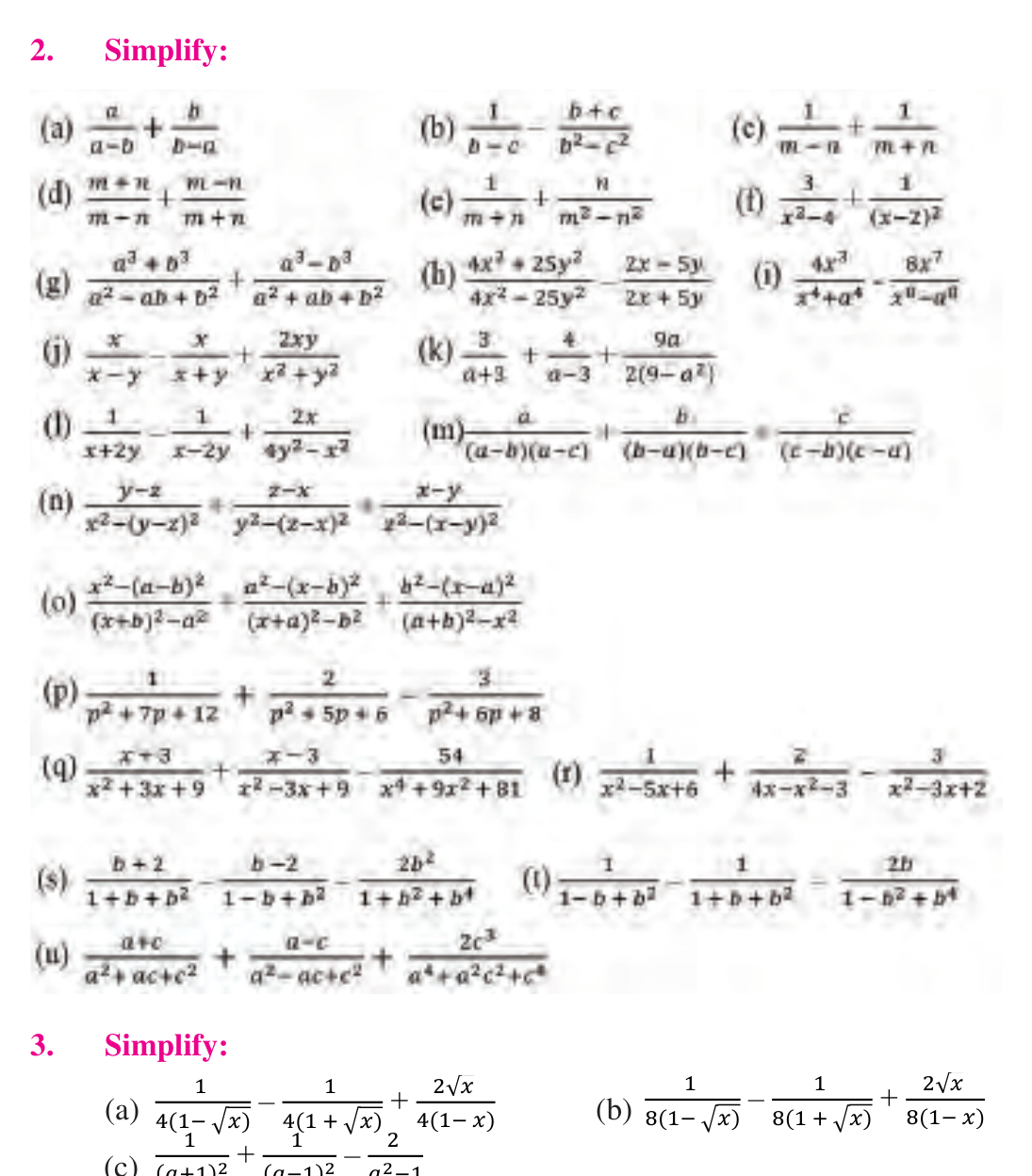
At the end of every answer, try factorising the numerator. Many of these collapse to 0, 1 or a short fraction.
The full lesson is waiting for you
The notes are free to read in full. A free account opens the rest of the practice, and tracks your progress and confidence score for every subject. Presentations and videos need approval from Learn Yeti.