Buying Rate and Selling Rate at the Bank
An exchange rate tells us how many Nepali rupees one unit of a foreign currency is worth on a particular day. A bank in Nepal publishes two rates for every currency, because it both buys and sells foreign money. When you bring foreign currency to the bank and take rupees home, the bank is buying from you. When you pay rupees and take foreign currency away, the bank is selling to you.
Buying rate: the rate at which a bank gives Nepali rupees in exchange for a foreign currency. It is the rate used when you hand foreign money to the bank.
Selling rate: the rate at which a bank gives a foreign currency in exchange for Nepali rupees. It is the rate used when you take foreign money from the bank.
The selling rate of a currency is always a little higher than its buying rate. The bank pays you slightly less for your foreign money than it would charge you for the same amount, and that small gap is how the bank earns from exchanging money.
Why Nepali Rupees Stand in the Middle
A bank in Nepal does not swap one foreign currency straight into another. The Nepali rupee is always the go-between. Suppose a traveller holds Canadian Dollars and needs Japanese Yen. Two exchanges happen, one after the other:
- The bank buys the Canadian Dollars and pays rupees for them, at the buying rate of the Canadian Dollar.
- The bank then sells Japanese Yen for those rupees, at the selling rate of the Japanese Yen.
Currency you GIVE to the bank: use its buying rate. Currency you TAKE from the bank: use its selling rate.
Once both exchanges are written down, the rupees drop out of the final answer. What is left is a direct link between the two foreign currencies, such as how many Yen one Canadian Dollar gives. There are two ways to find that link, and both are shown below on the same questions so that you can compare them.
Exchange Rates for the Examples
The worked examples use these rates from one day's list. For each currency only the rate that the exchange actually needs is shown: the buying rate for a currency given to the bank, and the selling rate for a currency taken from it.
| Currency | Amount | Value in Nepali rupees | Rate used |
| Canadian Dollar | 1 | Rs. 98.08 | Buying rate |
| Japanese Yen | 10 | Rs. 9.37 | Selling rate |
| Australian Dollar | 1 | Rs. 87.82 | Buying rate |
| Swiss Franc | 1 | Rs. 133.76 | Selling rate |
The Japanese Yen is quoted for 10 Yen, not for 1 Yen. Rs. 9.37 buys ten Yen. If you read it as the price of one Yen, your answer comes out ten times too small.
Method 1: Equating the Value of One Rupee
The first method finds how much of each foreign currency one rupee is worth. Both results describe the very same Rs. 1, so they must be equal to each other. That equation joins the two foreign currencies directly. The method runs in four stages:
- Turn round the rate of the currency you give, so that rupees are on the left, then divide to find what Rs. 1 is worth in that currency. Call this equation (i).
- Do the same with the selling rate of the currency you want. Call this equation (ii).
- Since (i) and (ii) both equal Rs. 1, set their right-hand sides equal to each other.
- Multiply or divide both sides to leave the amount you were asked about alone on one side, then calculate.
Worked Example: 1 Canadian Dollar into Japanese Yen
Question: Using the rates above, change 1 Canadian Dollar into Japanese Yen. The Canadian Dollar is given to the bank, so its buying rate is used. The Yen is taken from the bank, so its selling rate is used.
Step 1: Writing the buying rate of the Canadian Dollar the other way round:
\[ \text{Rs. } 98.08 = 1 \text{ Canadian Dollar} \]
Step 2: Dividing both sides by 98.08 to find what one rupee is worth. This is equation (i):
\[ \text{Rs. } 1 = \frac{1}{98.08} \text{ Canadian Dollar} \]
Step 3: Writing the selling rate of the Japanese Yen the other way round:
\[ \text{Rs. } 9.37 = 10 \text{ Japanese Yen} \]
Step 4: Dividing both sides by 9.37. This is equation (ii):
\[ \text{Rs. } 1 = \frac{10}{9.37} \text{ Japanese Yen} \]
Step 5: Equating the right-hand sides of (i) and (ii), because both are worth Rs. 1:
\[ \begin{aligned} &\frac{1}{98.08} \text{ Canadian Dollar} \\ &= \frac{10}{9.37} \text{ Japanese Yen} \end{aligned} \]
Step 6: Multiplying both sides by 98.08 so that 1 Canadian Dollar stands alone:
\[ 1 \text{ Canadian Dollar} = \frac{10 \times 98.08}{9.37} \text{ Yen} \]
Step 7: Calculating. Since \( 10 \times 98.08 = 980.8 \) and \( 980.8 \div 9.37 = 104.67 \) correct to two decimal places, the result is:
\[ 1 \text{ Canadian Dollar} = 104.67 \text{ Yen} \]
Does the answer make sense? One Canadian Dollar is worth about 98 rupees, while one Yen is worth a little under one rupee. So a Canadian Dollar should buy roughly a hundred Yen, and 104.67 fits that picture.
Worked Example: 250 Australian Dollars into Swiss Francs
Question: Change 250 Australian Dollars into Swiss Francs. The Australian Dollar is given to the bank at its buying rate, Rs. 87.82, and the Swiss Franc is taken from the bank at its selling rate, Rs. 133.76.
Step 1: Writing the buying rate of the Australian Dollar the other way round:
\[ \text{Rs. } 87.82 = 1 \text{ Australian Dollar} \]
Step 2: Dividing both sides by 87.82. This is equation (i):
\[ \text{Rs. } 1 = \frac{1}{87.82} \text{ Australian Dollar} \]
Step 3: Writing the selling rate of the Swiss Franc the other way round:
\[ \text{Rs. } 133.76 = 1 \text{ Swiss Franc} \]
Step 4: Dividing both sides by 133.76. This is equation (ii):
\[ \text{Rs. } 1 = \frac{1}{133.76} \text{ Swiss Franc} \]
Step 5: Equating the right-hand sides of (i) and (ii), since both are worth Rs. 1:
\[ \begin{aligned} &\frac{1}{87.82} \text{ Australian Dollar} \\ &= \frac{1}{133.76} \text{ Swiss Franc} \end{aligned} \]
Step 6: Multiplying both sides by 87.82 to find the value of 1 Australian Dollar:
\[ \begin{aligned} &1 \text{ Australian Dollar} \\ &= \frac{87.82}{133.76} \text{ Swiss Franc} \end{aligned} \]
Step 7: Multiplying both sides by 250, because the question is about 250 Australian Dollars:
\[ \begin{aligned} &250 \text{ Australian Dollar} \\ &= \frac{87.82 \times 250}{133.76} \text{ Swiss Franc} \end{aligned} \]
Step 8: Calculating. Since \( 87.82 \times 250 = 21955 \) and \( 21955 \div 133.76 = 164.14 \) to two decimal places:
\[ \begin{aligned} &250 \text{ Australian Dollar} \\ &= 164.14 \text{ Swiss Franc} \end{aligned} \]
A quick check: a Swiss Franc costs more rupees than an Australian Dollar, so 250 Australian Dollars must buy fewer than 250 Francs. The answer 164.14 is fewer, as it should be.
Method 2: The Chain Rule
You already know two ways of finding an unknown amount: the unitary method and ratio and proportion. The chain rule is another way. It is especially quick for money exchange, because it lets you write all the rates at once and do a single calculation at the end.
Chain rule: if A, B and C are the currencies of different countries, and A = B, B = C and C = A, then A × B × C = B × C × A. In words, the product of all the numbers on the left-hand sides equals the product of all the numbers on the right-hand sides.
\[ A \times B \times C = B \times C \times A \]
The lines are called a chain because each one is hooked onto the one before it. A chain is written in this order:
- Start the first line with the amount you are given on the left, and the unknown x in the currency you want on the right.
- Begin each new line with the currency that ended the line before it. If the first line ends in Japanese Yen, the second line starts with Japanese Yen.
- Keep adding lines from the rates until a line ends in the currency the first line started with. The chain is then closed.
- Multiply all the numbers on the left, multiply all the numbers on the right, set the two products equal and solve for x.
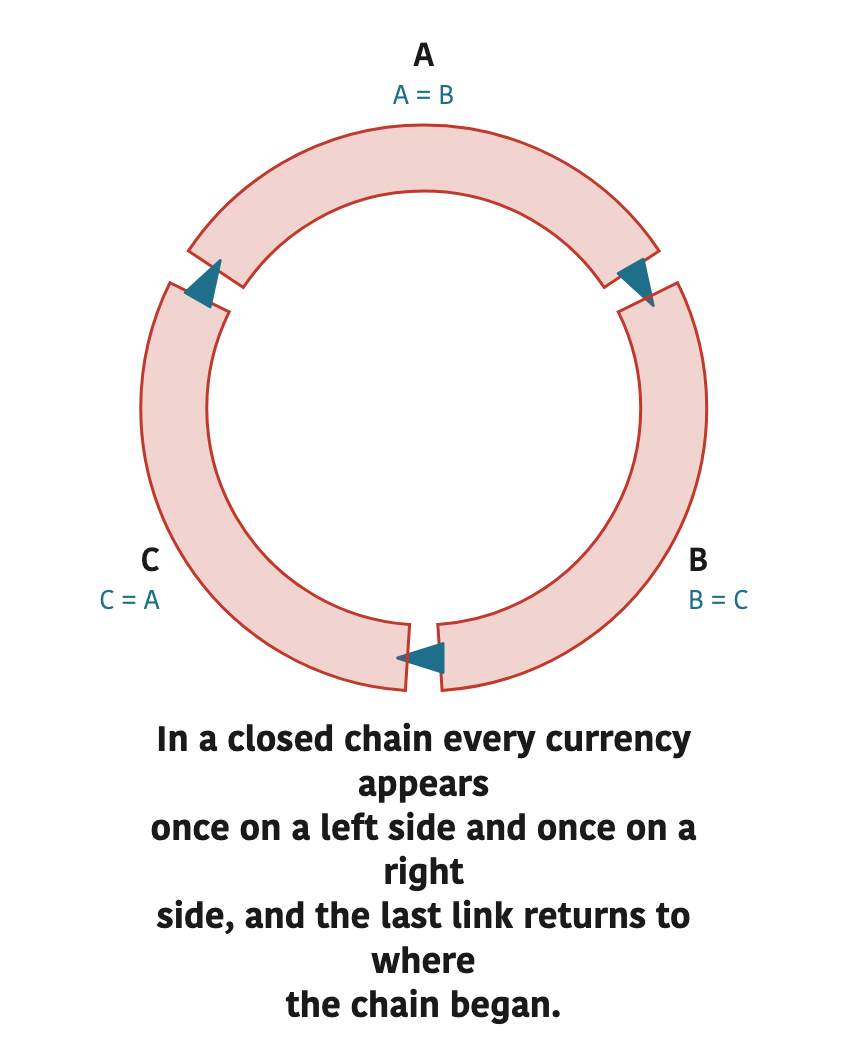
If your last line does not end in the currency your first line began with, the chain is not closed. Either a rate is missing or one line has been written the wrong way round. Do not multiply until the chain closes.
The Same Two Questions by the Chain Rule
First, 1 Canadian Dollar into Japanese Yen. Let 1 Canadian Dollar be worth x Japanese Yen.
Step 1: Writing the first link, from the unknown:
\[ 1 \text{ Canadian Dollar} = x \text{ Japanese Yen} \]
Step 2: Writing the second link, starting with Japanese Yen because the first link ended there:
\[ 10 \text{ Japanese Yen} = \text{Rs. } 9.37 \]
Step 3: Writing the third link, starting with rupees and ending with the Canadian Dollar, which closes the chain:
\[ \text{Rs. } 98.08 = 1 \text{ Canadian Dollar} \]
Step 4: Multiplying the left-hand numbers and the right-hand numbers and equating the products:
\[ 1 \times 10 \times 98.08 = x \times 9.37 \times 1 \]
Step 5: Dividing both sides by 9.37 to leave x alone:
\[ x = \frac{10 \times 98.08}{9.37} = 104.67 \]
So 1 Canadian Dollar = 104.67 Japanese Yen, exactly the answer Method 1 gave. Notice that the chain did the same work as equations (i) and (ii), in three short lines.
Now 250 Australian Dollars into Swiss Francs. Let 250 Australian Dollars be worth x Swiss Francs.
Step 1: Writing the first link, from the unknown:
\[ 250 \text{ Australian Dollar} = x \text{ Swiss Franc} \]
Step 2: Writing the second link, starting with the Swiss Franc:
\[ 1 \text{ Swiss Franc} = \text{Rs. } 133.76 \]
Step 3: Writing the third link, from rupees back to the Australian Dollar, which closes the chain:
\[ \text{Rs. } 87.82 = 1 \text{ Australian Dollar} \]
Step 4: Equating the product of the left-hand numbers with the product of the right-hand numbers:
\[ 250 \times 1 \times 87.82 = x \times 133.76 \times 1 \]
Step 5: Dividing both sides by 133.76 and calculating:
\[ x = \frac{250 \times 87.82}{133.76} = 164.14 \]
Hence 250 Australian Dollars = 164.14 Swiss Francs, the same answer as before.
A Chain Through Pounds: Dollars for Rupees
Question: If 500 American Dollars ($500) = 390 Pound Sterling (£390) and Rs. 7,547 = £50, how many American Dollars can be exchanged for Rs. 10,308?
Here no rate joins dollars and rupees directly. The pound links them, and the chain rule copes with this easily because it simply takes one more link. In the working below, Dollar means American Dollar and Pound means Pound Sterling. Let x American Dollars be worth Rs. 10,308.
Step 1: Writing the first link, dollars to pounds:
\[ 500 \text{ Dollar} = 390 \text{ Pound} \]
Step 2: Writing the second link, starting with pounds and ending in rupees:
\[ 50 \text{ Pound} = \text{Rs. } 7547 \]
Step 3: Writing the third link, from rupees back to dollars with the unknown, which closes the chain:
\[ \text{Rs. } 10308 = x \text{ Dollar} \]
Step 4: Equating the product of the left-hand numbers with the product of the right-hand numbers:
\[ 500 \times 50 \times 10308 = 390 \times 7547 \times x \]
Step 5: Dividing both sides by \( 390 \times 7547 \) to leave x alone:
\[ x = \frac{500 \times 50 \times 10308}{390 \times 7547} \]
Step 6: Multiplying out the top and the bottom:
\[ x = \frac{257700000}{2943330} \]
Step 7: Dividing, correct to two decimal places:
\[ x = 87.55 \]
So $87.55 can be exchanged for Rs. 10,308. As a check, £1 is about Rs. 151, and one dollar is about 0.78 of a pound, so a dollar is worth roughly Rs. 118. Rs. 10,308 divided by 118 is close to 87, which agrees.
One More Worked Example: US Dollars into Euros
Question: On a certain day a bank buys US Dollars at 1 US Dollar = Rs. 133.20 and sells Euros at 1 Euro = Rs. 145.60. A student going abroad has 400 US Dollars. How many Euros will the bank give for them? Let 400 US Dollars be worth x Euros.
Step 1: Writing the first link, from the unknown:
\[ 400 \text{ US Dollar} = x \text{ Euro} \]
Step 2: Writing the second link from the selling rate of the Euro:
\[ 1 \text{ Euro} = \text{Rs. } 145.60 \]
Step 3: Writing the third link from the buying rate of the US Dollar, which closes the chain:
\[ \text{Rs. } 133.20 = 1 \text{ US Dollar} \]
Step 4: Equating the two products:
\[ 400 \times 1 \times 133.20 = x \times 145.60 \times 1 \]
Step 5: Dividing both sides by 145.60, and using \( 400 \times 133.20 = 53280 \):
\[ x = \frac{53280}{145.60} = 365.93 \]
The student receives 365.93 Euros. A Euro costs more rupees than a US Dollar, so the number of Euros should be smaller than 400, and it is.
Choosing a Method and Checking the Answer
| Method | What you find first | When it suits best |
| Equating the value of Rs. 1 | What one rupee is worth in each foreign currency | When both currencies are given against rupees |
| Chain rule | Nothing separately: all links are written, then one calculation | When there are several links, or a third currency such as the pound joins the two |
Both methods always give the same answer, because they use the same rates. Whichever you choose, run through these checks before writing the final answer:
- The currency given to the bank uses its buying rate, and the currency taken uses its selling rate.
- A rate quoted for 10 or 100 units has been used as 10 or 100 units, not as one.
- In a chain, the last line ends in the currency the first line began with.
- The size makes sense: changing into a currency worth more rupees gives fewer units, and into one worth fewer rupees gives more units.
- Money is rounded to two decimal places.
Using the selling rate for the currency you hand over. The bank is buying that currency from you, so only its buying rate is correct. The wrong rate gives an answer that looks reasonable but is not what the bank would pay.
The full lesson is waiting for you
The notes are free to read in full. A free account opens the rest of the practice, and tracks your progress and confidence score for every subject. Presentations and videos need approval from Learn Yeti.