What Sport Science Is
While a player is running a race, a great deal is happening in their body and mind at the same moment. The heart beats faster, breathing speeds up, and the leg muscles tighten and relax in turn. At the same time the mind is busy with the wish to win, the fear of losing and the pressure of the crowd. One slip on the track could also cause an injury. All of these belong to sport, so they need to be understood together rather than one at a time.
Sport science is the subject that does exactly this. It is connected with many sides of sport. It studies the human body in a disciplined way, which means by following careful rules and methods rather than guessing. Its aim is to find out two things: how people can stay healthy through games and sporting activities, and how sport performance can be developed. Sport performance means the ability a player shows on the field, such as how fast a sprinter runs or how accurately a footballer passes the ball.
Sport Science: the subject that studies the human body in a disciplined way and examines every aspect of sport, to find out how people can stay healthy through games and sporting activities and how sport performance can be developed.
The Three Main Branches of Sport Science
Sport science is one large subject, but it contains several fields. Three of them are studied as its main branches:
- Sport psychology: the study of a player's mind, behaviour and the surroundings that affect their play
- Exercise physiology: the study of how exercise affects the systems of the body
- Sport medicine: the knowledge that protects players from disease and injury and treats them when they are hurt
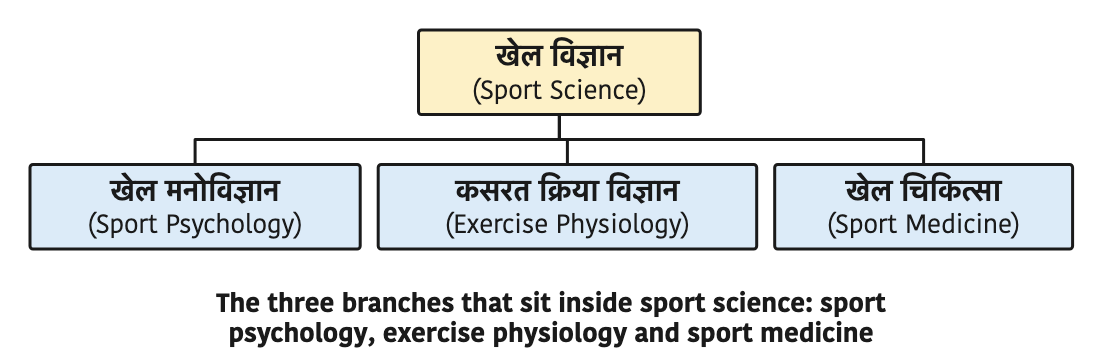
Think of a girl preparing for a 400 metre race at district level. Before the start she feels very nervous and her hands shake. Understanding and removing that problem needs sport psychology. Understanding what regular training has changed in her heart, lungs and muscles needs exercise physiology. Treating her ankle when she twists it in practice, and advising her on what nourishing food to eat, needs sport medicine. Only with all three working together can she become a strong runner.
Introduction to Sport Psychology
Sport psychology is treated as an integral part of general psychology, meaning a part that cannot be separated from it. It is also explained as applied psychology, because it takes what psychology knows and uses it on real problems in sport. So sport psychology is a branch of applied psychology. It gained its own separate identity in the 1960s. Even so, it is still regarded as a new subject in the field of sport.
Sport psychology studies two things: the behaviour of players in connection with sport, and the surroundings that influence the game. For example, it tries to understand why a goalkeeper who plays well in practice makes mistakes in a big tournament in front of thousands of spectators, or why the whole team plays badly when two of its players quarrel.
Sport Psychology: the subject that teaches sporting skills according to the individual and group wishes, needs and individual differences of players, identifies their problems quickly, and helps make them mentally and practically alert and capable so that they can give an excellent performance and succeed in competitions.
In this way sport psychology solves the practical problems that appear in players and builds a healthy, suitable attitude of mind in them. By studying how a person behaves in sport, it looks at every side of a problem so that the problem can be removed.
Need of Sport Psychology
Sport psychology has a direct effect on the world of sport. It draws the nation, society and players towards sport, and it plays a major part in steadily raising a player's skill, ability and level. The reasons sport psychology is needed are these:
- To identify the individual and group problems and differences of players and adopt ways of solving them
- To teach physical activity skills according to each player's interest, age, gender and ability
- To help players accept both defeat and victory gracefully
- To choose a game for a person according to their personality
- To help players show excellence in competitions and set new records
- To raise the self-confidence and morale of players
- To support the proper physical, mental, social and emotional growth of children, and to make the fullest use of modern sports equipment
However strong the body is, a player whose mind is frightened, discouraged or restless cannot show their full ability. Sport psychology gets the mind ready for the game.
Introduction to Exercise Physiology
To understand this branch, first understand two terms: exercise and physiology. When we do squats, run, skip or do push ups, we repeat the same body movement again and again. Such an activity is called exercise.
Exercise: a physical activity in which a person repeats various body actions again and again, as much as is needed.
Physiology: the analytical study of all the functions of the human body, including its mechanical and biochemical functions. It is a part of sport medicine.
Now put the two terms together. After a person takes part in different exercises, the effects on the physical, mechanical and biochemical workings of their body are analysed and studied. That study is exercise physiology.
Exercise Physiology: the analytical study of the effects on physical, mechanical and biochemical processes that follow a person's participation in various physical exercises.
Do not treat physiology and exercise physiology as the same thing. Physiology studies all the functions of the body. Exercise physiology studies only the effects that exercise has on those functions.
Exercise physiology is learning that comes through physical education activities and physical practice. A person becomes strong, healthy and capable only by doing physical practice. Because every person's body is different, exercise physiology is the science that studies each person's practice and the effect it has on the different systems of their body.
Exercise physiology is closely related to biology. It studies how the body works in its environment and how the organs of the body act on one another. For example, it studies what the muscles, heart, lungs and bones do and how they do it. For this reason the field that studies how the human body functions is also called human exercise physiology.
Exercise physiology looks for answers to these questions:
- How does the body change after children take part in sport?
- What effect does regular activity and exercise have on sport performance?
- What should be done to improve how the body's systems work?
- What are the helpful and harmful effects of sport on the body?
Importance of Exercise Physiology
Because it is the science of how exercise and physical activity affect the human body, exercise physiology matters a great deal in physical education. Its value lies in the benefits that come from studying the body's systems. It is important for these reasons:
- It shows that physical practice has a positive effect on a person's blood circulation, breathing and muscles.
- It helps keep the production and work of hormones and body juices in the organs, systems and glands regular during physical activity.
- It helps the different organs of the body work correctly.
- It helps increase the capacity of the body's systems.
- By explaining how muscles are built and how they work, it gives knowledge about physical fitness, endurance and strength.
- It helps develop sport performance and the working of nerve impulses.
- It helps discover the individual ability of each person.
- It supports research in the field of sport.
For example, a volleyball coach who understands exercise physiology can work out which player has low endurance and which has more strength. The coach can then plan training to suit each player's body.
Introduction to Sport Medicine
During sport, players can suffer injuries that range from minor ones, such as a twisted foot, to complex ones, such as a broken bone. If these injuries are not treated in time, a player may be forced to retire from the sport altogether. A good player's career can end because a small injury was ignored. This is why sport medicine was developed: to treat players' wounds and injuries and to make their sport performance even better.
Sport Medicine: the branch of sport science developed to treat players' wounds and injuries and to make their performance better, which gives players knowledge of preventive and curative measures that protect them from disease and injury.
Sport medicine gives knowledge of two kinds of measures. Preventive measures stop disease or injury from happening in the first place, for example warming up before play and wearing the right shoes. Curative measures are the treatment given after an injury has already happened. Together, both kinds of knowledge help develop a player's sport performance and physical fitness.
Importance of Sport Medicine
The importance of sport medicine can be seen in these points:
- It helps make players aware of the problems that may arise during play.
- If an accident causes an injury or another physical problem, it gives immediate treatment and a solution so that the player can quickly return to the game.
- It helps a person's own abilities and qualities come out fully by giving them the right conditions.
- It helps choose sporting activities that match a person's interest, wishes, ability and level.
- It studies the weaknesses seen in players and helps correct them, so that performance develops.
- It gives players knowledge of curative measures so they can stay safe from disease and injury.
- It makes players aware of eating nutritious food planned scientifically according to the nature of the game and the needs of the player.
- It discourages the use of drugs and makes players aware of their effects.
- Through sport medicine, players can develop their sport performance.
Drugs must never be used to get ahead in sport. Sport medicine discourages their use because they harm both the player's body and their sporting career.
The Three Branches Side by Side
All three branches share one goal: keeping players healthy and raising their sport performance. Each one works from a different starting point.
| Branch | What it studies | How it helps the player |
| Sport psychology | Players' behaviour and the surroundings that affect play | Raises morale, teaches graceful acceptance of results, matches games to personality |
| Exercise physiology | The effects of exercise on the body's systems | Improves circulation, breathing and muscles, discovers individual ability |
| Sport medicine | Preventing and treating disease and injury | Gives quick treatment, guides nutrition, discourages drug use |
A steady mind, a body made strong by training, and care given in time: only when these three come together is a player complete. Sport science brings all three into one subject.
The full lesson is waiting for you
The notes are free to read in full. A free account opens the rest of the practice, and tracks your progress and confidence score for every subject. Presentations and videos need approval from Learn Yeti.