What Health Promotion Means
Looking after health does not start only when we fall ill. Stopping disease before it begins, protecting the health we already have and making it better still are just as important. Taken together, this work is called health promotion. It includes teaching people about health, changing unhealthy habits, giving vaccines, improving the environment and developing the community. Put simply, health promotion is the process of lifting a person's physical, mental, emotional and social health from a lower level towards the highest level they can reach.
In 1986, the first international conference on health promotion was held in the city of Ottawa, Canada, led by the World Health Organization. The conference issued the Ottawa Charter for Health Promotion. The best known definition of health promotion comes from this charter.
Health promotion: the process of enabling people to increase control over, and to improve, their health. (Ottawa Charter, 1986)
Here, control over health means being able to manage the things that affect it: food, habits, behaviour, housing, education, poverty, the environment, and social and cultural conditions. A teenager who knows which foods carry which nutrients can think for themselves when choosing a snack. Once people have the knowledge and the skills, they can make decisions about their own health, and that is exactly what control means.
Definition by Labonte and Little (1992): health promotion is any activity or programme designed to improve the social and environmental conditions that increase people's experience of health.
The first definition stresses making people capable. The second stresses improving the social and environmental conditions in which people live. Read together, they show that health promotion works both inside the person and in the world around them.
Health promotion is a broad effort to avoid disease, stay healthy and improve the state of our health. It keeps physical, mental, social and emotional health in balance, and it is the duty of the individual, the family, the community, society and the government together.
The Five Priority Actions from Ottawa
The Ottawa conference called on every country in the world to adopt five actions as priorities. It developed them as a strategy: if all countries follow them, people's health can be promoted. These five actions are therefore the methods a government uses to promote the health of its own people:
- Build healthy public policy, for example a law that stops smoking in public places.
- Develop personal skills, for example teaching people to choose and cook a balanced meal.
- Strengthen community action, for example neighbours running a cleaning campaign together.
- Create supportive environments, for example providing clean water and toilets in schools.
- Reorient health services, for example giving weight to preventing disease and raising awareness, not only to treatment.
These five are what a government and a country do, but each person has a part to play as well. To promote our own health, we must make everything from our daily habits to our surroundings healthy and suited to us.
What Directly Shapes Our Health
Our health is not decided in hospitals alone. Several things we meet every day have a direct effect on it:
- personal habits and behaviour
- nutrition
- the physical environment around us
- the social environment
When these are positive and healthy, they support health promotion. For that, a person's social and economic position must also be strong. Health can be promoted for everyone only when discrimination by caste and ethnicity, by gender and by class is ended, and everyone is brought forward in a way that lets them take part. Think of a family that cannot get treatment because it has no money, or a girl who is given less nutritious food because she is a daughter. However good the advice they receive, staying healthy is hard for them. So alongside each person's daily activities, the political and social climate of the whole country must be healthy too. In this sense, health promotion is also a social and political process.
Six Ways to Promote Health
There are several ways to promote a person's health. The six main ones are:
- (a) Food and nutrition
- (b) Physical exercise
- (c) Healthy habits
- (d) Better access to health services
- (e) Raising awareness about health and health promotion
- (f) A healthy environment
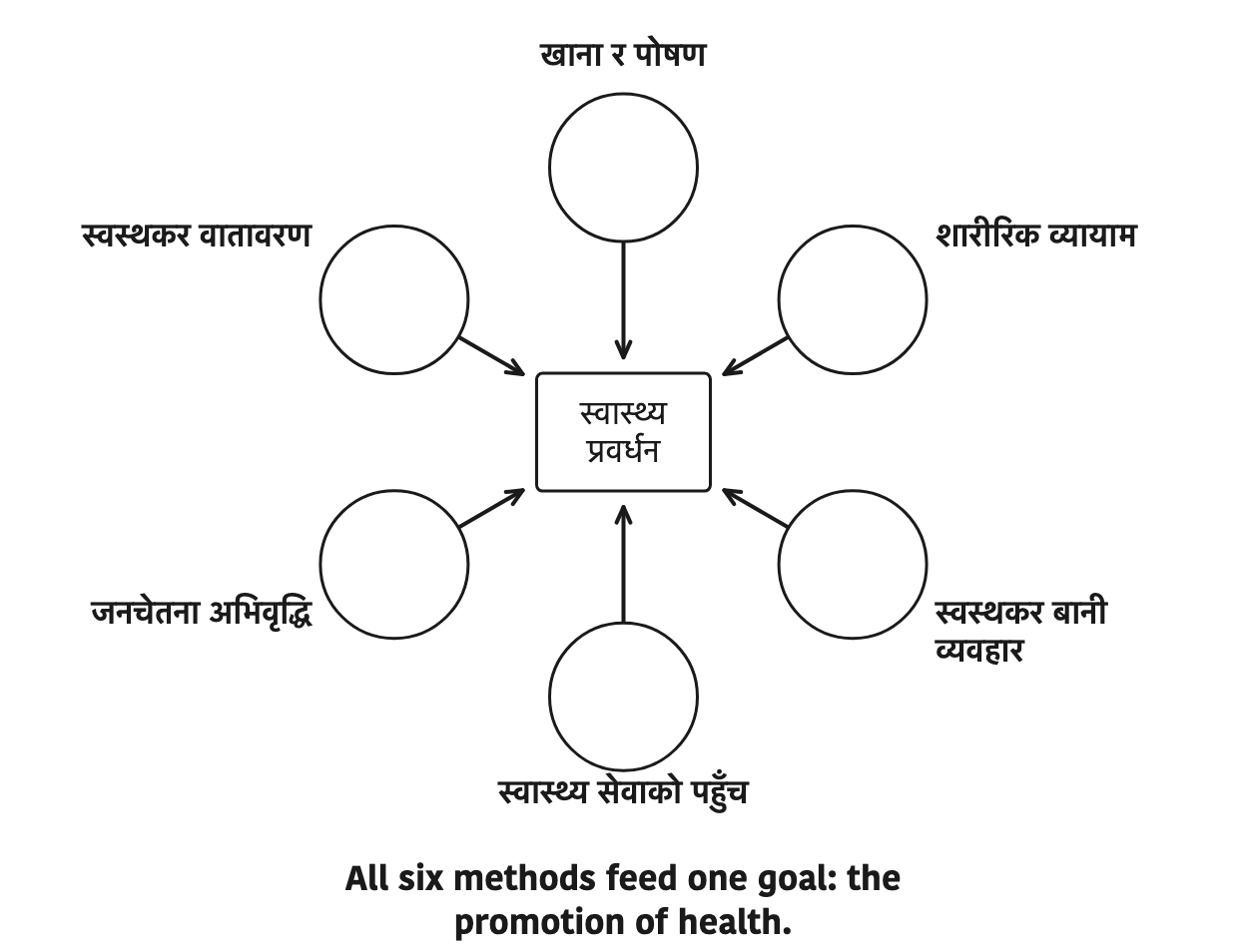
The five priority actions from Ottawa and the six methods of promoting a person's health are not the same list. The five actions are a strategy for countries and governments. The six methods run from food and nutrition to a healthy environment. Read carefully to see which list a question is asking for.
(a) Food and Nutrition
The body needs several kinds of nutrients to grow, to work and to fight disease:
- carbohydrates
- proteins
- fats
- vitamins
- minerals
- salts
- water
Malnutrition: the condition in which the body does not get the nutrition it needs, either because there is not enough food, or because food is available but people do not know how to eat it in the right amounts.
Avoiding malnutrition does not need expensive food. Turning the grain and vegetables already at home into a balanced meal is enough. Nutritious local foods such as green vegetables, maize, wheat, millet, pulses and fruit should be eaten together in the right balance. A meal of millet porridge with lentils and green vegetables costs little and gives the body a wide range of nutrients. To promote health, we must build the habit of combining nourishing foods in a balanced way.
Packaged market foods such as instant noodles, biscuits and chocolate contain few nutrients, so they do little good for our health. For a school snack, roasted maize and soybeans made at home, or a piece of fruit, is far more nourishing than a packet of instant noodles. To promote our health we should always choose nutritious, wholesome food.
(b) Physical Exercise
Just as health promotion needs good nutrition and a healthy environment, it needs physical exercise just as much. That is why exercise is called indispensable for health. It makes every part of the body strong and firm, and it helps the body digest the food we eat properly. A person who exercises regularly does not fall ill easily.
We should set aside some time from our daily work and exercise and play sport regularly, in a way that does not harm the body. Running in the morning, cycling, playing football or volleyball at school and helping with work at home all count as physical activity. A little every day is better than a lot on one day and nothing for the rest of the week, because the benefit of exercise comes from doing it regularly.
(c) Healthy Habits
A person's habits play a large part in protecting and promoting their health. Health is not built by one good day. It is built by what we repeat every day, so our habits must always be healthy. Some habits that promote health are:
- getting up early in the morning
- going to the toilet regularly
- bathing and keeping every part of the body clean
- being physically active and exercising regularly
- eating snacks and meals on time, and eating nourishing, balanced food
- making time for recreation
- not smoking and not drinking alcohol
- paying attention to personal hygiene
- disposing of waste in the proper way
These habits are linked to one another. A student who gets up early has time to exercise, to bathe and to eat on time. That is why healthy habits must be adopted if health is to be promoted.
(d) Better Access to Health Services
Even with good habits, we still need health services when we fall ill, need a vaccine or need a check-up. If we are far from the services the government provides, promoting health becomes hard. So the government must extend health services to every village. Class discrimination must be ended so that services reach poor people too. Only when everyone can get health care easily, at the time they need it, can the health of all the people be promoted.
For example, a pregnant woman in a remote village can have regular check-ups if there is a health post near her home. Where the nearest hospital is a whole day's walk away, the same check-ups become impossible for many women.
(e) Raising Awareness about Health and Health Promotion
People change their habits only once they understand their health. So communities need awareness programmes about health, such as programmes on:
- personal cleanliness
- keeping the community clean
- ways to prevent different kinds of disease
- changing lifestyle to avoid non-communicable diseases
A non-communicable disease is one that does not pass from person to person, such as diabetes or high blood pressure. Many of these diseases are linked to diet and lifestyle, so awareness does a great deal to prevent them. When the government and the people of a community work together to run awareness programmes from time to time, such as street dramas, school rallies and health camps, health can be promoted.
(f) A Healthy Environment
To protect and promote health, all three kinds of environment around us must be healthy: the physical, the social and the economic. Each one is made healthy by different actions:
| Environment | What makes it healthy |
| Physical | using toilets, managing waste properly, keeping the surroundings of home and school clean, personal cleanliness |
| Social | getting along and playing together with friends at school, living in harmony with neighbours, avoiding quarrels, helping one another |
| Economic | ending economic and social deprivation in society, guaranteeing social equality for everyone |
Clean surroundings mean fewer germs, flies and mosquitoes to spread disease. A friendly social environment keeps the mind calm and happy. When everyone has equal opportunity, nobody has to go without food or treatment because of poverty. In this way the three environments together promote the health of the people in a community.
When All the Ways Work Together
The six methods do not work in isolation. A child who eats balanced meals but lives beside a heap of rubbish can still fall ill again and again. A patient who exercises every day but cannot reach a health post will not get treatment in time. So personal habits, nutrition, the physical environment and the social and economic environment must all be made positive. Health promotion is complete only when, at the same time, people's social and economic position is strengthened, discrimination by class, caste and gender is ended so that everyone moves forward together, and the country's political and social climate is kept healthy.
The full lesson is waiting for you
The notes are free to read in full. A free account opens the rest of the practice, and tracks your progress and confidence score for every subject. Presentations and videos need approval from Learn Yeti.