Places and Traditions That Carry History
A country keeps its past alive in two ways. Part of it stands in stone, brick and wood: temples, palaces, statues and ponds. The rest lives in people: festivals, dances, dress, music and the stories told about them. When we talk about the historical and cultural significance of something, we explain what it tells us about the people who made it, and why it still matters to people today.
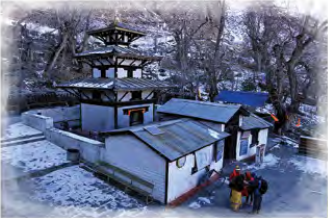
Muktinath stands high in the Himalaya in Mustang. Hindus and Buddhists both treat it as holy, and pilgrims have walked there for centuries. Its significance lies partly in that sharing: one sacred place, two faiths, and no quarrel over it.
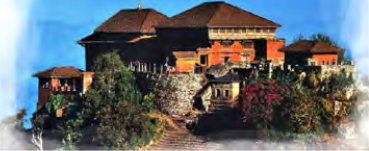
Gorkha Durbar sits on the ridge above Gorkha bazaar. It was the seat of the Shah kings, and from here Prithvi Narayan Shah began the campaign that joined many small kingdoms into modern Nepal. A visitor to the palace is standing where the story of the country begins.
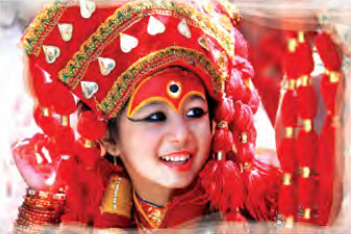
The Kumari is part of a Newar tradition of the Kathmandu Valley. A young girl is chosen and worshipped as a living goddess, dressed in red, crowned, and marked with a painted eye on her forehead. She is carried through the city during festivals such as Indra Jatra. The custom is centuries old, and it is still practised.
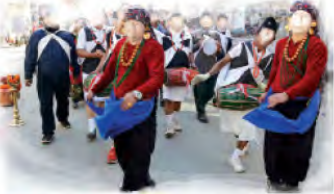
A dance like the one above is history that people can join in. The drums, the steps and the costumes are passed from grandparents to grandchildren, and every performance at a festival tells the community who it is and where it came from.
To speak about the significance of a place or a tradition, answer three questions: What is it? What does it tell us about the past? Why does it still matter today?
- It was built by ... in the time of ...
- It is sacred to ... because ...
- It has been celebrated for centuries, and people still ...
- It reminds us of ...
- Without it, we would forget that ...
Pratap Malla: The Poet King of Kantipur
Pratap Malla was one of the most famous kings of the Malla dynasty. He ruled Kantipur, the kingdom we now call Kathmandu, in the seventeenth century, at a time when the valley was divided into three rival kingdoms: Kantipur, Lalitpur and Bhaktapur. The reading about him is history writing. It moves through his life in time order, names people and places exactly, and ends with a judgement on his reign.
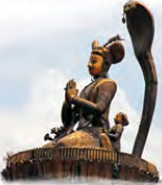
His statue still stands on a tall pillar in Hanuman Dhoka Durbar Square in Kathmandu. Anyone who walks through the square today is looking at the work of this king, because much of what surrounds the pillar was built or rebuilt by him.
How He Came to the Throne and How He Ruled
Pratap Malla gained experience of running the kingdom while his father, King Laxmi Nara Singh, was still alive. When his father's madness grew worse, Pratap Malla imprisoned him and ruled Kantipur himself as regent. This beginning is described as both interesting and controversial. It is interesting because a son jailed his own father and took his place. It is controversial because people can still argue about it: was he protecting the kingdom from a sick ruler, or simply seizing power early?
Regent: a person who rules a country in place of a king or queen who cannot rule, because the ruler is too young, too ill or away.
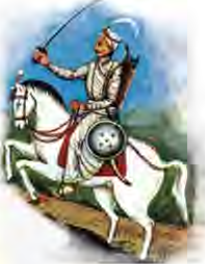
He was an able administrator. Kantipur developed greatly during his reign, and trade with Lhasa in Tibet went on well. His greatest skill was diplomacy. He kept the kings of Lalitpur and Bhaktapur busy with each other. Sometimes he sided with Bhaktapur and threatened Lalitpur; at other times he aligned himself with Lalitpur and attacked Bhaktapur. Because the two neighbours never trusted each other, neither became strong enough to threaten Kantipur.
Diplomacy: the skill of managing relations with other states or people cleverly, so that you get what you want without open war. The reading's word for this skill in Pratap Malla is 'tact'.
A Builder of Temples and Palaces
Pratap Malla was a religious-minded man, and a great deal of the Kathmandu that tourists photograph today comes from his building work:
- He built a beautiful temple at Guhyeshwari and fenced it.
- He renovated the temple of Pashupatinath and raised a pinnacle over it.
- At Swayambhu he built Pratappur, Kabeendrapur and many other temples, and set up a gilt copper vajra, the thunderbolt symbol.
- He renovated the temples of Basuki, Bhimsen, Taleju and Degutale.
- To ward off evil, he set up an image of Hanuman, the monkey god, beside his palace gate. From then on the palace was called Hanumandhoka.
- He built the golden gate of the palace and set up images of Nri Simha, Kal Bhairab and Vishwaroop at Layaku Bahi.
- Inside the palace he built Sundari Chowk and Mohan Chowk, two courtyards.
- He had a pond dug at Bhandarkhal, filled it with water brought from Budhanilakantha, and laid in it an image of Narayan lying down, an exact replica of the one at Budhanilakantha Temple.
Notice the difference between building and renovating. Guhyeshwari was built new; Pashupatinath, Taleju and Degutale already existed and were renovated, that is, repaired and improved. Budhanilakantha was neither: he only copied its image for his own pond.
Kabeendra, the King of Poets
Pratap Malla was a vastly learned king and a poet. He wrote poems in five languages: Sanskrit, Nepal Bhasa, Nepali, Bengali and Hindi. He also knew the Arabic and Roman scripts and could read English letters. Proud of his poems, he conferred on himself the title 'Kabeendra', which means king of poets.
The reading compares him with Akbar, the Mughal emperor of India, who was famous for gathering wise men at his court. Like Akbar, Pratap Malla respected and patronised the scholars of his day. Lambakarna Bhatta, who came from Maharashtra, Nri Simha Thakur from Bihar and Jamana Gurubhaju of Kantipur were among them. He loved music too, so musicians were welcomed and honoured at his palace.
The writer calls these scholars 'jewels in the galaxy of scholars'. This is a metaphor. The scholars were not really jewels and the palace was not a galaxy; the words compare them to bright, precious things gathered in one shining place, which tells us how highly the writer rates the king's court.
His Last Years and His Legacy
Pratap Malla had five sons: Bhupendra, Chakrabartendra, Nripendra, Mahipatendra and Parthibendra. He wanted them to learn how to govern while he was still alive, so he made each son rule the country for one year in turn. The plan ended in grief. His second son, Chakrabartendra, died the day after he took over. The king and queen were heartbroken, and to console the queen he made a huge pond in front of the present Tri-Chandra College. It is still known as Ranipokhari, the queen's pond.
Pratap Malla died suddenly while watching the religious dance of Harisiddhi. He had ruled for thirty-three years, from 1641 A.D. to 1674 A.D. The reading's final judgement is that Nepal made remarkable progress in every field under him. There was peace and prosperity at home and no threat from outside. Trade with India and China made the country rich, art and literature flourished, and the kings of Bhaktapur, Lalitpur and the other neighbouring kingdoms did not dare to invade Kantipur.
| What he did | What it shows about him |
| Imprisoned his mad father and ruled as regent | Ambitious and ready to rule |
| Played Lalitpur and Bhaktapur against each other | A skilful diplomat |
| Built and renovated many temples | Religious-minded |
| Wrote poems in five languages | Learned and creative |
| Gathered scholars and musicians at court | A patron of learning and the arts |
| Let each son rule for a year | A father planning for the future |
| Made Ranipokhari for the grieving queen | A caring husband |
Saying the Possessive: /s/, /z/ or /iz/
Possessive 's: the apostrophe and s added to a noun to show that something belongs to it, as in Dick's house or Nepal's border.
The possessive 's is always written the same way, but it is spoken in three different ways. Which one you use depends on the last sound of the noun, not its last letter. These are the same rules that decide how a plural -s or a third person -s is spoken.
- Say /iz/, an extra syllable, after a hissing or hushing sound: s, z, sh, ch, j. Ramesh's, the bus's, coach's, James's.
- Say /s/ after a voiceless sound, one made without the voice buzzing: p, t, k, f, th. Dick's, a week's, the aircraft's.
- Say /z/ after every other sound: vowels and voiced sounds such as b, d, g, l, m, n, r, v. Luna's, Nepal's, my brother's, children's.
Voiced and voiceless sounds: put your fingers on your throat and say 'zzz', then 'sss'. The buzz you feel in 'zzz' means the sound is voiced; no buzz in 'sss' means it is voiceless.
When a plural noun already ends in s, we write only an apostrophe after it, and we add no new sound at all: the girls' excitement sounds just like 'the girls excitement'. The final sound is the one the plural already had, so parents' ends in /s/ and ladies' ends in /z/. Some famous old names ending in an /iz/ sound, such as Socrates and Ulysses, also take only the apostrophe and no extra syllable.
| /s/ | /z/ | /iz/ |
| Dick's house | Luna's pet | Ramesh's phone |
| the aircraft's black box | Lisa's essay | Thomas's job |
| a week's work | Nepal's border | the bus's arrival |
| my parents' wedding | my brother's book | James's office |
| children's shoes | coach's decision | |
| the girls' excitement | princess's necklace | |
| the ladies' room | ||
| Socrates' philosophy | ||
| Ulysses' friends |
Thomas ends in the letter s but James's and Thomas's still get /iz/, while Socrates' and Ulysses' do not. And 'a week's' ends in the letter k but the sound /k/ is voiceless, so it takes /s/. Always listen to the sound, not the spelling.
Talking About the Past
Narrating means telling what happened, in the order it happened. A good spoken narration uses past tense verbs, time words that move the listener forward, and a word or two about how you felt. Here is a short narration of a holiday:
"When our school closed for the autumn holidays, I could hardly wait to see my grandparents in Pokhara. I phoned my grandmother on Thursday and told her I would arrive the next evening. The bus left Kathmandu at seven in the morning, and for most of the journey I watched the rivers below the road. My uncle met me at the bus park at five. For the next ten days I helped my grandfather in his vegetable garden, flew kites with my cousins and went boating on Phewa Lake. On the last evening we all ate together, and I felt sad to leave. It was the best holiday I have had."
Time words hold a narration together: first, then, after that, the next morning, at five, for ten days, on the last evening, finally.
To ask about someone's past actions, use did with the base form of the verb. The answer uses the past form and repeats the time:
Do not put the past form after did. 'What did Tony went?' is wrong, because did already carries the past. Say 'What did Tony do?' and 'Where did he go?'
When you tell others about a party you attended, a simple plan keeps the talk clear. Cover four things, in this order:
- Who invited you.
- Where you were invited.
- Why the party was organised.
- Anything you offered or received.
Simple Past and Past Continuous
Simple past: the tense for an action that started and finished at a time in the past. Form: the past form of the verb (V2). Example: I washed the dishes after dinner.
Past continuous: the tense for an action that was in progress at a moment in the past. Form: was or were + verb-ing. Example: At eight o'clock I was washing the dishes.
The difference is the difference between a dot and a line. The simple past sees the whole action as one finished event, a dot on the timeline. The past continuous sees the action from the middle, still going on, a line on the timeline. We use was with I, he, she, it and singular nouns, and were with we, you, they and plural nouns.
| Tense | Form | Example |
| Simple past | past form of the verb (V2) | She wrote a letter. |
| Past continuous | was / were + verb-ing | She was writing a letter. |
| Past perfect | had + past participle (V3) | She had written a letter. |
Verbs of state are not normally used in the continuous: be, have (meaning own), know, like, want, believe. Say 'The hotel was wonderful', never 'The hotel was being wonderful', and 'There was a bomb there', never 'There was being a bomb'.
When and While
These two tenses are most often used together, joined by when or while. The patterns below cover almost every sentence you will meet.
- A long action is interrupted by a short one. The long action takes the past continuous, the short one the simple past: I was doing my homework when the telephone rang.
- While usually introduces the long, background action: The alarm went off while Trishna was sleeping.
- Two long actions went on at the same time. Both take the past continuous: While Mother was cooking, Father was reading the newspaper.
- One short action followed another. Both take the simple past: When the doors opened, the audience rushed into the stadium.
The choice of tense can change the meaning completely. 'When I arrived home, my dad was preparing snacks' means he had started before I came in. 'When I arrived home, my dad prepared snacks' means he started after I arrived, perhaps because I arrived.
'While I washed my shirt, I found a note' is weak, and 'I was finding a note while I washed' is wrong. Finding is sudden and short, washing takes time: I found a thousand rupee note while I was washing my shirt.
Turning a Timeline into Paragraphs
A timeline gives you the bones of history: dates and bare events. Paragraphs put flesh on them. The events below are the major steps in Nepal's journey from the Panchayat System to multiparty democracy, and the dates are in Bikram Sambat (B.S.).
| Date (B.S.) | Event |
| 1st Poush, 2017 | King Mahendra dismissed the elected government, suspended parliament, imprisoned the Prime Minister and ministers, banned political parties and their activities, and seized all power |
| 22nd Poush, 2017 | King Mahendra announced the partyless, autocratic Panchayat System |
| 10th Jestha, 2036 | A referendum was announced |
| 20th Baishak, 2037 | The referendum vote took place |
| 10th Jestha, 2042 | A non-violent civil disobedience movement began |
| 7th Falgun, 2046 | The mass movement formally started |
| 26th Chaitra, 2046 | The multiparty system was restored |
Timeline: a line on which events are marked in the order they happened, each with its date.
- Step 1: Group the events. Here they fall into two parts: how democracy was taken away in 2017, and how it was won back between 2036 and 2046.
- Step 2: Give each group one paragraph, and open each paragraph with a sentence that says what it is about.
- Step 3: Turn every note into a full sentence in the simple past, and use the passive where the doer is unknown or unimportant: 'A referendum was announced'.
- Step 4: Join the events with time expressions: on 1st Poush 2017 B.S., three weeks later, nearly two decades later, within two months, at last.
- Step 5: End with a sentence that sums up the whole journey.
A strong opening for the first paragraph might read: "On 1st Poush 2017 B.S., King Mahendra brought Nepal's elected government to a sudden end. He dismissed the government, suspended parliament and imprisoned the Prime Minister and his ministers. Three weeks later, on 22nd Poush, he announced the partyless Panchayat System."
A date in history writing must be copied exactly. Write the day, the month and the year, and add B.S. or A.D. so the reader knows which calendar you mean.
Writing an Opinion About History
Some people say studying history is a waste of time; others say it is essential. An opinion essay of about 200 words takes a side and defends it. It is not enough to say 'I think history is important'. You must give reasons, support each with an example, and show that you have considered the other side.
- Opening: state the question and your opinion in one or two sentences.
- Body: give two or three reasons, each with an example. Pratap Malla's Ranipokhari, or the thirty-year struggle for democracy, make good Nepali examples.
- The other side: mention the opposite view fairly, then answer it.
- Conclusion: repeat your opinion in fresh words.
Useful opinion phrases: In my opinion, I strongly believe, Firstly, Moreover, For example, Some people argue that, However, In conclusion.
Flowers That Carry Meaning
Flowers are not only pretty; in every culture they carry meanings. In Nepal the night jasmine, with its small white petals and orange stem, falls from the tree before dawn and is gathered for worship. The lotus grows out of muddy water yet stays clean, so it stands for purity, and gods and the Buddha are shown seated on it. The globe amaranth keeps its purple colour for weeks after it is picked, so during the festival of lights sisters string it into garlands for their brothers as a wish for long life. The same flower can mean something quite different in another country.
Flowers in Russian Culture
The second reading is a feature article, the kind found in a magazine or a travel website. It begins with what all people share. Flowers are a staple gift everywhere, and for most of us any bunch will do, as long as it smells pleasant and looks colourful. Russians are no different: they too give flowers as a token of love and affection, and receiving them is always heartwarming.
Then the article turns to what is different. In Russia, flower-gifting is guided by strict etiquette. The rules change with the setting, so the flowers you give in a romance are very different from the flowers you take when visiting someone's home. Give the wrong flower and you may offend the person receiving it.
Etiquette: the set of accepted rules of polite behaviour in a society or on a particular occasion.
Symbol: a thing that stands for an idea. A red carnation is a flower, but in Russia it is also a symbol of patriotism. The use of symbols is called symbolism.
Carnations: Red for Victory, White for Bad Luck
Red carnations are full of patriotic feeling. The meaning goes back to the February Revolution of 1917. The Russian Social Democratic Workers' Party of Bolsheviks produced huge numbers of cardboard pins shaped like red carnations. The badges became very popular and turned into a symbol of resistance against the Russian Provisional Government. Ever since, the red carnation has meant victory and love of country.

White carnations mean the opposite. They are bad omens: their washed-out petals are believed to strip the person holding them of good luck and talent. That is why you should never give white carnations to a performer. Yet the same flower has a kinder side. Russians believe that a white carnation placed under your pillow at night leaves you inspired when you wake up the next morning.

Poppies and Yellow Flowers
In Russia the red poppy stands for weakness and fleeting love. So giving a red poppy to someone you love works against the wish for a long, healthy relationship. Poppy seeds, however, are seen quite differently. At traditional Russian weddings poppy seed is eaten as a symbol of happiness for the married couple, and the seeds are sometimes put in the bride's and groom's shoes as a symbol of procreation, the hope of children.

In many cultures yellow is a bright, happy colour that stands for friendship. In Russia yellow flowers stand for sadness and dishonesty. A bunch of yellow flowers given to a loved one announces a break-up that cannot be avoided. A well-known Russian break-up song is even called 'Yellow Tulips'.

Chamomile, Lily of the Valley and the White Calla Lily
Chamomile is the national flower of Russia. Its slender white petals surround a bright yellow centre. Russians believe that chamomile, taken as tea or used in aromatherapy, brings a wide range of health benefits, even against serious diseases from cancer to diabetes. A lesser-known belief says it keeps mosquitoes and flies away, and a bunch thrown into a fire is thought to drive off irritating insects.

The article says Russians believe chamomile treats diseases such as cancer and diabetes. This reports a belief; it is not medical advice, and no flower tea replaces a doctor's treatment. When you read, notice verbs like 'believe' and 'is thought to', because they tell you the writer is reporting an opinion.
Among women, chamomile is also used to tell fortunes. You pluck the petals one at a time, murmuring 'he loves me, he loves me not', until the last dainty petal gives the answer. The lily of the valley is used the same way: each petal is plucked while the holder silently repeats 'it will happen, it won't happen'.
Finally, the white calla lily. It is an elegant flower that would look perfect beside a white wedding dress, but bring a bouquet of them to a Russian wedding and the other guests will be horrified. White calla lilies symbolise death and are believed to foreshadow the split of the newly-wed couple.
| Flower | Meaning in Russia | What to do |
| Red carnation | Patriotism and victory | A proud, patriotic gift |
| White carnation | Bad omen, loss of luck and talent | Never give to a performer; under the pillow it inspires |
| Red poppy | Weakness and fleeting love | Do not give to someone you love |
| Poppy seed | Happiness and procreation | Eaten at weddings, put in the couple's shoes |
| Yellow flowers | Sadness, dishonesty, break-up | Do not give to a loved one |
| Chamomile | National flower, healing, keeps insects away | Drunk as tea, used in aromatherapy |
| Chamomile and lily of the valley | Fortune-telling | Petals plucked one by one |
| White calla lily | Death, the split of a newly-wed couple | Never take to a wedding |
Listening: The Gurkhas at the Palace
The listening task is a news report about Gurkha soldiers taking up guard duty at the royal palaces in Britain. Before you listen, look at the badge below. It shows two crossed kukris, the curved fighting knives carried by Gurkha soldiers, with a crown above them. It is the badge of the Brigade of Gurkhas, the soldiers from Nepal who have served in the British Army for generations. The crown stands for the British monarch they serve; the kukris stand for Nepal and its soldiers' famous courage.

The first task asks you to complete sentences as you listen. Each gap wants one kind of information, and knowing the kind before the recording starts is half the work. The gaps ask for the name of the soldiers guarding Windsor Castle, how long ago the Gurkhas began serving the British Crown, the month in which the soldiers began preparing, what drill is about, the number of weeks of training, and which time (first, second, third) the Gurkhas have guarded Buckingham Palace. The second task asks for fuller answers: when the guard duty began, two places the Gurkhas guard, what each soldier carries on parade, the total length of the training course, and how one soldier's family felt when their son joined the British Army.
- Read every gap and question before the recording starts.
- Predict the kind of answer: a number, a month, a place, an object, a feeling.
- On the first listening write short notes, not full sentences.
- On the second listening check your notes and fill what you missed.
- Check spelling and make sure each answer fits the grammar of its sentence.
The Past Perfect: The Earlier of Two Past Actions
Past perfect: the tense for an action that was completed before another action or time in the past. Form: had + past participle (V3). Example: The train had left before we reached the station.
When you tell a story in the past, the simple past carries the main events forward. The past perfect lets you step back to something that happened even earlier. Compare these two sentences:
- When we reached the station, the train left. The train left just as we arrived, so we might have seen it pull out.
- When we reached the station, the train had left. The train was already gone before we got there.
Words like before, after, already, by the time and when often signal the past perfect. 'Alexander had conquered one-fourth of the world before he was thirty' and 'Ramchandra had bought the ticket before he went to the cinema' both put the earlier action in the past perfect and the later one in the simple past.
Here all three past tenses work together in one short story: "Last Saturday Priya went to the market in Dharan. She had saved her pocket money for months, and she wanted a new schoolbag. While she was looking at the bags, a boy ran past and knocked her purse out of her hand. By the time she picked it up, he had disappeared. Luckily, he had taken nothing, because the purse had fallen shut."
A sentence with ago takes the simple past, not the past perfect or the present perfect: 'The children arrived five minutes ago'. Use the past perfect only when you are pointing back from another past moment.
Writing a Story from an Outline
An outline gives you the skeleton of a story in short notes separated by dots. Your job is to turn the notes into a living story. The outline for 'The Bat, the Birds, and the Beasts' runs: a great conflict between the birds and the beasts; two armies collected together; the bat refuses to join; says he is a beast; beasts request; says he is a bird; peace made, no battle; rejoicing; bat wishes to join; both turn against him; threaten to tear him into pieces; bat flies away; moral.
- Step 1: Read the whole outline first and find the beginning, the problem, the turning point and the ending.
- Step 2: Give the story a setting: a time and a place. 'Long ago, in a great forest...' is enough.
- Step 3: Expand each note into one to three sentences, adding what the characters say and feel.
- Step 4: Keep to past tenses: the simple past for events, the past continuous for background, the past perfect for anything earlier.
- Step 5: Link the events with words like one day, soon, however, at last.
- Step 6: Give the story a title and end with the moral in one clear sentence.
Moral: the lesson about right behaviour that a story or fable teaches, usually stated in one sentence at the end.
Sometimes you are given the first sentence instead of an outline, such as: 'One warm summer afternoon an old owl was dozing when a grasshopper disturbed it with a very raspy song.' Notice that this sentence already uses the past continuous for the background (was dozing) and the simple past for the interruption (disturbed). Your story continues from that moment: what the owl did, how the grasshopper answered, and how the conflict ended.
Project: A King's Reign on a Timeline
The unit ends by bringing the reading and the writing together. Choose one famous king of Nepal, such as Prithvi Narayan Shah, Jayasthiti Malla, Ram Shah or Pratap Malla himself. Collect information about him from books, elders or reliable websites. Pick out the major events of his reign, put them in order with their dates, and display them as a timeline on chart paper, with one short sentence in the simple past beside each date.
The full lesson is waiting for you
The notes are free to read in full. A free account opens the rest of the practice, and tracks your progress and confidence score for every subject. Presentations and videos need approval from Learn Yeti.