When the Internet Becomes Dangerous
The internet lets us study, shop, pay bills, chat with friends in other countries and share photographs in seconds. The same connection that brings the world into your room can also let in people who mean harm. They do not need to break a window or pick a lock. A weak password, a careless click or a message sent to a stranger is enough.
Cyber security: the practice of protecting computers, phones, networks, online accounts and personal information from theft, damage and misuse.
The first danger is theft. A hacker breaks into a computer system to steal what is stored there: names, addresses, photographs, bank details, passwords. A warning flashing on a screen may be the first sign that a machine has been attacked. Sometimes criminals do not break in at all. They trick a person into typing a password into a fake page and then use it to empty a bank account.


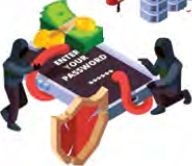
Hacker: a person who gets into a computer, network or account without permission, usually to steal information or cause damage.
The second danger is cruelty. On social media a person can be mocked, threatened or shamed in front of hundreds of people, and the insults follow them home on their phone. Words like 'loser', 'ugly' and 'stupid' typed in a moment can leave someone frightened and alone for months.
Cyberbullying: using phones, social media, games or the internet to insult, threaten, embarrass or harass another person again and again.
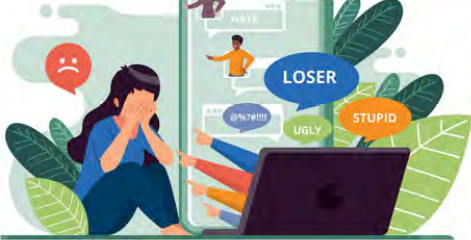
The third danger is deception. Online, anyone can pretend to be anyone. An adult can pose as a teenager, a boy can pose as a girl, and a stranger can use someone else's photograph. This is called faking an identity, and it is the idea at the centre of the story that follows.
Fake identity: a false name, age, gender or photograph that someone uses online to hide who they really are.
Hacking, stealing data, bullying and cheating people with fake identities are not pranks. They are crimes, and in Nepal, as in most countries, people who commit them can be arrested and punished.
Cybercrime: a crime committed using a computer, phone or the internet, such as hacking, online fraud, identity theft or online harassment.

Before reading on, think honestly about two things. Has anyone ever pretended to be someone else with you online, or bullied you there? And what do you already do to protect yourself: do you check who a friend request is from, keep your profile private, or tell an adult when something feels wrong?
Parents: The Story
"Parents" is a short story adapted from Vishnu Singh Rai's collection Martyr and Other Stories. It is told in the first person by a father, and most of it is quick, sharp dialogue. The humour is gentle, but the ending turns the whole story upside down.
The narrator is sixty years old, bald, with a big belly, and he jokes about all three. His daughter Anuja is thirteen and spends most of her time on the computer, chatting and sending messages to her many e-friends. A few days earlier she told him about a new e-friend, a girl of twelve, whom she likes very much. Now she announces that she is going to meet this friend, immediately, and alone.
Her father has warned her before about bad people who fake themselves as teenagers, chat with girls like her and wait for a chance to take advantage of them. Anuja does not listen. She calls him obsessed. He knows she thinks of him as an overprotective old man who sees ghosts in every dark corner. So he offers a deal. He will drive her there and stay in the car. If a girl of twelve is waiting, he will go window shopping and leave them alone. If there is no girl, they will wait ten minutes and come home. Anuja stamps her feet and calls the plan ridiculous, but she agrees.
On the way he teases her that she looks like a boy in her new outfit. That remark opens the door to a confession. Stumbling over her words, Anuja admits that she chatted with this girl as a boy. The friend knows her only as a boy. The shock is so great that the car swerves.
At the meeting place there is no girl in sight. About a hundred metres away, a car with dark windows is parked on the other side of the road. Boys are playing cricket on a playground and a couple of cows are munching dried hay. The father walks up and down, looks at his watch, looks at the dark car, and walks again. Then the dark car starts and speeds away. When ten minutes are up, he gets back into his own car, satisfied: the girl his daughter chatted with must have been fake.
The next day he tells the whole event to his colleague Dhurva, who laughs. Dhurva explains what really happened. The girl was real. Her mother had driven her to the meeting place early, in the car with dark windows, to check whether there really was a boy of thirteen. All she saw was an old man with a big stomach and a bald head lurking around. So she never let her daughter out of the car and drove home. The father stammers. Dhurva adds the final blow: the mother described him as a lecherous old man with an evil leer on his face.
The events, in the order they happened:
- Anuja told her father about her new e-friend.
- Anuja told him she wanted to go and see this new friend.
- Her father went with her to meet the friend.
- On the way he noticed that she looked like a boy in her new dress.
- She revealed her secret e-identity: she had chatted as a boy.
- At the meeting place they saw a car on the other side of the road.
- They waited ten minutes for Anuja's friend.
- The next day Anuja's father shared the incident with his colleague.
What the Story Is Really About
The title is plural. There are two parents in this story, not one, and both are doing exactly the same thing. The father goes to the meeting place to protect his daughter from a stranger who might be faking. The mother goes to the meeting place to protect her daughter from a stranger who might be faking. Each of them sits in a car, watches, waits, and finally drives away. The only difference is that we see the story through the father's eyes, so we share his suspicion of the dark car without once suspecting ourselves.
The father went looking for a dangerous man and became one, in someone else's eyes. The danger he feared was real enough to guard against, but the person each parent took for the danger was the other parent.
The story also shows that a fake identity is dangerous even when nobody means harm. Anuja is not a criminal. She simply pretended to be a boy, perhaps as a game. But that small lie meant the other family expected a boy of thirteen and found a sixty-year-old man instead. A harmless meeting between two girls turned into two frightened parents and two embarrassed children. Honesty online protects the other person as well as yourself.
Finally, look at how Anuja and her father speak to each other. She dismisses his worry with words like 'obsessed', 'ridiculous' and 'impossible'. He hides his worry behind jokes about his age, his belly and his bald head. Neither is wrong to feel what they feel. What both lack is a calm, honest conversation before the car ever leaves home.
Never go alone to meet someone you know only from the internet. Tell a parent or another trusted adult first, meet in a busy public place, and take the adult with you.
Intonation: How the Voice Rises and Falls
Say "You are coming" twice: once as a flat statement, once as a surprised question. The words are the same, but the meaning changes because your voice moves differently. That movement is intonation. It tells the listener whether you are stating, asking, listing, doubting or finishing.
Intonation: the way the pitch of the voice rises and falls while speaking. It is about how we say things, rather than what we say.
Falling intonation (↘): the pitch of the voice falls at the end of the sentence. It is the most common pattern in English.
Falling intonation sounds complete and certain. It is used in these five kinds of sentence:
- Statements: I'll be back in a ↘minute.
- Commands: Write your name ↘here.
- Wh-questions, which ask for information: Where do you come ↘from?
- Question tags that only confirm what the speaker already believes: He thinks he's so clever, doesn't ↘he?
- Exclamations: How nice of ↘you!
Rising intonation (↗): the pitch of the voice rises at the end of the sentence. It is normally used with yes/no questions and with question tags that are real questions.
- Yes/no questions: Do you like your new ↗teacher?
- Question tags that really ask, because the speaker is not sure: We've met already, ↗haven't we?
A question tag can fall or rise, and the choice changes the meaning. A falling tag says "I know this, please agree." A rising tag says "I am not sure, please tell me." "You locked the door, ↘didn't you?" expects yes. "You locked the door, ↗didn't you?" is a genuine question.
Rise-fall intonation (↗↘): the voice rises and then falls.
- Choices, or alternative questions: Are you having ↗soup or ↘salad?
- Lists, where the voice falls on the last item to show the list is finished: We've got ↗apples, pears, bananas and ↘oranges.
- Unfinished thoughts, or partial statements, where the speaker leaves something unsaid. Asked "Do you like my new handbag?", a friend may reply: Well, the ↗leather is ↘nice... (but I don't like it).
- Conditional sentences, where the tone rises in the first clause and falls gradually in the second: If he ↗calls, ask him to leave a ↘message.
Fall-rise intonation (↘↗): the voice falls and then rises, usually within one word.
- Hesitation or reluctance: So you'd be willing to confirm that? Well... I ↘sup↗pose so...
- Hesitation or reluctance: You didn't see him on Monday? I don't quite ↘re↗member...
- Politeness, doubt or uncertainty: Perhaps we could ↘vis↗it the place?
| Pattern | Symbol | Used for | Example |
| Falling | ↘ | statements, commands, wh-questions, confirming tags, exclamations | Where do you come ↘from? |
| Rising | ↗ | yes/no questions, tags that really ask | Do you like your new ↗teacher? |
| Rise-fall | ↗↘ | choices, lists, unfinished thoughts, conditionals | Are you having ↗soup or ↘salad? |
| Fall-rise | ↘↗ | hesitation, politeness, doubt | I ↘sup↗pose so... |
Now apply the patterns to lines from the story. Read each one aloud and let your voice follow the arrow:
- A statement falls: I'm going to meet my e-mail ↘friend.
- A wh-question falls, then a yes/no question rises: ↘Why? Is it because I'm 60 years ↗old?
- An exclamation falls, and so does the statement after it: ↘God! I tried to digest this new ↘information.
- Two choices rise then fall: Is it because I'm 60 years ↗old? Or is it because I've a big ↘belly?
- A tag that confirms falls: She knows me as a boy, doesn't ↘she?
- A yes/no question rises: Do you know what she said about ↗you?
- A list rises on each item and falls on the last: They ↗came out of the car, ↗waited for the girl and finally ↘returned home.
- A statement falls: You are obsessed, ↘dad.
Criticising Past Actions with Should Have
When Dhurva tells the father what really happened, both father and daughter feel embarrassed. Looking back, it is easy to see what each of them did wrong. English has a neat structure for pointing out a mistake that is already in the past: should have or shouldn't have, followed by the past participle.
Should have + past participle: says that something was the right thing to do in the past, but it did not happen. Shouldn't have + past participle: says that something was wrong to do in the past, but it did happen. Both are used to criticise, to regret or to give advice too late.
\[ \text{should (not) have} + \text{past participle} \]
- Anuja shouldn't have introduced herself as a boy to her e-friend. (She did, and it caused the trouble.)
- Anuja should have told her father the truth before they left home. (She did not.)
- The father shouldn't have paced up and down staring at the parked car.
- The two families should have spoken to each other before arranging a meeting.
- The girls should have met in a busy public place with both parents present.
Compare this with plain should + base verb, which gives advice about the present or the future. In the first conversation below the mother advises; in the other two the speaker criticises something already done.
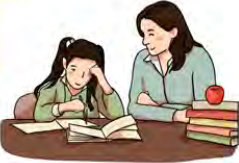
"You should see a doctor" looks forward: go now. "You should have seen a doctor" looks back: you did not go, and that was a mistake.
When you criticise a friend, the structure helps you sound fair rather than harsh, because it points at the action and not the person. Starting with "I think" softens it further: "I think you should have saved your work before the power went off."
Because "should've" sounds like "should of" in fast speech, many students write "You should of told me." This is always wrong. Write "You should have told me" or "You should've told me."
Should, Ought to and Must
Should, ought to and must are modal verbs. They come before the base form of a main verb and add a shade of meaning to it. All three say that something is right or necessary, but they differ in how strongly they say it and why.
Advice: a suggestion about what would be good or sensible to do. We usually express it with should. Example: You should raise your voice against discrimination.
Moral obligation: a duty that comes from what is right, fair or kind, rather than from a law. We usually express it with ought to. Example: You ought to be fair in your judgment.
Compulsion: something that has to be done because a rule, a law or the speaker demands it, with no real choice. We express it with must. Example: You must abide by the traffic rules while driving.
| Modal | Meaning | Positive | Negative |
| should | advice | You should see a doctor. | You shouldn't offend people with harsh words. |
| ought to | moral obligation | We ought to learn to apologise. | You ought not to lie to your parents. |
| must | compulsion | You must wear a helmet on a motorbike. | We mustn't disrespect our nation at any cost. |
In practice, should and ought to are very close, and in many sentences either is correct. Ought to carries a slightly stronger feeling of duty: "Every child ought to take good care of their ageing parents" speaks of what is morally right, not merely sensible. Must is the strongest of the three and leaves no room for choice. After all three, the verb stays in its base form: must go, should eat, ought to help. Never add -s, -ed or -ing.
Mustn't means something is forbidden. Shouldn't means it is a bad idea. "You mustn't cross on a red light" is a rule; "You shouldn't eat so much junk food" is advice. Using mustn't for mild advice makes you sound rude.
Replying to an Email Invitation
Imagine that Sambridhi writes to her friend Niti to invite her family to a small reception party for her elder brother Naman's wedding, at ABC Party Venue in Dumre, Tanahun, on 21st March at 5 p.m. She attaches a location map and asks Niti to let her know whether they can come. Niti cannot attend because of urgent family business, so she must write back and decline politely.
A reply that declines an invitation has one hard job: to say no without hurting the person who asked. It does this by thanking first, apologising with a reason, and ending warmly. A good reply follows this order:
- Subject line: keep the original subject and add Re: at the start, so the reader knows it is a reply.
- Greeting: Dear Sambridhi, just as the invitation greeted you.
- Thanks: thank her for the invitation and say you were happy to receive it.
- Apology and reason: say clearly that you cannot come, and give a short, honest reason.
- Good wishes: congratulate the couple and wish the family a happy celebration.
- A warm offer: suggest visiting soon or ask to see photographs.
- Closing and name: With warm wishes, or With best regards, followed by your name.
Keep the tone friendly but tidy. Write in full sentences, avoid text-message short forms like 'u' and 'thx', and keep it short: four short paragraphs are enough. Past tense suits the apology if the event is over ("I was unable to attend"), and future tense suits it if the event is still ahead ("I will not be able to attend").
Cyber Security: Basic Internet Safety Tips
The second reading is an informative article that opens with a comparison. We lock the door to keep our home safe, use a lock on our bike and keep valuable possessions in a safe. So what do we do to protect our identity online? The article argues that modern life is so intertwined with the internet that the question can no longer be avoided. Almost every daily task can now be done online, and most people own several devices: laptops, phones, tablets, smartwatches and smart TVs. The more accounts and devices you have, the more chances criminals have to reach your personal information.

Online safety matters at every age, but some groups are more vulnerable: children, teenagers and senior citizens. The article then gives practical advice in eight short paragraphs, labelled A to H. Each paragraph deals with one habit.
| Paragraph | Heading | Main advice |
| A | Protect your personal information with strong passwords | Mix letters, numbers and special characters; use different passwords for different accounts; change them often; never share them; store them in an encrypted file; untick 'Keep me signed in' and 'Remember my password'. |
| B | Keep your personal data safe | Protect information offline too; shield the PIN pad; watch for card skimmers at fuel pumps; use a chip card; read terms and conditions; never enter card details on an insecure website. |
| C | Make sure your devices are secure | Use passwords, fingerprint readers or face scanning on every device. One report found that 30% of smartphone users did not lock their phones at all. |
| D | Pay attention to software updates | Install updates promptly, especially security upgrades, and turn on automatic updates. |
| E | Be careful about WiFi | Avoid unsecured public wifi; use only secure websites; log out after a transaction; check your account statement; protect your own wifi with a strong password and change it often. |
| F | Set up two-factor authentication | Add a second layer of security so that an account stays safe even if someone knows the password. |
| G | Keep personal information private | Do not reveal account details; accept friend requests only from people you know in person; delete inappropriate messages; do not post information about friends; remember that posts can be seen by everyone. |
| H | Back up your personal data | Copy important information onto external hard drives and make new backups regularly. |

Two-factor authentication: a way of proving who you are with two different things, usually a password plus a code sent to your phone, so a stolen password alone cannot open your account.
Skimmer: a small hidden device fixed to a card machine or fuel pump that secretly copies the details of any card used there.
Encrypted: turned into a secret code so that only someone with the right key or password can read it.
Notice what the article claims and what it does not. It says a chip card is more secure than a magnetic strip card because of its more sophisticated technology; it says nothing about cheap or expensive cards. It warns against entering financial details on websites that are not secure; it does not say never to enter them anywhere. It names three vulnerable groups together; it does not rank teenagers above the others. Reading exactly what a text says, and no more, is the skill that true or false questions test.
The article ends on its main point: by educating yourself about cyber security, you put yourself one step ahead of the cyber criminals.
Listening for Internet Safety Measures
The listening task is a recording about staying safe on the internet. Before it plays, think about your own habits: how often you go online and what you use the internet for. That warm-up matters, because a listener who has already thought about a topic recognises its words faster.
The first task gives nine safety measures. For each one you put a tick if the speaker mentions it and a cross if the speaker does not. The measures are:
- Make sure your internet connection is secure.
- Make sure that the computer has a firewall and antivirus working.
- Always use a strong email password.
- Do not share your password with anyone, except your parents.
- Do not save your password on any devices.
- Close unused internet accounts.
- Be careful about where you click while using the internet.
- Be careful about what you post from cyber cafes.
- Inform your parents if you find violent content in the webpage.
The second task asks five questions to be answered in not more than four words: what the internet allows us to do, what protects a computer from virus attack, what to do after using email, why we should not click on ads or links, and whom to consult about an internet problem in a cyber cafe.
Some habits make this kind of task much easier:
- Read all nine measures before the recording starts and underline the key word in each: firewall, strong, except your parents, save, unused, click, cyber cafes, violent.
- Listen for meaning, not only for the same words. A speaker may say 'shut down accounts you no longer use' for 'close unused internet accounts'.
- Watch the small details. 'Do not share your password with anyone' is not the same as 'with anyone except your parents'. Tick only if the detail matches.
- For the short answers, write a phrase, not a sentence. Four words means four words, so cut every word that is not needed.
- After listening, compare with a partner, then share a real problem you have faced online and how you solved it.
Articles: A, An, The or No Article
A, an and the are the three articles of English. They are tiny words, but they tell the listener whether you mean any one thing or one particular thing. Sometimes the right choice is no article at all.
Indefinite article (a, an): used before a singular countable noun when we mean any one, or mention something for the first time. Example: I have a fever.
Definite article (the): used when both speaker and listener know which one is meant, or when there is only one. Example: Did you read the book I gave you?
Zero article: no article at all, used before most names of people and places, meals, sports, and some nouns like home. Example: What did you have for breakfast?
Choosing between a and an depends on the first SOUND of the next word, not its first letter. Use an before a vowel sound and a before a consonant sound.
| Word | First sound | Article | Why |
| actor | 'a' vowel | an actor | begins with a vowel sound |
| hour | 'ow' vowel | an hour | the h is silent |
| eye | 'eye' vowel | an eye | begins with a vowel sound |
| early | 'er' vowel | an early bus | the article goes with the next word, early |
| ewe | 'yoo' consonant | a ewe | sounds like 'you' |
| European | 'yoo' consonant | a European | sounds like 'you' |
| one-dimensional | 'w' consonant | a one-dimensional view | 'one' begins with a w sound |
| lovely | 'l' consonant | a lovely garden | begins with a consonant sound |
Do not choose a or an by looking at the spelling. Say the word aloud. 'University', 'ewe' and 'European' start with a vowel letter but a 'y' sound, so they take a. 'Hour' and 'honest' start with a consonant letter but a vowel sound, so they take an.
Use the in these situations:
- Something already known to both speakers: Could you open the window, please?
- Something that is the only one in its setting: We had to sit on the floor. I love the living room.
- Superlatives: This is the biggest fish I have ever caught.
- Musical instruments: Can you play the flute well?
- Rivers, seas and oceans: The Nile is the longest river in Africa.
- Countries whose names are plural or contain a word like 'kingdom': the Netherlands, the United States.
- A unique post or position: The president is elected every five years in Nepal.
- An adjective used for a whole group of people: the blind, the poor, the elderly.
- A building visited for a reason other than its main purpose: Mrs. Paudel went to the school to meet her son's teacher.
Use no article in these situations:
- Names of single mountains: Everest is the pride of our country.
- Names of roads, streets and most towns: New Road is a financial hub in Kathmandu.
- Names of institutions that begin with a person's or place's name: Aarohan Gurukul Theater was founded in 1982.
- Meals: What did you have for breakfast?
- Sports and games: Do you always play badminton at school?
- Home, after verbs of movement: What time did you get home yesterday?
- School, church or hospital when used for its main purpose: The children go to school at ten.
Some common expressions always take a: half an hour, keep an eye on, a man of action, What a lovely garden! Learn them as whole phrases.
Writing a Newspaper Article
A newspaper article informs a wide public about a topic that matters to them. It is not a personal essay. It is written in a formal, clear style, usually in the third person, and it backs up its points with facts and examples rather than feelings alone.
Newspaper article: a piece of factual writing for a newspaper, with a headline, the writer's name, an opening that grabs attention, a body that develops the topic, and a conclusion.
- Headline: short and striking, so a reader wants to read on.
- Byline: the writer's name, or a line such as 'By our correspondent'.
- Introduction: set the scene. For an article on the internet and cyber security, introduce the internet and technology and how quickly they have spread.
- Body paragraph one: the use of the internet in our daily lives, such as study, banking, business, health and communication.
- Body paragraph two: the abuses of the internet, such as hacking, fraud, cyberbullying, fake identities and fake news.
- Body paragraph three: the need for data privacy and practical ways to protect it.
- Conclusion: sum up the balance, and end with a clear message for readers.
Give each paragraph one main idea and open it with a sentence that states that idea. Link the paragraphs with words such as however, moreover, as a result and finally, so that the article reads as one argument instead of five separate notes.
Making an Awareness Pamphlet
Pamphlet: a small printed sheet or folded leaflet that gives information or advice on one topic, meant to be read quickly and handed out or displayed.
An awareness pamphlet on cybercrime has two jobs: to show people what cybercrime looks like, and to tell them what to do about it. Because readers glance at a pamphlet rather than study it, every part must be short and easy to see.
- A bold title that speaks to the reader, such as 'Think Before You Click'.
- A few kinds of cybercrime, each with a one-line explanation: hacking, online fraud, cyberbullying, fake profiles.
- Warning signs to watch for, such as messages asking for passwords or strangers asking to meet.
- Five or six safety tips written as short commands: Use strong passwords. Turn on two-factor authentication.
- Where to get help: a parent, a teacher, or the police.
- Simple drawings or symbols, such as a lock or a shield, to make the page easy to remember.
The full lesson is waiting for you
The notes are free to read in full. A free account opens the rest of the practice, and tracks your progress and confidence score for every subject. Presentations and videos need approval from Learn Yeti.